
– He’s rolling out of the June NASDAQ (NQ) contract and will reference September 2025 contracts going forward (NQ, ES, DAX).
– Market context: current environment is a “troubled market” — chaotic consolidation/time distortion driven by geopolitical risk — causing low willingness to trend and large gap risk.
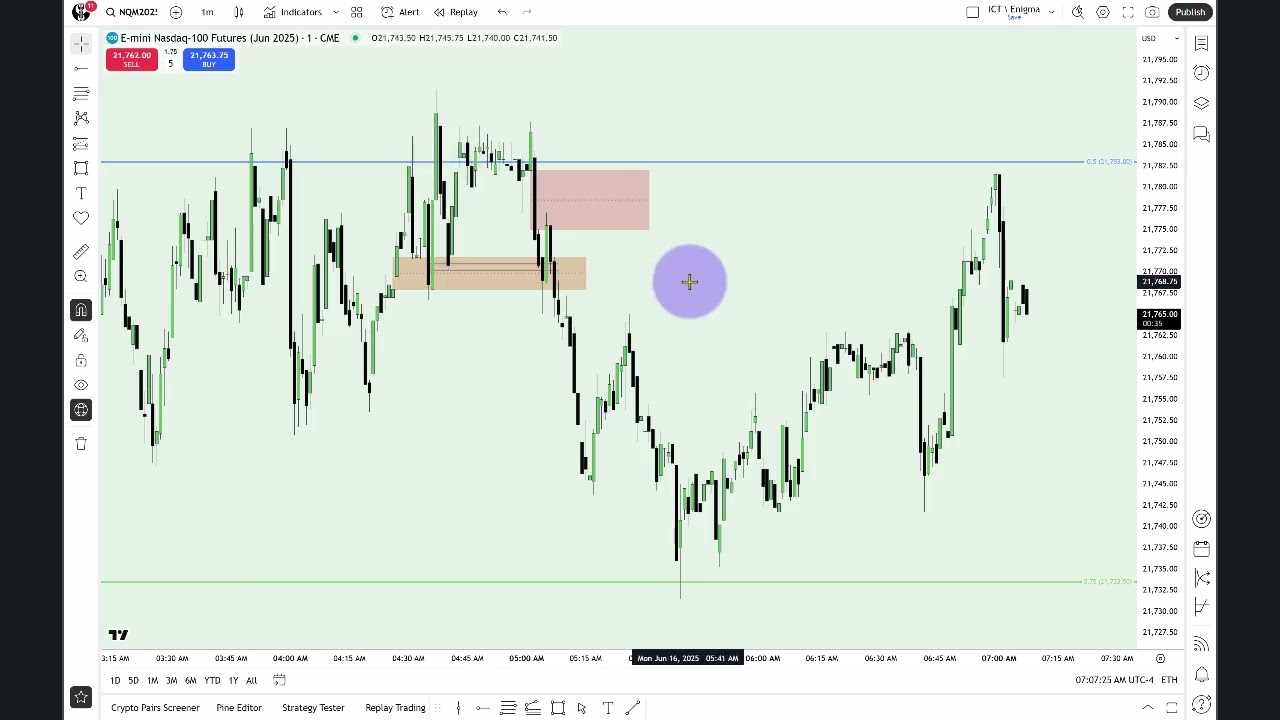
– Chart analysis (daily → 1-min/30-sec): key reference is the Feb. 24 daily level (consequent encroachment / “cibby”), several fair value gaps and liquidity pools, and a recent failure to reach a longer-term upside target. Price has been oscillating around quadrant levels (low, midpoint, upper quadrant, high) and leaving liquidity and volume-imbalance signatures.
– Trading approach in this environment: be nimble, stop thinking only in classic support/resistance, use algorithmic/order-flow concepts (consequent encroachment, fair value gaps, premium/discount anchored to breaks of structure). Aim for setups that offer sufficient edge (he looks for ~15 handles net on NQ before entering shorts).
– Risk & trade management: he uses very tight, precise stop placement (often 1–2 ticks above/below defined micro levels) and proprietary “PD arrays” that he will not teach or reveal. He stresses that he’s not giving trade advice and that risks are unusually large now.
– Personal notes: brief anecdote about his family and puppy, reiterates he won’t disclose broker relationships or certain methods, and confirms future analysis will use the September contract.
Year: 2025
-
2025 Lecture Series – Keys To Success In Troubled Markets June 16, 2025
-
2025 Lecture Series – EurUsd & NQ Futures June 11, 2025
Brief market update and context
– Speaker has been tied up with a family matter; this is a short commentary on the NASDAQ, EUR and macro risks.
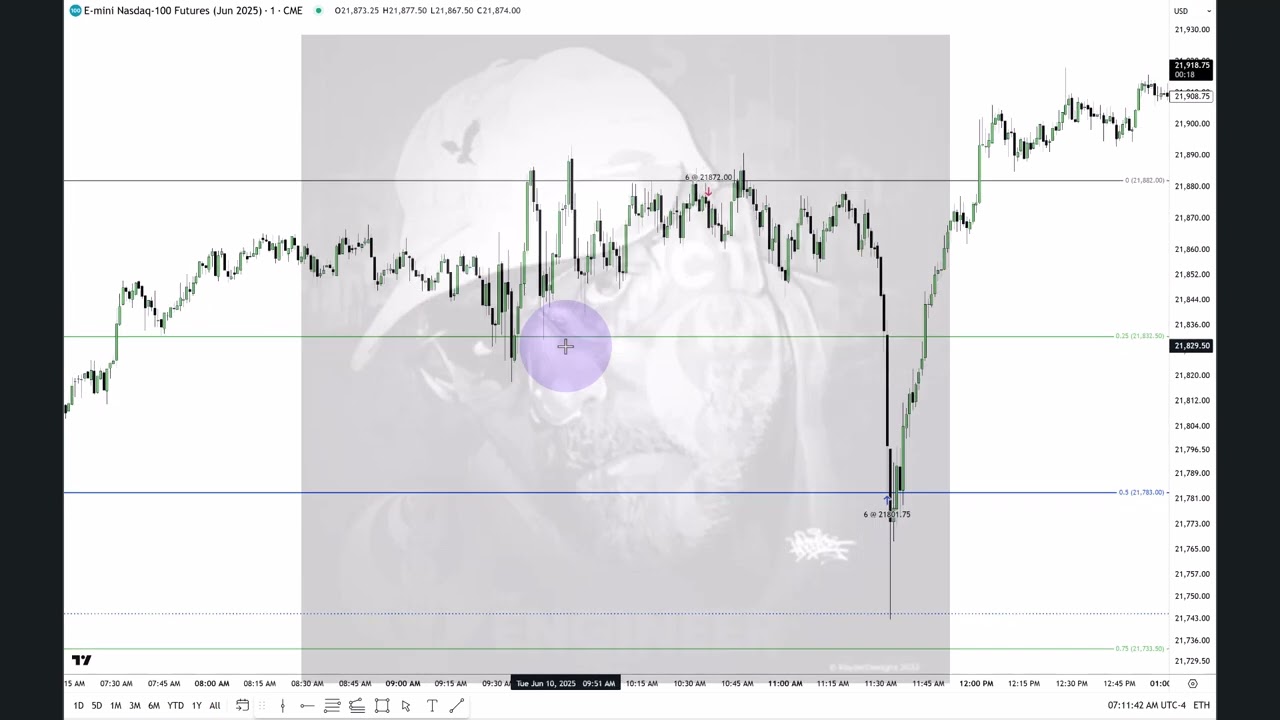
– Main theme: expect higher prices for NASDAQ (continuing the prior bias), but be cautious because near-term volatility is likely.NASDAQ technical view
– Daily: price has been repeatedly encroaching a prior wick/imbalance (daily CBI from Feb 24, 2025) and is tracking toward a cluster of fib/“consequent encroachment” levels and quadrant boundaries.
– The speaker has no open position; would be comfortable stepping to the sidelines if price fills the fair-value gap. He stresses that in the current climate professionals avoid pressing edges.Macro calendar / risk advice
– CPI today and PPI tomorrow create a high-volatility “Molotov cocktail.” Don’t trade aggressively; this is a poor environment for taking high risk or overtrading.
– General market stance is risk-on (dollar weak, euro/gold/silver expected higher), but short-term moves from data releases are unpredictable.Commodities and fundamentals
– He prefers commodities (gold/silver) over equities because of clear supply/demand drivers—believes metals have further upside, especially silver for industrial demand.EUR and trading process
– Euro: previously signaled levels—if they break down, expect sideways consolidation; if they hold, higher prices remain likely.
– Emphasis on journaling, experience, and having a tested model; novices should avoid gambling in messy market conditions.Personal / closing
– Limited trading activity this week; small missed opportunities but content to sit out.
– Thanks listeners for prayers; a reminder to be careful this weekend (U.S.) and to trade conservatively around data. -
2025 Storytellers Series – Dollar & EurUsd June 05, 2025
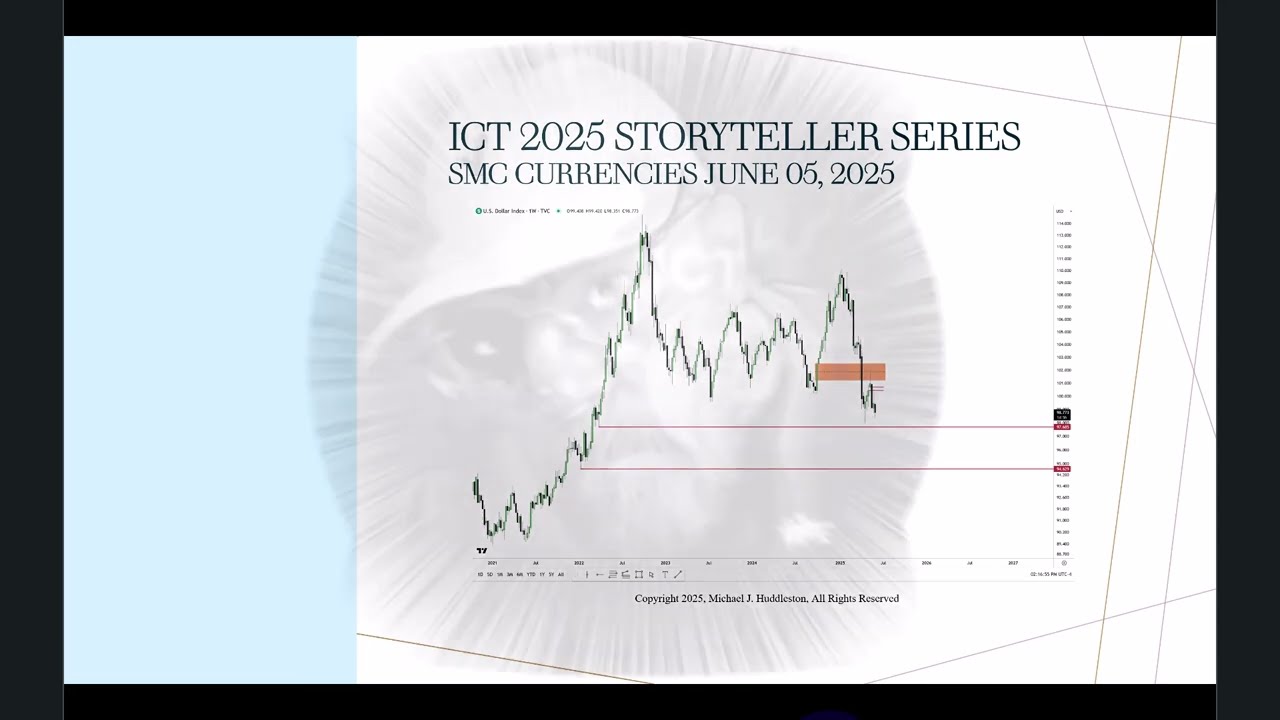
– Context: Storytellers Series (episode 3), June 5, 2025 — focused on the dollar index and EUR/USD (not covering other FX pairs). The presenter is not actively trading Forex and treats it separately from his index-futures work.
– Big-picture view: Global trade friction, tariffs and geopolitical risk are creating chaotic fundamentals. The presenter believes this environment is broadly negative for the U.S. dollar and that a softer dollar (higher EUR/USD) is the more likely outcome.
– Market stance: Not bullish on the dollar index; expects lower dollar levels over time unless major geopolitical tensions unexpectedly resolve. He sees the broader market as risk-on (stocks can still rally), which supports a weaker dollar.
– Technical approach: Analysis relies on technical constructs across timeframes—weekly, daily, hourly, 15-min, and 5-min—using concepts like fair value gaps, inversions, buy/sell-side efficiency, liquidity pools and order blocks. Key higher-timeframe sell-side liquidity and inversion gaps are focal points for downside targets.
– Near-term triggers and risks: Employment and upcoming nonfarm payroll (NFP) data can change the picture; recent employment data caused short-term moves. Heavy manipulation and wide, unpredictable ranges are possible, making FX trading riskier now.
– Practical cautions: He warns inexperienced or undercapitalized traders not to over-leverage or trade impulsively—profitability is difficult in the current FX climate. This commentary is opinion, not trading advice.
– Frequency: He plans to post daily-ish EUR/USD and dollar-index updates when relevant, but remains cautious and will keep precise trade-levels private until warranted.
-
2025 Storytellers Series – NQ Futures June 05, 2025
– This is the Storyteller review for the June 5, 2025 NASDAQ futures contract, building on the June 4 video where key levels were posted.
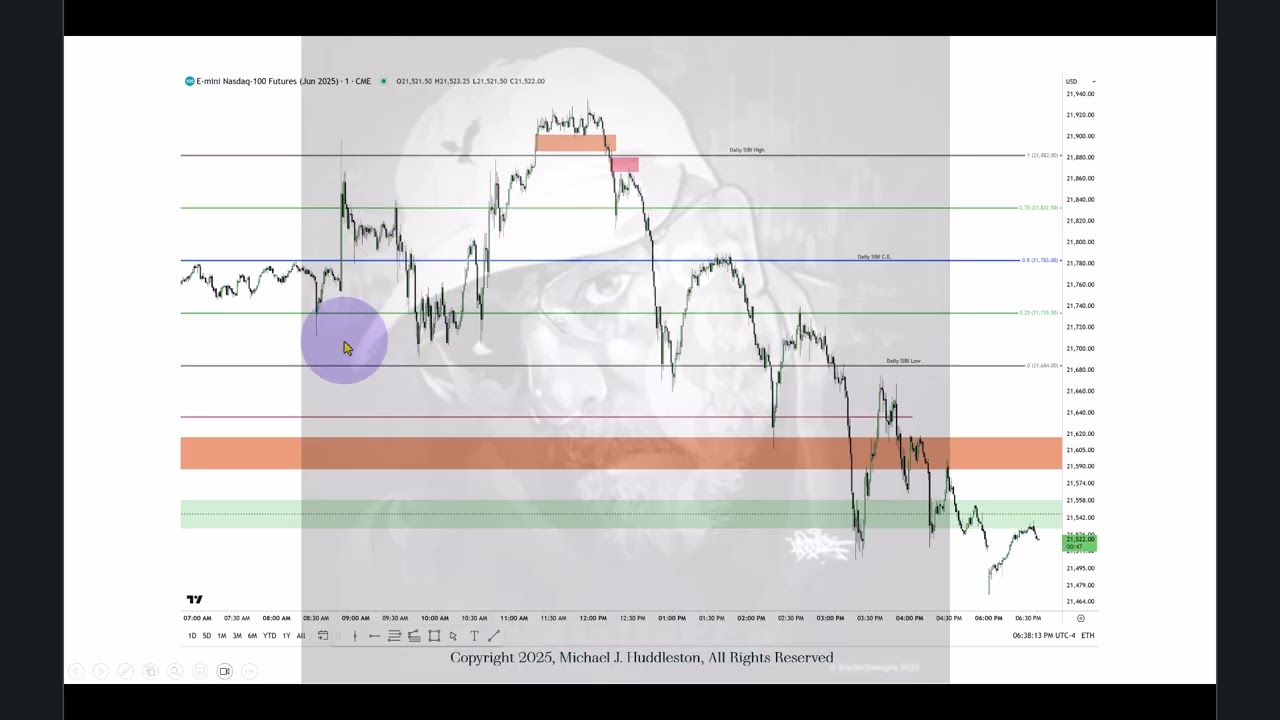
– ICT focused on a single concept: the daily “SIBI” (daily inefficiency / fair-value gap) and its graded levels (upper quadrant, consequent encroachment, lower quadrant, and low). Higher-timeframe inefficiencies are treated as real support/resistance.
– Because it’s non-farm-payroll week, price was choppy and rangebound (especially Wed–Thu). New traders were advised to stop trading by about 7:00 AM ET ahead of the Friday release to avoid being caught in volatile, whipsaw action.
– The intraday analysis used only the 1-minute chart and the daily inefficiency levels — no opening-range gaps, opening-gap tools, or new fair-value-gap techniques were used that day.
– Practical trade notes: the presenter shorted near the London high into liquidity, watched price interact with the daily cibby levels (lower quadrant, order blocks, inversion fair-value gaps), took stops, and then followed further short/long opportunities as price cycled through those levels. The action showed classic NFP-week stop-hunts, liquidity grabs, and consolidations.
– Main takeaway: knowing and trading around higher-timeframe inefficiencies within the context of the economic calendar simplifies entries and management; once price leaves the daily cibby, other reference points must be used. Study the one-minute chart and the prior video for details. -
Welcome Colorblind | May 24, 2025
ICT uses the metaphor of a love letter unfolding to describe the journey from beginner excitement to disciplined trading. Early on traders are romantic about quick profits and often copy others; that short-term enthusiasm can turn to fear, jealousy, and distraction—especially from social media. The core message: focus on process, not individual outcomes. Be “colorblind” to trades (don’t fixate on black/red results); follow your rules, manage risk, and develop your own model. Losing trades and drawdowns are normal and valuable for learning; take personal responsibility rather than blaming others or chasing influencers. The speaker values humility, vulnerability, and long-term discipline, and wants students to become independent enough that they no longer need his guidance.
-
ICT Shotgun Saturday – Confessions Of The Market Maker | May 17, 2025
This talk addresses how attention, marketing and social media manipulate traders’ emotions and choices, and stresses disciplined, realistic trading backed by risk management and process.
Key points:
– Visuals, influencers and ads sell emotion and community more than truth; they prime people to chase trends and short-term gratification.
– Successful trading depends on a repeatable model, sound risk management, small consistent edges (e.g., disciplined scalps), and resisting adrenaline-driven overleverage.
– Most new traders fail quickly because they trade too big, import personal weaknesses (impulsiveness, entitlement) into the market, or chase hype.
– Real education focuses on identifying and managing your psychological flaws, building protocols and practicing consistent execution—not showing off results or secret indicators.
– The speaker encourages responsibility, realistic goals (paying bills, steady gains) and joining communities that emphasize learning and process over celebrity or marketing.Overall: ignore flashy marketing, know yourself, follow a clear model with strict risk controls, and prioritize consistency over chasing improbable wins.
-
Something New Under The Sun | May 10, 2025
Summary — “Something New Under the Sun”
– Purpose: a long, candid talk defending ICT’s originality and teaching, explaining why his methods work, and advising traders on mindset, practice and what to avoid.
– Originality vs. influences: He credits older traders/books (Larry Williams, Connors & others) for inspiration but argues his methods (SMT/smart-money technique, fair-value gaps, PD arrays, time-based macro ideas) are distinct, refined and practically applied to modern electronic markets.
– Core concepts taught:
– Fair Value Gaps (first-presented FVG) and PD arrays as actionable levels.
– SMT (relative strength / smart-money divergence) to time entries before liquidity runs.
– Emphasis on time-based delivery (hourly/macros, 15s tape-reading) — markets are driven by predictable, scripted order-flow behaviors, not mystical “buying/selling pressure.”
– Focus on identifying where liquidity/inefficiencies are and entering ahead of the move (not reacting/chasing).– Practical learning path: backtest → tape-read (observe, no demo) → demo trade → small live sizing. Journal KPIs and progress; measure consistently.
– Mindset and personal development:
– Expect adversity, setbacks and internal fear; success requires patience, discipline, and self-work more than a “silver-bullet” indicator.
– Guard your trading process and don’t broadcast weaknesses; avoid hero-worship, shortcuts and chasing social-media validation.
– Accept imperfect performance while improving incrementally; aim for consistency over perfection.– Critique of common retail practices:
– Many indicators/schools (supply-demand zones, Ichimoku, Elliott, RSI lore) are gimmicky or too subjective.
– Prop/“monetized demo” firms and excessive leverage encourage gambling behavior; better to grow one real account responsibly.
– Public posturing, fake proofs and affiliate-driven marketing often mask lack of real, repeatable edge.– Social media & persona: He uses an abrasive persona deliberately to hold attention and provoke engagement; much of his teaching is given free and unmonetized to disarm critics and force students to do the work.
– Evidence and challenge: He claims consistent, provable calls (public examples) and invites challengers to demonstrate superior live performance; asserts his framework yields repeatable edge that others can replicate if they do the work.
– Opportunities beyond trading: once skilled, traders can monetize via streaming, signals, teaching, affiliate revenue, or institutional roles — multiple income streams reduce fear and improve trading objectivity.
– Practical tips: study 15-second / low-timeframe tape-reading to see algorithmic patterns; use daily/weekly to define bias and short timeframes to spot execution points; learn when not to trade (macro events, seek-and-destroy weeks).
– Final messages: do the hard work, journal, measure progress, avoid distractions and entitlement, and recognize there really is “something new under the sun” — a reproducible, time-based, institutional-informed approach to price that disciplined students can learn and apply.
-
Keys To Understanding The Present Market Narrative | May 3, 2025
Summary:
– Purpose: ICT thanks listeners and explains he’ll teach a focused lesson distinguishing two core trading concepts: market bias and narrative.
– Bias vs. narrative:
– Bias = simple directional view (bullish or bearish) on a chosen timeframe (daily, weekly, intraday).
– Narrative = the practical story of how price will get to that target — the timing, the sequence of candles, where liquidity will be hunted and how order flow will deliver price.– Core mechanics: markets move by time-based, algorithmic delivery of liquidity, not by the naive “more buyers than sellers” story. Large participants and algos create predictable patterns (liquidity runs, order blocks, relative equal highs/lows).
– Timeframes and fractals: the same principles apply across scales (15-second, 1-minute, 4-hour, daily). Studying sub-minute charts reveals repeatable time-based price behaviors that explain intraday moves.
– Practical routine (homework): use the ict’s charts (he will post them) and study the morning session border (9:30–11:00 Eastern). Screenshot the 1-minute at session close, then examine sub-1-minute (15s) to identify relative equal highs/lows, times they form, and how price revisits them. Repeat daily to build pattern recognition.
– Jigsaw metaphor: build the “border” (session range) first, then work inward. Session highs/lows, Asian session ranges and pre-market windows are key “border pieces” for narrative construction.
– Risk management and psychology: placing stops and controlling position size is essential — accept that you’ll be wrong sometimes. Avoid chasing entries, impatience, and FOMO. Being disciplined and patient matters more than finding a “perfect entry.”
– Indicators & tools: level-2, fancy indicators, volume profile, etc., are largely unnecessary if you understand liquidity, time, and price. ICT emphasizes simplicity: time and price behavior are sufficient.
– Market environment: current markets are highly volatile and manipulated at times. That makes trading harder; prop firms and demo-funded models can be misleading. Be cautious with firms that frequently change rules or appear focused on customer acquisition rather than fair payout. Regulators may intervene.
– Instructor’s stance: ICT shares decades of experience, doesn’t monetize these lessons, warns against influencer hype and materialism, and encourages focus on learning and disciplined practice over showmanship.
– Takeaway: learn to distinguish bias (where you expect price to go) from narrative (how and when it will be delivered). Practice daily, study sub-minute price action within session windows, respect risk management, and build experience over weeks/months rather than chasing shortcuts.
-
Keys To Infinite Setups That Yield | April 26, 2025
Main idea
– Stop chasing indicators and “shiny” systems. Focus on time-based price delivery — predictable, recurring price runs that occur at specific sessions and times (session liquidity) — and build one repeatable trading model around them.Key principles and tactics
– Prioritize session timing: the first hour (roughly 9:30–10:30 ET) is the busiest for order flow; watch 10:30–11:30 (London close overlap) and other session opens (AM/PM/London/GlobeEX) for consistent opportunities.
– Use liquidity magnets: fair value gaps, new‑day/new‑week opening gaps, relative equal highs/lows, and previous-day/week highs & lows concentrate liquidity and are reliable targets.
– Pick one PD (price-delivery) array or setup you understand and master it before learning others. Mastery and repetition are more valuable than constantly switching methods.
– Trade futures when possible (uniform highs/lows across participants) rather than retail FX, which has inconsistent highs/lows across brokers.
– Risk and execution: define your first partial‑profit target and stop before entering; accept that you will lose sometimes and cut losses quickly if the setup fails.
– Practice: backtest and condition yourself (e.g., stay in market for an entire session on demo) to develop market feel and discipline.
– Mental/behavioral: eliminate distraction, ignore social-media noise and “gurus,” be tenacious, and develop the discipline to follow your chosen model consistently until it yields.Outcome promised
– By focusing on time-based, liquidity-driven setups and mastering one approach, you remove ambiguity, reduce stress, and create a reliable path to consistent trading performance and independence. -
ICT Shotgun Saturday: A Murder Of Crows | April 12, 2025
ICT uses personal stories (music soundtrack, a formative relationship, and early struggles) to show how people, habits and social pressures shape a developing trader. Key messages:
– Identify and prune toxic relationships — your “murder of crows” can hold you back or encourage ego-driven behavior.
– Don’t trade for validation or social-media applause; emotional trading and performing for others derail progress.
– Filter outside stimuli carefully; guard your mind and let in only what supports your goals.
– Journal your struggles and trades — recording failures and lessons is therapeutic and essential for growth.
– Aim high (pick your “gold” goal), commit long-term, and accept the hard, slow growth process — adversity molds skill and courage.
– Value the backstory (the work and hardship) more than flashy results; authentic success rarely comes overnight.
– Be humble, serve others, and shift focus from “me” to purpose — that change transformed the speaker’s trading and life.
– Become like an eagle: independent, focused, with clear vision and endurance, not merely clever like a crow.Overall: prune negative influences, build disciplined habits, keep perspective, and persist through growing pains to achieve lasting success.