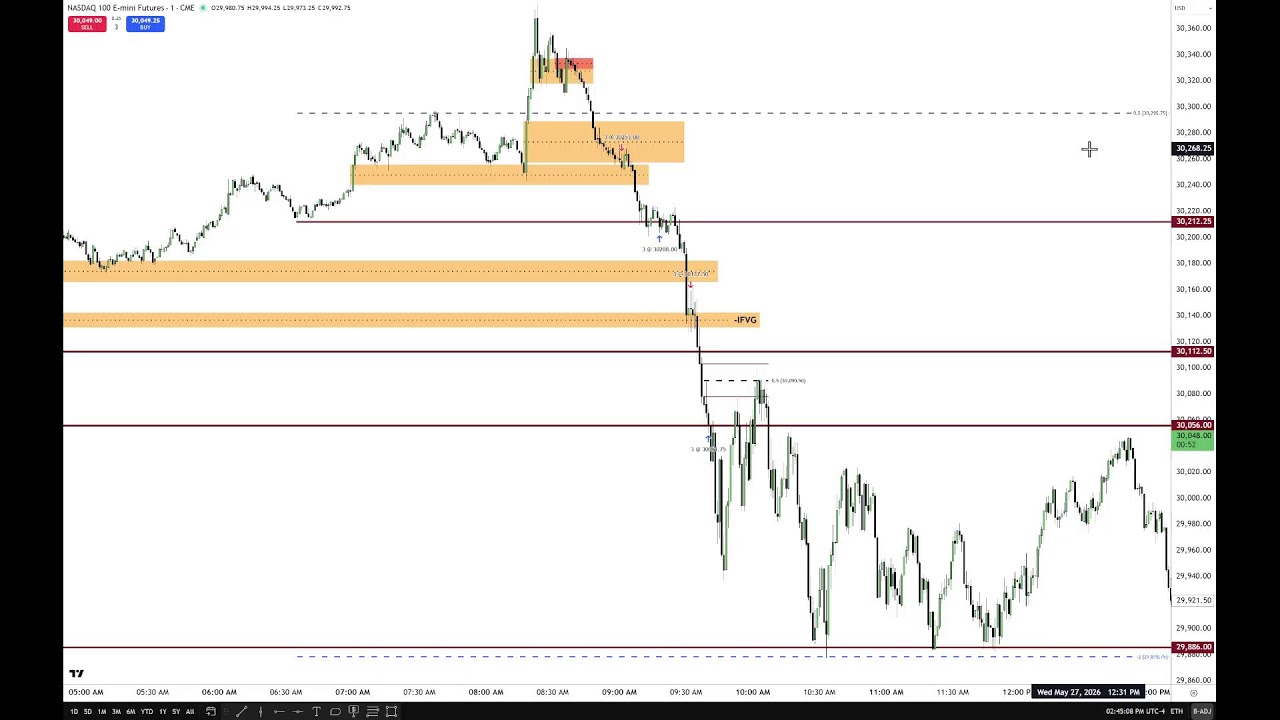
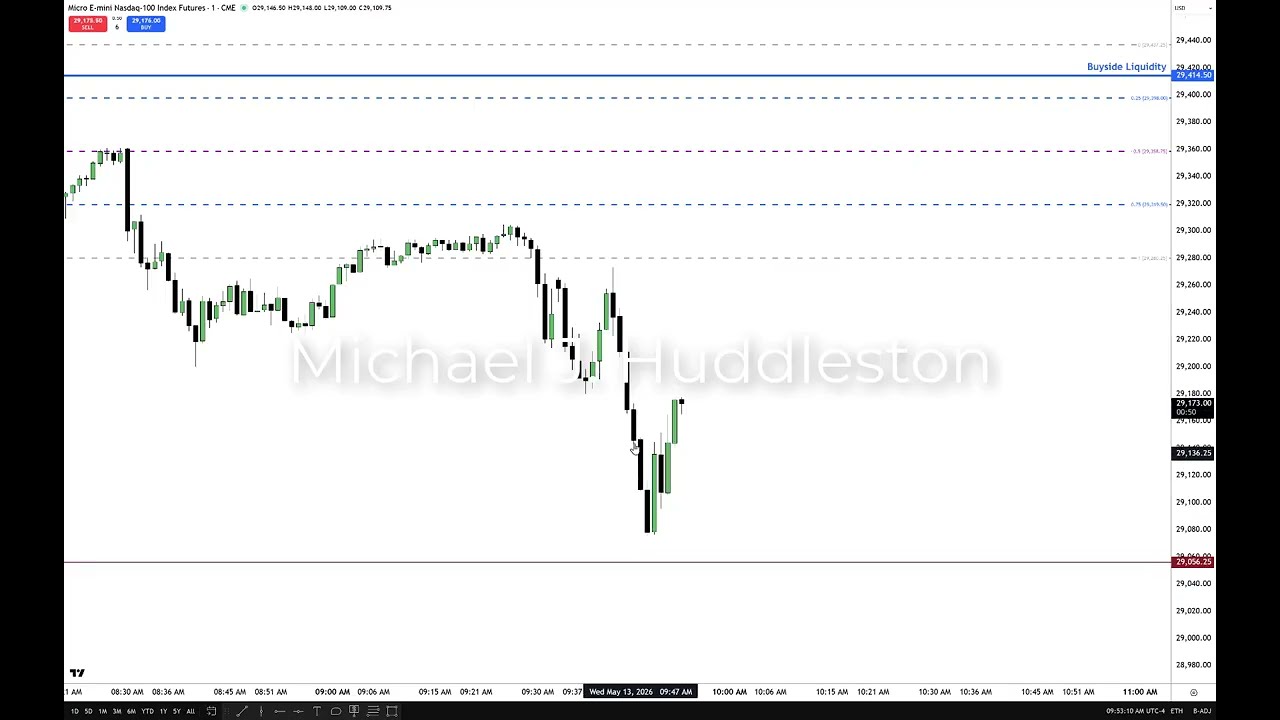
– Focus: Review of the NASDAQ/ES daily charts and a live intraday example showing how the speaker reads price action to identify short opportunities even inside a primary bull market. – Instruments & accounts: Recommends micro contracts for small or inexperienced accounts (and for prop-firm trading) to reduce risk and size.
– Market context: Predicted a post‑May rally after taking out relative highs, then identified a specific daily volume‑imbalance area that would act as a magnet for price and a likely place for a short‑term reversal.
– Key technical concepts taught: read the open/high/low/close, spot volume imbalances, fair‑value gaps (and inversion FVGs), “consequent encroachment” and inefficiencies after blowoff runs, and use measured moves/standard‑deviation projections to set targets.
– Trade rules and mindset: prefer short setups that show quick, one‑direction fills of inefficiencies; use fulcrum/measure moves and -2 SD projections for precision; accept being stopped if overleveraged is avoided; novices (<~1–2 years) should favor longs in a bull market.
– Execution example: identified an intraday fair‑value gap and volume imbalance, entered a short around the open with a built‑in buffer, saw a clean drop to the target but missed some of the larger move—used the experience as intel.
– Warnings and advice: don’t rely on “gimmicks” or paid holy‑grail claims; develop price‑reading language/discipline; keep capital and living expenses in reserve (two years, ~$100k suggested) before trading full‑time.
– Operational note: will reduce public real‑time detail in future live trading to avoid influencing other traders’ orders; continues to teach concepts and critique poor mentorships.
Main takeaway: focus on clean price‑action reading (open/high/low/close, volume imbalances, fair‑value gaps), manage risk and position size, gain experience before aggressively shorting into a bull market, and use measured projections to plan entries and targets.
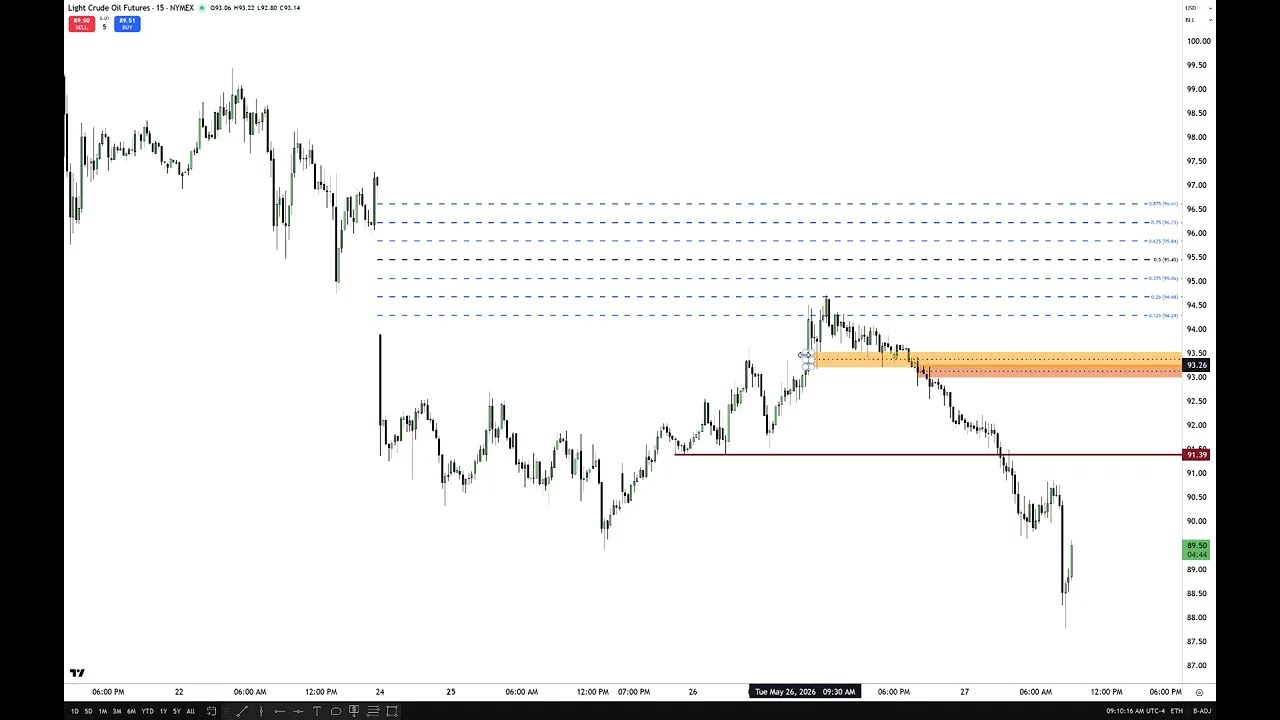
– Market backdrop: Prices are largely driven by geopolitical news (U.S./Israel/Iran) — stay cautious and avoid chasing volatile instruments. – Recent price action: After a gap down, the author expected further weakness and described a quick, profitable short based on 15‑minute and 1‑minute patterns (relative equal lows, an inversion/fill of a volume/price imbalance). Stop was placed above the swing high. – Dollar/FX: The dollar (DXY) is stuck in a range, so USD-based major forex pairs are quiet; non‑USD (exotic or cross) pairs show more movement. – Metals: Gold and silver have shown capitulation-like behavior after big rallies. ICT advised taking profits earlier and is currently sidelined on metals, not bullish on silver. – Crypto: Bitcoin failed to push past the 127k area, then sold off. Key supports to watch are the mid/high‑tens of thousands (noted ~49.7k) and then the ~24–26k area; downside risk remains. – Trading stance: The author is being cautious, practicing on demo for indices (ES/NQ) and not trading live due to fickle market conditions. – Takeaway: Be selective, follow price structure and risk management, and avoid markets the author has flagged to “leave alone.”
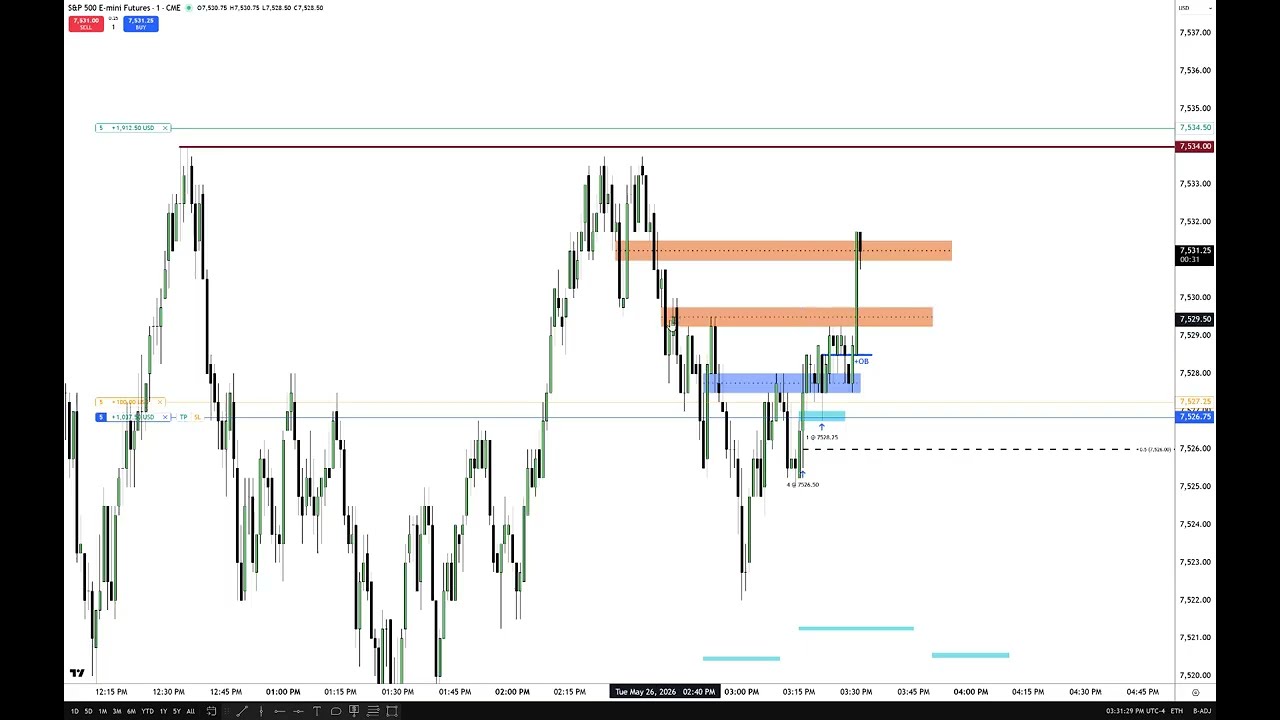
Michael describes taking a long trade with a stop loss just below a recent low, targeting the last hour’s relative equal highs (around 3,400–3,450). They watch for accumulation, footholds, fair value gap inversions and order-blocks as entry/validation points, then raise stops to reduce risk as price confirms. The session is slow and “spotty” early, but a run of big green candles and algorithmic buying in the 3:15–3:45 macro window drives a clean rip higher. The trader criticizes sloppy use of “macro” by others, notes this was tradable though not ideal, and ultimately clears positions after the highs are taken out.
– Time comes before price. Anchor your charts to New York local time and use vertical time lines—time windows strongly govern predictable market behavior.
– Key times to watch:
– Market open / opening price at 9:30 ET (opening range gap).
– New York “lunch macro” 11:30–13:30 ET (optimal setups usually form in the first hour, 11:30–12:30).
– PM opening range around 13:30–14:00 ET (use this for the late session and evening sessions).
– Opening range gap: the gap between the prior close and the opening price is a useful reference. It often fills, acts as discount/premium arrays, and can become a trampoline for continuation in the direction of the higher timeframe.
– Combine time with price projections: measure the opening-range gap and use Fibonacci/standard-deviation multipliers (he refers to roughly 6.5–7.5 “SD” levels empirically) to project targets. Use these projections in the specific time windows (especially the lunch macro) for higher-probability signals.
– Liquidity mechanics: expect stop-hunts and liquidity runs (micro spikes that are later “redelivered”). Markets often move to clean out liquidity (everyone’s stop losses) before reversing.
– Trade selection & risk management:
– Be highly selective shorting at all-time highs; inexperienced traders should avoid aggressive shorts against a strong higher-timeframe trend.
– Use limit orders placed around known wicks/relative equal lows/highs for exits; take partial profits and be mindful of one-tick overruns.
– If market is sloppy or choppy, don’t trade—wait for clearer setups (e.g., next morning pre-market).
– Markets behave algorithmically and repeat patterns at specific times—studying the time+price relationships repeatedly builds the necessary edge.
– Practical advice: practice, study the time-based methods, and be patient—experience is required to execute these techniques reliably.
Bottom line: prioritize time structure (NY time windows), measure opening-range gap projections, expect liquidity grabs, manage risk carefully (especially when trading against the higher-timeframe trend), and practice consistently to internalize these repeatable patterns.
– Context & setup: The speaker walks through a live trade using an inversion/fair-value-gap as a long entry, targeting the 8:30-news candlestick high. The plan is to buy in the lower half of the gap, wait for a candlestick close inside/above key levels, and push price toward the buy-side liquidity zones.
– Technical rules emphasized: watch candlestick bodies (preferably staying in the upper half of the gap), respect wick/correction closes (a close above the corrective wick is confirmation), and prefer a fast, low‑candle-count rip (speaker wanted <7 candles to first partial).
– Risk & position management: use stops below the relevant candlestick low, scale into/out of the position (take partials at meaningful highs), move stops to reduce risk, and keep a small residual position if necessary rather than over‑leveraging.
– Market behavior: describes frequent stop-hunts, manual intervention/“manipulation,” and baiting of retail shorts. These conditions require more active management and patience compared with clean, low-resistance liquidity runs.
– Psychology & process: accept losses as part of trading; don’t fear stops; avoid revenge trading or overtrading after a stop; follow rules and a consistent model. Experience desensitizes the trader to market “jump scares.”
– Teaching philosophy: there are no shortcuts—learning comes from watching price and practicing. The speaker rejects flashy marketing and emphasizes practical experience, journaling, and developing one’s own approach rather than copying others.
– Practical takeaway: trade the plan, manage risk proactively (partials and stop moves), monitor each new candlestick to see if it still supports the thesis, and prioritize consistent process and experience over chasing perfect trades.
ICT opens a live podcast to announce a major personal change: he is stepping away from his provocative trading persona (“ICT”) and much of his market-focused teaching to devote himself to his Christian faith, family, and sharing the Gospel.
Key points:
– His wife, sister, and brother-in-law recently received the Holy Spirit; this and other spiritual experiences (including a strong impression to “remove the profane”) triggered a deeper conversion and renewed spiritual calling.
– He feels God has released him from using a profane, attention-grabbing persona to attract an audience; he no longer wants to rely on that style and intends to stop being primarily the ICT market teacher.
– He will significantly reduce or stop live streams, paid mentorship, market calls, and daily trading content (he even says he will not trade again), though he doesn’t rule out occasional market commentary.
– He plans to focus on Bible study and faith content; he will not monetize that channel for profit and promises any ad revenue will go to St. Jude (with audits).
– He urges generosity, warns that money and trading won’t save people from coming hardships, and acknowledges some followers may leave but accepts that outcome.
Overall: grateful and resolved, he’s closing the ICT chapter to prioritize faith, family, and a life that reflects his renewed spiritual convictions.
– Participants praised Michael’s live masterclass for clearly demonstrating his price-action methodology (PD arrays, fair value gaps, gradients) in real time and showing how textbook concepts apply during live markets.
– Core technical themes: use PD arrays/gradient levels, fair value gaps (FVGs), order blocks, suspension blocks, wicks/encroachment, and quadrant/array positioning to judge directional bias and trade decisions.
– Macros/time: trade during defined macro “kill-zone” times (5010 macros) when possible — win rate and expectancy improve. Don’t trade ahead of macro events; use macro windows or enter shortly after if price supports the move.
– Grid lines: horizontal lines = price levels; vertical lines = time. Michael declined to teach proprietary/time-secret techniques beyond basic session/kill-zone times.
– Practical rules: prefer simplicity and consistent rules (if-then logic). Backtest, paper-trade in a lab, and prove concepts to yourself rather than chasing complexity or FOMO.
– Trade management: look for signature behaviors (e.g., staying in upper/lower halves for bullish/bearish bias), use the largest/tallest relevant wick for anchoring, and avoid setups that spend too many candles inside a PD array (around five candles wears out the setup).
– Timeframes: if small‑timeframe inefficiencies look fragmented, go up one timeframe to clean/merge them into a single actionable inefficiency. Use a 20-day lookback to collect salient PD arrays (shorter lookbacks can still work).
– Gap-and-go logic: large opening-range/gap setups (gap-and-go) are high-probability triggers—e.g., gap into a 25% quadrant and fail to run higher → short in gap-down cases (and vice versa).
– Behavioral advice: control emotions, avoid trading on FOMC/volatile multi-event days (or trade demo), prioritize discipline over overtrading, and practice patience.
– Props vs personal accounts: consider allocating capital to a personal account rather than overrelying on prop firm accounts—trading your own capital is often easier and more practical long-term.
– Next content: Michael plans additional lectures and PD-array releases later in the year (including more on the Reaper array, but some advanced time methods will remain undisclosed).
Overall message: stick to simple, repeatable price-level rules, trade during macros, validate methods via backtesting/paper labs, manage emotion and risk, and focus on consistent execution rather than chasing secret techniques.
Quiz
1) According to ICT, what is his primary instruction regarding trading around macro times (e.g., 50/10 macros)? A. Always position yourself well before the macro begins to capture the full move. B. Avoid trading during macros; only trade long after they finish. C. Do not trade ahead of the macro; trade during the macro or just after it. D. Macros are irrelevant—only price matters, never consider macro times.
2) Why does ICT refuse to fully teach certain time-based techniques to the community, as explained in the transcript?
A. He thinks time-based techniques are worthless and don’t help trading.
B. He considers some time knowledge proprietary/too advanced and believes many students would choke on that extra complexity.
C. He forgot the details and never recorded them.
D. He prefers students to invent their own time methods without guidance.
3) When a trader sees many small imbalances or “broken pieces” on a 1-minute chart, what does ICT recommend doing to simplify and clean up inefficiencies?
A. Keep using the 1-minute chart and manually pick the cleanest wick.
B. Go up one time frame (e.g., to 2- or 3-minute) to merge and clean those pieces into one inefficiency.
C. Ignore the imbalances and trade only larger timeframes such as daily.
D. Delete prior session data to reduce clutter.
4) When trading near all‑time highs with a large bullish opening gap, which price behavior did ICT say would make him more inclined to trust a continuation (“gap and go”)?
A. Price immediately smashes through the upper quadrant level without hesitation.
B. The upper quadrant is traded to, price flirts just below it and shows interest (doesn’t smash through), indicating continuation.
C. Price trades only in the lower half and stays bearish.
D. Multiple candles form inside the gap for a long time, indicating strong continuation.
5) For building a matrix of salient PD arrays and relevant opening prices, what look-back period did ICT recommend as a good baseline?
A. Last 5 days only
B. Last 10 days only
C. Last 20 days (with options to go 40 or 60)
D. Last 365 days
Answer Key with evidence
1) Correct answer: C
Evidence: “Don’t try to predict the move or be positioned ahead of the macro. … don’t try to trade ahead of the macro. Trade either during the macro time or just after it as long as you’re in close proximity to what starts that trade.” (Transcript, ICT response)
2) Correct answer: B
Evidence: “There are things in time that I was very honest and told you all as a community that I would not divulge… I’m not going to breach that line. I’m not going to change it. … And many of you think that if you had it, it would help you. You would go crazy with it because I was on the edge of that. So, just know that it’s not necessary.” (Transcript, ICT response)
3) Correct answer: B
Evidence: “What you can do is just go back — go up one time frame. … It can in a one minute perspective, it looks like it’s two broken. But if you do it as a two minute or a three minute, it may give you a better cleaner inefficiency to work with. So, it kind of like helps you consecutive where there’s volume imbalances.” (Transcript, ICT response)
4) Correct answer: B
Evidence: “If we have a gap higher … when the upper quadrant gets traded to and it flirts with it just below that, but then says I’m not going to go any lower, then I would be more inclined to trust that it’s going to be gap and go. If it’s really wanting to to go lower and be heavy, it’ll smash through that upper quadrant level and just cut right through it.” (Transcript, ICT response)
(related time references in transcript concerning highs/gaps: ICT referenced the all-time highs context and gap behavior; also discussed specific intraday wick at “9:47 Eastern time” as a wick he highlighted during the live stream.)
5) Correct answer: C
Evidence: “So, yes, you going you’re going to go back 20 days and everything that you would utilize within your model … You’re going to go back 20 days, and everything that you would utilize within your model and what PD array that you like to use or implement, you’re going to look for all of them. … Yes, 20 days, 40 days, and 60 days look back. But you can’t you can’t do wrong if you’re going back the last five days.” (Transcript, ICT response)
– Context and protocol: Today is an FOMC day — trade by 10:30 ET (first hour) and then step to the sidelines until the Fed’s statement and press conference. Be neutral/no bias heading into the announcement; expect choppy, manipulated, or lethargic price action.
– CFD vs futures / legality: The presenter uses CFD feeds (US100, US500) for demos but paper-trades them because U.S. citizens can’t legally trade some CFD brokers. Price/time alignment between CFD candles and futures is the key when transposing levels. He does not endorse brokers or affiliate deals.
– Recap of yesterday’s execution: He demonstrated a short on MNQ based on a large opening-range gap down, targeting lower-quadrant/octant levels and portions of last week’s range (30% → 20%). Trade rationale relied on market-maker sell-model signatures: opening-range gap, inversion/fair-value gaps, consequent encroachment, and relative equal lows.
– Technical framework emphasized: opening-range gaps (RTH), octants/quadrants, inversion/fair-value gaps, order blocks, buy/sell-side inefficiencies, and relative equal highs/lows as liquidity targets. He uses time-aligned candles to map levels between feeds.
– Practical live observations: This morning’s action was slow and balanced with minor buy- and sell-side inefficiencies. He described what would confirm a bullish run (body above specific midlines) versus signs that a lower sweep was likely (bodies staying in lower halves, closing below key lows).
– Execution mechanics note: He avoids market-replay for live execution demonstrations because replay changes on-screen execution markers; highlighted that small differences in candle formation/timing matter when mapping levels.
– Trading mindset and pedagogy: Tape-reading is a discipline—make it routine, calm, and process-oriented (meditative rather than adrenaline-driven). Trust a repeatable model, accept uncertainty, practice indifference to outcomes, keep a journal, and focus on risk management and execution rather than chasing profits or emotional wins.
– Final practical advice: On FOMC days, limit live trades, observe and learn, and only engage when your model gives clear, high-probability setups. Experience and repetition build pattern recognition and emotional control; maturity is accepting that not every session will produce a perfect outcome.
– Purpose/tone: Michael hosted an open, collaborative Trader Round Up encouraging inclusivity among trading influencers, humility in teaching, and continuous improvement. He wants dialogue between communities, not toxicity.
– Market environment: Markets are tougher now with more manipulation and “wick hunts.” That makes trading harder, not impossible — students should learn to navigate modern conditions rather than only studying older, calmer markets.
– Study guidance: Michael recommends studying his most recent content first (so you learn to trade today’s environment) and then work backwards. He’s published targeted playlists (e.g., “If I were 20…”, other curated playlists) to help new students prioritize material.
– Core concepts emphasized: read price “breath” (inhalation/exhalation of candles), PD Arrays (price discovery areas), fair value gaps (FVGs), order blocks, rejection/return blocks, SMT (relative strength between correlated indices), opening-range gaps, octants/quadrants and top‑down analysis (monthly → weekly → daily → intraday).
– Practical trade principles:
– Use proximity and confluence to choose entries; pyramiding and using higher‑TF structures to refine one‑minute entries are acceptable.
– Expect to be clipped sometimes — review logic, re‑enter if the setup still holds (don’t “throw the baby out with the bathwater”).
– Disassociate emotions from chart signatures; focus on measurable signatures, not feelings.
– Keep a disciplined journal and compare your own progress over time rather than comparing to other traders on social media.
– Specific technical notes from the session:
– Use current CFD charts if you can’t trade futures — behavior is broadly comparable for signatures even if individual candlesticks differ.
– Silver‑bullet refinements and sub‑minute FVG models were discussed as tools for higher‑frequency opportunities.
– For cluttered overlapping gaps, Michael suggested drawing the highest high and lowest low across the cluster and creating octants/quadrants from that aggregate range to simplify focus.
– On SMT and intermarket signals: SMT (relative strength across correlated instruments) is useful but not a standalone edge — it must be blended with other logic and context; sometimes apparent SMT signals are “phantoms.”
– Study/playbook advice: add clear confluences to your model and test them (macros, midnight/6:00 opens, FVGs, order blocks, etc.). Start with one robust model, master it, then explore related patterns you repeatedly see.
Overall takeaway: trade modern market structure by learning signatures and logic, prioritize recent, real‑time examples, build simple repeatable models with clear confluence, journal progress, and avoid comparing yourself to social media highlights.
Quiz
1) According to ICT, what should a new student with limited time study first?
A. Older market conditions from many years ago
B. ICT’s most recent material and then work backwards
C. Only textbook technical analysis (moving averages, crossovers)
D. Random social media trade highlights
2) If your stop is clipped by apparent manipulation, what does ICT advise?
A. Quit trading immediately
B. Publicly call out market manipulators
C. Review the trade, admit user error if applicable, and re-enter if the logic still holds
D. Double your position to recover losses
3) What is ICT’s stance on using SMT (intermarket relative strength) as a trading signal?
A. SMT alone is always sufficient to enter trades
B. SMT alone is never useful in any situation
C. SMT can be useful but must be blended with additional logic; alone it does not warrant participation
D. SMT applies only to NASDAQ and not to other instruments
4) When multiple opening gaps and ranges overlap on a chart, what method does ICT recommend to simplify which levels to focus on?
A. Plot every single gap and trade all of them equally
B. Ignore opening gaps and use moving averages
C. Take the highest high and lowest low of the combined ranges and draw octants/quadrants across that composite range
D. Only use the 1-minute chart and discard higher-timeframe structure
5) Regarding trading CFDs versus futures and concerns about missing “real-time” futures data, what does ICT say?
A. CFDs are unusable; you must trade futures only
B. Futures always behave identically to CFDs, so no difference matters
C. CFDs and futures can differ in detail, but if you know what you’re looking for they generally behave very similarly and you can trade the CFD using the same concepts
D. CFDs always show cleaner price action and should replace futures for all traders
Answer key with evidence (no timestamps available in transcript):
1) Correct: B
Evidence: “I would suggest that they focus on whatever I’ve done most recent and work backwards… I’m teaching now how to navigate with that stuff going on anyway. So there’s no better way of being able to determine whether someone’s worthwhile learning from than seeing them navigate right now the right now market.”
2) Correct: C
Evidence: “We don’t throw the baby out with the bathwater. We just see what it was. Okay, they clipped me, but it still looks like it’s going to go. Okay, re-enter and see what happens… There’s no greater boost of confidence than saying, ‘Okay… I got clipped… re-enter and see what happens.’”
3) Correct: C
Evidence: “SMT, you in and of itself without any logic added to it, you it doesn’t warrant any participation at all… what you’re identifying, it’s a real phenomenon. But don’t be discouraged if it comes against the one you’re in because it just means that it’s going back to get in sync…”
4) Correct: C
Evidence: “What I do… I take the highest high of everything I’m looking at in terms of the range. If it’s new day opening gaps, new week opening gaps… I get the highest high and the lowest low. And I do the octants and quadrants cross that. And that… gives me all the PDAs I would have used anyway but it gives me the furthest extreme all the key levels in between and I’m just going to focus there.”
5) Correct: C
Evidence: “There’s going to be a difference in the pricing, but overall if you know what you’re looking for, they’re generally going to behave very very close to one another… find that time candle I’m referring to. Find it on the CFD and it’s going to behave the same way.”
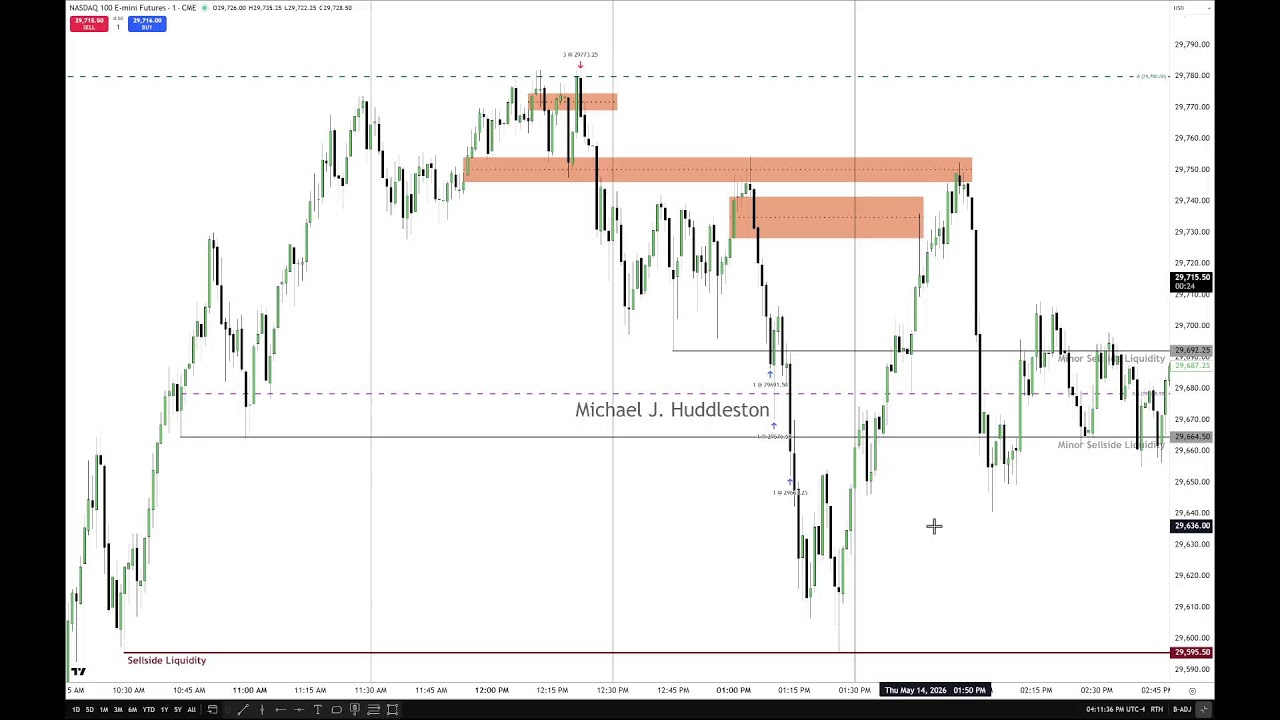
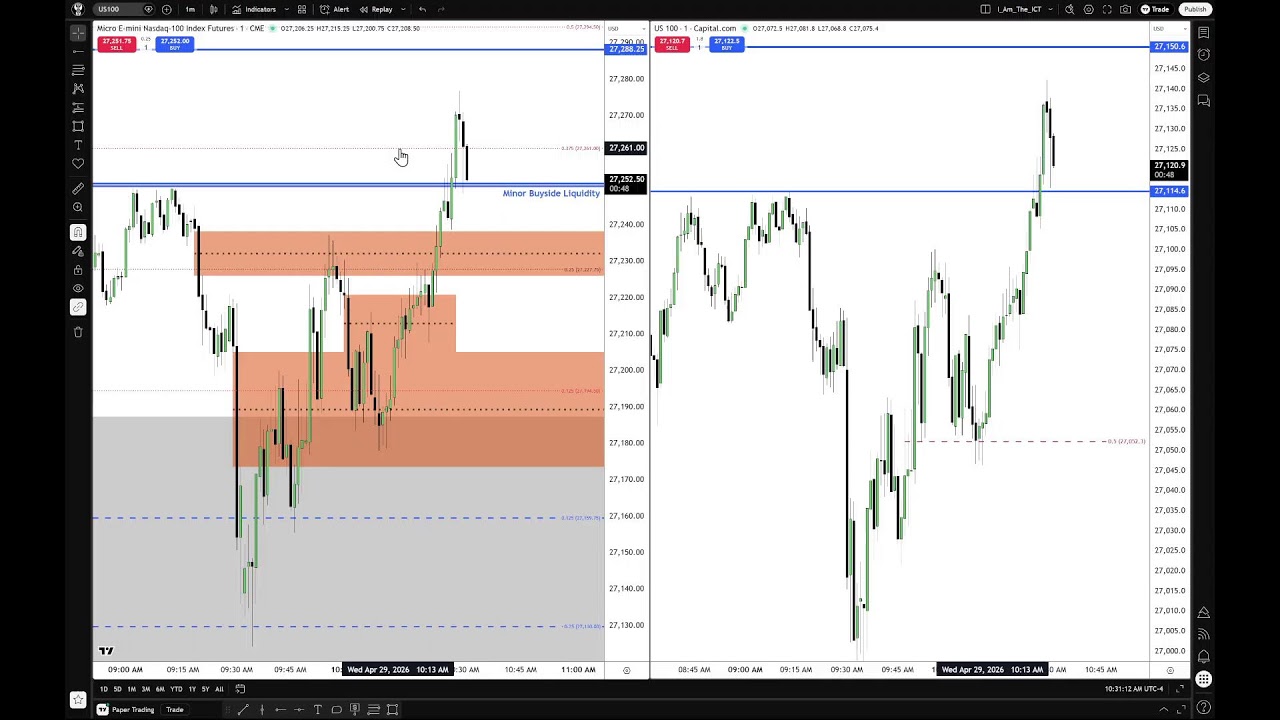
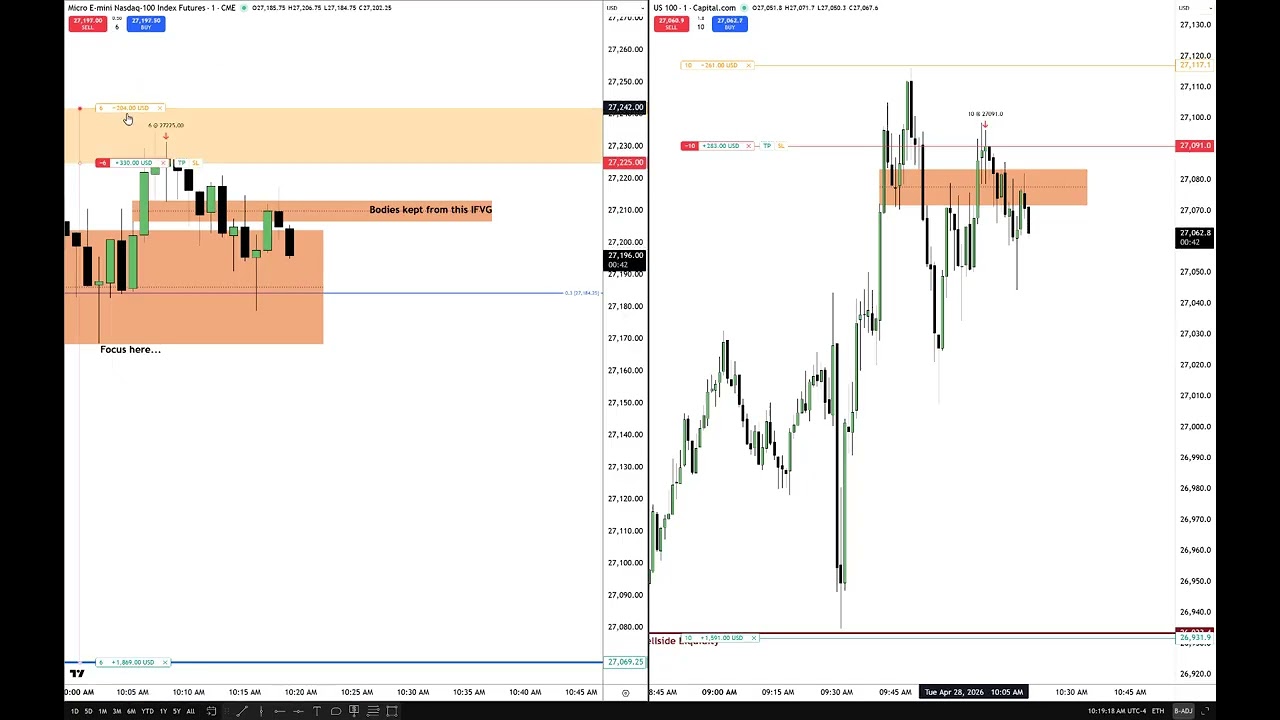
– ICT is executing a short trade in the micro NASDAQ (MNQ) and mirroring it on a US 100 CFD, adjusting stops and targets to the relative equal lows from that morning. – He highlights price discrepancies between real-time MNQ futures and the CFD feed but emphasizes that the same liquidity-based entry logic (lower quadrant 75, opening-range/gap levels, order blocks) can be transposed between futures and CFDs. – Key technical concepts used: opening-range gap, inversion/fair-value gaps, bullish/bearish order blocks, “gray pool” (sell-side liquidity pool between two wicks), event horizon (midpoint between lows), and body/wick placement as confirmation. – Trade management: stop placed above recent highs, partial profit-taking planned at an “event horizon” level, and a time stop rule if price fails to show directional conviction within a few candles. – He annotates the CFD chart heavily for students who can’t access futures markets, demonstrating that CFD price action can validly reflect the same order-flow signals (while noting legal/regional restrictions on CFD trading). – Emphasizes not endorsing any broker shown (Capital.com appears on his chart but he has no affiliate relationship). – The trade is executed and managed live (demo for CFDs due to US legal limits), partials are taken, and execution confirmations appear in the corner—used to teach that the method works across instruments when managed properly. – Overall point: the order-flow/liquidity approach and execution rules used for MNQ futures can be applied to CFDs; careful stop management, candle-body rules, and liquidity targets drive entries, confirmations, and exits.
Quiz
1) What instrument did ICT say he was shorting at the start of the session?
A. S&P 500 futures
B. Micro NASDAQ (MNQ)
C. US 100 CFD only
D. EUR/USD
2) Why did ICT compare MNQ futures price versus the CFD price?
A. To promote Capital.com as a broker
B. To show CFDs are illegal everywhere
C. To compare and contrast real-time price action and show they may differ but map similarly
D. To prove market replay is necessary
3) Which specific entry mechanism level did ICT mention using?
A. Upper quadrant 50 level
B. Lower quadrant 75 level
C. VWAP pivot level
D. Opening range high
4) What name did ICT give to the two-wick liquidity area he annotated?
A. Event horizon
B. Minor sellside pool
C. ICT gray pool
D. Inversion fair value gap
5) What trade management action did ICT describe after the move progressed?
A. Closed the entire position immediately
B. Doubled the position size
C. Took partial profits (e.g., “take three off”, “take two off”)
D. Moved stop to break-even and added a new leg
Answer key with evidence (no timestamps available):
1) B. Micro NASDAQ (MNQ)
Evidence: “All right. So, we’re going to be doing some work here in the CFD. So, I’m going short here in the micro NASDAQ.” and later references to “MNQ” throughout.
2) C. To compare and contrast real-time price action and show they may differ but map similarly
Evidence: “Notice that the prices do not agree, but we’re comparing and contrasting real-time price action with MNQ futures price versus the CFD um price…” and “I’m comparing and contrasting what I would do if I was doing the futures contract only versus what I see in the CFD market.”
3) B. Lower quadrant 75 level
Evidence: “the entry mechanism which is the lower quadrant 75 level”
4) C. ICT gray pool
Evidence: “There’s a gray pool forming. … Now, in between those two consequent encroachments, that is the ICT gray pool.”
5) C. Took partial profits (e.g., “take three off”, “take two off”)
Evidence: “Take three off. That’s good. … And we’ll take two off here in the MNQ and we’ll market that.” and “I’m probably going to take something off.”