The discussion focused on trading psychology, community behavior, and risk management. A debate began over whether experienced traders should be told to “dream small,” with one speaker arguing that advanced traders should aim higher, while beginners need simpler goals.
The conversation then shifted to whether drama among traders and influencers is harmful or simply part of a competitive industry; the main takeaway was that competition is fine, but mob mentality, harassment, and threats are dangerous and should be avoided.
Multiple traders shared personal experiences about the emotional challenge of becoming consistently profitable. They stressed that the real difficulty is not finding an edge, but managing yourself, simplifying your process, keeping risk under control, and handling the pressure that comes with success.
Several speakers emphasized journaling, self-reflection, patience, and focusing on controllable factors rather than social media noise.
ICT also warned strongly against toxic online behavior, noting that influencer drama can escalate into real-world threats and harm. He encouraged students to avoid divisive behavior, stay focused on trading, and treat the market with discipline and simplicity.
The session ended with mutual support, gratitude, and encouragement to keep growing personally and professionally.
Summary — Trader Roundup (live discussion with ICT/Michael, Kitt and students)
– Session focus: live review of price action and teaching on order-flow concepts (fair value gaps, inversions, order blocks, breakers) and how to use them to anticipate moves in algorithmic markets.
– Key trading concepts covered: – Fair value gaps (FVGs) and inversion setups — watching how 1‑min candles react to gaps to judge follow‑through vs. false moves. – Order blocks, rejection blocks and the “unicorn” / purge-and-revert market‑maker model for entries. – WICKs (wick that shows both buy‑side and sell‑side delivery) as a balanced price range that often outranks other gaps for grading levels. – Event‑horizon and pyramid entries between PD arrays (price/time reference levels) as advanced execution techniques.
– Trade management & tactics: – Use clear entry rules, scale / partials and trailing when structure invalidates (e.g., close/encroachment below a consequent level). – “Secure profits” — take low‑hanging fruit, scale off winners, and don’t insist on being right over being profitable. – Practical exercise suggested: small, repeatable limit entries (example: capture two ES handles) to build confidence and small, consistent gains.
– Process & learning advice: – Pick one simple model that fits you, master it, backtest it, then add confluences. Don’t chase every new idea. – Actively test “how my model can fail” — define invalidation signatures and time/risk tolerances. – Time is an edge — grade time windows (session/opening ranges) as well as price levels.
– Psychology, life & accountability: – Trading requires discipline, handling fear/greed, and balancing life priorities. Journaling (including non‑trading life) preserves lessons and perspective. – Be mindful of relationships: communicate goals and boundaries with partners; trading won’t automatically fix relationship pain. – Treat money as a servant; shift focus from output obsession to consistent input/process work.
– Market structure & reality: – Markets are largely algorithmic; manual intervention (market makers / “Phil”) happens and can distort otherwise algorithmic behavior. – Be aware social and algorithmic feedback loops exist — many people trade the same visible levels, which can create targets and traps.
– Community, credibility & criticism: – ICT emphasizes transparency (live teaching) and rejects paid “signal” promises; warns against influencers/marketing that monetize hype rather than teach real process. – Hosts addressed false online accusations and trolls: do due diligence, focus on demonstrable evidence and stay in your lane; don’t be distracted by drama.
– Tone & purpose: the show mixes technical instruction, mentorship, personal testimony and moral/faith perspectives (trading as a tool to bless family and serve, not as vanity). The repeated message: do the hard work, pick a simple repeatable approach, manage risk, protect relationships, and trade with humility and patience.
Quiz
1) Why does ICT say he will not run a paid signal service? A. He believes students should learn independently and not rely on mentorship. B. He says many people following signals create liquidity that algorithms or operators can target, causing interventions that wreck a signal service. C. He thinks signal services are illegal. D. He prefers to sell private coaching instead.
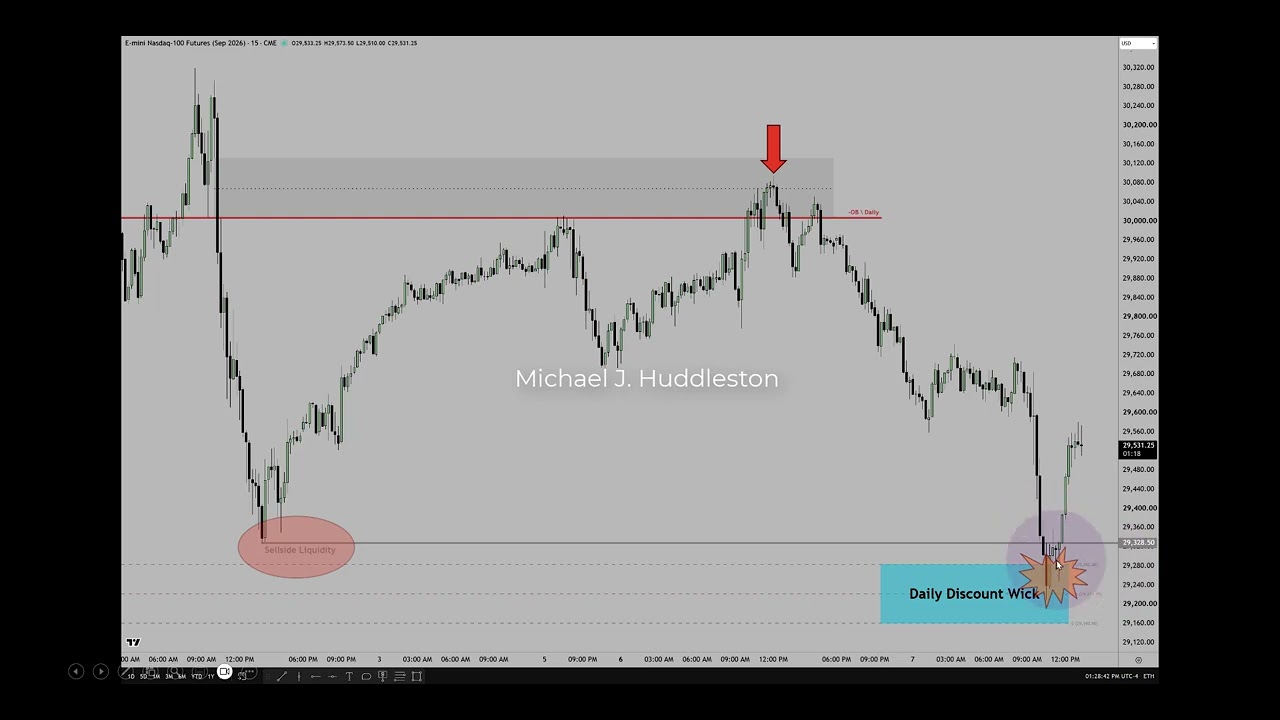
2) According to ICT, why is a wick given priority over a SIBI or BISI when grading levels? A. Because wicks are easier to draw on charts. B. Because a wicks represents both buyside and sellside delivery, making it a balanced price range that trumps SIB/BISI. C. Because SIB/BISI are only relevant on weekly charts. D. Because wicks always indicate future breakouts.
3) What did ICT call “Phil” in the stream and what did it indicate? A. A trading algorithm that always follows retail orders. B. A type of candlestick pattern signaling continuation. C. Manual intervention: a sudden one-minute candlestick run up to his called level suggesting human participation. D. A nickname for hedging strategies used by algorithms.
4) How does ICT compare the significance of daily higher-timeframe levels versus regular trading hours (RTH) opening range levels? A. He says daily levels are always more important than opening range levels. B. He says opening range levels are always more important than daily levels. C. He says they are on equal playing fields, but the opening range can produce a more sensitive reaction because of concentrated trading in the first 30 minutes. D. He says neither is useful for grading.
5) What does ICT describe as reasons he journals (keeps notebooks) outside of trading notes? A. To publish books and sell to students. B. To archive personal conversations, prayers, dreams and memories so he can relive and pass them on to family. C. To track other traders’ mistakes for exposure. D. To log only his winning trades for marketing.
Answer key (with transcript evidence and timestamps)
1) Correct: B. Evidence: ICT explains that if he put out signals “so many people would be following it… it would build the liquidity that would be easy for them to go in and just take it right off the vine,” and that manual intervention would wreck a signal service. (Transcript: ~00:03:00–00:05:30)
2) Correct: B. Evidence: ICT: “A wick is always gonna be able to trump a CIBI or bisi… go right to the wick because that’s the balanced price range.” He links the wick’s importance to it having both delivery sides. (Transcript: ~00:33:07–00:34:00)
3) Correct: C. Evidence: ICT describes a sudden one‑minute candle that “traversed all the way up to where I told you it was gonna go. That is manual intervention… That’s Phil, that’s manual intervention.” (Transcript: ~00:02:10–00:04:00)
4) Correct: C. Evidence: ICT: “they’re basically the same… There’s no greater importance… it’s just, you’re gonna be much more likely to see a sensitive reaction on the regular trading hours opening range because you’re trading in the first 30 minutes.” (Transcript: ~00:23:00–00:24:00)
5) Correct: B. Evidence: ICT describes keeping leather journals with conversations, prayers and dream journals so he won’t forget moments, can relive memories, and can pass them to his family: “My son asked me… I said, I don’t wanna forget good things… I record conversations with my kids… I record my response… they have a unique opportunity to be able to relive those moments again in my own handwriting.” (Transcript: ~01:11:30–01:20:00)
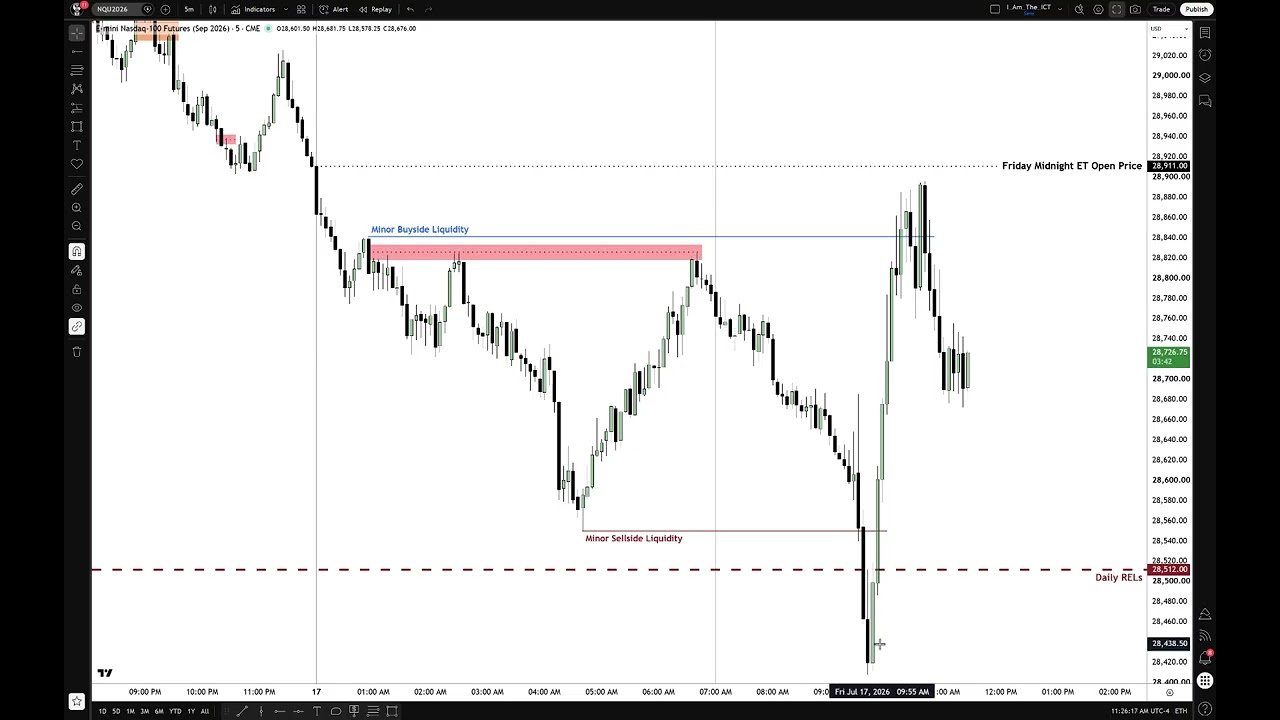
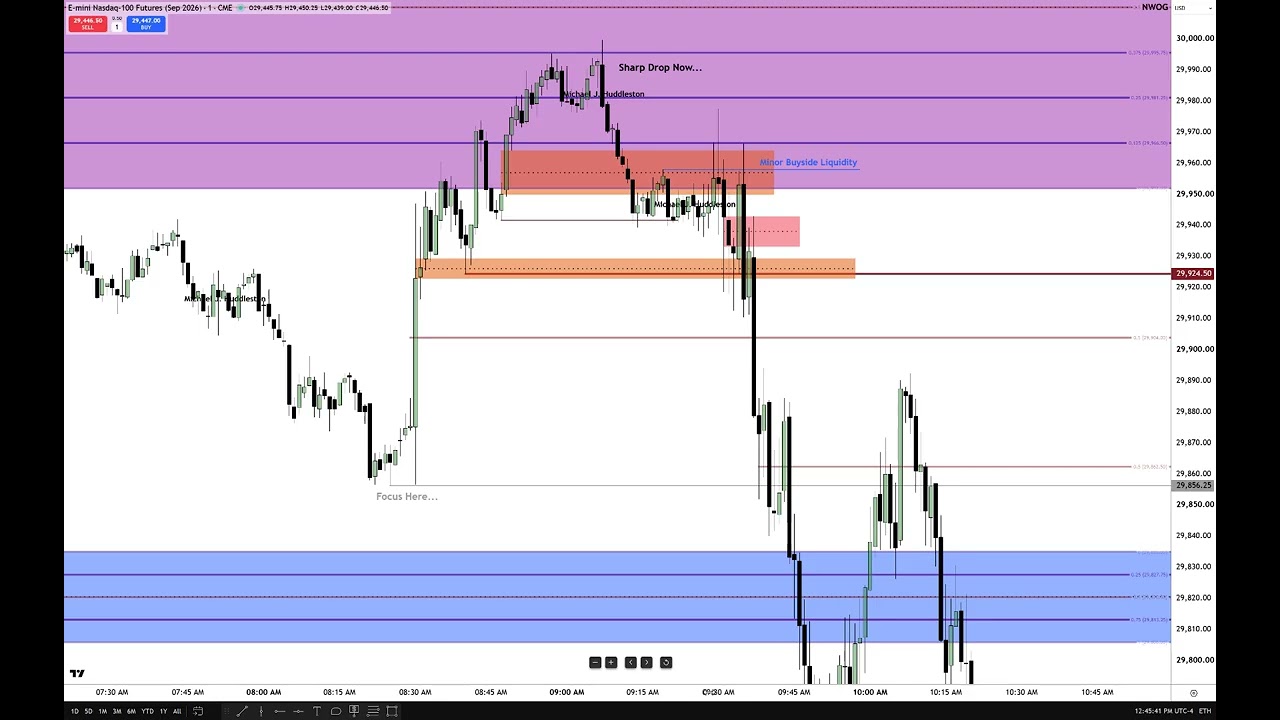
Market read (overall) – The presenter is biased bearish on US indices (Nasdaq, S&P), but is cautious about taking new shorts on a Friday (TGIF effects, weekend/gap risk, possible manipulation). Price action is one‑sided since the open and has produced several valid sell-side signals, but follow‑through is uncertain. – He repeatedly warns about market “shenanigans” / manipulation (pre‑market/electronic spikes, news-driven moves) and stresses gap risk on Sunday evening opens.
Technical framework (what ICT’s using) – Primary tools/concepts: fair value gaps (FVGs) / inefficiencies, volume imbalances, “consequent encroachment” (midpoint of a range), PD arrays / daily ranges, order blocks, and using higher‑timeframe levels to guide intraday tape reading. – Important rules: treat certain FVGs as inversion areas (if price closes beyond them on a body basis they can act as directional pivots); watch whether price leaves or lays bodies in the upper/lower halves of key wicks/ranges; rapid leaves of inefficiencies = high conviction moves, lingering/time distortion inside gaps = weak or problematic setups. – Use micro contracts and low leverage while learning; prefer observing price reactions to levels before trading.
Practical trading guidance / risk management – Don’t chase or force trades because a setup “looks good”; watch time‑of‑day, day‑of‑week (Fridays), and whether price behavior matches the expected signatures before committing. – Manage positions actively: take partial profits, trail stops, reduce size when price fails to act as anticipated; lower exit precision in chaotic markets to secure gains. – If a FVG or PD array isn’t performing as expected, treat that as actionable intel (i.e., it weakens the trade case).
Instrument highlights (brief) – Nasdaq / indices: bearish structure, multiple inefficiencies and sell‑side liquidity pools. He’s expecting lower prices over the coming weeks/months, but not necessarily intraday on Friday. – S&P / MES: similar dynamics — needs decisive follow‑through below recent lows to confirm continuation. – Dollar / EUR / GBP: dollar strength bias; euro and pound showing setups consistent with downside (watch bodies staying out of upper halves). – Crude (Brent/WTI): expects higher prices (mentions ~$180–200+/bbl as an outlook) but is not participating; warns about news-driven volatility. – Gold & silver: targets met; a Sunday open gap lower and heavy follow‑through would be very bearish. – Bitcoin / crypto: he’s skeptical and expects lower (he doesn’t trade crypto; commentary is opinion).
Teaching emphasis – Focus on learning tape reading and level behavior (observe, measure, test), not on instant live trading. Many failures stem from skipping practice/backtesting and overleveraging. – ICT stresses patience: only trade environments where multiple signals (time of day, FVG behavior, volume imbalance, body closes) favor the thesis.
Tone / housekeeping – He’s not issuing trade recommendations to follow; the livestream is instructional. He also shared anecdotes and frustrations (road rage, household interruptions) but the core is teaching level-based order‑flow interpretation and conservative risk management in a manipulative/high‑risk market environment.
1. According to ICT, what should bearish price action do after trading below a bearish suspension block? A. Stay in the upper half and run higher B. Stay out of the upper half and work toward lower prices C. Fill the entire gap immediately D. Reclaim the daily wick high
2. Why did ICT say he was reluctant to short aggressively on Friday? A. Because the market had already opened above the weekly high B. Because it was Friday and the market had already sold off well, making TGIF conditions less trustworthy C. Because the dollar index was bullish D. Because crude oil was failing to rally
3. What did ICT say about how inversion fair value gaps should behave in strong moves? A. They should spend a lot of time getting filled B. They should leave quickly, often in one or two candles C. They should always reverse into bull flags D. They should only work on daily charts
4. What was ICT’s view on Bitcoin in this transcript? A. He was strongly bullish and expecting a breakout B. He said it looked bad and he would not be comfortable being long C. He said it was guaranteed to reach all-time highs D. He said it was unrelated to fair value gaps
Answer Key: 1. B Evidence: “If it weren’t the if it wasn’t rather um Friday, say this was Thursday, I’d be all over this shorting it. But because it’s Friday, I’m a little reluctant to trust this going down.” 2. B Evidence: “If we’re bearish, if we’re going to continuously maintain bearishness, we want to see price once it trades below it here… we want to see that stay kind of like a no trespassing don’t don’t come up here anymore… and then we would see it uh you try to work towards lower prices.” 3. B Evidence: “if they’re valid, if they’re very much in the right side of the marketplace, they’re not going to waste your time. They’re going to try to run. They’re going to they’re going to use that moment and sharply leave it.” 4. B Evidence: “I wouldn’t be comfortable if I was long on Bitcoin. I’ll just say that… But this just looks it looks bad.”
– ICT will be away from X for about two weeks for Passion Week/Easter and to help friends. They’ll post a few short training videos but won’t be doing live analysis until they return in two Mondays.
Market overview and guidance:
– General stance: markets are messy and volatile with low volumes next week. Avoid live trading, focus on demo/practice and studying price action. Only take very high-conviction setups; preserve capital and manage risk.
– Dollar Index: recently ran up near 100.54. There are daily volume imbalances and wicks suggesting possible retracement lower; if the dollar weakens further, EUR/USD and GBP/USD could rally.
– EUR/USD: choppy, many wicks and conflicting signals. Current structure looks like an inversion fair value gap; bias is toward a move lower (targeting sell-side below ~1.13917) unless price reclaims the level above and becomes a bullish FVG.
– GBP/USD: similar struggle—interpreted as an inversion fair value gap for now; could change on geopolitical news.
– Gold & Silver: gold had an aggressive selloff and cleared key lows. Silver delivered a very large move driven by institutional positioning; both are event-driven and manipulable—recommend staying sidelined.
– Crude oil: ran up but is risky to trade now because geopolitics can move it violently; the speaker thinks it could go much higher ($180–200/bbl) but warns against trading it recklessly.
– Equities (E-mini S&P / Micro NASDAQ): trading in an ugly range. Watch specific volume/imbalance levels—only bullish if price trades and reclaims inversion fair value gaps. A potential new Fed chair could be a catalyst for a pronounced rally, but that’s speculative.
Tone and recap: – Markets are unpredictable right now—many political/geopolitical influences. The speaker emphasizes caution, risk management, and learning rather than forced trading. They’ll be back with live commentary after their break.
Quiz
1) According to ICT, what should traders do during Passion Week / the upcoming week he referenced? A. Increase trading frequency to capture volatility B. Avoid trading with real money and use practice/demo instead C. Aggressively trade commodities only D. Move all positions to long-term holds
2) How does ICT describe the gold and silver markets in the transcript?
A. Fair and easy to trade for beginners
B. Highly manipulated and risky, often driven by big institutional interests
C. Always bullish and safe to hold long-term
D. Unaffected by event-driven forces
3) What did ICT say would likely happen if the dollar index “loses this imbalance and go lower”?
A. Dollar strengthens and Euro/pound fall
B. Dollar weakens and Euro/pound rise
C. No significant change across FX pairs
D. Immediate global market crash
4) Which condition would cause ICT to change his current bearish stance on Euro dollar to a bullish one?
A. If Euro dollar trades above and reclaims the inversion fair value gap he identified
B. If gold and silver both spike simultaneously
C. If crude oil drops below $50 per barrel
D. If unemployment numbers are revised downward
5) What did ICT recommend regarding contract size / leverage for index trading this year?
A. Use full leverage and standard E-mini contracts for maximum gains
B. Focus on micro contracts (e.g., MNQ) to avoid overleveraging and encourage smaller risk
C. Only trade options, never futures
D. Avoid all index trading completely
Answer Key
1: B
2: B
3: B
4: A
5: B
Evidence from the transcript (timestamps not available):
Q1 Evidence (supports answer B):
– “because of uh or observance next week of the resurrection of our Lord and Savior Jesus Christ… I’m not engaging price action. I’m not trading that. Usually not commenting at all.”
– “don’t take any trades right now. Practice and demo. Just practice. Read price action…”
Q2 Evidence (supports answer B):
– “This market, just like gold, is extremely manipulated.”
– “they suppress it. They’re paper markets… these markets will do it because it’s the good old boys behind it all.”
Q3 Evidence (supports answer B):
– “If we lose this imbalance and go lower, then we’re probably going to see some pressure on dollar index and the Euro dollar and pound dollar will be allowed to go higher.”
Q4 Evidence (supports answer A):
– “if it were to trade above that then I would expect this to become a reclaimed bullish fair value gap but right now the characteristic that it’s under … is that of inversion fair value gap”
– “I’m looking for Euro dollar to give up the ghost and make a run below this low… But if this gets violated to the upside much like Euro dollar then I’m probably wrong.”
Q5 Evidence (supports answer B):
– “I told everybody I would be focusing on that market this year for the sake of encouraging you all not to be trying to overlever your accounts. So what do we have here? We have this wick… MNQ, this is the micro NASDAQ.”
– Opening: Live market commentary focusing on one teaching — “time distortion” — and chart-based analysis across the dollar index, FX (EUR/USD, GBP/USD), commodities (oil, gold, silver), Bitcoin, and US indices.
– Time distortion (key lesson): When price sits in a prolonged range on a low timeframe, go to higher timeframes to see the true structure and the inefficiencies (fair-value gaps/volume imbalances) price is trying to resolve. Use the behavior of candlestick bodies relative to the midpoint of those inefficiencies to infer institutional order flow (bodies staying in the lower half = bearish; in the upper half = bullish).
– Dollar index: Currently in large consolidation with structural shifts. ICT is biased to dollar staying firm or moving higher (flight-to-quality because of ongoing war), but names a clear “line in the sand” — loss of a specific suspension block/volume-bounce zone — that would flip the view bearish and favor higher EUR/GBP.
– FX (EUR/USD, GBP/USD): Mixed/50–50 setups; direction depends on what the dollar does. Seasonal tendencies could push EUR/GBP higher later, but war and broader uncertainty are overriding factors.
– Commodities & metals:
– Crude/Brent: Expect significant upside (mentions targets into $150–$180+ for Brent).
– Gold & silver: Recent sell-offs after failing key levels; watching for gaps/“consequent encroachment” and possible further downside. Silver is especially event-driven and volatile.
– Bitcoin: In protracted consolidation with a bearish lean; has specific lower targets if it breaks key lows, though a break above recent highs would turn the bias bullish.
– US indices: Bearish bias across Dow, S&P, NASDAQ supported by intermarket divergences (SMT) and distribution signals; specific downside targets given (e.g., NASDAQ ~22,779.75 continuous-contract target). Advises focusing on continuous contracts for structural analysis rather than individual delivery months.
– Trading guidance / risk management:
– In uncertain, event-driven markets (war, gaps), reduce trade frequency and leverage; be prepared to be wrong.
– Use continuous futures contracts for top-down analysis.
– Record timestamps of calls/levels for accountability.
– If you can’t grasp these concepts within months, reassess your approach — the rules presented are simple and rule-based, not subjective.
Overall: Market environment is conflicted and risky; use higher-timeframe context, fair-value gaps/volume imbalances, continuous-contract analysis, and conservative sizing to navigate time-distorted price action.
Quiz – Recap and Test Your Memory
1) According to ICT, what is the primary way to “fix” time distortion when price is stuck on a low timeframe? A. Lower your leverage and trade less frequently B. Go up to a higher timeframe to see the inefficiency it is trying to reach C. Use only one-minute charts and scalp more D. Switch to a different market entirely
2) When doing top-down analysis of index futures, which contract type does ICT emphasize using for clearer, smoothed higher-timeframe information? A. Front-month delivery contract (e.g., June) B. Continuous contract (no month code) C. Spot cash index only D. Only monthly options expiries
3) ICT identifies a specific “line in the sand” level for the dollar index. What defines that level? A. A simple round psychological price level B. A moving average crossover C. “This volume imbalance low, volume imbalance high” and a suspension block / inversion fair value gap D. Fibonacci retracement 61.8%
4) What is ICT’s overall bias on the major equity indices as expressed in the livestream? A. Strongly bullish and expecting sustained new highs B. Neutral — no clear bias C. Bearish — expecting distribution and lower targets (e.g., Dow, ES, NQ draws) D. Only intraday scalping bias, no directional view
5) What risk-management action does ICT recommend in the current uncertain (war-driven) market environment? A. Increase leverage to chase bigger moves B. Maintain usual trading frequency and risk C. Dial back trading frequency and lower leverage to smallest sizes D. Always hold positions overnight to capture weekend gaps
Answer key: 1: B Evidence: “What time distortion mean?… How do you fix it?… you go up to the higher time frames. … We’re in a one minute. We’re go up to a five minute. … Above 5 minute… 15-minute. It’s already jump off the chart at you.” (time-distortion section, near end) 2: B Evidence: “When you’re looking at trading the indicy market, are you referring to the continuous contract at all?… you always see me go to the continuous contract. … If you look up here. If you see a month ever, that’s not continuous contract. … it’s continuous contract because there’s no month being mentioned here.” (continuous contract discussion) 3: C Evidence: “you got this volume and bounce low, volume and bounce high. This is like the line in the sand for me. If we lose this, then I’m I’m not so optimistic for dollar.” (dollar index discussion) 4: C Evidence: “I’ve been sticking to I’m bearish on all the indices, and I’m telling you where my targets are… We’re seeing heavy distribution here. … that’s why I’ve been sticking to I’m bearish.” (indices discussion) 5: C Evidence: “Whenever I have been confronted with uncertainty, my experience has taught me to dial back frequency, dial back the desire to want to participate and then lower leverage. That means go down to the smallest leverage you can do.” (risk-management / war discussion)
Overview
– Live market commentary and teaching on price action across multiple instruments; the speaker uses concepts like fair value gaps, consequent encroachment, volume imbalances, event-horizon midpoints, and buy/sell-side liquidity pools.
– Repeated emphasis on risk management, selective trading, and that his commentary is not investment advice — do not trade solely on what he says.
Market views (short form)
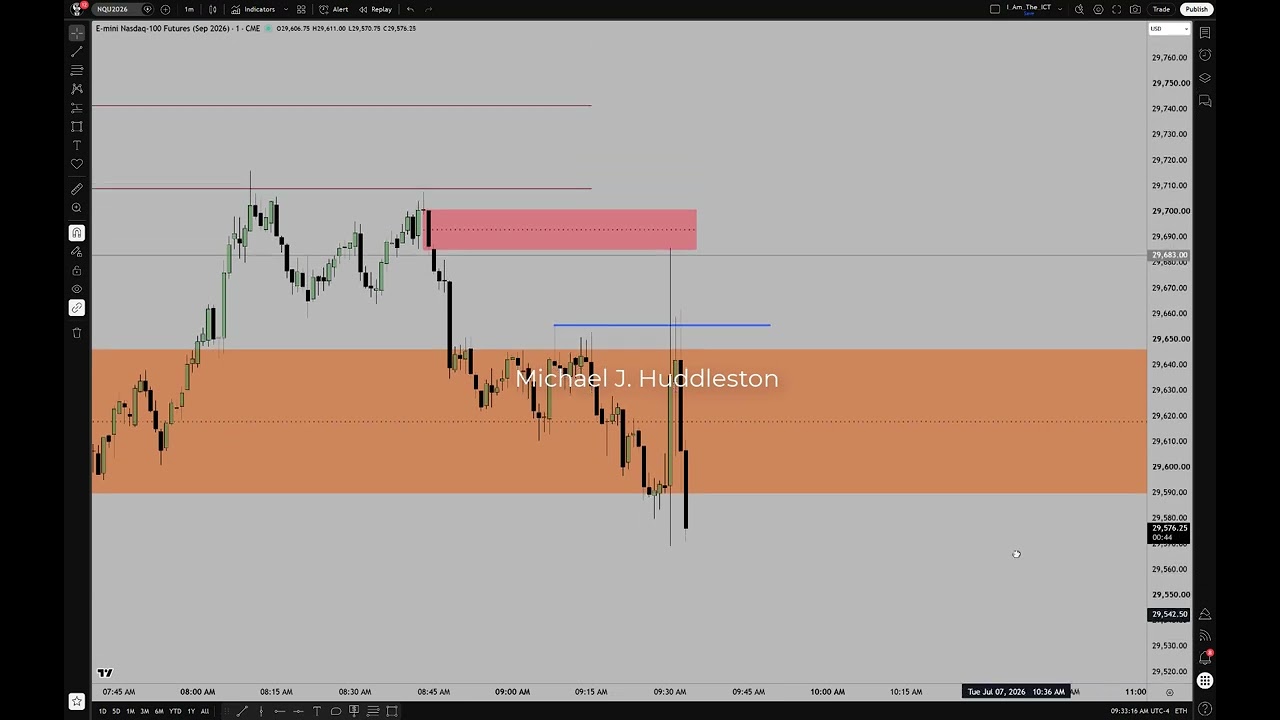
– Micro E‑mini NASDAQ (NQ/MNQ): Watching for a drop to a specific sell‑side liquidity level (~24,485); if price closes below certain wicks/gaps, expect continued downside.
– Dollar Index: Bias is firm-to-higher; sees prominent discount wick and volume/balance structure that supports further strength. If dollar is firm, expect EUR/GBP weakness.
– EUR/USD: Bearish bias if bodies stay below a key wick/encroachment level; watching sell‑side liquidity pools and an unresolved fair gap.
– GBP/USD (Cable): Expects a move lower toward a sell‑side liquidity pool if the pair confirms inversion/fair-value gap behavior; describes the market‑maker sell model and entry/validation rules.
– Bitcoin/crypto: Speaker is skeptical and personally doesn’t trade crypto; expects lower prices long‑term, outlines how he would manage partial exits if short. Warns of mania and high risk.
– Gold & Silver: Prefers caution—metals showing signs of a smart‑money exodus (especially silver, where he cites delivery shortages). Recommends taking profits rather than holding into potential deep retracements.
– Crude Oil: High volatility and manipulation; he personally avoids trading it despite expecting higher prices longer term.
– S&P (ES): Noted gaps, volume imbalances, and price actions that suggest potential continued downside; March 19, 2026 flagged as a defining day for direction.
Trading methodology & rules highlighted
– Primary tools: OHL(C) levels, fair value gaps, consequent encroachment (midpoints), volume imbalances, and liquidity pool mapping — rule‑based, visual order-flow reading rather than reliance on on‑tick internal footprint data.
– Event horizon (midpoint between lows/highs) used as targeting/partial-exit technique.
– Inversion fair‑value gap validation requires specific price behavior (closes, reclaims, midpoint tests) before treating zones as tradeable.
– Position management: use partial exits at structurally meaningful midpoints; take profits and preserve capital; be selective — don’t overtrade.
Warnings, commentary & community
– Markets are unusually manipulated and volatile; avoid trading into major news (e.g., FOMC) and be wary of hype.
– Strong criticism of paid gurus, rebranded/leaked mentorship content, and people who misinterpret his methods; he offers most teaching for free and stresses learning the rules before arguing.
– Personal/philosophical remarks: he teaches to protect traders from self-inflicted losses, values humility and charity, and encourages using trading gains to bless others rather than chase status.
Tone & intent – The presenter is candid, often colorful, and mixes technical teaching with personal anecdotes and strong opinions. Primary goals: educate on a rule‑based price‑action framework, prevent unnecessary losses, and build disciplined traders.
Quiz – Recap
1) According to ICT, what does he explicitly tell viewers regarding taking trades based on his live commentary? A. He encourages viewers to copy his trades exactly. B. He warns viewers not to take trades based solely on his commentary. C. He suggests viewers should always trade during his livestreams. D. He advises viewers to use maximum leverage when following his ideas.
2) What is ICT’s short-to-intermediate bias for the U.S. Dollar Index (DXY) in this session?
A. Bearish — he expects the Dollar Index to fall significantly.
B. Neutral — he has no view on the Dollar Index.
C. Bullish/Firm — he is not bearish and expects it to stay firm or go higher.
D. He recommends closing all Dollar positions immediately.
3) Which statement best reflects ICT’s relationship with Bitcoin/crypto A. He is long large positions in Bitcoin and recommends others buy. B. He actively day-trades crypto and teaches intraday crypto strategies. C. He has never traded Bitcoin/crypto and personally would not touch it. D. He runs a paid crypto mentorship and solicits students for crypto trades.
4) What guidance did ICT give regarding gold and silver in the livestream?
A. He urged viewers to aggressively buy and hold both metals for massive gains.
B. He warned that metals could retrace, advised taking profits, and noted delivery/supply issues in silver.
C. He recommended ignoring risk management for precious metals.
D. He said silver has abundant physical supply and no delivery risk.
5) What is ICT’s stance on trading crude oil during the market environment he described?
A. He recommends active trading in crude oil because it’s stable and predictable.
B. He advises treating crude like a “rattlesnake” and not trading it due to extreme volatility and geopolitical risk.
C. He suggests using high leverage in crude to maximize gains.
D. He states crude oil prices are irrelevant and offers no opinion.
Answer key (with evidence from transcript and approximate location in the recording):
1) Correct answer: B
Evidence: “guys are taking trades based on what I’m saying and I asked you not to do that. I know do not do that stuff.” (Opening portion of the transcript / early in the livestream)
2) Correct answer: C
Evidence: “I’m not bearish on dollar index. So that means I’m expecting lower prices on euro, lower prices on pound dollar… I personally don’t think that we’re done with the dollar index going up higher.” (Dollar Index section / early–middle)
3) Correct answer: C
Evidence: “I have never traded Bitcoin. I’ve never traded crypto… I wouldn’t touch it. I wouldn’t trade it. And that’s just my opinion.” (Bitcoin section / middle of the transcript)
4) Correct answer: B
Evidence: “When we were trading here, I said it would be univilized for you not to be taking profit in silver and gold… There is no silver to take delivery of… So the people that were holding it to take delivery, what’s their incentive to hold the contract? None.” (Gold & Silver sections / middle of the transcript)
5) Correct answer: B
Evidence: “don’t trade it. … Crude oil doesn’t make sense. It doesn’t make sense. There’s so much volatility now… Treat it like a rattlesnake. … I’ll admire you from a distance, but I’m not trying to touch you because it’s going to bite you.” (Crude oil section / middle of the transcript)
– Opening and tone: A supportive group mentoring session led by ICT (Michael) and host Kitt. Speakers share trading experiences, questions, and personal struggles; vulnerability and authenticity are encouraged.
– Tilt and coping (Pit Munch): Pit Munch described a specific tilting episode, documented patterns in notes (blood flow to hands → neck → face = danger zone). Effective countermeasures: leave the desk for 10+ minutes, shut down devices, take a long shower until calm, journal the event and end the trading day. Result: she stopped tilting after adopting these steps.
– Psychology and practice: ICT and Kitt emphasized the importance of procedures to separate impulse from trading decisions, cultivating humility, and building disciplined protocols. Journaling and reflecting on bodily signals were highlighted as powerful tools.
– Market pressures and funded accounts: Several callers (Jack, others) described stress from rising living costs and war-related market volatility, leading to overtrading and blowing funded accounts. Discussion focused on patience, adapting to changing conditions, and the need to stick to rules rather than chase payouts.
Technical concepts and teaching points: – “First presented” fair value gap (FVG): ICT explained it’s the first FVG that fits the trader’s narrative/criteria, not simply the first gap seen. Narrative (expected price delivery) guides which FVG to use. – Inversion FVGs, consequent encroachment, order blocks and market-maker models were discussed as practical schematics (multi-timeframe alignment, one-minute resolution for detail). ICT encouraged students to post charts when asking technical questions for precise feedback.
– Faith and personal growth: A younger participant (Johann) raised questions about repentance and deservingness. ICT responded that Christians still sin and should confess; spiritual growth involves seeking God’s will, serving others, and aligning life with higher principles rather than treating God as a wish-granting tool.
– Health, discipline and performance: Multiple speakers stressed physical health as foundational for consistent trading — diet, sleep, breath work, saunas/ice baths and Wim Hof breathing. ICT urged reducing processed foods and sugar, intermittent fasting, and breathing techniques (slow exhale, longer than inhale) to lower heart rate and manage stress. Good physical care improves focus and resilience.
– Community and process: Emphasis on following protocols when asking questions (include charts), helping others, and using mentorship resources (spaces, recordings). The group closed with gratitude and encouragement to keep studying, serve others, and maintain self-care.
Overall: The session blended practical trading instruction (FVGs, market-maker setups, timeframes) with strong focus on trading psychology, disciplined routines, physical health, spiritual balance, and community support as keys to long-term success.
Quiz
Recap, and test your knowledge
Answer key below
Question 1
What did ICT say is necessary to prevent repeated tilting in trading?
a) Trade smaller lot sizes b) Avoid trading during news events c) Put procedures and protocols in place and remove yourself from stimuli d) Only trade when confident
Question 2
According to ICT, what is the correct definition of a “first presented fair value gap”?
a) The first gap that appears on the chart each day b) Any gap formed during the first hour of trading c) The first gap that appears regardless of market conditions d) The first gap that fits the narrative and criteria within a trading model
Question 3
What did ICT say his current bias in current market conditions?
a) It is the most reliable way to trade b) It should always be followed strictly c) He is currently not trusting it and instead focuses on narrative d) It should only be used for long-term trades
Question 4
What did ICT say about trading markets like crude oil or silver in current conditions?
a) They are the best markets to trade right now b) Traders should increase position size in them c) He recommends staying hands-off because they are dangerous d) Only beginners should avoid them
Question 5
How does ICT describe improving trade entries using smaller timeframes?
a) Smaller timeframes are unnecessary b) Always use the 1-minute chart only c) Drop to lower timeframes to see clearer inefficiencies when needed d) Only use higher timeframes for accuracy
Answer Key with Evidence
1. c) Put procedures and protocols in place and remove yourself from stimuli
Evidence:
“If you don’t check yourself, if you don’t put procedures and protocols in place… and you’ve removed yourself from the stimuli.” Timestamp: 00:07:30 – 00:07:54
2. d) The first gap that fits the narrative and criteria within a trading model
Evidence:
“It’s the first presented fair value gap that fits the narrative and the criteria I’m looking for within my model.” Timestamp: 00:30:00 – 00:30:30
3. c) He is currently not trusting it and instead focuses on narrative
Evidence:
“I have zero bias lately because I don’t trust higher timeframe bias… I’m just looking for what’s the current narrative right now.” Timestamp: 00:32:00 – 00:32:30
4. c) He recommends staying hands-off because they are dangerous
Evidence:
“I wouldn’t touch it… it’s giving me every bit of evidence that I should not touch it.” Timestamp: 00:56:00 – 00:57:00
5. c) Drop to lower timeframes to see clearer inefficiencies when needed
Evidence:
“I’m gonna keep dropping down to smaller timeframes until I get that… resolution I’m aiming for.” Timestamp: 01:05:00 – 01:05:30
– Format and tone: A wide-ranging community discussion led by Kitt with ICT (Michael) and multiple students sharing trading progress, personal stories, and faith-driven perspectives. The atmosphere blended practical market instruction, mentorship, and spiritual/psychological counsel.
– Personal testimonies: Daniel described grieving his wife while raising four children and emphasized patience — “let time do the heavy lifting” — and the danger of trading from lack. Several speakers (Wolf, Diamond, Dan) testified to intuition and spiritual guidance, urging humility, surrender, and character development as prerequisites for durable trading success.
– Core trading principles reinforced: – Multi-timeframe alignment (macro → micro) and waiting for clear confluence before entering. – Use of ICT concepts: order blocks, P.D. arrays, fair value gaps (FVGs), market-maker model, premium/discount, relative equal highs/lows and lows, and gap/range logic. – Practical rules and nuances: the left-of-two-highs/lows rule for higher-probability equal-high/low setups; TGIF (weekly retracement idea — expect 20–30% retraces of a one-directional weekly range; extreme up to ~40%); treat opening-range-gap “grid” (last 5/10/20 days) as premium/discount framework; hold partials around midpoints/10:30 if FVGs don’t fill. – Newer terminology explained: mean/threshold, equilibrium, consequential encroachment, and “event horizon” (a naming convention to improve exit planning for price that goes beyond visible levels).
– Psychology & process: Strong emphasis on demo/practice, removing leverage and emotional pressure while learning, disciplined risk, resisting pride, and treating trading as a craft developed over time. Sanctified stewardship—use returns to bless others—was repeatedly encouraged.
– Community & resources: Speakers applauded the value of ICT mentorship videos and X/Twitter spaces. Plans underway to organize/ archive content (playlists, annotated resources) and make it easier to study; volunteers and contributors welcomed.
– Closing theme: The group stressed unity — “we rise by lifting others” — patience, spiritual and mental alignment, and disciplined study as the path to sustainable performance.
Quiz (Test your trading knowledge)
1) According to ICT, when the Lord speaks in a non-audible way, how does that voice most often feel? A. Loud and thunderous B. Calming, felt in the chest/belly, male-sounding, and short/succinct C. Indistinguishable from your normal conscience voice D. A high-pitched whisper
2) For a strongly one-directional weekly move, what retracement range does ICT say the week’s close commonly returns to (TGIF idea)? A. 5–10% of the weekly range B. 10–15% of the weekly range C. 20–30% of the weekly range (sometimes up to 40% in extremes) D. 50% of the weekly range
3) What label did ICT confirm for the combined structure formed by multiple past opening-range gaps (e.g., several days or Mondays/Fridays)? A. OR Matrix B. Opening Range Gap Grid (or simply “grid”) C. Gap Mesh D. Weekly Mesh
4) What is ICT referring to with the term “consequent encroachment” (or the idea behind that phrasing)? A. A dollar-based stop-loss rule B. An expected retracement into about half of an inefficiency / fair-value gap C. A volatility indicator that signals expansion D. A timeframe label for intraday only
Answer Key
1) B 2) C 3) B 4) B
Evidence
1) Internal/non-audible voice characteristics (supports Q1 → B) – ICT: “I have lots of experiences, uh, where I felt the Lord speak, and I’ve heard, and it’s not always an audible, but it’s, many times it’s like internal, like, it’s like it’s either in your belly or it’s in your chest. … It’s very confident. You want it to keep talking, like you want it to keep speaking to you, but it’s always real short, succinct, just what’s necessary.” — [00:22:39]–[00:23:30]
2) TGIF weekly retracement percentages (supports Q2 → C) – ICT: “TGIF is a retracement idea on the weekly range… if it’s a one directional week… it’s more likely that it’s going to gravitate back towards 20% or 30% of the range that it created for that week… In extremes, it can go to 40%.” — [01:18:43]–[01:20:02]
3) Label for combined opening-range gaps = “grid” (supports Q3 → B) – ICT: “Yes, that’s what I refer to it as. And I just define it by how many, how many one periods I look back. … For you as students, grid is fine.” — [01:04:24]–[01:04:50]
4) “Consequent encroachment” meaning (supports Q4 → B) – ICT: “…The gaps or when there’s an element of inefficiency… I chose the middle, uh, ground instead of saying equilibrium. ‘Cause it’s not equal… So it’s encroaching on the consequence of you holding that position. You’re gonna have to endure retracement up to half of it. So it’s encroaching upon what is reasonable for you to absorb as drawdown…” — [02:16:30]–[02:17:30]
Opening: ICT checks audio, says he’ll keep remarks short and join Trader Round UP afterward.
Challenge to critics: Calls out online trolls and challengers, invites anyone to trade live on Axi with real broker statements to prove results rather than trash-talk.
Trading philosophy: Advocates small, disciplined growth over gambling — start with one micro contract, target modest weekly/daily goals (e.g., $50/day, $250/week, $1,000/month), and compound as you grow.
Methodology: Emphasizes structured price analysis (market structure, grids, PD arrays, order blocks, fair value gaps) and knowing specific levels and times rather than random guessing.
Risk management: Warns against over-leveraging, chasing big payouts, and demo/gambling mindsets that condition bad behavior; promotes slow, incremental consistency (e.g., weekly percent gains).
Learning process: Teaching filters out lazy students — you must practice in your own account, learn through mistakes, and be patient; no shortcuts to experience.
Social media/toxicity: Criticizes online negativity and fake gurus who prioritize engagement over real trading skill; many detractors lack discipline and can’t replicate results.
Personal notes and anecdotes: Mentions specific students and incidents (leaderboard competitors, a livestream he advised, students who transformed), and stresses underlying personal work (self-confidence, removing toxic influences) is essential for success.
Closing: Encourages disciplined study and practice, reiterates openness to public, verifiable challenges, and signs off to join the Traders Roundup podcast.
Overall message: Trade methodically, start tiny, focus on structure and consistency, ignore performative online criticism, and do the hard work to become reliably profitable.
Quiz
1) What weekly profit target using a single micro contract did ICT suggest as a starting goal? A. $50 per week B. $250 per week C. $1,000 per day D. $5,000 per week
2) What strike-rate did ICT claim to have achieved that week? A. 60% strike rate B. 75% strike rate C. 100% strike rate D. 0% strike rate
3) Which of the following did ICT say about Larry Williams-style over-leveraging? A. It’s safe to risk 1–2% per trade. B. Williams used extreme leverage, risking ~30% of his account on single trades, which is madness. C. Williams never had big drawdowns. D. Over-leveraging is the only path to consistent profits.
Answer key
1) B 2) C 3) B
Evidence from the transcript 1) One-micro $250/week / $50/day suggestion (supports answer 2-B) – Quote”One micro, we’re just trading with one micro contract. Try to make $250 a week, four weeks in a row… Use one micro to make $50 net each day. If you’re gonna trade every day…” – He explicitly gives $250/week (or $50/day) as the starter target.
2) 100% strike rate claim (supports answer 3-C) – Quote:”But if you look at what I did this week, using the smallest of leverage… here it is, the end of the week and we look back and it’s a hundred fucking percent strike rate.” – He claims a 100% strike rate for that week.
3) Larry Williams over-leveraging (supports answer 4-B) – Quote “Larry Williams was just going in there like a monster over leveraging to the hilt. Okay? And there’s no doubt about it, you can just look at his statements and look at his positions. That was crazy leverage. Risking 30% of his account on, you know, on single trades.”
– ICT reviews end-of-week price action and emphasizes a trading concept he calls “immediate rebalance” — a price delivery behavior (PD Array) he codified — which recently hit his target precisely on the dollar index and signaled directional moves. – Dollar strength (immediate rebalance) translated into clear selling opportunities in dollar-quoted FX pairs (EUR/USD, GBP/USD, AUD/USD, etc.); EUR/USD and GBP/USD behaved largely as he expected. – Technical themes he repeatedly uses: fair value gaps, consequent encroachment (50% midpoint of wicks), rejection blocks, discount/ premium wicks, order blocks, volume imbalances, and gradient levels (quadrants/octants). These guide entries, targets and invalidation. – Commodities: crude needs a close above the wick midpoint to confirm a run higher; gold remains range-bound with possible lower pullback; silver he expects could be manipulated lower (cites historical precedent) and may fall quickly if key levels break. – Equity futures (micro E-Mini S&P and micro Nasdaq): he anticipates a weak Sunday open (gap down) and continuation lower toward prior lows; recommends using micro contracts and paper/demo trading given current volatility. – Trade example: he discussed a micro trade where market structure, fair value gaps and discount wicks informed entry/stop management; TradingView paper-trading glitches limited his ability to modify stops. – Practical advice and risk notes: use demo/micro to practice, don’t rush to trade live, be cautious over the weekend due to geopolitical risk, and allow trades room to breathe in volatile markets. – Mentorship/philosophy: he positions himself as a price-action teacher who shares concepts freely, defends his methodology against critics, stresses discipline and study, and encourages community learning rather than drama.