
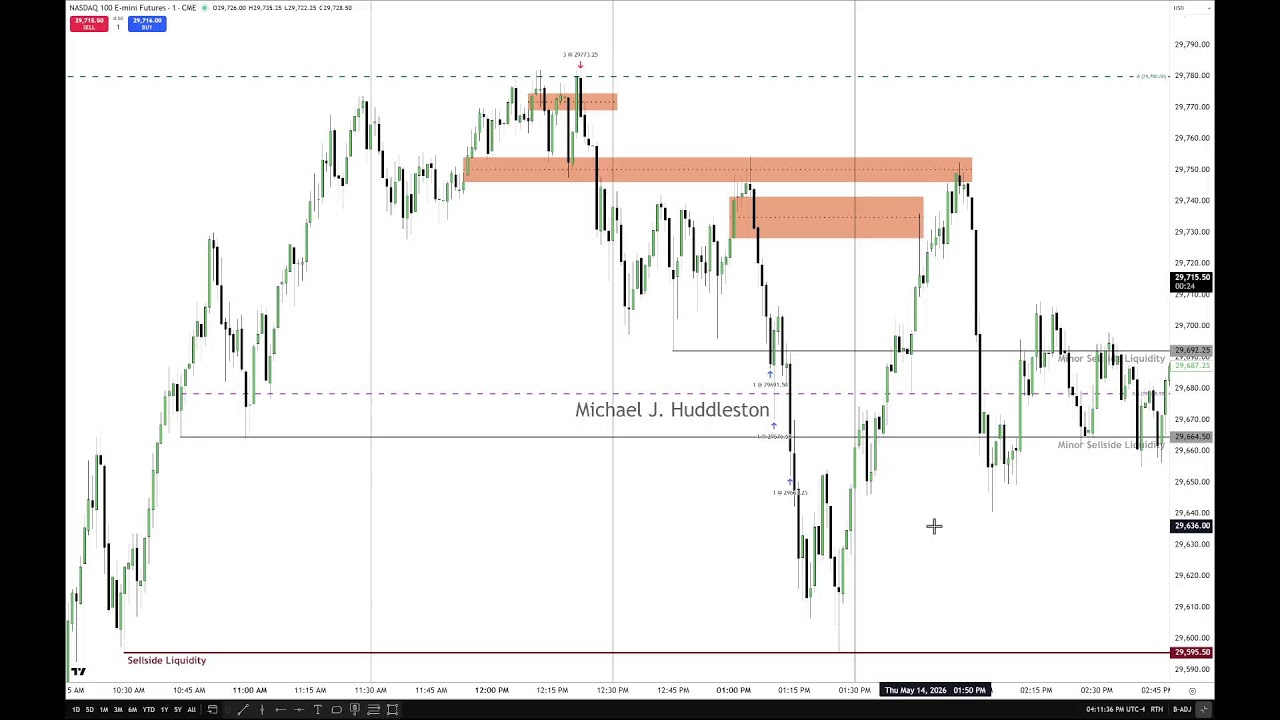
– Time comes before price. Anchor your charts to New York local time and use vertical time lines—time windows strongly govern predictable market behavior.
– Key times to watch:
– Market open / opening price at 9:30 ET (opening range gap).
– New York “lunch macro” 11:30–13:30 ET (optimal setups usually form in the first hour, 11:30–12:30).
– PM opening range around 13:30–14:00 ET (use this for the late session and evening sessions).
– Opening range gap: the gap between the prior close and the opening price is a useful reference. It often fills, acts as discount/premium arrays, and can become a trampoline for continuation in the direction of the higher timeframe.
– Combine time with price projections: measure the opening-range gap and use Fibonacci/standard-deviation multipliers (he refers to roughly 6.5–7.5 “SD” levels empirically) to project targets. Use these projections in the specific time windows (especially the lunch macro) for higher-probability signals.
– Liquidity mechanics: expect stop-hunts and liquidity runs (micro spikes that are later “redelivered”). Markets often move to clean out liquidity (everyone’s stop losses) before reversing.
– Trade selection & risk management:
– Be highly selective shorting at all-time highs; inexperienced traders should avoid aggressive shorts against a strong higher-timeframe trend.
– Use limit orders placed around known wicks/relative equal lows/highs for exits; take partial profits and be mindful of one-tick overruns.
– If market is sloppy or choppy, don’t trade—wait for clearer setups (e.g., next morning pre-market).
– Markets behave algorithmically and repeat patterns at specific times—studying the time+price relationships repeatedly builds the necessary edge.
– Practical advice: practice, study the time-based methods, and be patient—experience is required to execute these techniques reliably.
Bottom line: prioritize time structure (NY time windows), measure opening-range gap projections, expect liquidity grabs, manage risk carefully (especially when trading against the higher-timeframe trend), and practice consistently to internalize these repeatable patterns.
Leave a Reply