– Quick personal aside about his wife shopping, then a brief, family‑friendly market review.
– Recap of prior analysis (end of March YouTube/Twitter Spaces): he expected a drawdown to relative equal lows with a possible intraday reversal, warned about May volatility/new Fed chair, and described targets that could accelerate to the relative equal highs if certain levels cleared.
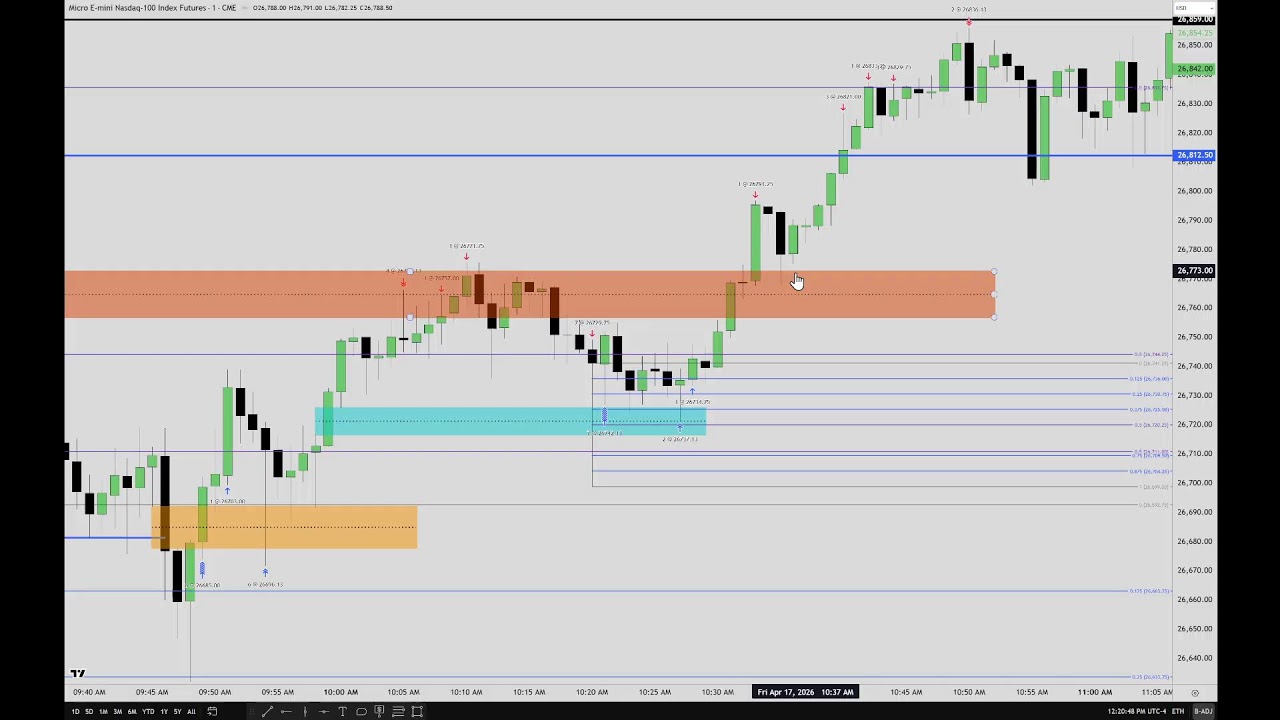
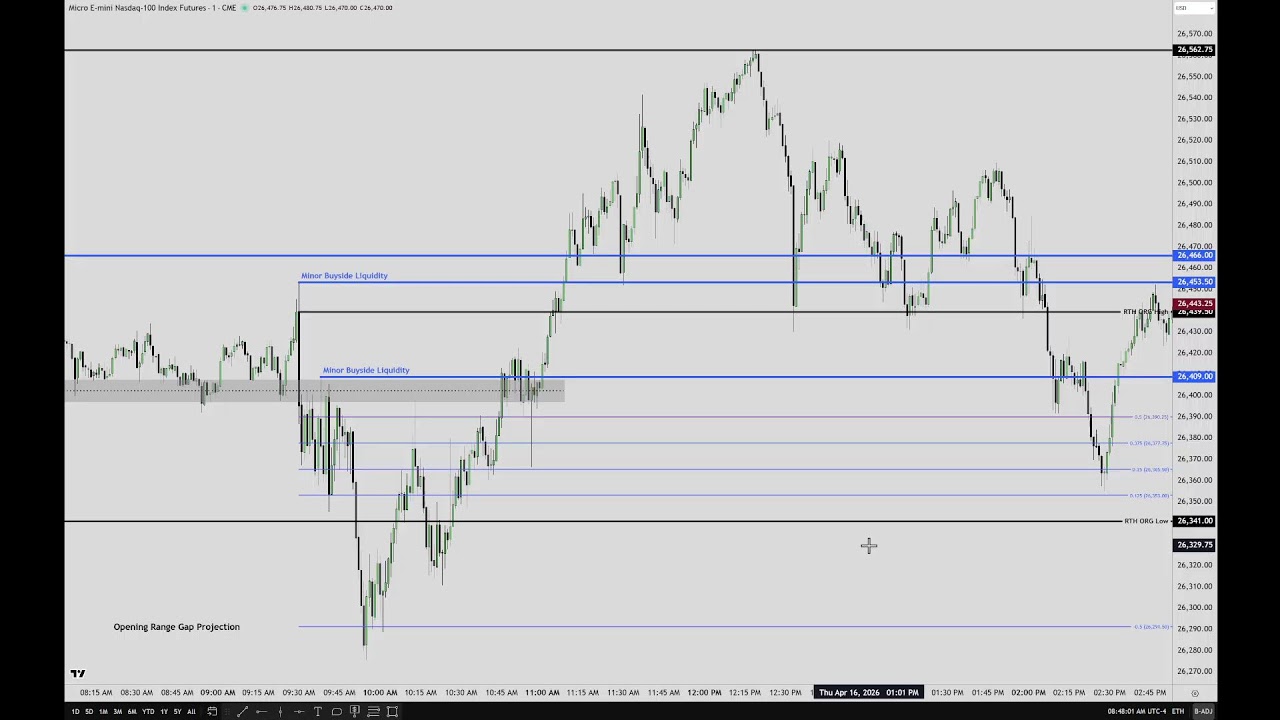
– On the micro NASDAQ intraday, he walked through specific levels: Thursday high (~26,563), all‑time/contract high (~26,859), and the midpoint “event horizon” (~26,711). He also highlighted the regular‑trading opening‑range midpoint (consequent encouragement) and an 8:23 electronic low as short‑term draw targets.
– Streaming issues forced him to call and timestamp trades on X (Twitter); he asks followers to link those tweets to TradingView to verify the real‑time calls.
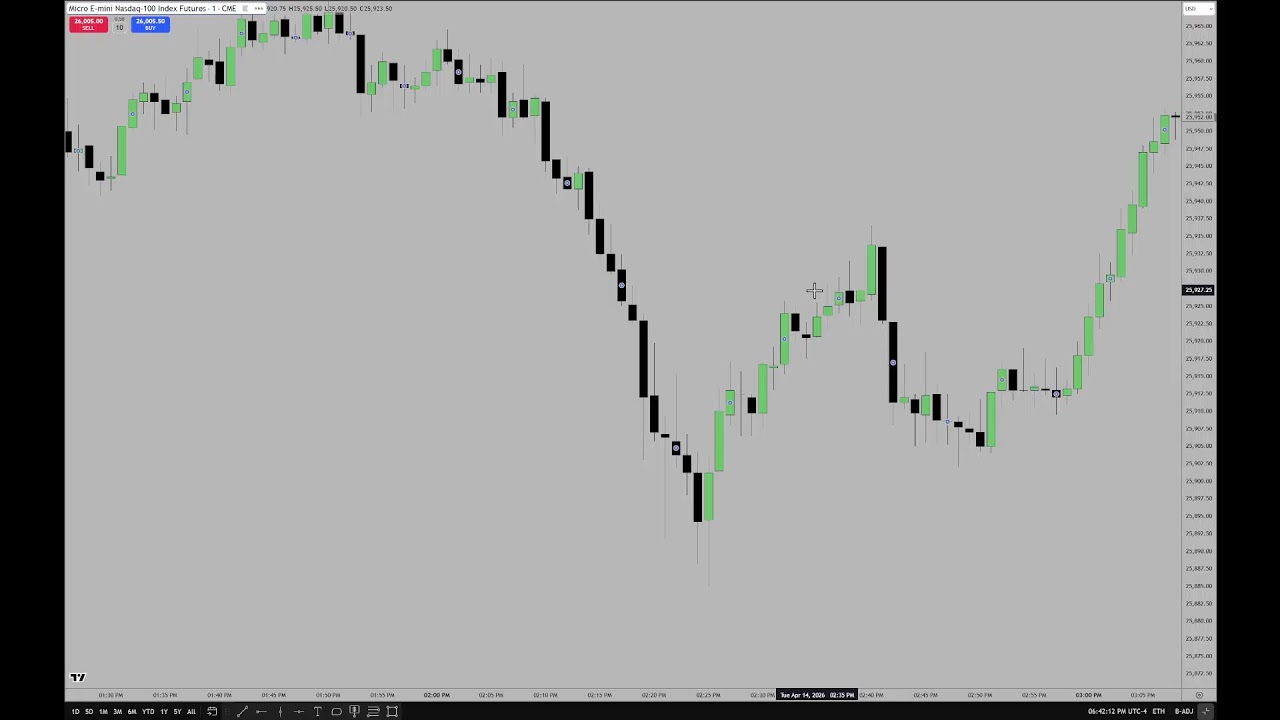
– Trade actions and rationale: he identified fair value gaps, order blocks, propulsion blocks and a “bolo” defensive PD Array, used these order‑flow visuals to go long in stages (multiple single‑contract adds), took partials at fair‑value gap extremes, raised stops, and was later stopped out by what he characterizes as a manual stop hunt (not algorithmic).
– Main claim: his technical framework (continuous contract, PD arrays, inversion fair value gaps, event horizon) produced accurate targets and worked this week; he defends his bullish positioning and rebuts critics who said he didn’t call it.
– Logistics and sign‑off: he’ll be off Monday for a long weekend, returns Tuesday, thanks his community, and signs off.
– Purpose: Quick market review before a live trading stream, focused on practical teaching for new traders (use Micro Nasdaq instead of minis to avoid excessive volatility and overleveraging).
– Market view and targets:
– Micro Nasdaq (MNQ) buy-side engaged; yesterday’s daily high was called live at 26,562.75 (claimed “to the tick”).
– Intraday objective ~26,711 (midpoint/event-horizon between liquidity pools); next larger target ~26,859.
– S&P (MES) smashed all-time highs; Nasdaq weightier but both strong.
– Dow target ~49,439 with potential acceleration intraday toward its all-time high.
– Technical approach and observations:
– Emphasis on price-action reads: opening price, high/low/close, fair-value gaps, opening-range gaps, “consequent encroachment,” discount/premium sensitivity, time-distortion accumulation, and using short timeframes (1-minute) for entries.
– He maps liquidity pools and uses an “event horizon” technique (0.5 midpoint) to project intraday targets.
– Warns Friday can produce odd behavior: moves during electronic hours might push through levels that close differently in regular hours.
– Commentary on market structure and credibility:
– Argues markets are algorithmically driven and “rigged” by market-making algorithms; claims dealers/algorithms drive price and hunt liquidity/stops.
– Defends his prior live calls and criticizes other commentators who deny algorithmic control or claim his results are cherry-picked.
– Practical notes: platform latency affected live order placement; he will call out entry/exit levels verbally when platform order entry is impractical.
Quiz
1. According to ICT, why was he looking at Micro Nasdaq instead of the mini contracts?
A. Because the micro contract has less volatility and is better for brand new students
B. Because the mini contract was unavailable that morning
C. Because the micro contract moves faster than the mini contract
D. Because he was only trading the Dow that day
Answer Key and Evidence
1. A
Evidence: “I’ve been focusing on teaching how brand new students should be watching price action… let’s be practical about this in the beginning… obviously I can trade minis, but for someone that’s brand new, it’s not advised because the volatility… Look at this. This is violent.”
– The session began with technical problems on YouTube but proceeded on other platforms; participants praised the livestream and mentorship value.
Michael (ICT) demonstrated a live stop hunt: he publicly posted his stop, it was run (alleged manual intervention), he was stopped out, then re-entered and the trade largely hit his target—used as proof of market manipulation and as a teaching moment. – Core concepts discussed and applied: fair value gaps (FVG), inversion FVGs, PD arrays, market-maker buy/sell models, opening/first-hour dealing ranges, session liquidity, internal vs external range liquidity, and multi-timeframe confluence.
Practical trading lessons emphasized: – Treat every executed trade (including stops) as information/intel to re-evaluate the plan. – In a bullish market, require additional confluence to take shorts—be more selective. – Reduce trade frequency, manage risk, avoid over-leveraging, and stop trading after reaching daily profit or loss limits. – Know exactly what you are looking for before entering (clear rules and criteria), and develop tape-reading skills through repetition. – Use session-specific timing (New York/London) and structured models rather than subjective forecasts.
Several students shared questions and experiences (entries, OTEs, impulsivity, time cycles); Michael and other experienced students provided guidance tailored to each. – Michael refuses to run a public signal service because widely-shared stops and setups would be targeted and exploited.
Macro/gap risk: Michael warned about weekend/black-swan events (geopolitical shock) creating large Sunday/Monday gaps—advised traders to expect the unexpected and cultivate indifference to outcomes. – Closing message: focus on disciplined, rule-based models, develop patience and emotional control, and treat trading as managing probabilities rather than seeking certainties.
Quiz
1. According to ICT, what should a trader do after being stopped out if the original market idea still appears valid?
A. Immediately double the position size
B. Sit on their hands and reassess the chart
C. Reverse the trade without checking price action
D. Stop trading for the rest of the month
2. What did ICT say is the best way to approach a bearish trade in the current bullish environment?
A. Use fewer confluences than usual
B. Ignore higher time frame context
C. Require more confluences and stronger alignment
D. Trade only based on one fair value gap
3. What did ICT say about making his stop loss public during the live stream?
A. It had no effect on price
B. It proved the market can run public stops and then continue in the intended direction
C. It caused price to stop trending entirely
D. It invalidated all of his market concepts
4. When price action is overlapping between the first 30-minute opening range and the first hour’s dealing range, what did ICT say should be prioritized?
A. The first 30 minutes and then the 10:00 silver bullet if needed
B. The last hour of the day
C. Only the wick of the 10:30 candle
D. The daily close only
5. What did ICT recommend for a trader who makes money but keeps giving it back due to overtrading?
A. Trade more often to stay sharp
B. Keep increasing risk to recover losses
C. Stop after the day’s profit target and turn the computer off
D. Ignore session timing and trade all day
Answer Key with Evidence
1. B
Evidence: “Every time you get stopped out, you have a moment to re-evaluate everything… Go right in the price action… If this was just a run on liquidity and I was part of that, would I take a trade based on this right now? Sure. Okay, I’m in again.” He also said, “sit on our hands” and “do nothing” when the trade is no longer valid.
2. C
Evidence: “Yes, I think it should be true for everyone… If you’re looking to short in this environment… you need an additional confluence to short right now. Even more. Even more than that.” He also said bearish trades require “several several things and multi-time frame.”
3. B
Evidence: “I gave the entire [__] world my stop loss… So what it did proved these Wall Street guys have no idea what the [__] they’re talking about because it happened live… As soon as the stop hit and closed the position out printed the screenshot right on my X.” He also said, “That was a manual intervention… Today illustrated that.”
4. A
Evidence: “The first order of business is the first 30 minutes. That’s the opening range… If the range is essentially the same… go back to what was presented in the first 30 minutes. If there’s a fair value gap in there, it’ll use that. If there isn’t… then go into 10:00, look for silver bullet.”
5. C
Evidence: “Don’t make another trade after you profit for the day. Turn your computers off. Do something else. Don’t trade on Fridays if you’re profitable.”
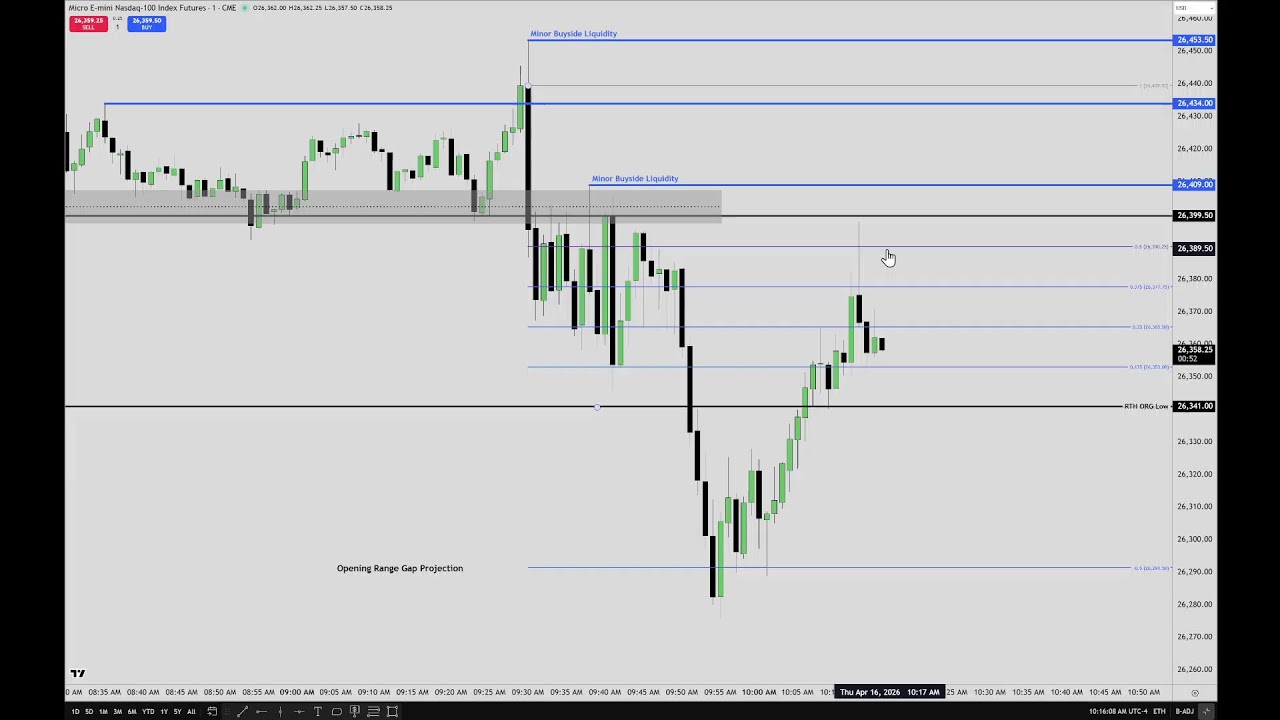
– Morning livestream focused on trading the opening-range gap and fair value gaps (FVGs). The market opened with a premium gap above the prior regular-hours settlement, giving a short/bearish bias for the first 30 minutes.
– Key tactical concepts: identify inversion FVGs, use the opening price (9:30) and the regular-hours settlement to mark the opening-range gap, watch for consequent encroachment (half-gap) — ~70% probability of a move to the half-gap — and use a negative 0.5 projection outside the gap as a target if price breaches it.
– Practical execution: stage levels before open, wait for the first presented FVG, use if-then rules, and treat the first 30 minutes as the most important timeframe for morning context.
– Coaching philosophy: new traders should do many executions for ~4–8 weeks to desensitize to outcomes, study winning vs losing setups to identify repeatable signatures, and avoid shortcut-seeking. With experience, a 1:1 risk:reward model can be profitable. – Live-demo issues: the presenter experienced significant TradingView lag and poor fills, which interfered with entries and management — a reminder to use reliable execution platforms. – Behavioral advice: make trading enjoyable, keep clear parameters, and focus on disciplined observation and repetition rather than chasing shortcuts.
Quiz
1. What did ICT say about the first 30 minutes of trading? A. It is not important compared with the lunch session B. It only matters when using a 5-minute opening range C. It is highly important and gives the rhyme and reason for the morning session D. It should be ignored until the afternoon session
Answer Key with Evidence
1. C Evidence: “That first 30 minutes is going to give you the rhyme and reason for the entire morning session” and “The first 30 minutes of trading, highly highly important. That’s the opening range.”
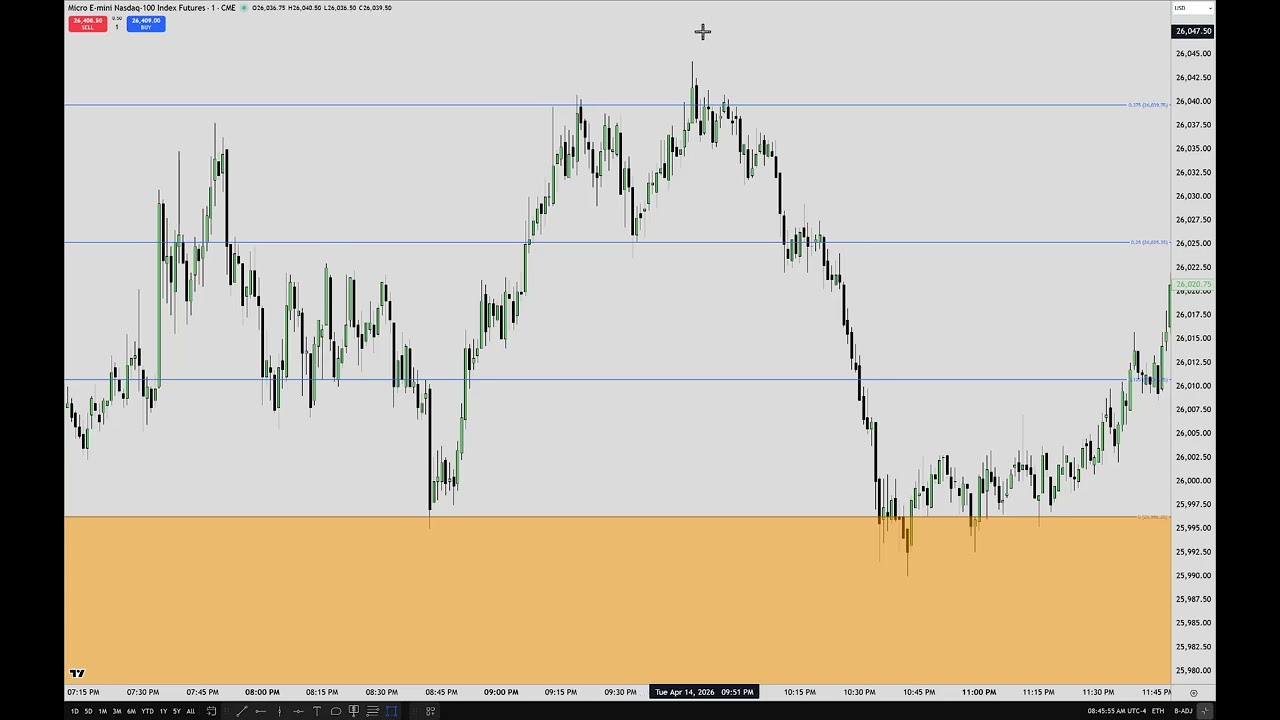
ICT reviews an Asian-session trade they shared on X, explaining the setup, execution, and rationale. Working off a macro window around 9:50–10:10 and using daily as their highest actionable timeframe, they identified a key wick/premium area and an inversion/fair-value gap (FVG) as a higher-timeframe turning point. Dropping to a 1-minute chart they hunted a Turtle-Soup–style entry into two stages of buy-side liquidity, then used a bearish FVG to short into deeper liquidity pools. They recorded the entire trade live (not market replay) and posted it for verification. They scaled out with partials near the swing low and closed the remainder near the targeted liquidity; price later reclaimed the lower FVG and rallied. Main lessons: treat wicks/gaps and FVGs as important levels, combine higher- and lower-timeframe context, and manage entries/exits into liquidity.
This is a trading-focused livestream Q&A with Michael (ICT) and community members. Key themes:
Teaching approach
– Michael aims lessons at novices (about a four-week practice baseline), intentionally simplifying entries so new traders can build a repeatable sample set before adding advanced tools.
– He balances demonstrating live execution with teaching fundamentals so students can study and later layer on higher-level concepts.
Core technical ideas explained
– Fair value gaps (FVGs), inversion FVGs, consequent encroachment (midpoint of prominent wicks), and the use of wicks as short-term resistance/support were discussed as decision points for bias and entries.
– Opening range gaps, standard‑deviation targets, graded consecutive imbalances, suspension blocks, and how to run/draw ranges across multiple consecutive FVGs were covered as practical frameworks.
– Time‑distortion (chop/noise) vs. consolidation/accumulation: resolve by moving up a timeframe; look for a clear structure (e.g., a prominent wick or imbalance) to indicate likely direction.
High-frequency / timing
– Michael described recurring market‑maker buy/sell models roughly every 15 minutes and said sub‑minute study is required to recognize and apply them; they’re present but require deliberate, live observation to learn.
Practice and execution advice
– No shortcuts: watch candles form live (market replay is insufficient), record sessions, and spend weeks collecting real examples.
– Manage emotions: step away or lock yourself out after emotional trades; do not chase revenge trades—better to walk away.
– Live streaming adds pressure and complexity; it’s okay to disengage when your focus or mindset is compromised.
Community, requests, and next steps
– Students (doctors, lawyers, engineers, young traders) praised the streams and urged deeper lessons on the “silver‑bullet” volume‑imbalance fractal; Michael offered to teach it if there’s demand.
– Several students shared progress (funded accounts, recovered drawdowns), reinforcing discipline and study as keys to improvement.
Quiz
1.What did ICT say new students should do for the first four weeks? A. Trade only the opening range gap B. Randomly take every fair value gap and short-term run on liquidity C. Only use Fibonacci retracements D. Focus only on weekly highs
2. According to ICT, how often does the market maker buy/sell model appear? A. Every hour B. Every 30 minutes C. Every 15 minutes D. Only at the open
3. How did ICT describe time distortion A. A strong trending market B. A type of news event C. Chop or noise, clarified by going up in time frame D. A gap that must always be filled immediately
4. What did ICT say about the best response when price action looks muddy inside the opening range A. Trade more aggressively B. Wait for a breakout candle C. Step back and avoid trading D. Buy the first wick low
Answer Key with Evidence
1. B — ICT said: “I’m not gonna do a four-week session of just going out here and just randomly taking every fair value gap and short-term run on liquidity. That’s what a brand-new student’s supposed to do.” Evidence: [00:01:30]–[00:02:00]
2. C — ICT said: “Because I told you it’s there… Every fifteen minutes, it’s going to be there.” Evidence:[00:06:00]–[00:06:30]
3. C — ICT said: “Time distortion is basically what everybody else is gonna call chop or noise.” Evidence: [00:47:33]–[00:48:00]
4. C — ICT said: “The easiest thing for you to do is take a step back and say, ‘I’m not touching it right now.’” Evidence: [01:00:00]–[01:00:30]
5. C — ICT said: “If you wanna compare and contrast notes with live trading, I’m all for it. But if you wanna make it a pissing contest and dick measuring contest, then we’ll go… I’m not hiding from anybody.” He also said drama marketing should go away. Evidence: [01:16:00]–[01:19:30]
– This was a live trading “drill” session meant as practice, not trade advice. The instructor repeatedly warns viewers not to copy these live examples with real money and to use demo/paper accounts for drills.
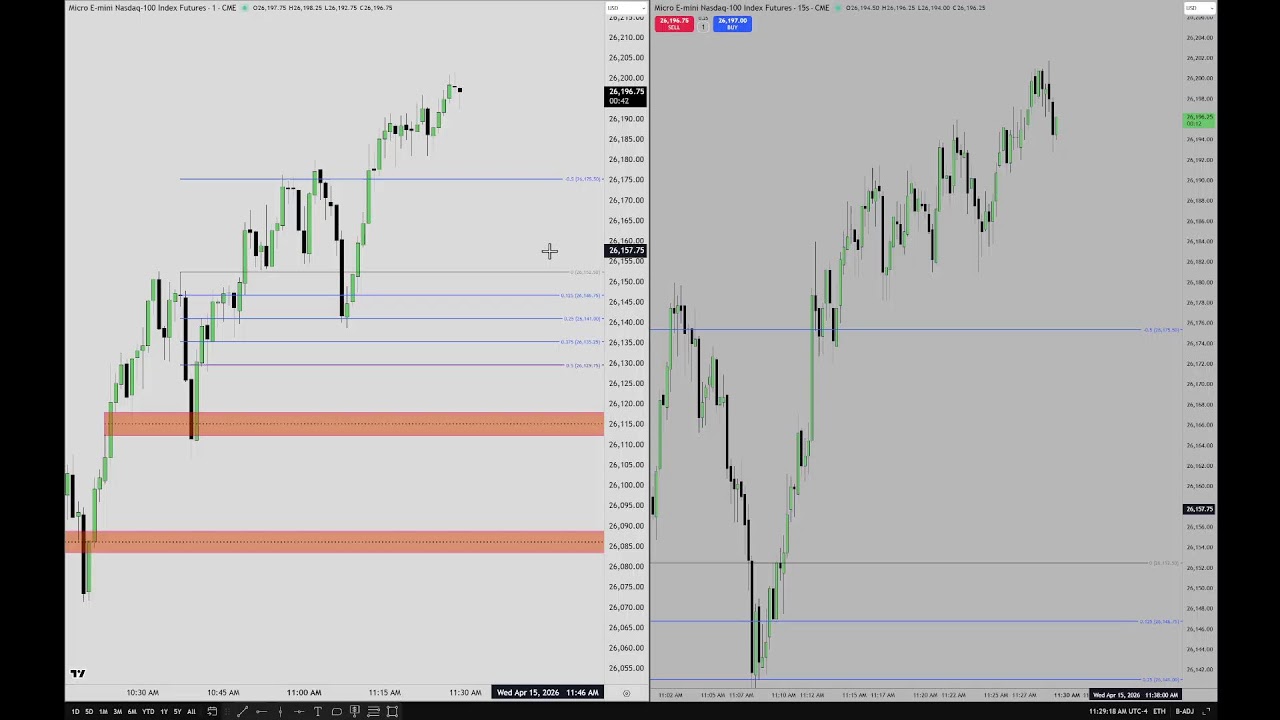
– Focus and method: working mainly on 1-minute charts with a sub‑1‑minute executable frame (15‑second) to practice entries into fair value gaps (today) and order blocks (upcoming). The aim is to learn how to spot small inefficiencies, liquidity pools, relative equal highs/lows, and consequent encroachment.
– Objective and trade sizing: treat drills like “leg day” — uncomfortable but necessary. Target small, low‑risk moves (roughly 10–15 handles), use a one‑for‑one model, place stops, and accept that outcomes don’t matter for the exercise.
– Mindset and psychology: primary goal is to desensitize to fear/need-to-be-right. Record emotional reactions, keep a journal, narrate and review your screens, and build repetition/experience rather than seeking instant profits or highlight trades.
– Market commentary: the session’s market was “sloppy,” choppy and fast, with decoupling between indices and occasional order-fill glitches on TradingView. Such hard conditions are exactly where practicing is most useful.
– Practical tips: do drills for short periods (15 minutes/day minimum), screenshot glitches/fills, record yourself narrating price action, focus on process not outcomes, and keep edge sharp by ongoing practice even after profitability.
– Final point: there are no shortcuts — consistent practice, honest journaling, and accepting short‑term failure are required to develop reliable trading skills.
Quiz
1. According to ICT, what should traders do when there is nothing on the chart to work with?
A. Enter anyway to stay active
B. Wait and do nothing
C. Increase position size
D. Trade the opening bell only
2. What did ICT say is the purpose of these drills?
A. To make money quickly
B. To build a highlight reel for social media
C. To practice participation in price action without fear or money pressure
D. To predict every market move correctly
3. What target range did ICT repeatedly say he was looking for in these drills?
A. 1 to 3 handles
B. 5 to 8 handles
C. 10 to 15 handles
D. 25 to 30 handles
4. What did ICT say about using live trading accounts for these drill examples?
A. They are meant to be copied directly into funded accounts
B. They should only be used on futures contracts
C. They are not trade entries to copy into live or funded accounts
D. They only work during the London session
5. What market condition did ICT say would make him reluctant to participate?
A. Clean price action with open traffic
B. Fast, loose, low resistance liquidity run conditions
C. Messy, choppy, range-bound price action with shared candle ranges
D. A market with large clean imbalances and expansion
Answer Key with Evidence
1. B. Wait and do nothing
Evidence: “So if you have nothing to work on, you sit still.” He also said, “If there’s nothing in the chart, don’t force it.”
2. C. To practice participation in price action without fear or money pressure
Evidence: “You’re just simply looking for something to engage with to get accustomed to the watching price action… You got to get that baseline foundation of experience. And don’t be afraid.” Also: “Drills are simply looking for small little participations in price action with no monetary hope of making money and no fear of losing.”
3. C. 10 to 15 handles
Evidence: “think about how, say for instance, 10 to 15 handles. Okay? So, that’s a really good small low-hanging fruit objective to look for”
4. C. They are not trade entries to copy into live or funded accounts
Evidence: “please don’t take these as trade entries for you to put on your funded accounts. Do not try to copy them for your live account trading. If you’re here to do that, I promise you I’m going to hurt you.”
5. C. Messy, choppy, range-bound price action with shared candle ranges
Evidence: “when the candlesticks are all parked next to each other it’s like you trying to go northbound or southbound on interstates. And it’s frustrating.” Also: “When it’s like that… you’re more prone to see a lot of continued consolidations.” He described it as “high resistance liquidity run conditions” and “very messy.”
Summary — Trader Roundup live stream (participants: Kitt, ICT/Michael, students)
– Purpose/context: Community recap of Michael’s live-stream tape‑reading drills and Q&A. Hosts emphasized the “lab/college” mindset — short, repeated practice to build real experience and desensitize emotion.
– Daily drill recommendation: Use the 1‑minute timeframe for short drills (15 minutes/day), aim for small moves (10–15 handles) to learn price signatures without large P&L consequences. Record charts/audio, log time in trade, drawdown, emotions, and lessons.
– Core trading foundations: Focus on the four elements of a trade setup (money management, entry trigger, draw/target, and context). Month 1–2 core content is essential; month 4/5+ adds advanced precision but isn’t strictly required to be profitable.
– Timeframes and distortion: If 1‑minute looks “fuzzy,” back out to higher timeframes (5/10/15 min or 15‑sec when needed) to remove time distortion and clarify bias. Stack timeframes fractally.
– Market‑maker models / orderflow: Demonstrated market‑maker buy/sell models across 15‑minute intervals (including 15‑second reads). Key concepts: liquidity runs, inefficiencies, fair value gaps, order blocks, volume imbalances, relative equal highs/lows, WIC/WIX signatures, range projections and “six sister” market correlations (MES, MNQ, NQ).
– Specific tactics taught: look for rangers/liquidity inefficiencies on micro timeframes; use inversion/reclaim, opening range gap and midpoint logic, quadrant/sixteenth grading of ranges, and recognize turtle‑soup false‑breakout setups. Grade ranges/gaps — importance if anchored to gradient levels.
– Session/time‑based ranges: Always use the first 30 minutes (opening) as baseline; the first‑hour dealing range is useful while price remains near it and for intraday projections (including Asian, lunch, PM windows). Lunch/macro times often feature time distortion and retracements that can set up continuation or reversal.
– Instruments: Use whichever contract (mini/micro/futures) shows the actionable signature; CFDs can mirror futures’ candles but may differ in price — translate logic by candlestick structure.
– Journaling & pattern recognition: Take screenshots and notes; repeated review reveals time‑scheduled spooling (e.g., macro times like 9:50–10:10, lunchtime, PM session). Experience and disciplined recordkeeping are central to developing a reliable model.
– Macro perspective: Michael and community discussed liquidity/QE and money printing driving asset inflation; warnings about broader economic risk (inflation, supply issues) and implications for markets.
– Community & next steps: Mentorship content being refined; participants encouraged to revisit core content, practice daily in the “lab,” and build models incrementally.
Quiz
1. What did ICT say should be the focus when looking at the market on a very short timeframe during drills?
A. Predicting earnings reports
B. Looking for sub-one-minute low-hanging fruit like 10 to 15 handles, ranges, liquidity, and inefficiencies
C. Trading only the daily chart
D. Avoiding all chart analysis until the close
2. What did ICT say about the first 30 minutes of the trading day? A. It should never be used for analysis B. It is always a given and should always be used C. It is only useful after noon D. It matters only on consolidation days
3. When describing time distortion, what did ICT recommend doing if a lower timeframe chart looks fuzzy or unclear? A. Trade more aggressively B. Delete the chart and start over C. Go up in timeframes to remove the distortion and bring price back into focus D. Ignore price action and wait for the weekly close
Answer Key with Evidence:
1. B — Evidence: ICT said they were “just looking for inefficiencies to act on liquidity” and earlier the discussion highlighted “10 to 15 handles” and “sub one minute low hanging fruit.” [00:22:07-00:22:10], [00:02:30-00:03:00]
2. B — Evidence: “Well, every day you use the first 30 minutes. That’s always, always a given. That’s gonna happen all the time.” [00:39:14-00:39:30]
3. C — Evidence: “If you go up to a 10 minute… you’ll see that it’s absolutely 100% crystal clear… you wanna back it out.” Also: “go up in timeframes and it’ll remove it.” [00:26:26-00:26:30], [00:28:00-00:28:28]
Here’s a concise summary of the livestream content and main takeaways:
– Purpose: The session is a practice/drill demonstration—not trade advice. The instructor emphasizes using drills to build experience, desensitize to fear, and learn entry mechanics (like leg day in training).
– Timeframes & tools: Focus on the 1-minute chart with sub‑minute execution (15‑second) to practice entries, fair value gaps (today’s topic), and order blocks (scheduled for tomorrow).
– Approach to trades: Use paper/demo accounts only—do not copy live. Target small, repeatable objectives (roughly 10–15 handles) and use a simple 1:1 risk/reward stop model for drills.
– What to practice: Enter small, well-defined liquidity pools (gaps, imbalances, relative equal highs/lows, consequent encroachment/inversion fair value gaps), place stops, record outcome and emotions, then repeat.
– Mindset & risk management: Train indifference to outcomes—focus on repetition, not being right or making money. Journaling and recording trade narration help expose emotional issues and accelerate learning.
– Market commentary: Today’s market was messy—high resistance, choppy, decoupled between indices (MNQ vs. ES). Such conditions are hard but valuable for practice because they reveal problematic price signatures.
– Meta-advice: Real skill requires hands-on repetition; there are no shortcuts or paid fixes that reliably replace deliberate practice. Even profitable traders continue to practice off-account to retain edge.
– Logistics: Disclaimer—this is educational; trading with real money is separate. The instructor plans more drill sessions and a review later.
Bottom line: Use controlled, repeatable demo drills on short timeframes to build real-world experience, manage emotions, and develop pattern recognition before risking live capital.
Quiz
1. What was ICT’s main purpose for the session?
A. To provide live trade signals for funded accounts
B. To demonstrate drill practice in difficult market conditions
C. To predict the exact daily high and low
D. To teach only order blocks
2. What did ICT say you should do if there is nothing in the chart to work with?
A. Enter anyway to stay active
B. Wait for the market to move first
C. Sit still and do not force a trade
D. Switch to a higher time frame and trade immediately
3. What was ICT’s suggested target range for these drill trades?
A. 1 to 3 handles
B. 5 to 7 handles
C. 10 to 15 handles
D. 25 to 30 handles
4. What did ICT say about the mindset needed during these drill sessions? A. Focus on being right and making money B. Avoid all losses by only trading perfect setups C. Be indifferent to the outcome and use the session for experience D. Trade only when social media can verify the setup
Answer Key with Evidence:
1. B
Evidence: “I want you to think about how say for instance 10 to 15 handles… that’s a really good small lowhanging fruit objective… today we’re going to work with fair value gaps… please don’t take these as trade entries for you to put on your funded accounts… we’re going to look at how you can go in on a day-by-day basis… these types of little drills, little exercises”
No timestamp available.
2. C
Evidence: “So far, no gaps to work with. So, if you have nothing to work on, you sit still. This is all part of it, knowing what you’re looking for. If there’s nothing in the chart, don’t force it.”
No timestamp available.
3. C
Evidence: “I want you to think about how say for instance 10 to 15 handles. Okay? So that’s a really good small lowhanging fruit objective to look for…”
No timestamp available.
4. C Evidence: “It’s not about being right or wrong… You don’t care about being right… the outcome is not imperative. It’s not important. You don’t need it to be right. You don’t care.” No timestamp available.
– Market context: the market found support after dipping into the lower 30% of last week’s range and rallied strongly. The broader bias remains bullish with upside targets on the continuous contract near ~26,399.5, 26,562.75 and the all‑time adjusted high ~26,859.
– Key intraday concept: the “lunch macro” is a common intraday retracement that can begin as early as 10:30 (effectively the first-hour/first dealing‑range completion after the 9:30 open) and often pulls price back into the range established since the open.
– Trade framework: watch for higher highs into the macro window, then look to sell into buy‑side imbalances/sell‑side inefficiencies, inversion fair value gaps and bearish order blocks formed just before those highs. Target external range liquidity and wick midpoints as exits.
– Execution notes: prefer obvious, visually clear fair value gaps/imbalances (don’t force ambiguous setups). Use market orders for entry, pyramid into positions, and exit at defined liquidity points; the author shared a live short that hit targets and exemplified these rules.
– Teaching points: this is a repeatable, rule‑based approach (not the Turtle Soup method despite historical references). The author apologizes for a missed recording, praises student application, and will provide further live analysis tomorrow morning.
Quiz
1. What time window does ICT say the lunch macro can begin as early as? A. 9:30 Eastern B. 10:30 Eastern C. 11:30 Eastern D. 1:30 Eastern
2. According to ICT, what is the default direction of the lunch macro in a bullish market? A. It runs to the upside B. It stays flat until closing C. It runs to sellside / lower prices D. It reverses only after 1:30
—
Answer Key with Evidence
1.B. 10:30 Eastern Evidence: “the lunch macro can occur slightly earlier… it can begin around the 10:30 hour.”
2. C. It runs to sellside / lower prices Evidence: “So, that’s the target. So, that’s the that was my maximum objective for the macro… I was looking to go short there.” Also: “What’s the macro? The lunch macro. It’s a retracement inside of the range from 9:30… It can aim for this low.”