
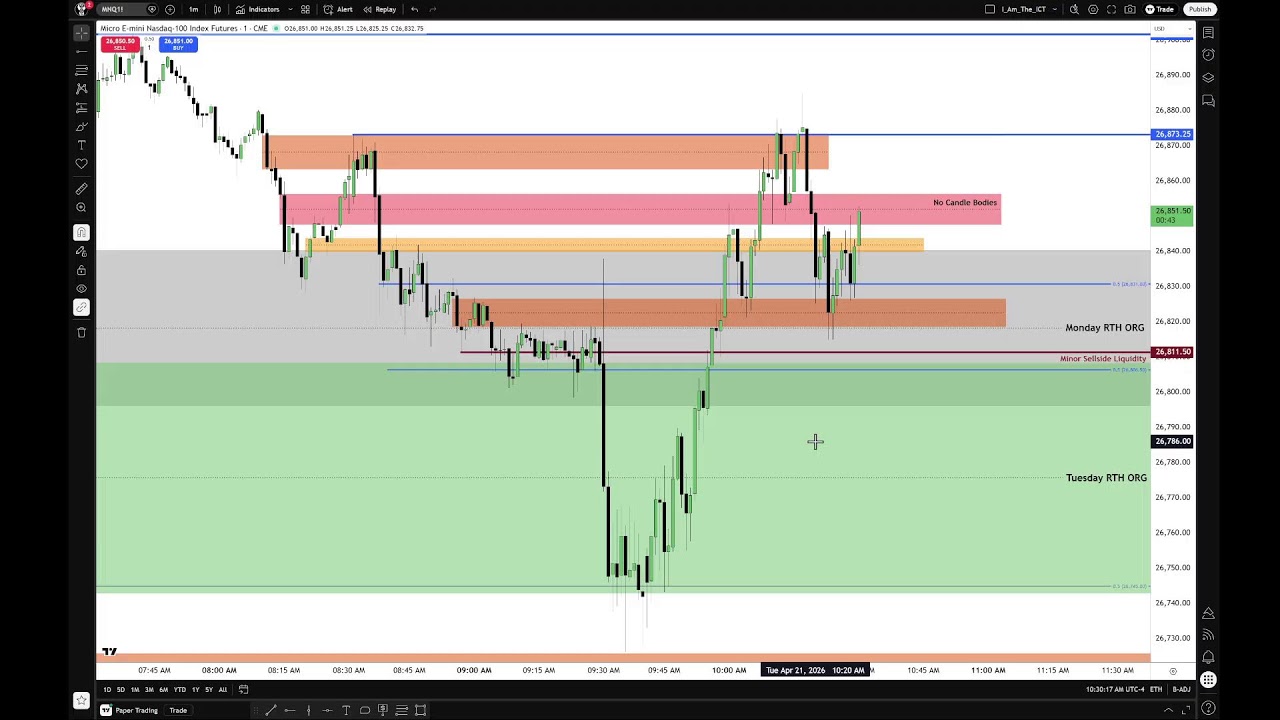
Summary:
– Market context: Fed Chair testimony at 10:00 (and headlines) creates low-probability conditions for precise intraday trading. The speaker is watching MNQ (micro E-mini Nasdaq) after a 9:30 open that ran up then dropped.
– Key technical focus: watching fair value gaps (FVGs), especially an inversion FVG and Monday’s regular trading hours (RTH) settlement/opening-range gap low (previous day 4:14 pm ET). Preference is for lower prices (short bias) with a target area near 26,695, but he acknowledges the Fed could push price higher and he won’t force participation.
– Execution notes: he was building a short between two FVGs and adding as price validated “premium sensitivity” (bodies concentrated in the lower half of a gap). He emphasizes bodies (real liquidity) over wicks, first-utilization validation of FVGs, and how inversion vs. bearish FVGs function.
– Practical rules taught:
– Use FVGs that show clear first-utilization (they prove themselves).
– If a gap acts as bearish on first use, trading above it can turn it into an inversion FVG (and vice versa).
– Order-block entry rule (candlestick selection): if the last candle in a series is the largest (or the smallest) use its open; if candles are uniform use the first (lowest) candle’s open.
– Risk/discipline points: he trades in a demo account to avoid offering regulated trade advice (not a licensed advisor), and to protect both him and viewers. He warns against copying posted levels as trade signals; instead build and test your own price-action model, and only trade when the market gives context.
– Teaching/operational notes: livestream and posting problems this morning; intends to work on entries in future lessons; time will be more limited due to family/grandparent responsibilities.
– Final advice: today is a study day—observe price action, journal objectively, don’t let social media/critics dictate trades, and only engage when your model and price action align.
Leave a Reply