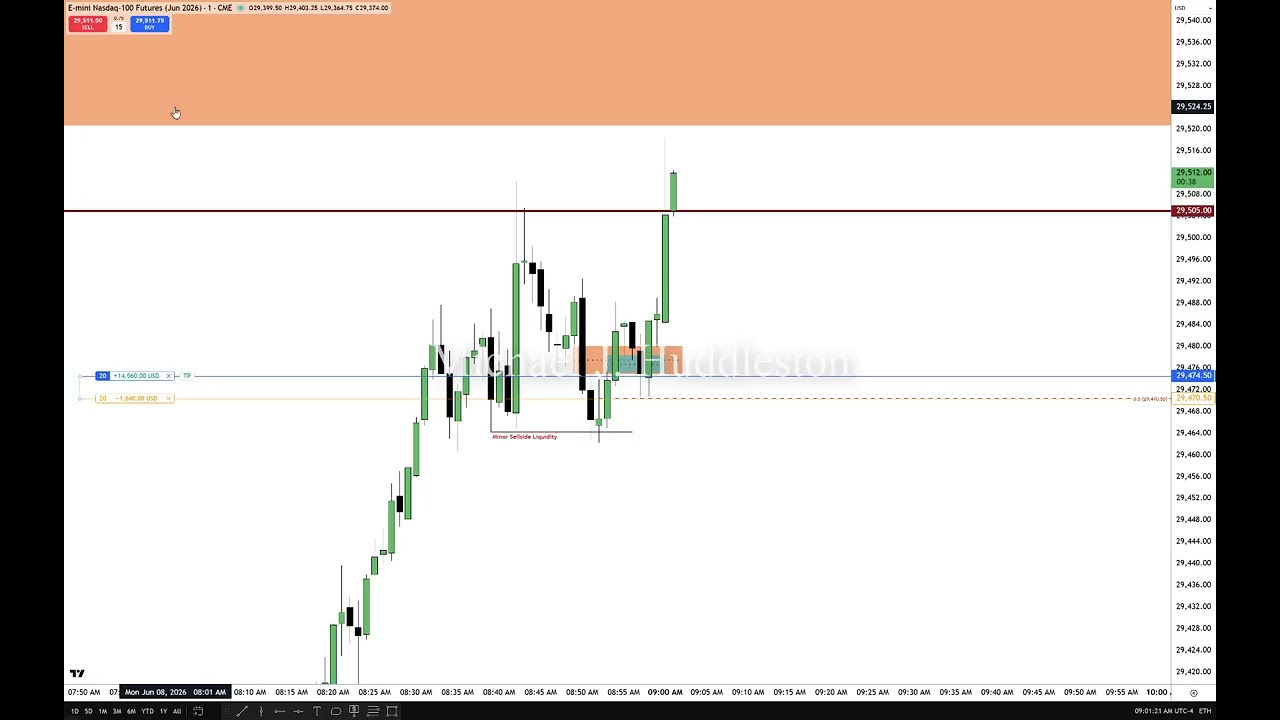
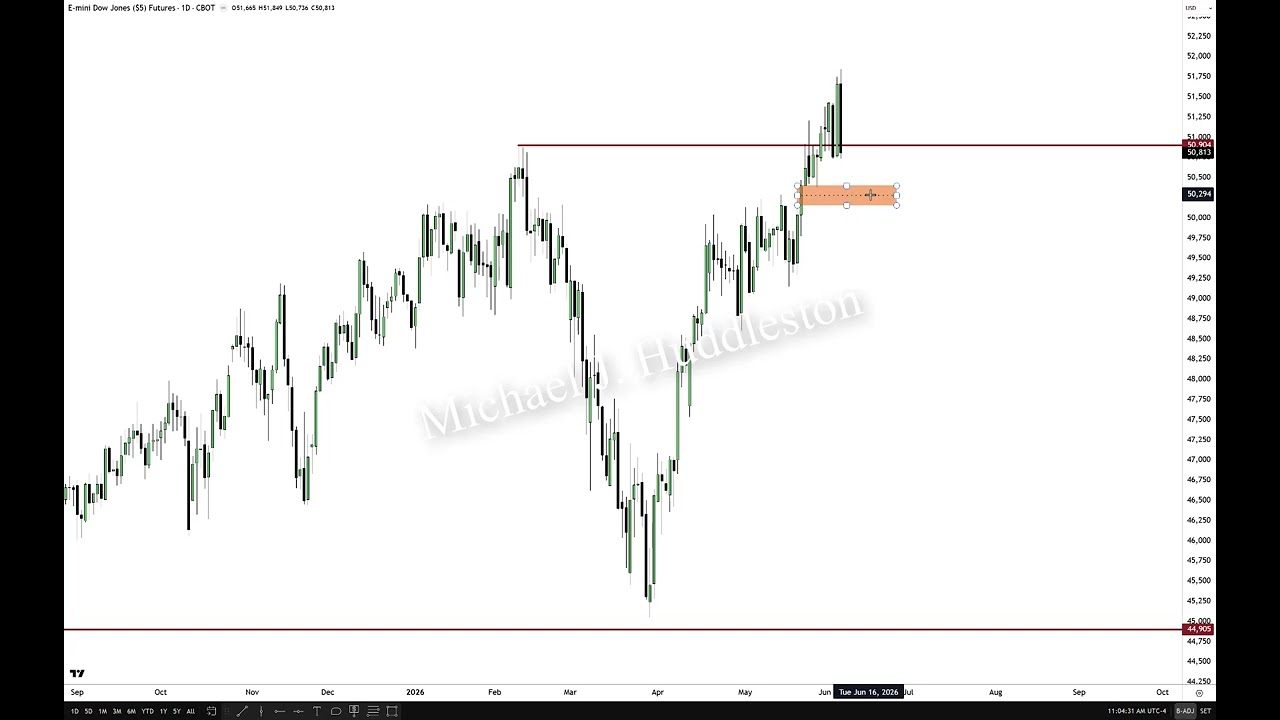
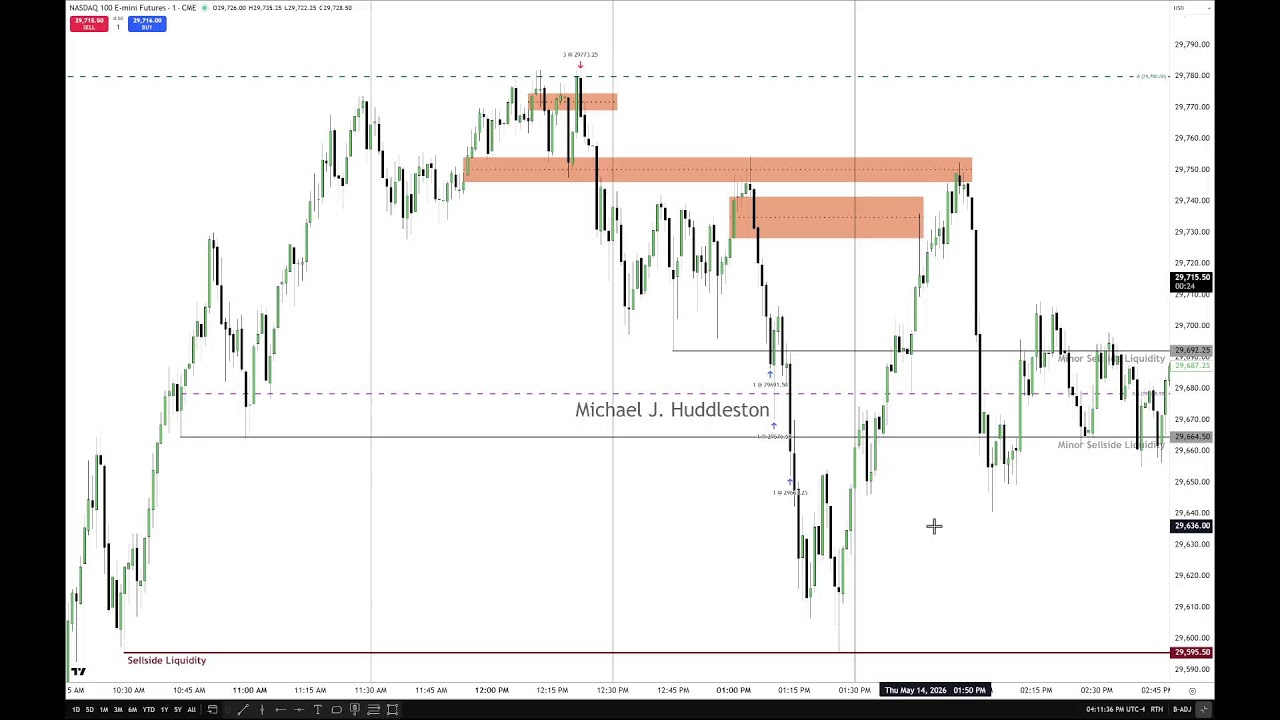
– Pre-market the trader expected a retrace into a daily volume imbalance and aimed for price to run up into the lower portion of that zone (orange box) before any meaningful short.
– Key structural cues: bullish inversion fair value gap(s), a bullish fair value gap, and a wick acting as a price boundary/inefficiency target.
– Plan: wait for a run-up to clear a specific high and trade into the orange area, then take action; layered entries/limits were used.
– Execution and management: sold partials (e.g., 15 contracts, left 5 as runners out of a 20-lot), staggered limit orders, and moved stops up to the low of the daily volume imbalance to lock profits.
– Outcome: received partial fills, peeled profits near the 555–560 vicinity, and was satisfied with the result.
– Teaching point: the trader favors a simple, visual OHLC-based model (high-probability market structure) over order-level data or complex indicators.
– Overall tone: cautious — expect volatile, potentially lower markets in the weeks ahead; watch key liquidity levels and “fair value gap” structures for trade cues.
– US dollar: looks poised to run higher (liquidity grabs and imbalance used), which would pressure EUR/USD and GBP/USD lower.
– EUR/USD & GBP/USD: both show prior buy-side clears and now look set to make new lows as inversion/fair-value gaps and sell-side liquidity are targeted.
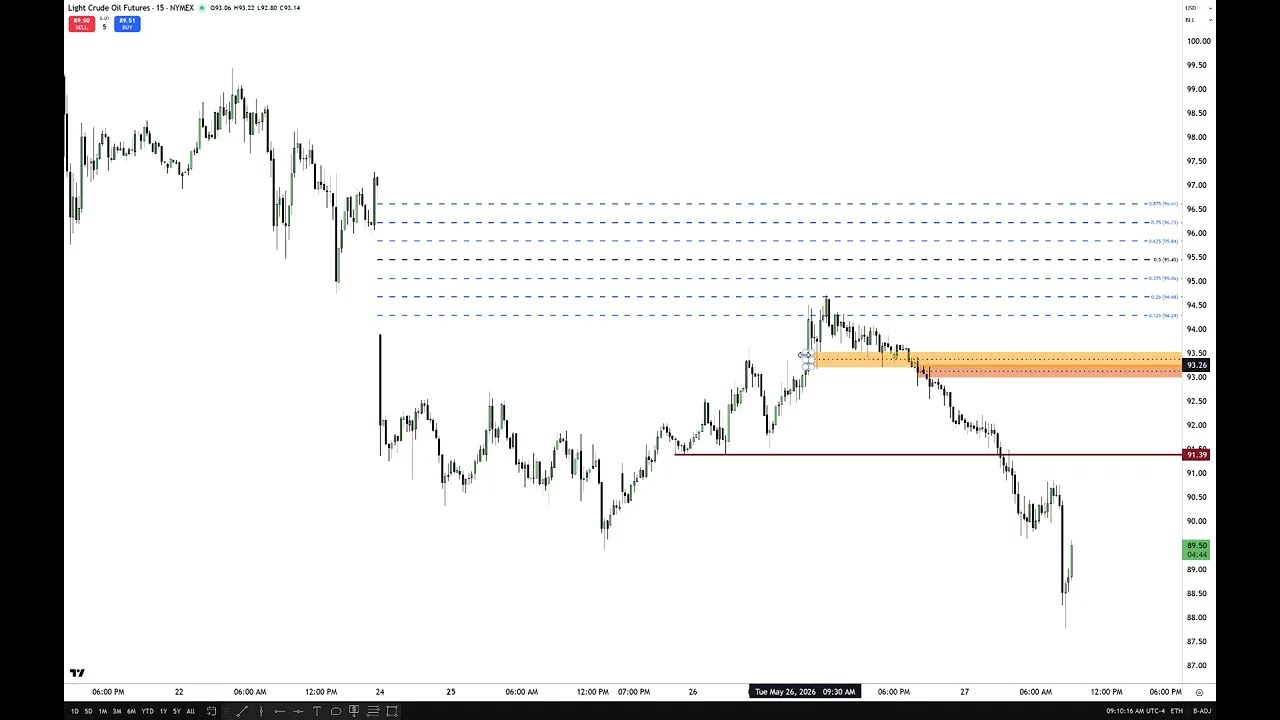
– Crude oil: event-driven and volatile — author advises staying out unless you accept big risk; possible upside from geopolitical dynamics but uncertain.
– Gold & silver: both appearing vulnerable. Gold could drop further if it closes below a key wick midpoint; silver has downside objectives (~$58, and pressure toward <$50 if momentum accelerates).
– US indices (Dow, ES, NQ): signs of capitulation and distribution; a small group of stocks has driven the apparent market strength. Expect possible retraces into identified imbalances followed by further weakness rather than a clean bullish continuation.
– Broader view: skeptical of bullish narrative and media; warns about concentrated financial power (private equity, bailouts) and potential pressures on retail savings/401(k)s.
– Logistics: author experienced posting issues on social platforms, will try to share updates and a study by 5:00, and expects to be active early in the week.
– Main point: With experience you can trade both longs and shorts — don’t be one‑minded in a market that moves both ways. Avoid shortcut mentors; learning price context takes time.
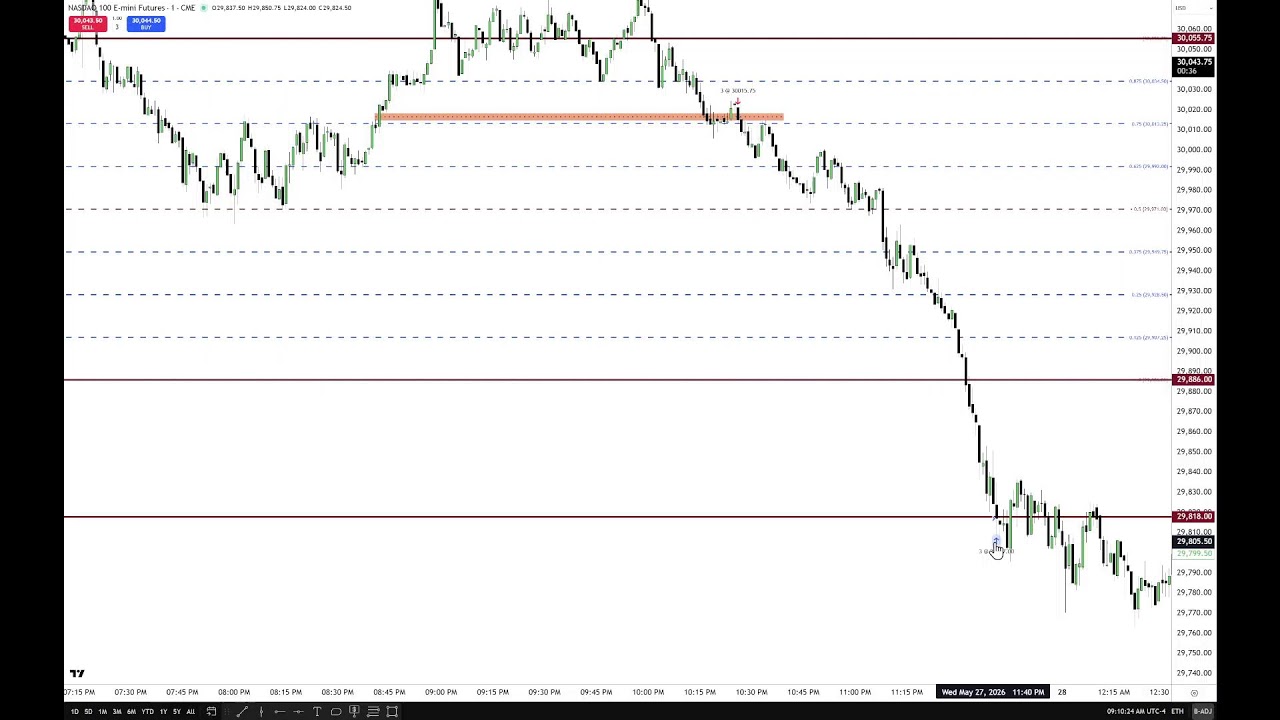
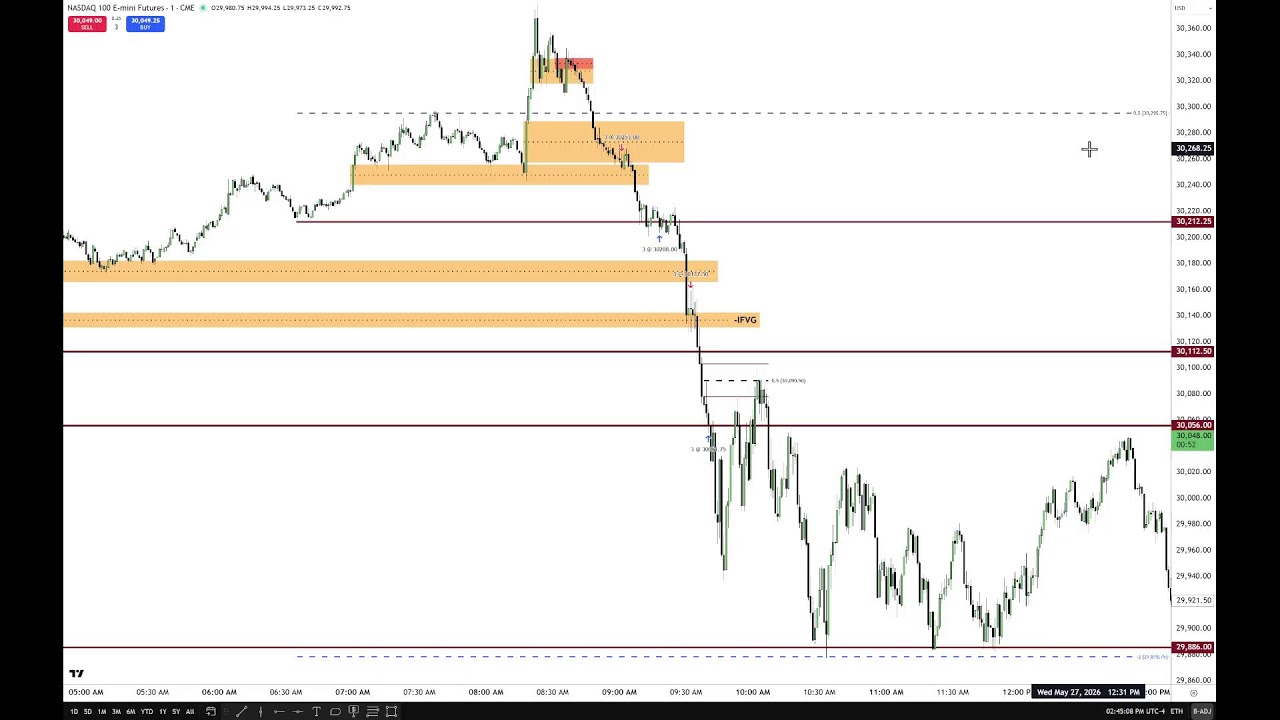
– Technical setup (Nasdaq NQ): NQ made a higher high while ES (S&P) didn’t — an SMT (inter‑market) divergence that set up a bearish narrative. A sell‑side imbalance / buy‑side inefficiency produced a displacement down through a swing low.
– Fair value gap usage: The presenter distinguishes a “first‑presented fair value gap” vs. an inversion FVG. The short entry was taken on the consequent encroachment of an inversion/first‑presented FVG; the initial drawdown was ~11 handles before the sell‑off resumed.
– Trade execution/management: The speaker exited into a fill near a target (June 1 daily high / relative equal lows). He noted a missed opportunity to scale/partial manage (take partials, add back) but prefers disciplined, non‑overtrading behavior.
– Intraday timing: The setup formed in the morning and delivered into the lunch macro window (approx. 11:30–13:30), hitting targets quickly in this instance.
– ES vs NQ dynamics: ES showed heavy distribution and lower highs while NQ showed higher highs (creating the divergence and confirming the bearish edge).
– Bitcoin: Bearish outlook on daily chart with multiple lower targets (mentions ~$24k area). Not investment advice.
– Tone/advice: Emphasizes practicing the method properly, understanding context and narrative, and not rushing or relying solely on quick, superficial mentors.
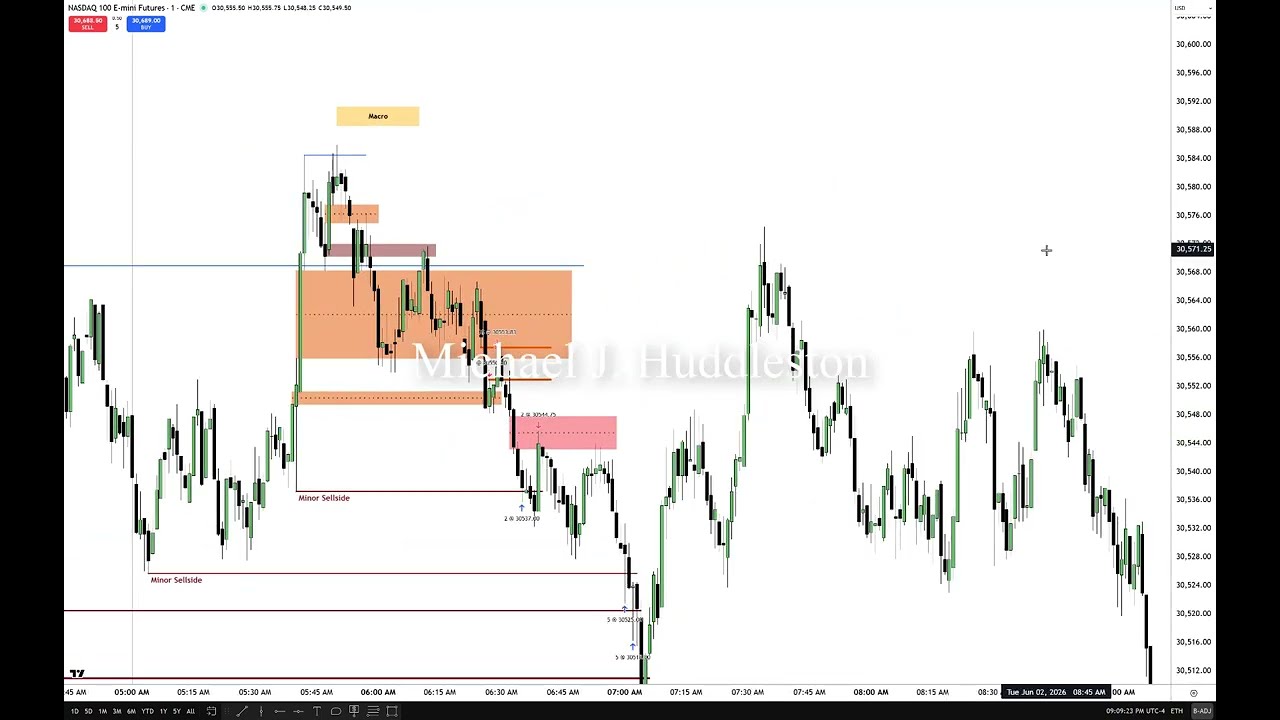
Micheal reviews a morning NQ trade executed from a phone, explaining the technical framework that guided entries and exits.
Key observations: relative equal highs formed during the London session and relative equal lows later; the trader prefers to start watching for higher-probability moves at 6:00 a.m. into the 7–9 a.m. pre-session. The trade used smart‑money concepts: buy- and sell-side liquidity, accumulation/distribution structure, breaker patterns, volume imbalances, and an inversion fair value gap (important: inversion gaps require a candlestick close to be validated, unlike order blocks).
Execution: a small initial two-contract long was entered anticipating a re-test of the inversion FVG, added into a bounce/encroachment, then flipped/added and scaled out as price breached minor sell-side levels and cleared the relative equal lows. The plan targeted a terminus objective and captured a significant down leg; partial profits were taken along the way. Final notes: watch relative equal highs/lows as liquidity magnets, avoid picking tops, and be patient—the “early bird” window around 6 a.m. is often where reliable runs begin.
Michael gives a pre-market review of the Nasdaq futures (NQ), recapping yesterday’s livestream and outlining a short bias based on liquidity structure and price/time alignment.
Key points:
– He graded two pools of liquidity anchored to specific lows and drew an equilibrium line; anything above that premium side was a candidate to short aiming to push below those lows.
– Yesterday’s market showed a rapid “blowoff” drop, a deferred delivery back into the range, then a selloff that ultimately hit the targeted area (just below his graded level).
– He emphasizes looking for algorithmic behavior tied to specific price/time windows (notably ~9:50–10:10), stop hunts, and precise price anchors rather than vague indicators.
– A preferred setup was a candlestick overlapping a gradient level forming an inversion/fair-value-gap (an ICT-style validation) used to enter shorts; the execution produced the expected speed and distance.
– Quick ES (S&P) note: price action there displayed clean imbalances and efficient runs—ideal low-resistance liquidity conditions—whereas congested, candle-stacking markets are less desirable.
– Practical advice: establish a premise, grade ranges by time and price, watch for inefficiencies/imbalances, manage risk (take profits or reduce size if the market becomes choppy), and let price/time align before committing.
He closes saying he’ll provide a forex/dollar update after the futures session.
– Focus: Review of the NASDAQ/ES daily charts and a live intraday example showing how the speaker reads price action to identify short opportunities even inside a primary bull market. – Instruments & accounts: Recommends micro contracts for small or inexperienced accounts (and for prop-firm trading) to reduce risk and size.
– Market context: Predicted a post‑May rally after taking out relative highs, then identified a specific daily volume‑imbalance area that would act as a magnet for price and a likely place for a short‑term reversal.
– Key technical concepts taught: read the open/high/low/close, spot volume imbalances, fair‑value gaps (and inversion FVGs), “consequent encroachment” and inefficiencies after blowoff runs, and use measured moves/standard‑deviation projections to set targets.
– Trade rules and mindset: prefer short setups that show quick, one‑direction fills of inefficiencies; use fulcrum/measure moves and -2 SD projections for precision; accept being stopped if overleveraged is avoided; novices (<~1–2 years) should favor longs in a bull market.
– Execution example: identified an intraday fair‑value gap and volume imbalance, entered a short around the open with a built‑in buffer, saw a clean drop to the target but missed some of the larger move—used the experience as intel.
– Warnings and advice: don’t rely on “gimmicks” or paid holy‑grail claims; develop price‑reading language/discipline; keep capital and living expenses in reserve (two years, ~$100k suggested) before trading full‑time.
– Operational note: will reduce public real‑time detail in future live trading to avoid influencing other traders’ orders; continues to teach concepts and critique poor mentorships.
Main takeaway: focus on clean price‑action reading (open/high/low/close, volume imbalances, fair‑value gaps), manage risk and position size, gain experience before aggressively shorting into a bull market, and use measured projections to plan entries and targets.
– Market backdrop: Prices are largely driven by geopolitical news (U.S./Israel/Iran) — stay cautious and avoid chasing volatile instruments. – Recent price action: After a gap down, the author expected further weakness and described a quick, profitable short based on 15‑minute and 1‑minute patterns (relative equal lows, an inversion/fill of a volume/price imbalance). Stop was placed above the swing high. – Dollar/FX: The dollar (DXY) is stuck in a range, so USD-based major forex pairs are quiet; non‑USD (exotic or cross) pairs show more movement. – Metals: Gold and silver have shown capitulation-like behavior after big rallies. ICT advised taking profits earlier and is currently sidelined on metals, not bullish on silver. – Crypto: Bitcoin failed to push past the 127k area, then sold off. Key supports to watch are the mid/high‑tens of thousands (noted ~49.7k) and then the ~24–26k area; downside risk remains. – Trading stance: The author is being cautious, practicing on demo for indices (ES/NQ) and not trading live due to fickle market conditions. – Takeaway: Be selective, follow price structure and risk management, and avoid markets the author has flagged to “leave alone.”
– Personal update: Michael has been family-focused and relaxed; others shared family news (graduation) and appreciation for reconnecting.
– Market conditions and trader sentiment: Price action has been difficult lately; many traders face drawdowns, shaken confidence, and frustration. Michael expects conditions may worsen and advises prudence.
– Trade less, trade better: When markets are hard, be highly selective—reduce participation, focus on high-probability setups, and avoid revenge or overtrading driven by emotion.
– Continuous study matters: Even profitable traders benefit from ongoing learning, backtesting, journaling, and revisiting core concepts. Adding new PD arrays/techniques slowly strengthens models and trade conviction.
– On teaching and claims of mastery: Beware of shortcuts and people selling oversimplified systems. Mastery takes time and foundation; claiming full understanding after consuming limited material is misleading.
– PD arrays, fair value gaps, imbalances and macros: Discussion of PD arrays (rebalance, redelivery, reclaimed), implied P.D Arrays (less visible/less rigid), nested inefficiencies, and how macros/time-of-day (e.g., 20-minute windows) can support or negate price moves. These tools provide anticipatory edge when combined with market structure and narrative.
– Global applicability: Michael’s concepts translate across markets (reports of success in Indian Nifty, China, Japan, Africa), supporting the idea of common algorithmic behaviors across exchanges.
– Practical trade management: To capture larger runs, scale up gradually—use partial exits, leave runners, desensitize yourself to unrealized gains through journaling and incremental exposure. Accept missed opportunities rather than forcing trades.
– Automation and macro data bots: Building a macroeconomic-data-driven tool is feasible and marketable, but complex and likely a long-term project; large firms are actively interested in such capabilities.
– Community and boundaries: The community is supportive; free content (YouTube) is extensive and valuable. Michael appreciates gratitude but prefers focused, question-driven sessions and warns against excessive praise in live contexts.
– Final tone: Encouragement to study deeply, be patient, marry concepts with market structure and time, and maintain discipline—these produce durable edge even in hard markets.
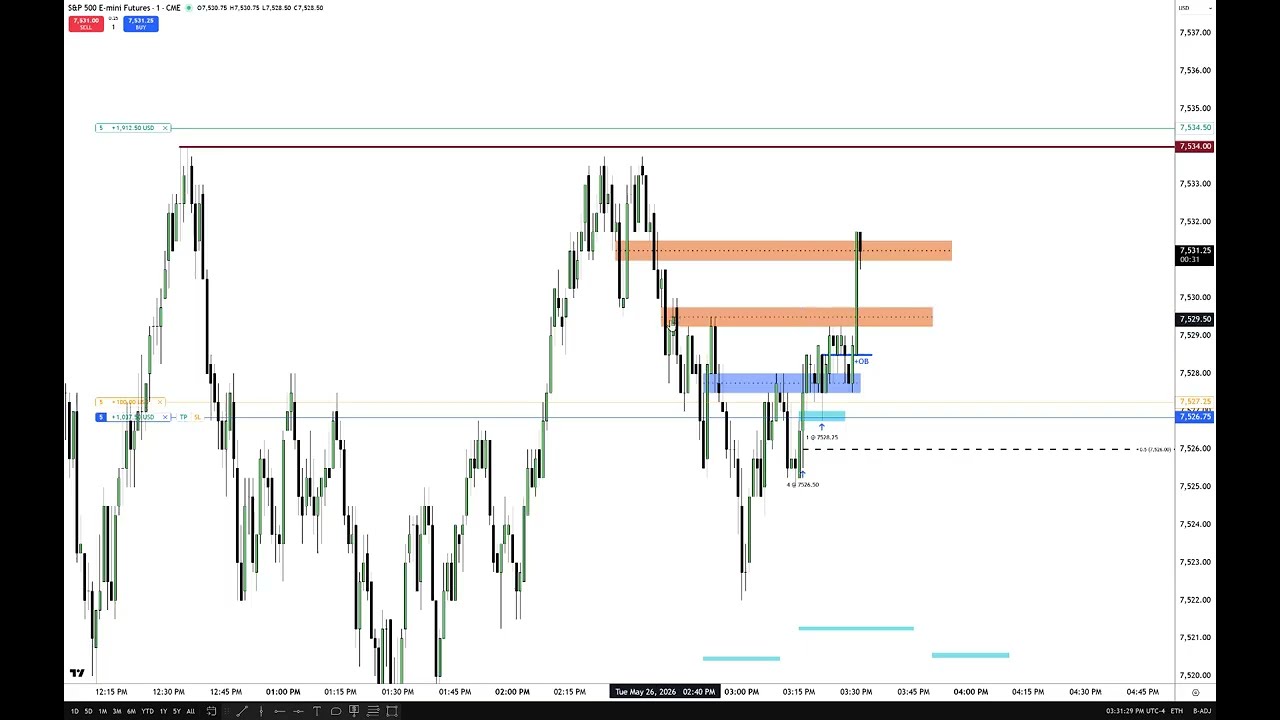
Michael describes taking a long trade with a stop loss just below a recent low, targeting the last hour’s relative equal highs (around 3,400–3,450). They watch for accumulation, footholds, fair value gap inversions and order-blocks as entry/validation points, then raise stops to reduce risk as price confirms. The session is slow and “spotty” early, but a run of big green candles and algorithmic buying in the 3:15–3:45 macro window drives a clean rip higher. The trader criticizes sloppy use of “macro” by others, notes this was tradable though not ideal, and ultimately clears positions after the highs are taken out.
– Time comes before price. Anchor your charts to New York local time and use vertical time lines—time windows strongly govern predictable market behavior.
– Key times to watch:
– Market open / opening price at 9:30 ET (opening range gap).
– New York “lunch macro” 11:30–13:30 ET (optimal setups usually form in the first hour, 11:30–12:30).
– PM opening range around 13:30–14:00 ET (use this for the late session and evening sessions).
– Opening range gap: the gap between the prior close and the opening price is a useful reference. It often fills, acts as discount/premium arrays, and can become a trampoline for continuation in the direction of the higher timeframe.
– Combine time with price projections: measure the opening-range gap and use Fibonacci/standard-deviation multipliers (he refers to roughly 6.5–7.5 “SD” levels empirically) to project targets. Use these projections in the specific time windows (especially the lunch macro) for higher-probability signals.
– Liquidity mechanics: expect stop-hunts and liquidity runs (micro spikes that are later “redelivered”). Markets often move to clean out liquidity (everyone’s stop losses) before reversing.
– Trade selection & risk management:
– Be highly selective shorting at all-time highs; inexperienced traders should avoid aggressive shorts against a strong higher-timeframe trend.
– Use limit orders placed around known wicks/relative equal lows/highs for exits; take partial profits and be mindful of one-tick overruns.
– If market is sloppy or choppy, don’t trade—wait for clearer setups (e.g., next morning pre-market).
– Markets behave algorithmically and repeat patterns at specific times—studying the time+price relationships repeatedly builds the necessary edge.
– Practical advice: practice, study the time-based methods, and be patient—experience is required to execute these techniques reliably.
Bottom line: prioritize time structure (NY time windows), measure opening-range gap projections, expect liquidity grabs, manage risk carefully (especially when trading against the higher-timeframe trend), and practice consistently to internalize these repeatable patterns.