
Summary:
– ICT emphasizes patience and warns against building premature expectations. He will share lecture notes via Telegram, YouTube, and his website; beware of impersonators and scams—he will never DM you.
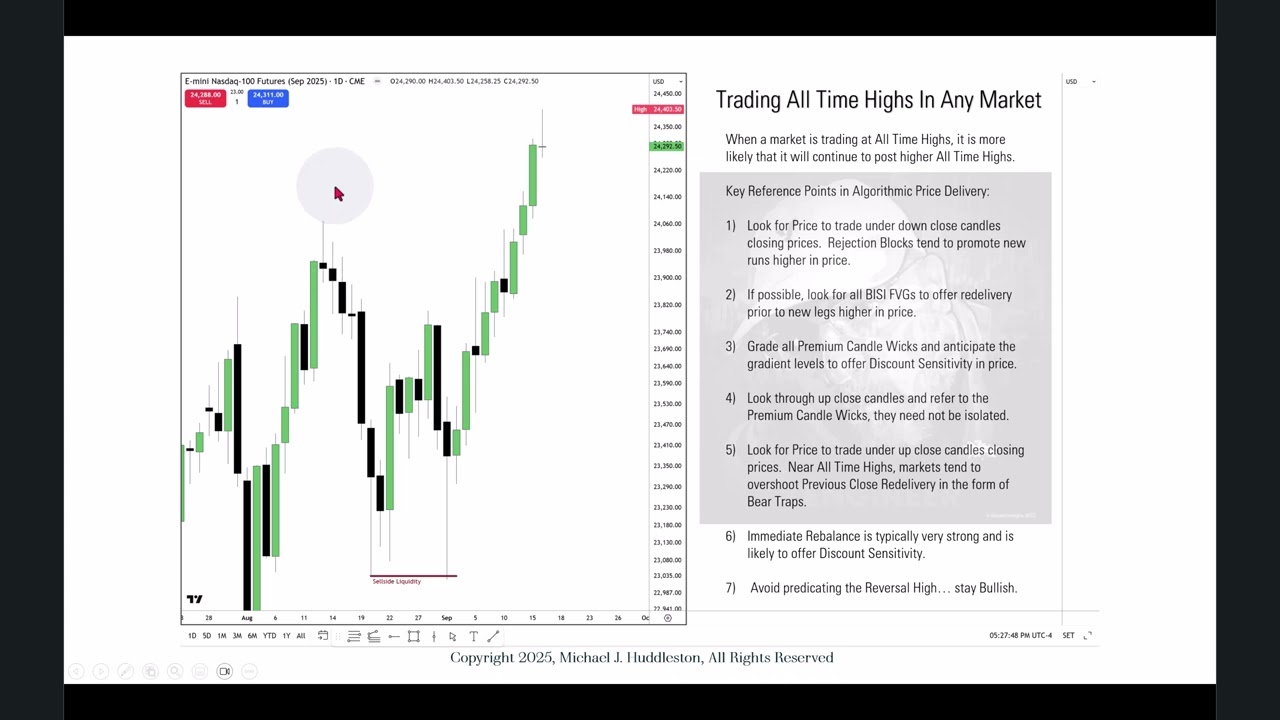
– Main topic: trading markets at or near all-time highs. Key principle: markets at highs are more likely to keep making higher highs, so avoid trying to predict the top.
– Tactical guidance (daily-timeframe focus):
– Treat down-close/up-close candles and their closing prices as rejection blocks and reference points.
– Expect overshoots below the previous day’s close (bear traps) that lure shorts before strong rebalances higher.
– Look for buy-side imbalances, fair-value/efficiency gaps, and “premium candle wicks” (and their midpoints/consequent encroachments) as areas of discount sensitivity where rallies often resume.
– Immediate rebalances back to prior candle highs commonly produce strong bullish moves.
– Risk management: don’t trade real money impulsively, avoid overleveraging, and accept occasional losses—manage trades so no single position can wipe you out.
– Practical advice: study historical charts across markets (stocks, Forex, futures) to recognize these repeating price behaviors; stay bullish until price convincingly proves a breakdown.
Quiz
1) According to ICT, when a market is trading at all-time highs, it is:
A. Very likely to immediately reverse and crash
B. More likely to continue to post higher all-time highs
C. Equally likely to go up or down with no bias
D. Impossible to trade and should always be avoided
2) Which price feature does ICT call a “rejection block” that tends to promote new runs higher in price?
A. Price trading above up-close candle highs
B. Price trading under down-close candles’ closing prices
C. Long upper wicks only
D. Opening gaps that never rebalance
3) What behavior near all-time highs does ICT describe as a common “bear trap”?
A. Market gaps higher and never looks back
B. Market trades below the previous day’s close (overshoots) enticing traders to short, then reverses higher
C. Market forms tight low-volatility ranges for weeks
D. Market shows immediate, sustained reversal confirmed in one candle
4) What is ICT’s recommendation about leverage and risk management?
A. Use maximum leverage to chase gains at all-time highs
B. Overleverage but use many positions to diversify
C. Avoid overleveraging so a single trade can’t take you out of the game
D. Never use stop losses under any circumstance
Answer key with evidence
1) B — More likely to continue to post higher all-time highs
Evidence: “When a market is trading at all-time highs, it is more likely that it will continue to post higher all-time highs.”
2) B — Price trading under down-close candles’ closing prices
Evidence: “Look for price to trade under down close candles. closing prices. These are rejection blocks and they tend to promote new runs higher in price.”
3) B — Market overshoots below the previous day’s close, enticing shorts, then reverses higher
Evidence: “it tends to create these little bear traps where it doesn’t just simply go back to the previous day’s close, it goes beyond that and trades lower… They’re going to think the market’s going to keep going lower… and that’s what the market makers tend to do… these are just very generic principles…” and “When that happens, generally, you’re going to see a very, very strong reaction… the market’s going to immediately launch higher from there.”
4) C — Avoid overleveraging so a single trade can’t take you out of the game
Evidence: “If you’re fearful that it’s going to take you out of the game on any one particular trade… then you’re probably over overleveraging… No trader should ever have their leverage or gearing on their trades that high.”
Leave a Reply