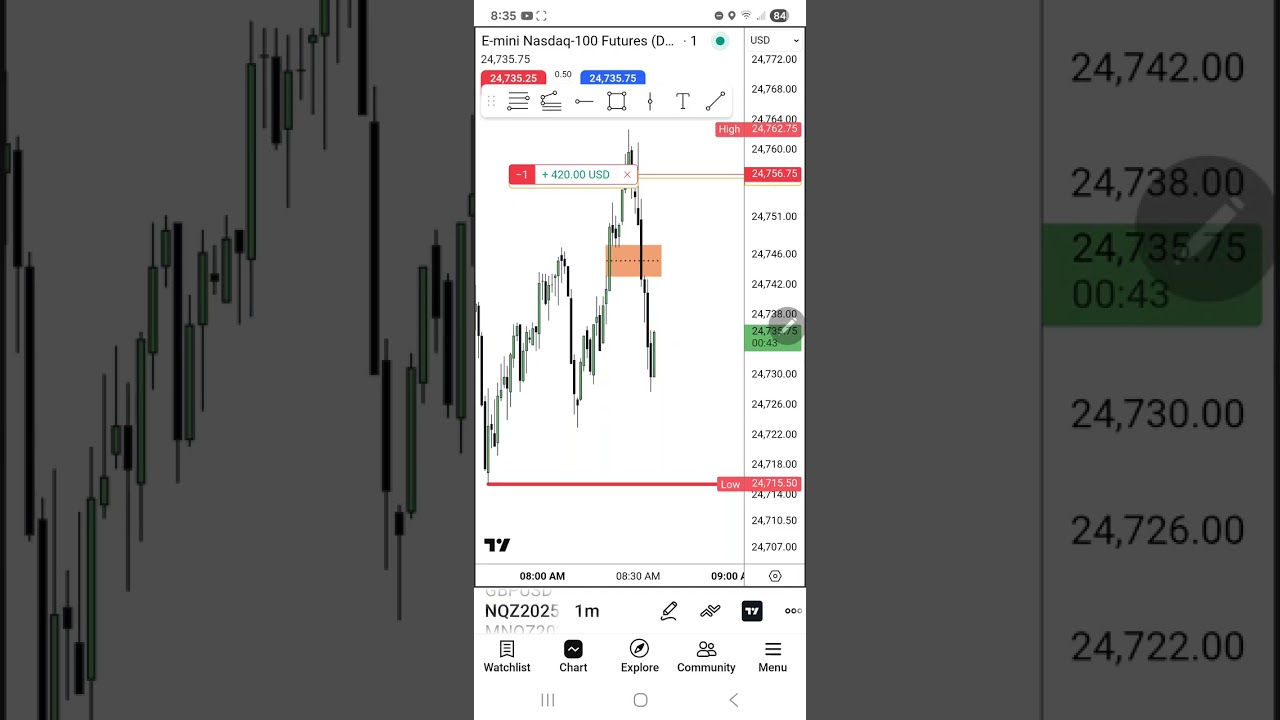
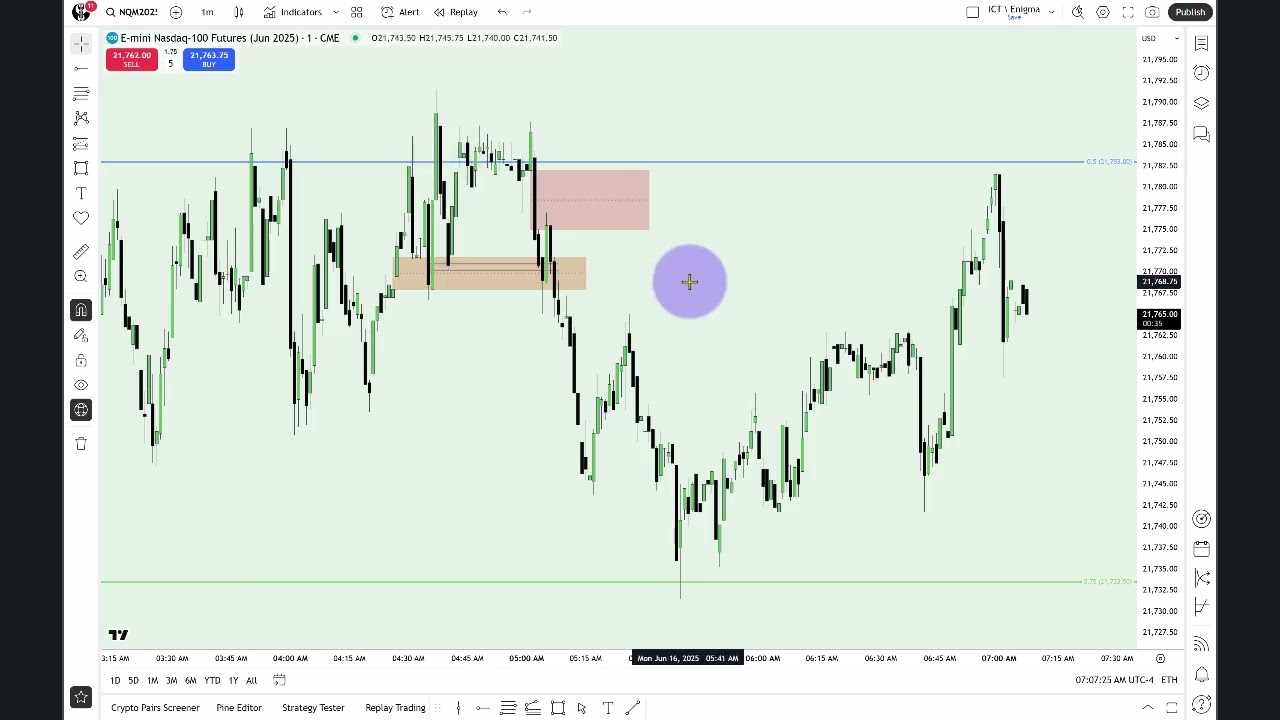
ICT is describing a short “turtle soup” trade setup: entering short above a recent high with a stop just above the inversion/value gap (around 764.5) and targeting lower precession/liquidity pools near ~723 and the 700-area. The thesis: smart money is selling into retail breakouts, so price should stay in the lower half of the current range, form long black candles, and erode through the blue-box liquidity without accumulation — ideally breaking strongly below ~714. Risk management: trade small (one contract), trail stops above the inversion, accept possible stop-outs from spikes, and remove risk as price moves lower. He emphasizes identifying inline and pooled liquidity as the reason price will decline, warns retail longs will be trapped, and encourages practice to learn the method. The commentary mixes trading instruction with casual multitasking (cooking) and encouragement to follow his approach.
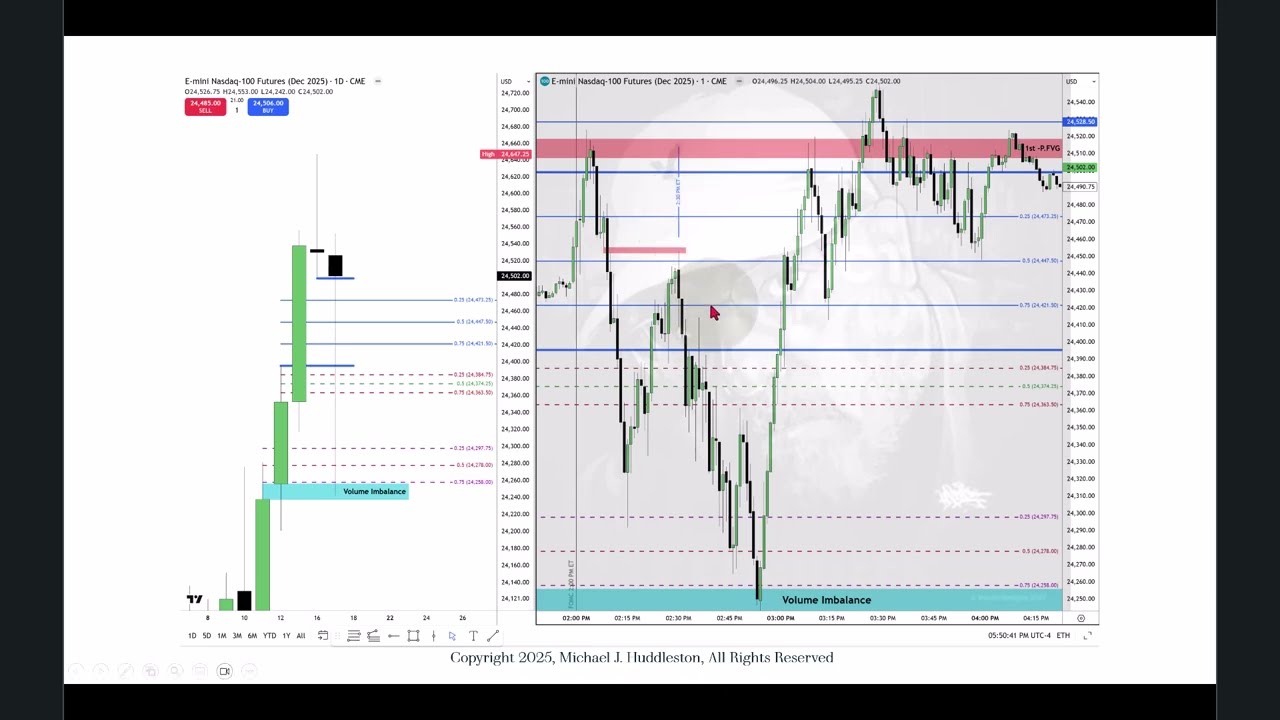
Here’s a brief, clear summary of the lecture (Sept. 17, 2025) on trading FOMC two-stage delivery and the NASDAQ session:
– Context: Rolled into the December NASDAQ futures contract; lecture uses both daily and 1-minute charts to connect higher- and lower-timeframe structure.
– Core trading philosophy: Focus on specific price points (opens/closes), volume balance, fair value gaps (FVGs), liquidity pools, inefficiencies, and market structure — avoid “trying to pick the top.” Intraday shorts are acceptable, longer swings usually follow the trend.
– Model 2022 (the speaker’s method): Run Fibonacci from relevant high to low, look for price to trade above 50% (premium), and use the classic 3/4 pullback “optimal trade entry” into FVG/inefficiencies for entries. (Instructor insists this is not “Goldbach” or “Enigma.”)
– Key levels and tools: grade HTF inefficiencies and quadrants onto LTF charts (upper/lower quadrant, consequent encroachment, premium/discount wicks, volume imbalances) — these are more precise than simple S/R.
– Definitions: premium wick = wick above a candle body; discount wick = wick below body. Distinguish FVGs from volume imbalances when annotating trades.
– Day’s structure / trade examples (NASDAQ): morning run then bearish shift in structure; identification of buy- and sell-side liquidity pools and unfinished business; speaker shorted in the morning, re-entered around the FOMC using the Model 2022 rules, and described being stopped out on one attempt.
– FOMC “two-stage delivery”: initial move at 2:00 (first stage), a pause/during the press conference, then a second distinct follow-through (second stage) — be surgical: get in/get out and avoid overtrading during consolidation.
– Practical tips: always transpose higher-timeframe levels onto lower-timeframe charts, maintain a multi-timeframe journal, print/annotate notes, and review the session replay (clip posted on X).
– Macro observations: Dollar index viewed as bearish until it forms constructive bullish arrays; Euro had a tight FOMC spike then rejection — FX was generally sloppy and less tradable intraday.
Main takeaway: trade with precise, multi-timeframe level grading (volume/FVG/liquidity concepts) and use the Model 2022 entry rules, especially on FOMC days where moves commonly occur in two distinct stages. Good discipline, quick execution, and journaling are emphasized.
Quiz
1) How does ICT describe the “optimal trade entry” in his Model 2022? A. A 50% retracement on any swing B. A 3/4 pullback in an impulsive price leg into a small inefficiency/fair value gap C. Buying the daily low and holding for weeks D. A simple moving average crossover
2) According to ICT, when does the “second stage” of FOMC delivery often begin intraday? A. 9:30 AM B. 2:00 PM C. 2:30 PM D. 4:00 PM
Answer Key with evidence
1) B — “the optimal trade entry, which is simply just a 3/4 pullback in a impulsive price leg like this, and then running up higher into this small little inefficiency right there.”
2) C — “Usually there’s a another wave of price action that begins at 2:30 and whatever the high or the low is, usually it’ll run for it.”
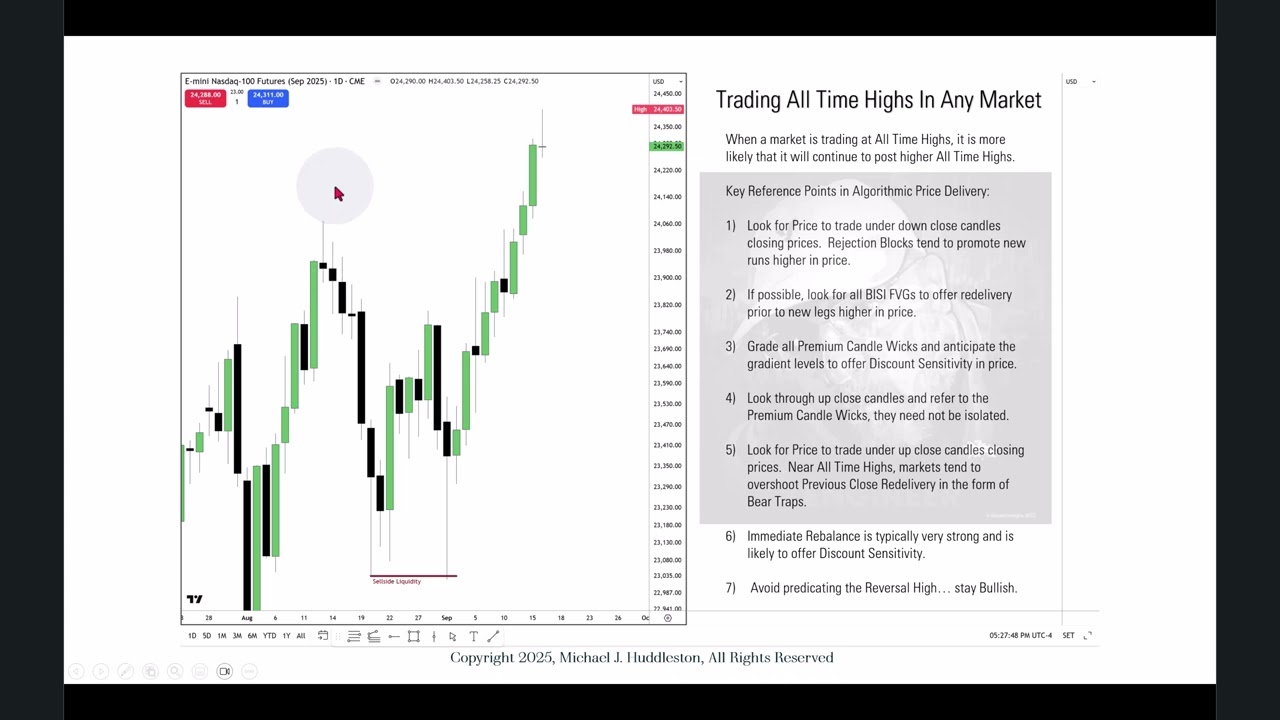
– ICT emphasizes patience and warns against building premature expectations. He will share lecture notes via Telegram, YouTube, and his website; beware of impersonators and scams—he will never DM you. – Main topic: trading markets at or near all-time highs. Key principle: markets at highs are more likely to keep making higher highs, so avoid trying to predict the top. – Tactical guidance (daily-timeframe focus): – Treat down-close/up-close candles and their closing prices as rejection blocks and reference points. – Expect overshoots below the previous day’s close (bear traps) that lure shorts before strong rebalances higher. – Look for buy-side imbalances, fair-value/efficiency gaps, and “premium candle wicks” (and their midpoints/consequent encroachments) as areas of discount sensitivity where rallies often resume. – Immediate rebalances back to prior candle highs commonly produce strong bullish moves. – Risk management: don’t trade real money impulsively, avoid overleveraging, and accept occasional losses—manage trades so no single position can wipe you out. – Practical advice: study historical charts across markets (stocks, Forex, futures) to recognize these repeating price behaviors; stay bullish until price convincingly proves a breakdown.
Quiz
1) According to ICT, when a market is trading at all-time highs, it is: A. Very likely to immediately reverse and crash B. More likely to continue to post higher all-time highs C. Equally likely to go up or down with no bias D. Impossible to trade and should always be avoided
2) Which price feature does ICT call a “rejection block” that tends to promote new runs higher in price? A. Price trading above up-close candle highs B. Price trading under down-close candles’ closing prices C. Long upper wicks only D. Opening gaps that never rebalance
3) What behavior near all-time highs does ICT describe as a common “bear trap”? A. Market gaps higher and never looks back B. Market trades below the previous day’s close (overshoots) enticing traders to short, then reverses higher C. Market forms tight low-volatility ranges for weeks D. Market shows immediate, sustained reversal confirmed in one candle
4) What is ICT’s recommendation about leverage and risk management? A. Use maximum leverage to chase gains at all-time highs B. Overleverage but use many positions to diversify C. Avoid overleveraging so a single trade can’t take you out of the game D. Never use stop losses under any circumstance
Answer key with evidence
1) B — More likely to continue to post higher all-time highs Evidence: “When a market is trading at all-time highs, it is more likely that it will continue to post higher all-time highs.”
2) B — Price trading under down-close candles’ closing prices Evidence: “Look for price to trade under down close candles. closing prices. These are rejection blocks and they tend to promote new runs higher in price.”
3) B — Market overshoots below the previous day’s close, enticing shorts, then reverses higher Evidence: “it tends to create these little bear traps where it doesn’t just simply go back to the previous day’s close, it goes beyond that and trades lower… They’re going to think the market’s going to keep going lower… and that’s what the market makers tend to do… these are just very generic principles…” and “When that happens, generally, you’re going to see a very, very strong reaction… the market’s going to immediately launch higher from there.”
4) C — Avoid overleveraging so a single trade can’t take you out of the game Evidence: “If you’re fearful that it’s going to take you out of the game on any one particular trade… then you’re probably over overleveraging… No trader should ever have their leverage or gearing on their trades that high.”
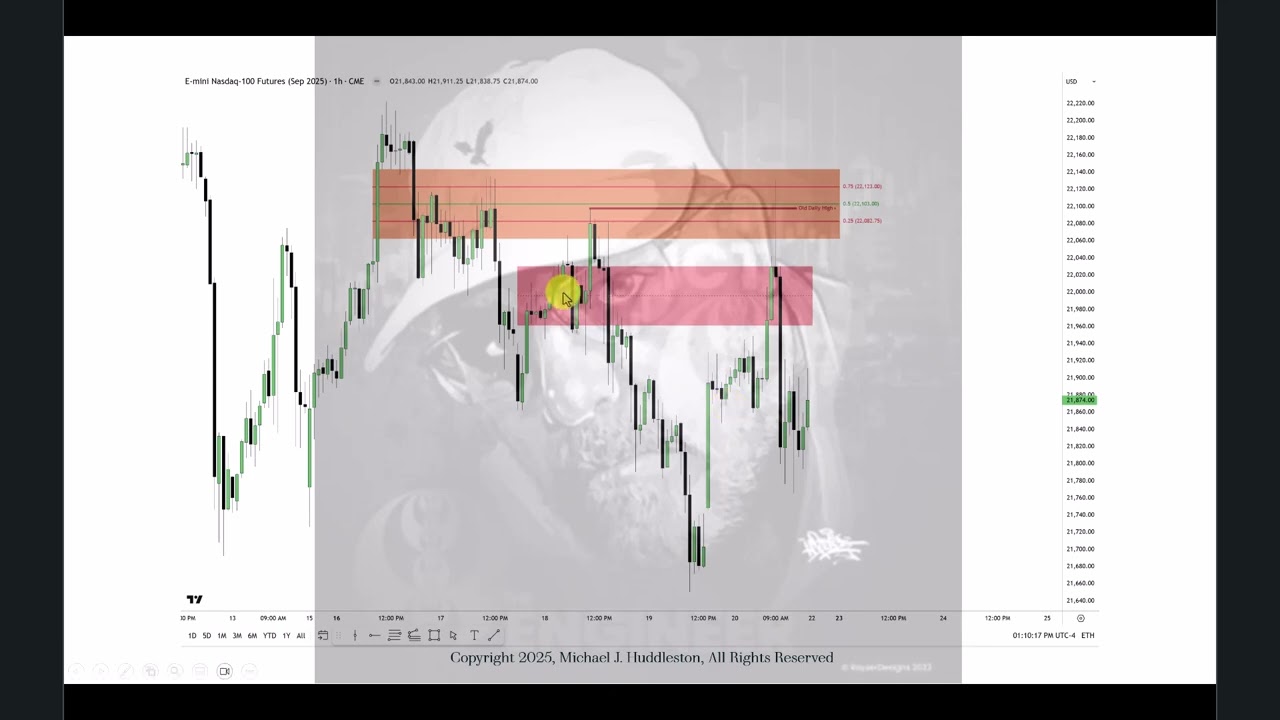
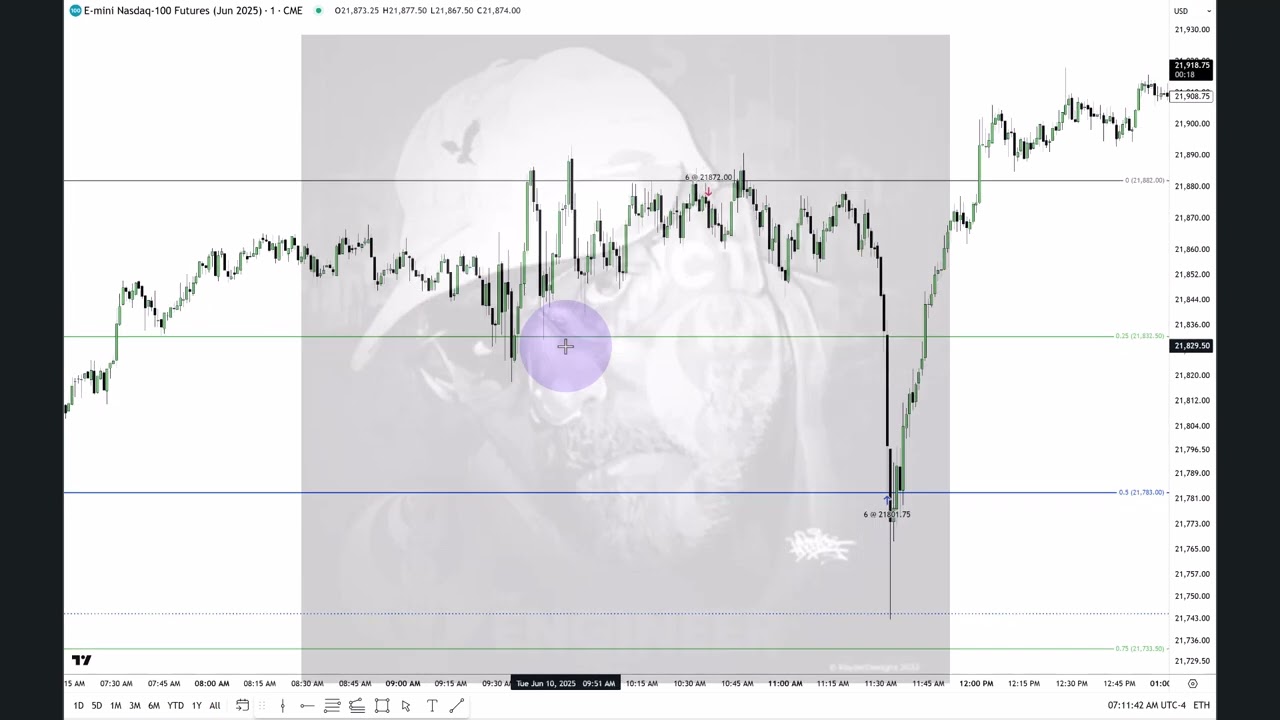
– ICT reviews his analysis and live execution on the September NQ futures for trading Friday, June 20/21, 2025, and references a pre-market video he posted at 4:50 a.m. ET on X/Twitter that outlined his bias and expected price behavior. – He had a bearish bias: he didn’t expect new highs, predicted price would overlap a specific daily range (marked on charts), and warned of weekend gap risk driven by Middle East geopolitical developments (Iran/Israel and likely U.S. involvement). – His methodology centers on identifying repeated, high-probability levels using multi-timeframe concepts (long/intermediate/short swing highs), PD arrays, order-blocks, inefficiencies (“CIBI”/“BISI”), opening-range and fair-value-gap logic—levels he says repeat and produce reliable setups. – Using that framework he executed a market-maker sell model: shorted into the rally above Wednesday’s daily high, pyramided, and captured the subsequent drop and gap closure. The trade largely unfolded as he predicted; some wick action briefly pierced a level but bodies respected his structure. – He emphasizes that this skill is gained through long experience and disciplined backtesting and cannot be shortcut by courses, signal services, or copying; his teaching aims to make students self-sufficient rather than dependent. – He also mentions technical issues with his Camtasia recordings (static screenshots during live recording) and explains why he doesn’t trade fully live for large audiences (broadcasting entries would degrade execution). – Throughout he asserts the uniqueness and proprietary nature of his approach, challenges others to replicate it, and stands by the pre-market call he posted publicly.
Quiz
1) Which commonly taught concept did ICT say is “infancy” and not the framework he uses? A. Supply and demand B. Elliott Wave C. Market profile D. Fibonacci retracement
2) Why did ICT say he avoids doing live executions for large audiences? A. He prefers private mentoring only B. Copying by many viewers would remove liquidity and throttle his specific fills C. Legal/regulatory reasons prevent live trading D. He doesn’t want to reveal his P&L
Answer Key and Evidence
Q1 Answer: A Evidence: “This is why I’m not supply and demand. Supply and demand is infancy. It’s it’s it’s lacking a lot.” (transcript)
Q2 Answer: B Evidence: “What happens if just oh, I don’t know, 10% of them, five% of them all try to get the same fill I’m aiming for, I’m probably not going to get filled. … it’ll it’ll distort or throw off or thwart my edge, my my very specific element of entry.” (transcript)
– He’s rolling out of the June NASDAQ (NQ) contract and will reference September 2025 contracts going forward (NQ, ES, DAX).
– Market context: current environment is a “troubled market” — chaotic consolidation/time distortion driven by geopolitical risk — causing low willingness to trend and large gap risk.
– Chart analysis (daily → 1-min/30-sec): key reference is the Feb. 24 daily level (consequent encroachment / “cibby”), several fair value gaps and liquidity pools, and a recent failure to reach a longer-term upside target. Price has been oscillating around quadrant levels (low, midpoint, upper quadrant, high) and leaving liquidity and volume-imbalance signatures.
– Trading approach in this environment: be nimble, stop thinking only in classic support/resistance, use algorithmic/order-flow concepts (consequent encroachment, fair value gaps, premium/discount anchored to breaks of structure). Aim for setups that offer sufficient edge (he looks for ~15 handles net on NQ before entering shorts).
– Risk & trade management: he uses very tight, precise stop placement (often 1–2 ticks above/below defined micro levels) and proprietary “PD arrays” that he will not teach or reveal. He stresses that he’s not giving trade advice and that risks are unusually large now.
– Personal notes: brief anecdote about his family and puppy, reiterates he won’t disclose broker relationships or certain methods, and confirms future analysis will use the September contract.
Brief market update and context
– Speaker has been tied up with a family matter; this is a short commentary on the NASDAQ, EUR and macro risks.
– Main theme: expect higher prices for NASDAQ (continuing the prior bias), but be cautious because near-term volatility is likely.
NASDAQ technical view
– Daily: price has been repeatedly encroaching a prior wick/imbalance (daily CBI from Feb 24, 2025) and is tracking toward a cluster of fib/“consequent encroachment” levels and quadrant boundaries.
– The speaker has no open position; would be comfortable stepping to the sidelines if price fills the fair-value gap. He stresses that in the current climate professionals avoid pressing edges.
Macro calendar / risk advice
– CPI today and PPI tomorrow create a high-volatility “Molotov cocktail.” Don’t trade aggressively; this is a poor environment for taking high risk or overtrading.
– General market stance is risk-on (dollar weak, euro/gold/silver expected higher), but short-term moves from data releases are unpredictable.
Commodities and fundamentals
– He prefers commodities (gold/silver) over equities because of clear supply/demand drivers—believes metals have further upside, especially silver for industrial demand.
EUR and trading process
– Euro: previously signaled levels—if they break down, expect sideways consolidation; if they hold, higher prices remain likely.
– Emphasis on journaling, experience, and having a tested model; novices should avoid gambling in messy market conditions.
Personal / closing
– Limited trading activity this week; small missed opportunities but content to sit out.
– Thanks listeners for prayers; a reminder to be careful this weekend (U.S.) and to trade conservatively around data.
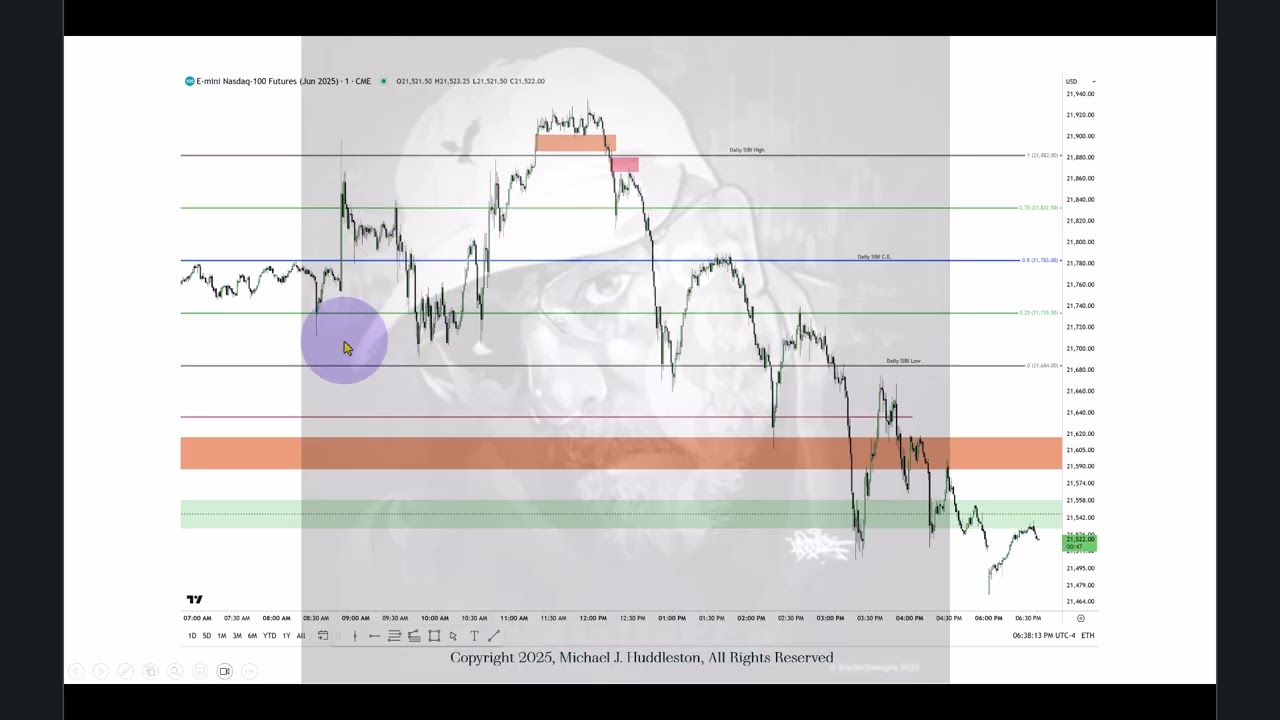
– This is the Storyteller review for the June 5, 2025 NASDAQ futures contract, building on the June 4 video where key levels were posted. – ICT focused on a single concept: the daily “SIBI” (daily inefficiency / fair-value gap) and its graded levels (upper quadrant, consequent encroachment, lower quadrant, and low). Higher-timeframe inefficiencies are treated as real support/resistance. – Because it’s non-farm-payroll week, price was choppy and rangebound (especially Wed–Thu). New traders were advised to stop trading by about 7:00 AM ET ahead of the Friday release to avoid being caught in volatile, whipsaw action. – The intraday analysis used only the 1-minute chart and the daily inefficiency levels — no opening-range gaps, opening-gap tools, or new fair-value-gap techniques were used that day. – Practical trade notes: the presenter shorted near the London high into liquidity, watched price interact with the daily cibby levels (lower quadrant, order blocks, inversion fair-value gaps), took stops, and then followed further short/long opportunities as price cycled through those levels. The action showed classic NFP-week stop-hunts, liquidity grabs, and consolidations. – Main takeaway: knowing and trading around higher-timeframe inefficiencies within the context of the economic calendar simplifies entries and management; once price leaves the daily cibby, other reference points must be used. Study the one-minute chart and the prior video for details.
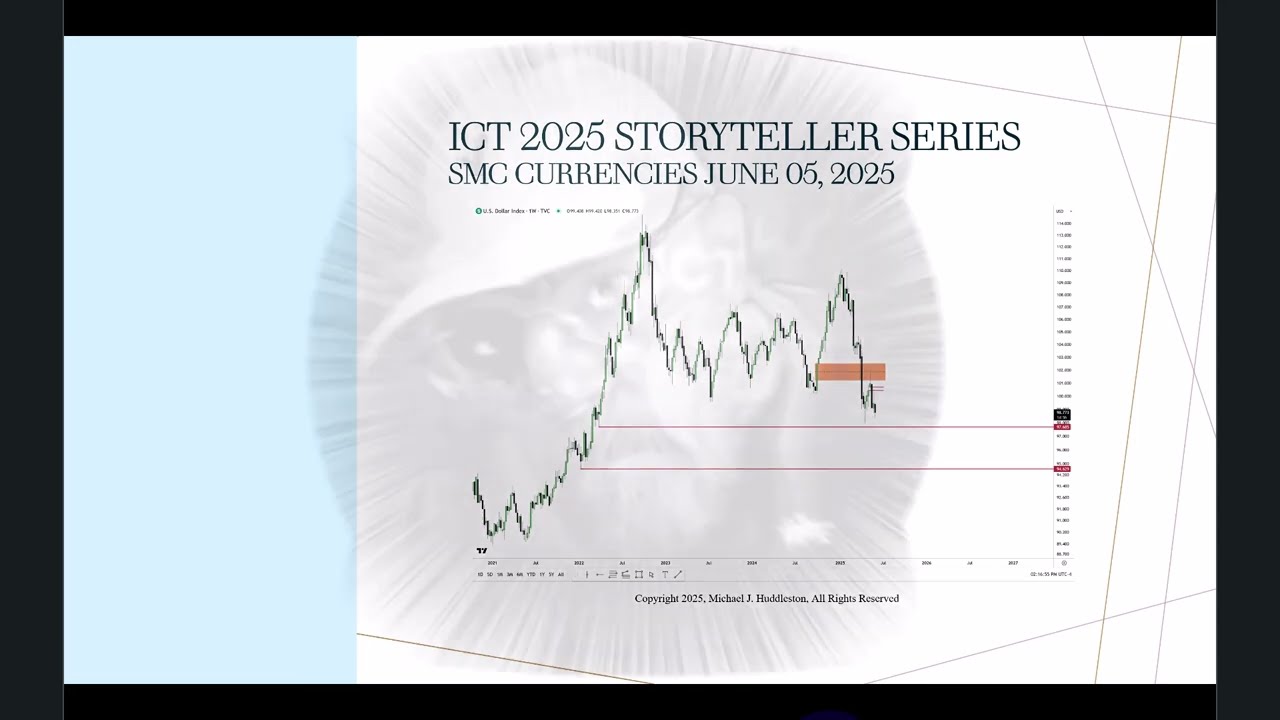
– Context: Storytellers Series (episode 3), June 5, 2025 — focused on the dollar index and EUR/USD (not covering other FX pairs). The presenter is not actively trading Forex and treats it separately from his index-futures work.
– Big-picture view: Global trade friction, tariffs and geopolitical risk are creating chaotic fundamentals. The presenter believes this environment is broadly negative for the U.S. dollar and that a softer dollar (higher EUR/USD) is the more likely outcome.
– Market stance: Not bullish on the dollar index; expects lower dollar levels over time unless major geopolitical tensions unexpectedly resolve. He sees the broader market as risk-on (stocks can still rally), which supports a weaker dollar.
– Technical approach: Analysis relies on technical constructs across timeframes—weekly, daily, hourly, 15-min, and 5-min—using concepts like fair value gaps, inversions, buy/sell-side efficiency, liquidity pools and order blocks. Key higher-timeframe sell-side liquidity and inversion gaps are focal points for downside targets.
– Near-term triggers and risks: Employment and upcoming nonfarm payroll (NFP) data can change the picture; recent employment data caused short-term moves. Heavy manipulation and wide, unpredictable ranges are possible, making FX trading riskier now.
– Practical cautions: He warns inexperienced or undercapitalized traders not to over-leverage or trade impulsively—profitability is difficult in the current FX climate. This commentary is opinion, not trading advice.
– Frequency: He plans to post daily-ish EUR/USD and dollar-index updates when relevant, but remains cautious and will keep precise trade-levels private until warranted.
ICT uses a “daily candle” metaphor to frame each day’s productivity: the high is your maximum achievable output and the low is the minimum you accept. Success requires planning the next day before you wake (or before sleep), defining your operating hours/“kill zones,” and picking specific, realistic goals rather than chasing every distraction.
Fear and greed are described as constant adversaries: greed tempts you to overreach after you’ve met goals; fear robs you of contentment by making you obsess over what you didn’t do. Both are defeated by discipline—predefined limits, patience (not impulsivity), and trading/working only with informed, high-probability setups.
Practical advice: prune social media, drama, and approval-seeking (they steal attention and productivity); learn from mistakes rather than dwelling in regret; balance personal life and work to avoid burnout; focus only on what you can control. The presenter’s goal is to teach independence—implement these habits, “go ghost” on distractions, and you’ll sleep content and perform consistently.