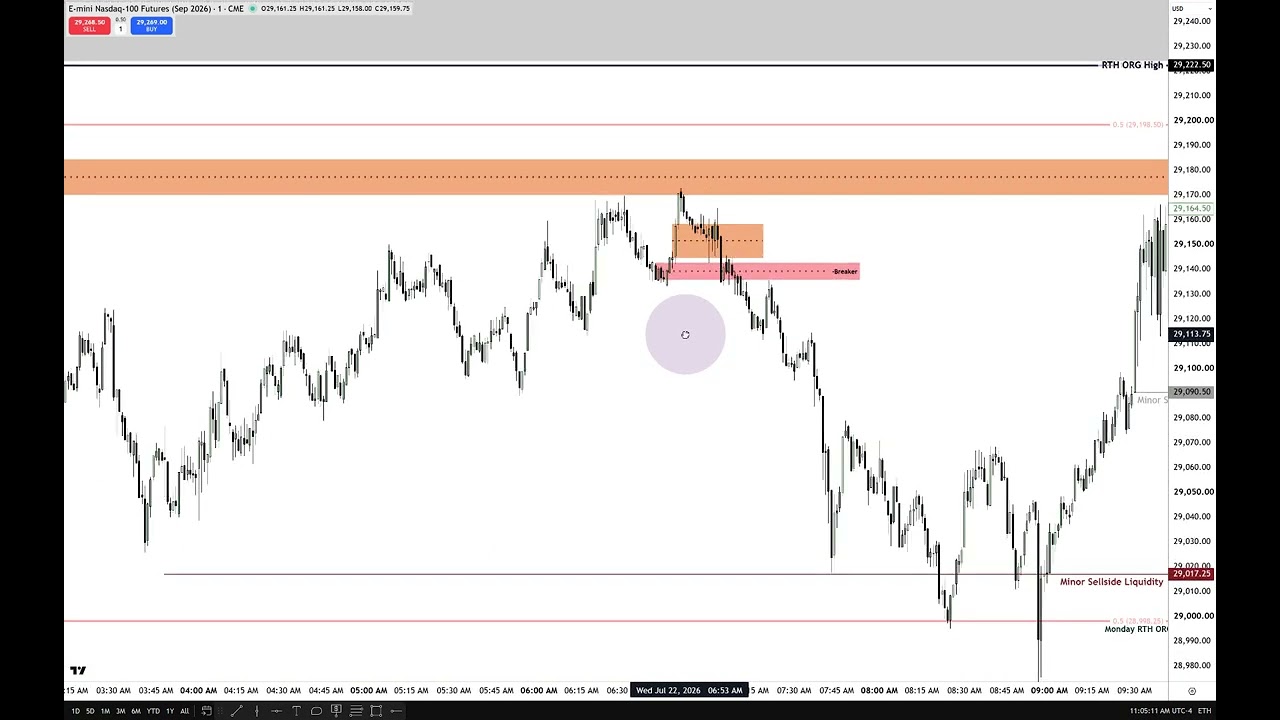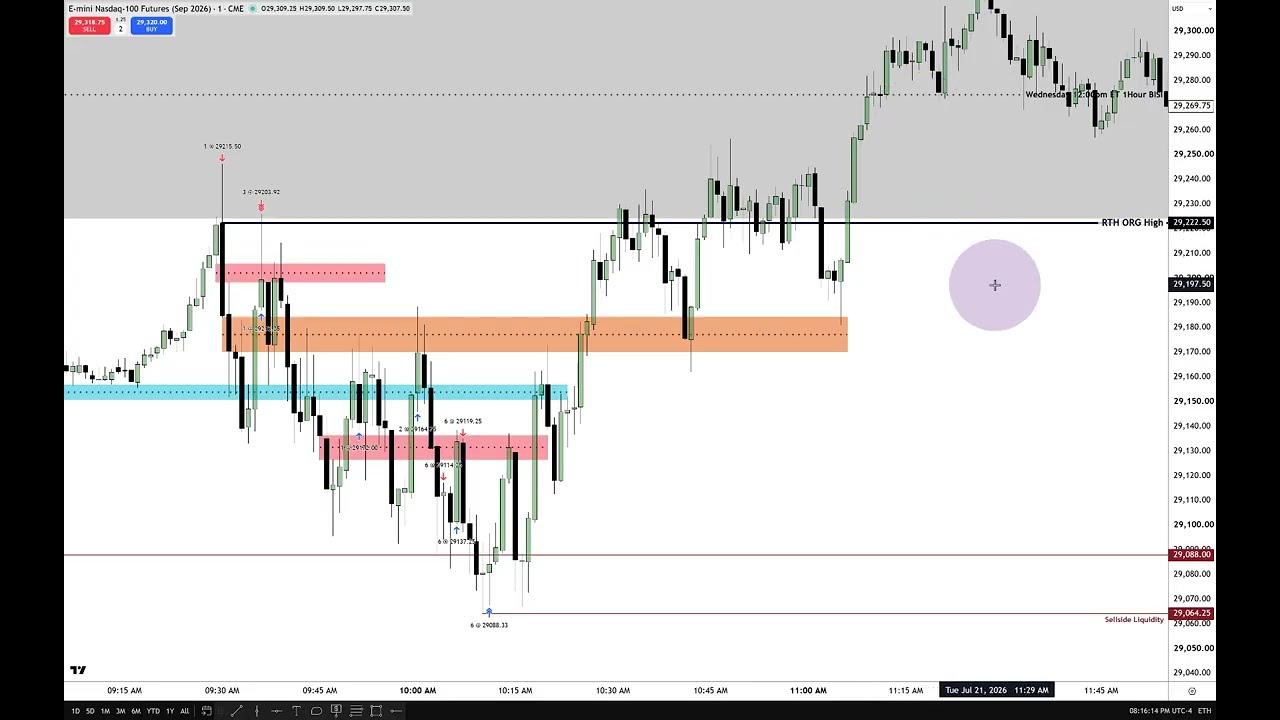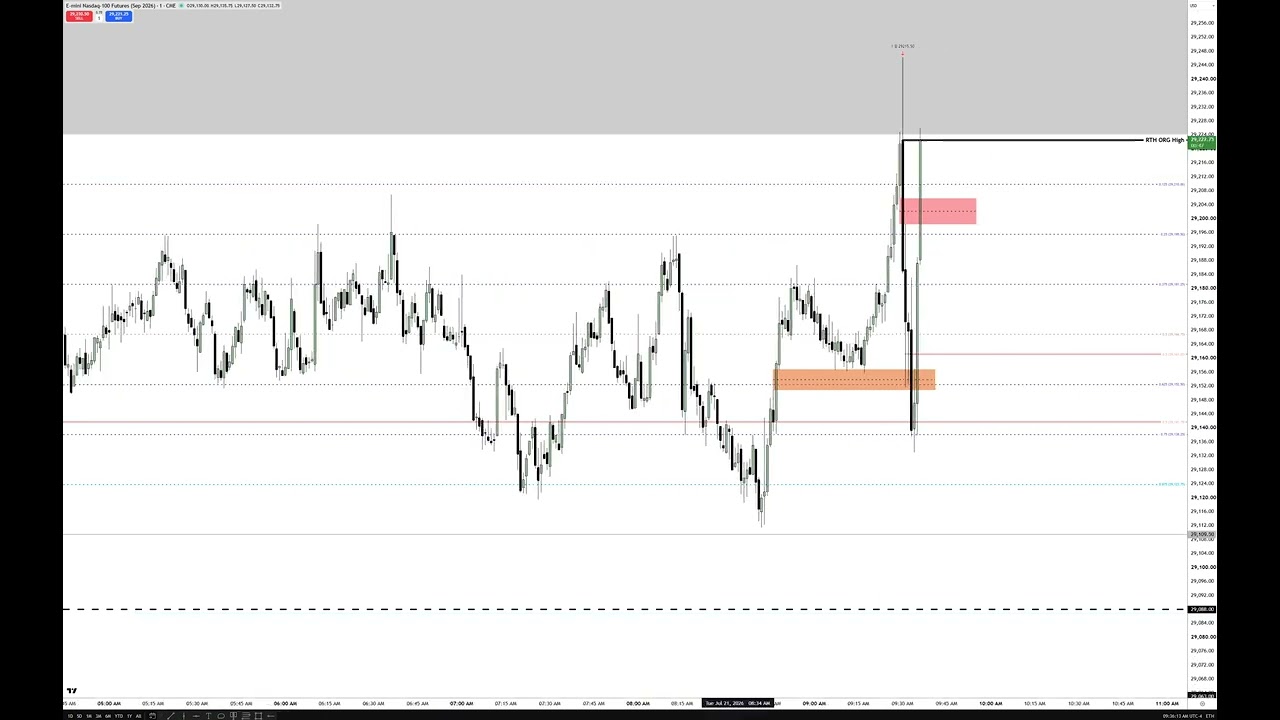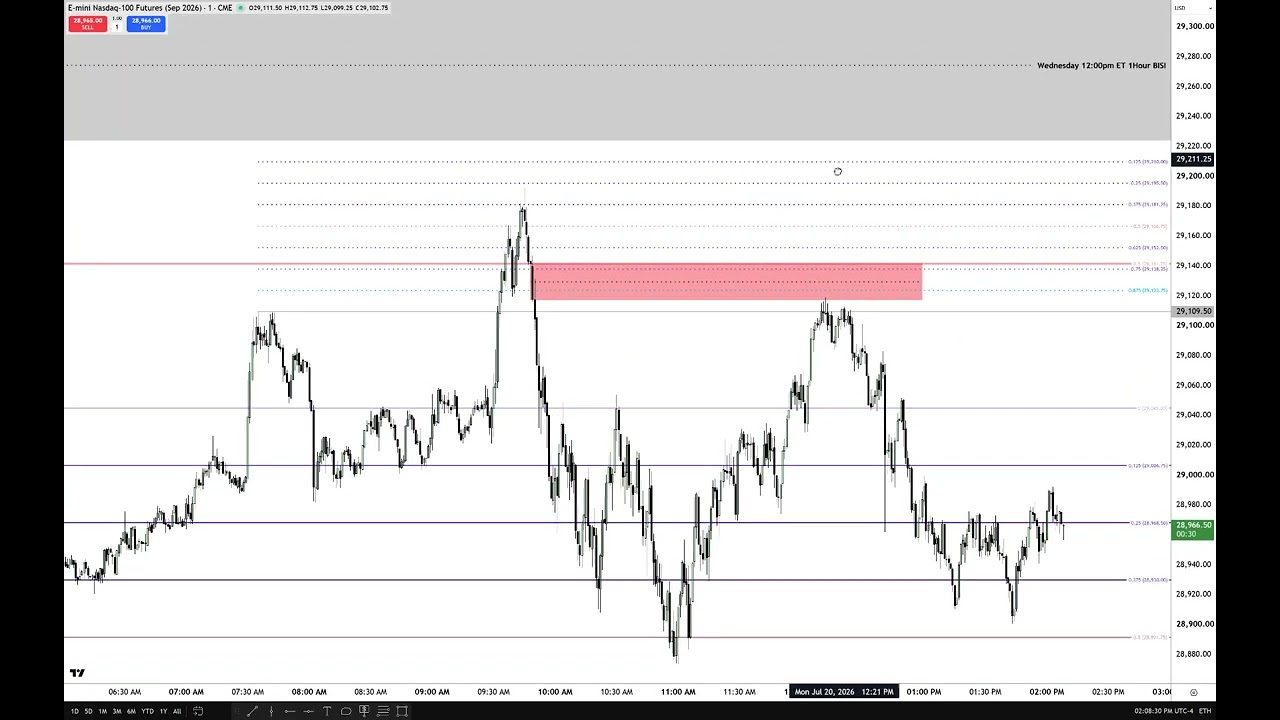
Tag: innercircletrader

  • TRU – ICT 4/8 Livestream Follow Through | April 8, 2026

    Summary:

    – Event horizon / Octa: Michael taught using an event horizon located between the lower cell side and the low of the daily suspension block. Bodies not touching an event horizon (or Octa) is an algorithmic signature; if price then goes above the consequent encroachment (CE) of a premium wick, close the position.

    – Daily suspension block behavior: If price exits the suspension block downward, any retracement must remain below the block’s lower quadrant to remain bearish; a retracement above the lower quadrant suggests a likely move to intraday highs.

    – First-presented fair value gap (FPFVG) and entries: FPFVGs can be used as inversion entries—wait for price to clear the old high/low, then enter from the consequent encroachment to the gap low (or equivalent structure). Lower timeframes can provide more precise entry/fair-value-gap structure when needed.

    – Volume imbalances / suspension blocks:
    High-timeframe volume imbalances and suspension blocks are important PD arrays in 2025–26; analyze them on the continuous contract so rollovers and gaps remain visible.
    – Regular trading hours (RTH) vs electronic hours (ETH): The algorithm “redelivers” inefficiencies seen overnight into RTH. Neither is inherently greater; use them together (ETH shows continuous structure that RTH revisits).

    – Tape reading & practice plan: Learn to draw likely direction, watch open/high/low/close in real time (avoid market replay). If you can’t watch live, record sessions (OBS recommended) and review. Do at least 6–8 weeks of focused live tape reading, then 6–8 weeks of paper trading.

    – Journaling & psychology: Keep private journals tracking concrete KPIs (e.g., how specific setups perform at specific times), contract sizes that make you nervous, and the internal voice. Awareness and control of emotion improves trading.

    – Risk management and market environment guidance: Given current extreme volatility and manipulation, return to basics—lower leverage, smaller goals (single high-probability moves), and preserve capital rather than chasing big windfalls. Be nimble: close trades when your pre-defined market-signature conditions change. – Instruments caution: Michael advised caution on gold (and similar highly manipulated instruments); many students are recommended to avoid it given current conditions.

    – Community / session conduct: Michael asked listeners to provide concise, structured feedback about what they observed in price action (so he can build models). He requested less chit-chat and more focused answers to make sessions efficient and more useful to everyone. Overall takeaways: focus on simple, repeatable PD arrays (suspension blocks, volume imbalances, FPFVGs, quadrants/octas), practice disciplined tape-reading and journaling, use ETH and RTH in combination, manage risk tightly in the current volatile market, and contribute concise, structured feedback in live sessions

    Quiz

    .1) What did ICT say about the relationship between regular trading hours and electronic trading hours?
    A. Regular trading hours are greater than electronic trading hours
    B. Electronic trading hours are greater than regular trading hours
    C. They work together, and one is not greater than the other
    D. They should never be used together

    2) According to ICT, what should traders do in the current high-volatility market?
    A. Use the most aggressive leverage possible
    B. Focus on simplicity, lower leverage, and basic trading
    C. Hold for the daily high and low every day
    D. Trade for long periods until a full move completes

    3) When ICT discussed the wick near the consequent encroachment, why did he say he chose that wick?
    A. It was the highest wick in the session
    B. It was the lowest wick in that price run ahead of his target
    C. It was the first wick of the opening range gap
    D. It was the wick with the biggest volume imbalance

    4) What did ICT say about the first presented fair value gap in today’s market conditions?
    A. It should always be traded with full size
    B. It only works on gold
    C. It is a useful tool, but precision is harder right now because of volatility
    D. It should be ignored in all cases

    5) What did ICT say about trading gold? A. Gold is the best instrument to trade right now
    B. He recommends everyone trade gold for volatility
    C. He does not think anyone should be trading gold right now
    D. Gold is only good for swing trading, not intraday trading

    Answer key:

    1) C Evidence: “[26:18] ICT: The emphasis is on redelivery and redelivery is accomplished in regular trading hours… whatever inefficiencies or P.D arrays exist in electronic trading hours… it’s a dance between the two… One’s not greater than the other.”

    2) B Evidence: “[01:10:10] ICT: …just going back to the, the lowest of required elements to a trade and lower leverage… “ and “[01:11:05] ICT: …I’m proud of it… It’s giving you the inspiration to think pres preservation, not capital increasement.”

    3) B Evidence: “[01:30:00] ICT: The wick I chose because it was the lowest one in that price run ahead of my target.”

    4) C Evidence: “[01:46:27] ICT: I’m not demanding that level of precision right now… there’s a lot of chaff in the marketplace.”

    5) C Evidence: “[01:16:12] ICT: …I would personally not touch this market.” and “[01:16:30] ICT: …I don’t think any of you should be trading gold…”

  • ICT 2026 Market Review \ April 07, 2026

    ICT 2026 Market Review \ April 07, 2026

    https://www.youtube.com/watch?v=zpLCZ1Y46Yk

    Summary:

    – The speaker links recent extreme market moves to geopolitical developments (Trump’s threats to Iran, Pakistan reportedly advising a different course, Iran’s defiance and public positioning around targets). He suggests a possible tactical delay (a two‑week window contingent on reopening the Strait of Hormuz) may have been used to disperse civilians, buying time for a later strike — but he stresses this is his speculation.

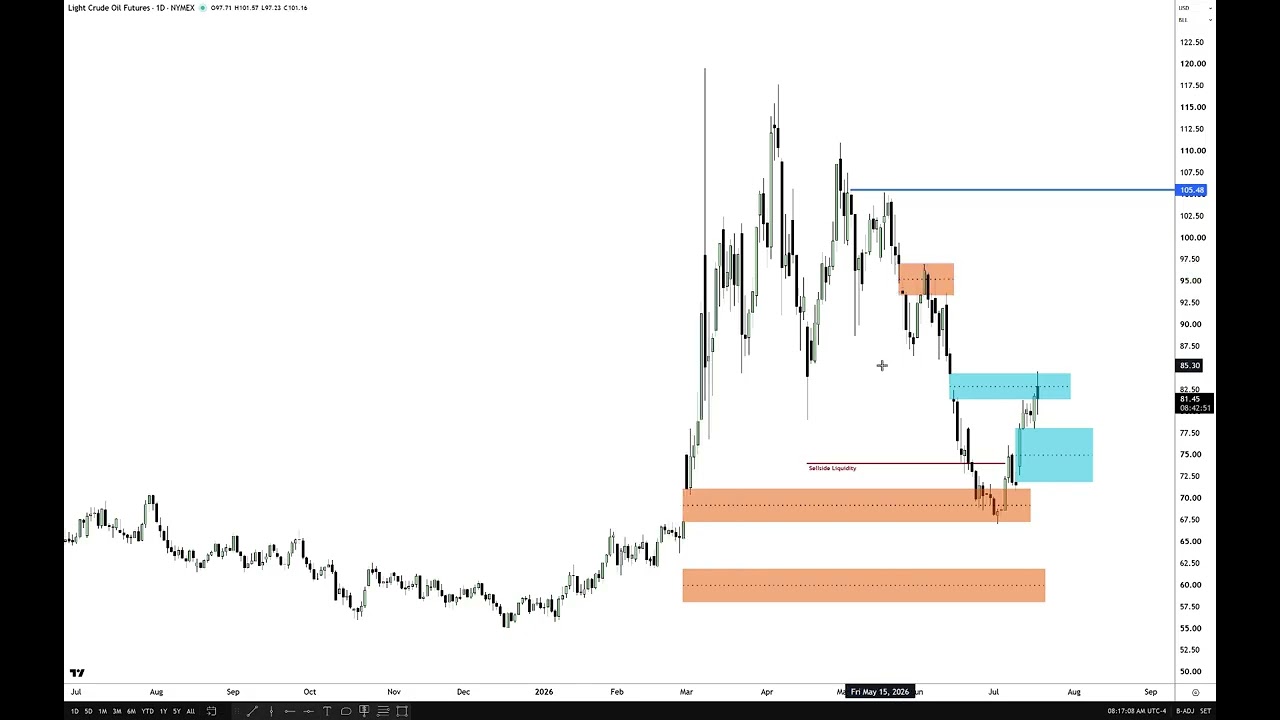
    – Crude oil was highly volatile (big gap and a sharp drop from ~$109+ toward the low $90s), but he remains fundamentally bullish on oil — the recent decline may have washed out longs, not ended the uptrend. Oil remains event-driven and can spike quickly if attacks occur.

    – Markets are being driven and amplified by headlines and off‑hours moves (stock index futures jumped, crude plunged). Single‑minute candlesticks have moved by hundreds of handles, demonstrating extreme intraday volatility.

    – Trading advice and risk warning: stay out of these markets if inexperienced or thinly funded; use stop losses; treat this year as an education year rather than taking big risks. Manipulation/insider positioning can create quick, damaging moves.

    – Technical/read‑on‑the‑tape notes: dollar index slipped, euro/pound are mixed (pound showing relative strength), stock futures (MES/MNQ) show bullish structure if they hold above recent upper halves of ranges and inefficiencies; gold/silver also touched inefficiencies but are risky to trade now.

    – Because of the volatile, event‑driven environment and his responsibility as an educator, he will scale back live trading/tape‑reading streams and focus on educational content for a while to avoid influencing followers into risky trades.

    – He emphasizes the human cost of the conflict, the emotional difficulty of trading such markets, and urges prudence and humility given the high uncertainty.

    Quiz

    1. According to ICT, what was one reason he believed the announced attack on Iran may not happen immediately?
    A. The markets had already closed for the week
    B. Pakistan advised a different avenue and people were standing around the targets
    C. Crude oil had already reached its final target
    D. The Strait of Hormuz had already been opened

    2. What did ICT say the market reaction after hours suggested about crude oil and stock index futures?
    A. Crude oil rose sharply while stock indices collapsed
    B. Both markets stayed unchanged
    C. Crude oil dropped hard while stock index futures rallied sharply
    D. Gold and silver were the only markets affected

    3. What did ICT repeatedly advise inexperienced traders to do in this environment?
    A. Trade only with higher leverage
    B. Ignore stop losses and hold through volatility
    C. Stay away from the market and use the time to study
    D. Focus only on shorting crude oil

    4. What did ICT say he expected would happen if crude oil moved higher again after the drop?
    A. Crude oil would probably stay flat for months
    B. Oil prices could rise parabolically if attacks resumed
    C. The dollar would instantly collapse to zero
    D. Gold would become the only tradable market

    5. What was ICT’s view on the possibility of a ceasefire?
    A. He believed a ceasefire was fully confirmed and permanent
    B. He thought the ceasefire would definitely open the Strait of Hormuz immediately
    C. He viewed it as temporary theater and doubted it would last
    D. He said the ceasefire would eliminate all market volatility

    Answer Key:
    1. B
    Evidence: “a course of action has been suggested to the Trump administration by Pakistan and a uh They counseled him to consider a different avenue” and “they gave an a reason to to let the people go home and get away from those targets.”

    2. C
    Evidence: “we’re up 600 plus handles on stock index futures, and crude oil’s down you know, tens of thousands of dollars per contract” and “crude oil opened up on that news. Sold off.”

    3. C
    Evidence: “If you’re not experienced… this is not your year. I promise you you’re you’re you’re going to regret probably doing anything with it” and “Take this year as an education year. Spend it studying. Learn some concepts. Study. And remove yourself from the risk.”

    4. B
    Evidence: “if they come back later on and do all the attacks they said and Iran said they were going to respond by hitting everything in the area oil-related and other… that’s going to obviously cause, you know, parabolic rise in oil prices.”

    5. C
    Evidence: “I don’t foresee the Strait of Hormuz becoming open immediately” and “I just I can’t see 2 weeks… This might be just a temporary little speed bump in what may continue going on” and “It’s all theater. It’s all It’s nonsense. There’s no easy answer to this. It’s a mess.”

  • ICT 2026 Market Review \ April 08, 2026

    ICT 2026 Market Review \ April 08, 2026

    https://youtu.be/3Uu2IB6kI28

    ICT gives a ~15-minute live review of the Micro Nasdaq (MNQ) price action, noting they may not stream tomorrow. He says viewers should also watch his earlier live stream because it explained the moves in real time.

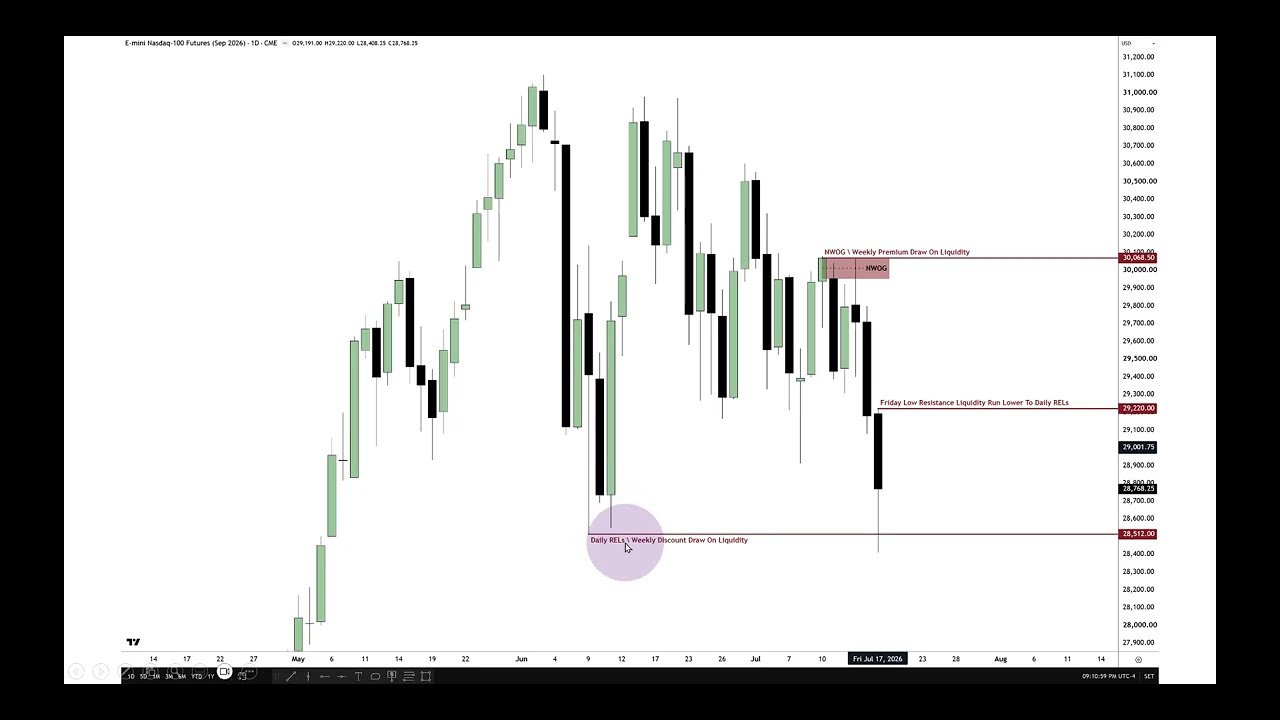
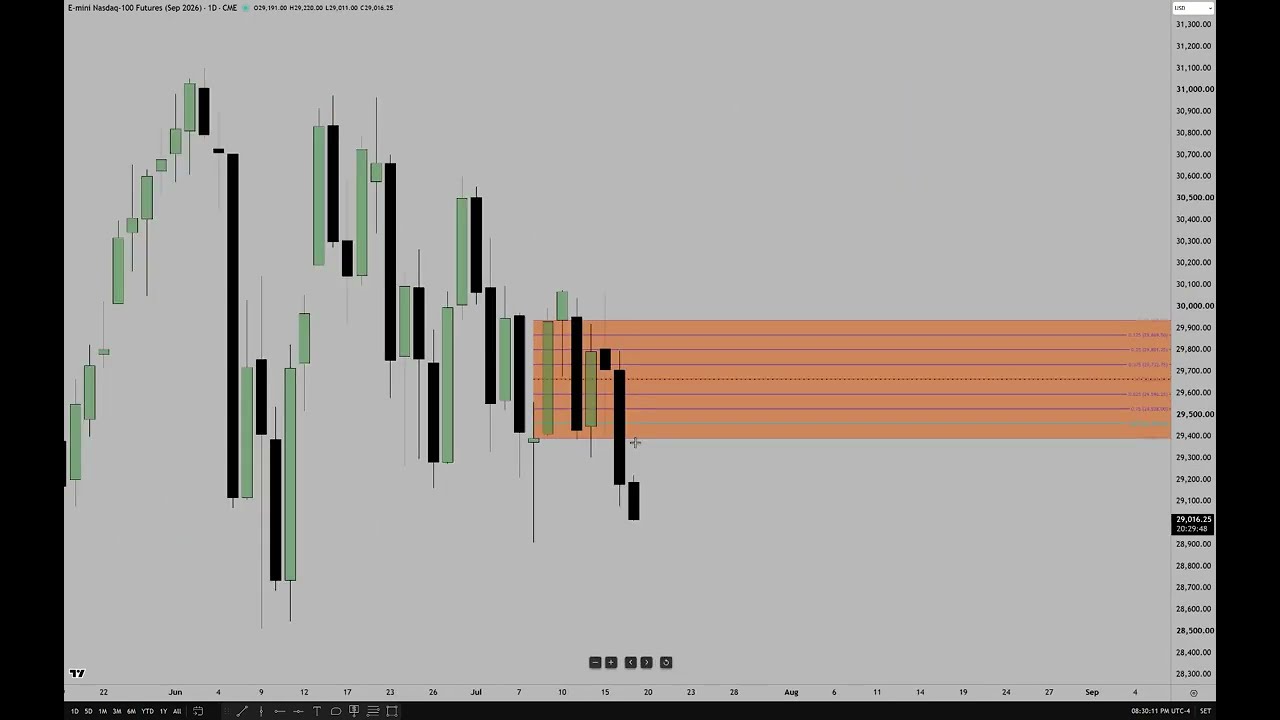
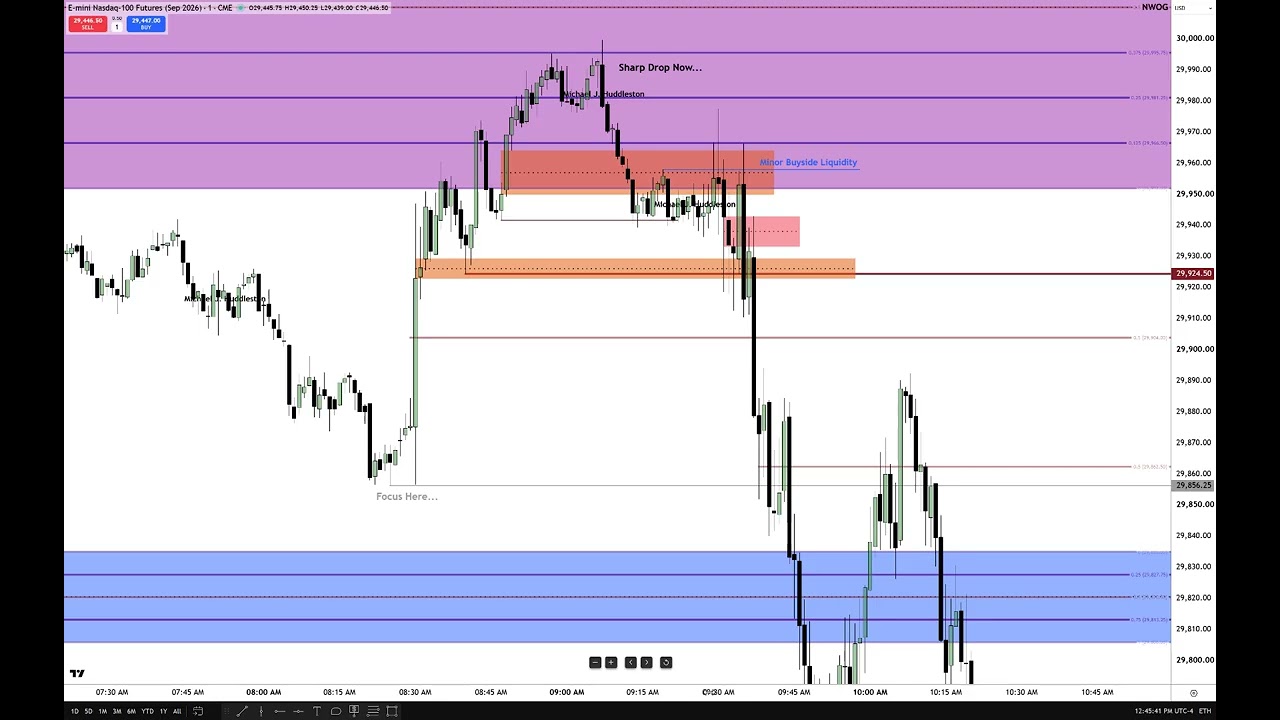
    Key technical points: a large regular-trading-hours opening-range gap formed after geopolitical headlines, price rallied into the midpoint of a daily “suspension block,” then fell to the block’s low (his target) and spent time trading in the lower half of that block.

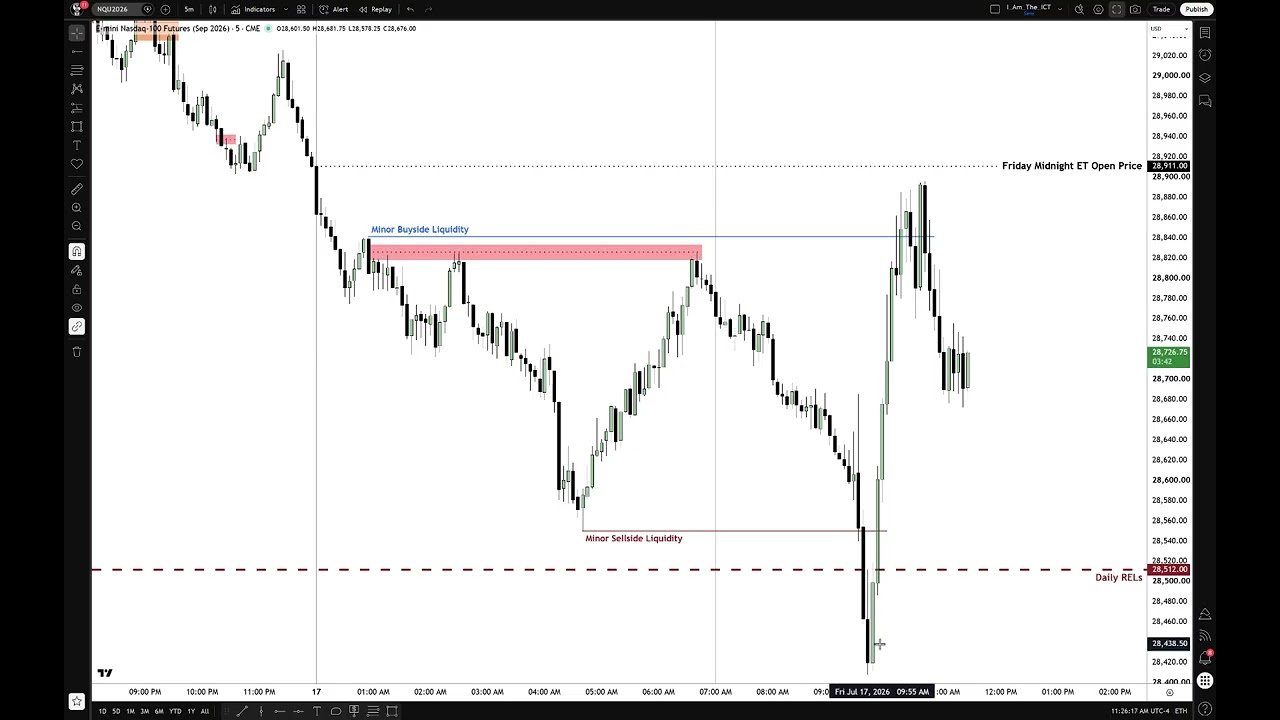
    He highlights a “fair value gap” (a buy-side inefficiency) and a recurring signature he uses: whether candlestick bodies — not just wicks — can touch key levels. Because the bodies failed to trade into the upper half of the suspension block (and could not touch certain levels), he interprets the structure as bearish and expects further downside unless price clears those levels at the next open.

    He warns that off-hours geopolitical developments could change the picture at the 6:00 open, so be prepared. Practical advice: use less leverage, avoid overtrading, require stronger confluence before committing, be nimble and satisfied with partial runs. He closes noting family commitments and that he’ll post if he streams later.

    Quiz

    1. According to ICT, what is the key sign of bearishness when price retraces into a premium level?
    A. The wicks must touch the level
    B. The bodies cannot touch the level
    C. Price must close above the level
    D. Volume must increase

    2. What did ICT say happens after price fails to get back up into the upper part of the daily suspension block?
    A. It becomes bullish
    B. It usually trades to consequent encroachment
    C. It immediately reverses to all-time highs
    D. It stops trading for the day

    Answer Key:

    1. B Evidence:“…if the bodies of the candlesticks can’t touch them… if the bodies can’t touch this key level while potentially being bearish… that’s bearish.”
    2. B Evidence: “When it fails to get there, is that bullish or bearish? It’s bearish… I would look for that to eventually still try to work its way down to consequent encroachment right here

  • ICT 2026 OR Tape-reading \ April 08, 2026

    ICT 2026 OR Tape-reading \ April 08, 2026

    https://youtu.be/yqBvOeOKcBM

    Summary:

    – ICT is focused on the micro NASDAQ this morning (despite FOMC minutes later) and watches one primary level: the low of a daily “suspension block” (shaded gray box) formed by a very large opening-range gap.
    – Key technical idea: price should draw to that low; if it breaks below, intraday retracements must stay in the lower quadrant (not reclaim the midpoint) for bearish continuation. Several downside targets were hit already.
    – Trading posture: be cautious — ICT would protect stops, take partial profits, and avoid overtrading. This commentary is observational, not trade advice.
    – Market context: volatility is amplified by geopolitical headlines and possible misinformation; that increases range and manipulation, so expect larger moves and be conservative.
    – Methodology emphasized: simple tape-reading (open/high/low/close, liquidity and inefficiencies) is sufficient — no complex indicators, footprint, or social-media hype needed.
    – Practice advice: watch live price action or record your screen, study individual one-minute candles, keep a study journal of expectations and emotions, and paper-trade consistently for 6–8 weeks before scaling up.
    – Psychological guidance: manage ego, fear, and overconfidence; learn to stop when you’re disciplined and “be content with enough.” Avoid chasing vanity metrics on social media.
    – Bottom line: focus on a few clear levels, practice disciplined tape-reading, protect capital, and develop emotional control — simplicity and repetition are the fastest path to consistent progress.

    Quiz:

    1. What did ICT say about using market replay instead of live recorded price action?
    A. It is better than live recording because it shows every tick
    B. It is the best method for learning order flow
    C. It is less useful because it only gives two updates per candle
    D. It should be used exclusively instead of tape reading

    2. What did ICT recommend as a starting exercise for developing traders?
    A. Trade multiple contracts in a live account immediately
    B. Watch live price action and learn where the market is likely to draw to
    C. Use Elliott Wave and footprint charts first
    D. Focus on social media trade calls and copy them

    3. What did ICT say about having a plan B in trading?
    A. Plan B is necessary for every setup
    B. Plan B helps reduce emotional pressure
    C. There should be no plan B, because it creates a scheduled exit to quit
    D. Plan B is only for demo accounts

    Answer Key:

    1. C — “market replay… it only seeing how it opens with a little bit of a flurry price action and then in the last little bit of movement. So, it’s only two updates to every new candle”
    2. B — “The first rule of engagement… is to know where it’s likely to go to… you have to submit yourself to watching these individual candlesticks”
    3. C — “There cannot be plan B. Okay? There’s no plan B… You just scheduled the exact premise why you’re going to quit and then fail.”

  • ICT 2026 Opening Range Tape Reading | April 7, 2026

    ICT 2026 Opening Range Tape Reading | April 7, 2026

    https://www.youtube.com/watch?v=gLt8kAG7noQ

    Summary:

    – ICT opened a livestream before the market open warning of unusually high risk and volatility today due to an anticipated geopolitical event tonight (creates bearish sentiment), so he’s staying neutral and observing rather than trading.
    – He repeatedly cautioned viewers not to use his real-time comments as trade signals — any winning moves today are likely chance/lottery-like; inexperienced traders should stay on the sidelines.
    – Market action: overnight and opening-range price behavior was messy (wicks, gaps, fair-value inefficiencies). The market took buy-side liquidity first (stopping shorts), then some sell-side moves — overall unclear and hard to read.
    – Technical focus: regular trading hours opening-range gap levels, liquidity pools, and recent wicks are key; price has been trading inside yesterday’s opening-range structure and lacked conviction one way or the other.
    – Teaching points: the session was treated as tape-reading practice — build anticipatory skills, learn to read market narrative (how stops and traps are engineered), and accept uncertainty rather than forcing trades.
    – Emphasis on risk management and experience: protect capital, avoid trading from fear or FOMO, don’t expect guarantees from teachers, and develop skill through disciplined observation and practice rather than rushed trading.

  • Trader Round Up – ICT Livestream Tape Read Follow Through | April 07, 2026

    Summary:

    A live trading mentorship session led by Michael (ICT) with host Kitt and several students asking questions and sharing observations. The focus was on tape reading, intraday models, and trader psychology.

    – Core trading guidance:
    – Tape reading and observing live price action are essential. Michael repeatedly recommends spending weeks/months just watching price (no trading) to build pattern recognition and emotional resilience.
    – Emphasize the first 30 minutes of the regular session (two 15‑minute intervals/opening range) as high‑value for finding expansions and trade opportunities.
    – Toggle the settlement/contract view on/off to find which setting reveals the most recent volume imbalances — use the setting that shows the relevant inefficiency.
    – Fair value gaps: only treat a fair value gap as valid after the candle that forms it closes; the gap’s presence before a high/low is the important signal.
    – Top‑down analysis is recommended (monthly → weekly → daily → shorter TFs), but most actionable intraday work can be done inside 15‑minute and lower timeframes. Lower TFs provide many practice opportunities but require faster decision-making.

    – Risk & execution advice:
    – In current elevated/uncertain markets, dial back trading frequency and leverage; adapt to greater volatility and potential manipulation.
    – Recommended progression: ~2 months of focused tape reading, then ~2 months of demo trading before taking live trades. – Favor process over money: disassociate trades from dollar outcomes, focus on consistent inputs and simple rules.

    – Psychology, consistency & journaling:
    – Patience, rule-following, and consistent daily practice are key. Many traders fail by rushing for profits, trading with emotion, or skipping deliberate observation.
    – Journal feelings and decisions; analyze emotional triggers (fear, greed, pride) to avoid repeating harmful behavior.
    – Progress over perfection — small consistent gains compound; avoid hunting for single big wins.

    – Personal reflections:
    – Michael shared candid life lessons about money, relationships, and how monetary success can distort self‑worth and attract/enable toxic dynamics. He stresses safeguarding personal values and choosing relationships not based on wealth.
    – Other students shared real examples of drawdowns and recovery, reinforcing the need to slow down, return to core protocols, and rebuild discipline.

    – Practical takeaway: simplify the workflow (top‑down to identify barriers, then focus on the opening range/first 30 minutes and tape reading), prioritize non‑monetized learning first, journal, and cultivate patience and consistent habits before increasing risk.

    Quiz

    1) According to ICT, what is the main reason he toggles the chart setting on and off when looking at continuous contracts?
    – A. To hide expired contract data from students – B. To find the setting that shows the most recent volume imbalance
    – C. To reduce chart clutter for presentation
    – D. To compare daily and weekly moving averages

    2) What did ICT say is the best way to learn before taking live trades?
    – A. Jump straight into live trading with small size
    – B. Spend at least a month tape reading, then two months demo trading
    – C. Use market replay until you can predict every candle
    – D. Trade only during news events to gain experience quickly

    3) When discussing fair value gaps, what did ICT say matters most? – A. The gap must appear after the high is taken
    – B. Candle three must close to confirm the fair value gap
    – C. The gap must be on a weekly chart to be valid
    – D. Only wick-to-wick gaps count, not body gaps

    4) What did ICT say about lower timeframes versus higher timeframes?
    – A. Lower timeframes always move faster in price – B. Higher timeframes are the only valid way to trade
    – C. Lower timeframes require more decisions and adjustment, but are useful for learning
    – D. Lower timeframes should never be used by new traders

    5) What advice did ICT give about relationships and money?
    – A. Money should always be shared immediately to prove trust
    – B. You should use money to test whether someone really loves you
    – C. You cannot buy love or pay for friendship
    – D. Being wealthy guarantees healthier relationships

    Answer Key:

    1) B Evidence: “I’m looking for those volume imbalances… What I’m looking for is the one setting that has the volume imbalance is showing in most recent price action.” [00:13:00-00:14:00]
    2) B Evidence: “For at least a month minimum. But I think two months is, is appropriate. Not even trying to take a demo account… Then you gotta do about two months of demo trading…” [00:39:36-00:40:30]
    3) B Evidence: “Candle three has to close for you to have the fair value gap there.” [00:16:38-00:17:00]
    4) C Evidence: “The lower the timeframe, the more requirement for you to make decisions and, and move and, and adjust.” [01:06:43-01:07:30]
    5) C Evidence: “You can’t pay for friendship and you can’t buy love.” [01:37:00-01:37:30]

  • ICT 2026 Market Review \ April 07, 2026

    ICT 2026 Market Review \ April 07, 2026

    https://youtu.be/zpLCZ1Y46Yk

    Summary:

    – ICT: giving market interpretation after a major geopolitical move (Trump/Pakistan/Iran) that jolted markets after U.S. hours.
    – Geopolitical thesis: Administration reportedly delayed strikes (two-week pause/ceasefire conditional on Iran opening the Strait of Hormuz). ICT speculates this may be a deliberate tactic to let civilians leave announced targets, then strike later — a temporary lull, not a true de-escalation.
    – Market reaction: massive volatility overnight — crude plunged (quoted ~$109 to ~$91), stock index futures spiked, enormous single-minute price swings in futures (hundreds of handles). These moves occurred in off-hours and surprised many traders.
    – Primary warning: markets are now highly event-driven and manipulable. If you’re inexperienced, undercapitalized, over-leveraged, or trade without stop losses, you risk catastrophic losses. Treat this year as an education year if unsure.
    – Trading stance: speaker remains structurally bullish on crude long-term but expects continued violent, unpredictable swings. He is personally hands-off for now and plans to stop live tape-reading/streaming and shift to educational content to avoid influencing others into risky trades.
    – Technical notes (brief): many instruments show price inefficiencies/volume imbalances and potential reclaimed fair-value gaps; watch whether retracements respect the “upper half” of those ranges. Dollar, EUR, GBP, indices, gold, and silver are all disorganized and sensitive to events.
    – Practical advice: remove risk (demo/training), use stop losses, don’t chase highlight reels or social-media bragging. Expect more volatility tied to news cycles and overnight sessions; be cautious about trading around geopolitical headlines.
    – Personal/ethical note: market moves are tied to real human suffering; this makes trading emotionally difficult. The speaker urges prudence and empathy, and will return to live trading only when conditions make sense.

    Summary: acute, event-driven volatility from geopolitical developments has created high-risk trading conditions. The speaker cautions inexperienced traders to stay out or study, uses technical observations to outline possible scenarios, and will step back from live trading to focus on education.

    Quiz:

    1) What did ICT believe was happening with the two-week ceasefire idea?
    A. It was guaranteed to end the conflict immediately
    B. It was mainly a way to buy time and let people move away from target areas
    C. It was meant to lower gold prices
    D. It was only about reopening stock exchanges

    Answer Key:


    1) B Evidence: “Think about what 2 weeks does. 2 weeks can lull someone into thinking that they got plenty of time.” and “they gave an a reason to to let the people go home and get away from those targets.”

  • Trader Round Up – It’s Friday | March 27, 2026

    Summary:

    The discussion focused on trading psychology, community behavior, and risk management. A debate began over whether experienced traders should be told to “dream small,” with one speaker arguing that advanced traders should aim higher, while beginners need simpler goals.

    The conversation then shifted to whether drama among traders and influencers is harmful or simply part of a competitive industry; the main takeaway was that competition is fine, but mob mentality, harassment, and threats are dangerous and should be avoided.

    Multiple traders shared personal experiences about the emotional challenge of becoming consistently profitable. They stressed that the real difficulty is not finding an edge, but managing yourself, simplifying your process, keeping risk under control, and handling the pressure that comes with success.

    Several speakers emphasized journaling, self-reflection, patience, and focusing on controllable factors rather than social media noise.

    ICT also warned strongly against toxic online behavior, noting that influencer drama can escalate into real-world threats and harm. He encouraged students to avoid divisive behavior, stay focused on trading, and treat the market with discipline and simplicity.

    The session ended with mutual support, gratitude, and encouragement to keep growing personally and professionally.

  • ICT 2026 Market Commentary \ March 19, 2026

    ICT 2026 Market Commentary \ March 19, 2026

    https://youtu.be/w2zTfhjScDg

    Summary:

    Overview
    – Live market commentary and teaching on price action across multiple instruments; the speaker uses concepts like fair value gaps, consequent encroachment, volume imbalances, event-horizon midpoints, and buy/sell-side liquidity pools.
    – Repeated emphasis on risk management, selective trading, and that his commentary is not investment advice — do not trade solely on what he says.

    Market views (short form)
    – Micro E‑mini NASDAQ (NQ/MNQ): Watching for a drop to a specific sell‑side liquidity level (~24,485); if price closes below certain wicks/gaps, expect continued downside.
    – Dollar Index: Bias is firm-to-higher; sees prominent discount wick and volume/balance structure that supports further strength. If dollar is firm, expect EUR/GBP weakness.
    – EUR/USD: Bearish bias if bodies stay below a key wick/encroachment level; watching sell‑side liquidity pools and an unresolved fair gap.
    – GBP/USD (Cable): Expects a move lower toward a sell‑side liquidity pool if the pair confirms inversion/fair-value gap behavior; describes the market‑maker sell model and entry/validation rules.
    – Bitcoin/crypto: Speaker is skeptical and personally doesn’t trade crypto; expects lower prices long‑term, outlines how he would manage partial exits if short. Warns of mania and high risk.
    – Gold & Silver: Prefers caution—metals showing signs of a smart‑money exodus (especially silver, where he cites delivery shortages). Recommends taking profits rather than holding into potential deep retracements.
    – Crude Oil: High volatility and manipulation; he personally avoids trading it despite expecting higher prices longer term.
    – S&P (ES): Noted gaps, volume imbalances, and price actions that suggest potential continued downside; March 19, 2026 flagged as a defining day for direction.

    Trading methodology & rules highlighted
    – Primary tools: OHL(C) levels, fair value gaps, consequent encroachment (midpoints), volume imbalances, and liquidity pool mapping — rule‑based, visual order-flow reading rather than reliance on on‑tick internal footprint data.
    – Event horizon (midpoint between lows/highs) used as targeting/partial-exit technique.
    – Inversion fair‑value gap validation requires specific price behavior (closes, reclaims, midpoint tests) before treating zones as tradeable.
    – Position management: use partial exits at structurally meaningful midpoints; take profits and preserve capital; be selective — don’t overtrade.

    Warnings, commentary & community
    – Markets are unusually manipulated and volatile; avoid trading into major news (e.g., FOMC) and be wary of hype.
    – Strong criticism of paid gurus, rebranded/leaked mentorship content, and people who misinterpret his methods; he offers most teaching for free and stresses learning the rules before arguing.
    – Personal/philosophical remarks: he teaches to protect traders from self-inflicted losses, values humility and charity, and encourages using trading gains to bless others rather than chase status.

    Tone & intent
    – The presenter is candid, often colorful, and mixes technical teaching with personal anecdotes and strong opinions. Primary goals: educate on a rule‑based price‑action framework, prevent unnecessary losses, and build disciplined traders.

    Quiz – Recap

    1) According to ICT, what does he explicitly tell viewers regarding taking trades based on his live commentary?
    A. He encourages viewers to copy his trades exactly.
    B. He warns viewers not to take trades based solely on his commentary.
    C. He suggests viewers should always trade during his livestreams.
    D. He advises viewers to use maximum leverage when following his ideas.

    2) What is ICT’s short-to-intermediate bias for the U.S. Dollar Index (DXY) in this session?
    A. Bearish — he expects the Dollar Index to fall significantly.
    B. Neutral — he has no view on the Dollar Index.
    C. Bullish/Firm — he is not bearish and expects it to stay firm or go higher.
    D. He recommends closing all Dollar positions immediately.

    3) Which statement best reflects ICT’s relationship with Bitcoin/crypto
    A. He is long large positions in Bitcoin and recommends others buy.
    B. He actively day-trades crypto and teaches intraday crypto strategies.
    C. He has never traded Bitcoin/crypto and personally would not touch it.
    D. He runs a paid crypto mentorship and solicits students for crypto trades.

    4) What guidance did ICT give regarding gold and silver in the livestream?
    A. He urged viewers to aggressively buy and hold both metals for massive gains.
    B. He warned that metals could retrace, advised taking profits, and noted delivery/supply issues in silver.
    C. He recommended ignoring risk management for precious metals.
    D. He said silver has abundant physical supply and no delivery risk.

    5) What is ICT’s stance on trading crude oil during the market environment he described?
    A. He recommends active trading in crude oil because it’s stable and predictable.
    B. He advises treating crude like a “rattlesnake” and not trading it due to extreme volatility and geopolitical risk.
    C. He suggests using high leverage in crude to maximize gains.
    D. He states crude oil prices are irrelevant and offers no opinion.

    Answer key (with evidence from transcript and approximate location in the recording):

    1) Correct answer: B
    Evidence: “guys are taking trades based on what I’m saying and I asked you not to do that. I know do not do that stuff.” (Opening portion of the transcript / early in the livestream)

    2) Correct answer: C
    Evidence: “I’m not bearish on dollar index. So that means I’m expecting lower prices on euro, lower prices on pound dollar… I personally don’t think that we’re done with the dollar index going up higher.” (Dollar Index section / early–middle)

    3) Correct answer: C
    Evidence: “I have never traded Bitcoin. I’ve never traded crypto… I wouldn’t touch it. I wouldn’t trade it. And that’s just my opinion.” (Bitcoin section / middle of the transcript)

    4) Correct answer: B
    Evidence: “When we were trading here, I said it would be univilized for you not to be taking profit in silver and gold… There is no silver to take delivery of… So the people that were holding it to take delivery, what’s their incentive to hold the contract? None.” (Gold & Silver sections / middle of the transcript)

    5) Correct answer: B
    Evidence: “don’t trade it. … Crude oil doesn’t make sense. It doesn’t make sense. There’s so much volatility now… Treat it like a rattlesnake. … I’ll admire you from a distance, but I’m not trying to touch you because it’s going to bite you.” (Crude oil section / middle of the transcript)

  • Trader Round Up – Post ICT Livestream 3/19 | March 19, 2026

    Summary — Trader Roundup transcript (Mar 19)

    – Opening and tone: A supportive group mentoring session led by ICT (Michael) and host Kitt. Speakers share trading experiences, questions, and personal struggles; vulnerability and authenticity are encouraged.

    – Tilt and coping (Pit Munch): Pit Munch described a specific tilting episode, documented patterns in notes (blood flow to hands → neck → face = danger zone). Effective countermeasures: leave the desk for 10+ minutes, shut down devices, take a long shower until calm, journal the event and end the trading day. Result: she stopped tilting after adopting these steps.

    – Psychology and practice: ICT and Kitt emphasized the importance of procedures to separate impulse from trading decisions, cultivating humility, and building disciplined protocols. Journaling and reflecting on bodily signals were highlighted as powerful tools.

    – Market pressures and funded accounts: Several callers (Jack, others) described stress from rising living costs and war-related market volatility, leading to overtrading and blowing funded accounts. Discussion focused on patience, adapting to changing conditions, and the need to stick to rules rather than chase payouts.

    Technical concepts and teaching points:
    – “First presented” fair value gap (FVG): ICT explained it’s the first FVG that fits the trader’s narrative/criteria, not simply the first gap seen. Narrative (expected price delivery) guides which FVG to use.
    – Inversion FVGs, consequent encroachment, order blocks and market-maker models were discussed as practical schematics (multi-timeframe alignment, one-minute resolution for detail). ICT encouraged students to post charts when asking technical questions for precise feedback.

    – Faith and personal growth: A younger participant (Johann) raised questions about repentance and deservingness. ICT responded that Christians still sin and should confess; spiritual growth involves seeking God’s will, serving others, and aligning life with higher principles rather than treating God as a wish-granting tool.

    – Health, discipline and performance: Multiple speakers stressed physical health as foundational for consistent trading — diet, sleep, breath work, saunas/ice baths and Wim Hof breathing. ICT urged reducing processed foods and sugar, intermittent fasting, and breathing techniques (slow exhale, longer than inhale) to lower heart rate and manage stress. Good physical care improves focus and resilience.

    – Community and process: Emphasis on following protocols when asking questions (include charts), helping others, and using mentorship resources (spaces, recordings). The group closed with gratitude and encouragement to keep studying, serve others, and maintain self-care.

    Overall: The session blended practical trading instruction (FVGs, market-maker setups, timeframes) with strong focus on trading psychology, disciplined routines, physical health, spiritual balance, and community support as keys to long-term success.


    Quiz

    Recap, and test your knowledge

    Answer key below

    Question 1

    What did ICT say is necessary to prevent repeated tilting in trading?

    a) Trade smaller lot sizes
    b) Avoid trading during news events
    c) Put procedures and protocols in place and remove yourself from stimuli
    d) Only trade when confident


    Question 2

    According to ICT, what is the correct definition of a “first presented fair value gap”?

    a) The first gap that appears on the chart each day
    b) Any gap formed during the first hour of trading
    c) The first gap that appears regardless of market conditions
    d) The first gap that fits the narrative and criteria within a trading model


    Question 3

    What did ICT say his current bias in current market conditions?

    a) It is the most reliable way to trade
    b) It should always be followed strictly
    c) He is currently not trusting it and instead focuses on narrative
    d) It should only be used for long-term trades


    Question 4

    What did ICT say about trading markets like crude oil or silver in current conditions?

    a) They are the best markets to trade right now
    b) Traders should increase position size in them
    c) He recommends staying hands-off because they are dangerous
    d) Only beginners should avoid them


    Question 5

    How does ICT describe improving trade entries using smaller timeframes?

    a) Smaller timeframes are unnecessary
    b) Always use the 1-minute chart only
    c) Drop to lower timeframes to see clearer inefficiencies when needed
    d) Only use higher timeframes for accuracy


    Answer Key with Evidence

    1. c) Put procedures and protocols in place and remove yourself from stimuli

    Evidence:

    “If you don’t check yourself, if you don’t put procedures and protocols in place… and you’ve removed yourself from the stimuli.”
    Timestamp: 00:07:30 – 00:07:54


    2. d) The first gap that fits the narrative and criteria within a trading model

    Evidence:

    “It’s the first presented fair value gap that fits the narrative and the criteria I’m looking for within my model.”
    Timestamp: 00:30:00 – 00:30:30


    3. c) He is currently not trusting it and instead focuses on narrative

    Evidence:

    “I have zero bias lately because I don’t trust higher timeframe bias… I’m just looking for what’s the current narrative right now.”
    Timestamp: 00:32:00 – 00:32:30


    4. c) He recommends staying hands-off because they are dangerous

    Evidence:

    “I wouldn’t touch it… it’s giving me every bit of evidence that I should not touch it.”
    Timestamp: 00:56:00 – 00:57:00


    5. c) Drop to lower timeframes to see clearer inefficiencies when needed

    Evidence:

    “I’m gonna keep dropping down to smaller timeframes until I get that… resolution I’m aiming for.”
    Timestamp: 01:05:00 – 01:05:30