Tag: ictyoutube

  • ICT 2026 Market Commentary \ March 25, 2026

    ICT 2026 Market Commentary \ March 25, 2026

    https://youtu.be/UQJW9obxt34

    Summary:

    – ICT will be away from X for about two weeks for Passion Week/Easter and to help friends. They’ll post a few short training videos but won’t be doing live analysis until they return in two Mondays.

    Market overview and guidance:
    – General stance: markets are messy and volatile with low volumes next week. Avoid live trading, focus on demo/practice and studying price action. Only take very high-conviction setups; preserve capital and manage risk.
    – Dollar Index: recently ran up near 100.54. There are daily volume imbalances and wicks suggesting possible retracement lower; if the dollar weakens further, EUR/USD and GBP/USD could rally.
    – EUR/USD: choppy, many wicks and conflicting signals. Current structure looks like an inversion fair value gap; bias is toward a move lower (targeting sell-side below ~1.13917) unless price reclaims the level above and becomes a bullish FVG.
    – GBP/USD: similar struggle—interpreted as an inversion fair value gap for now; could change on geopolitical news.
    – Gold & Silver: gold had an aggressive selloff and cleared key lows. Silver delivered a very large move driven by institutional positioning; both are event-driven and manipulable—recommend staying sidelined.
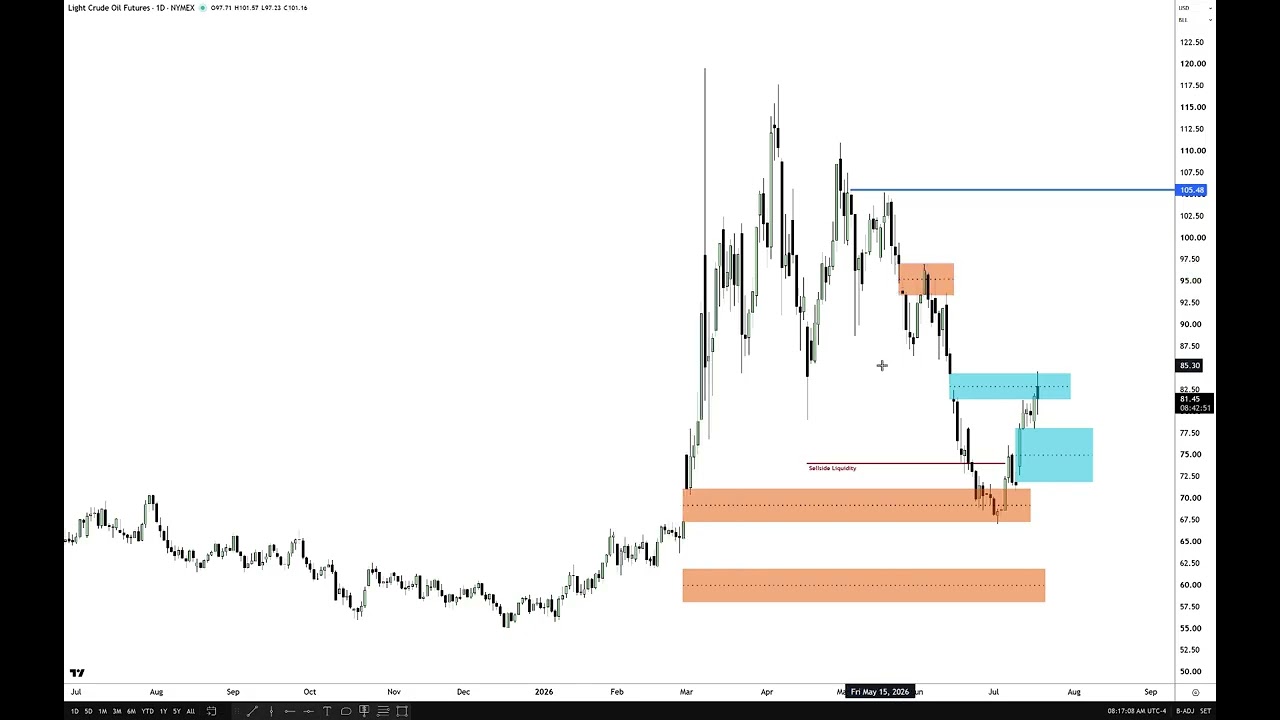
    – Crude oil: ran up but is risky to trade now because geopolitics can move it violently; the speaker thinks it could go much higher ($180–200/bbl) but warns against trading it recklessly.
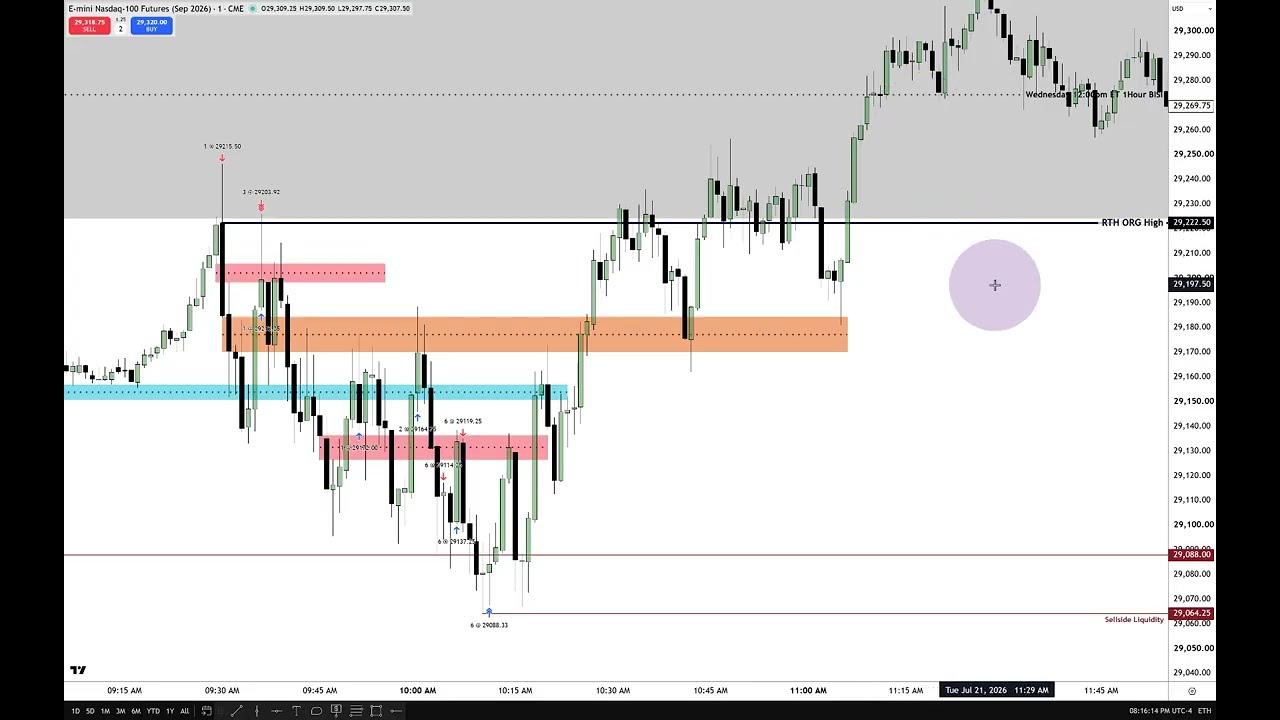
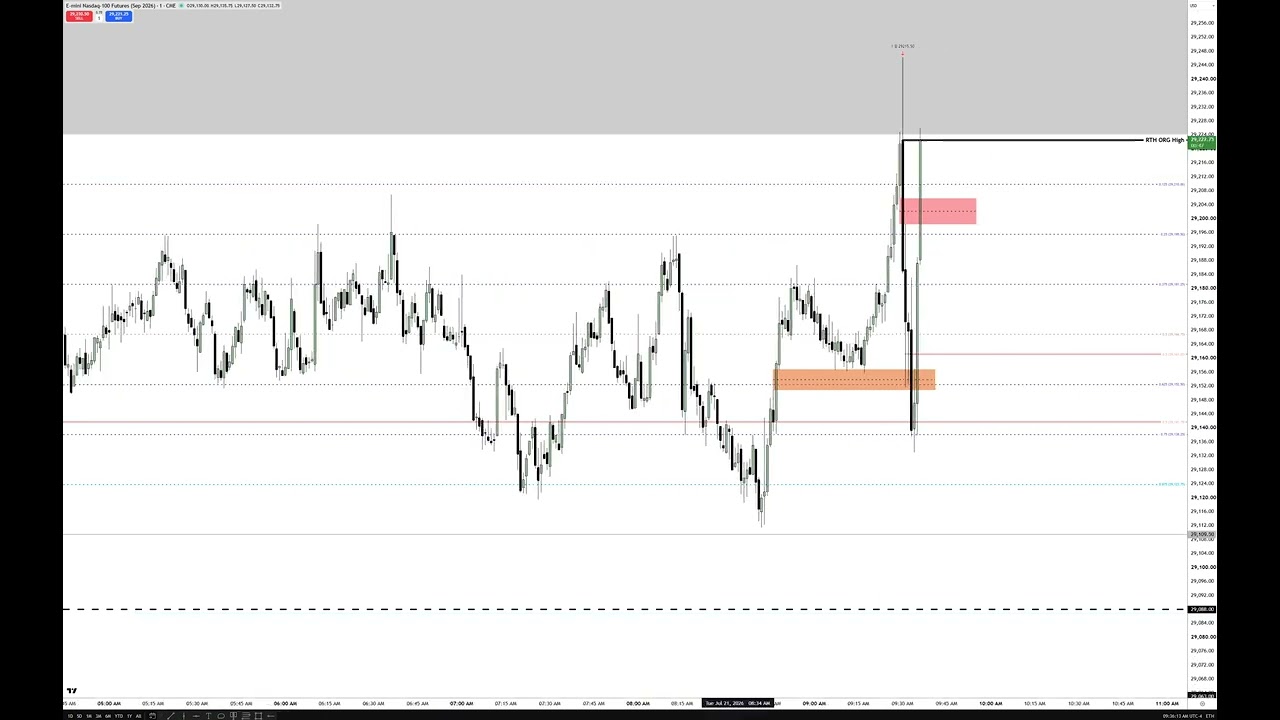
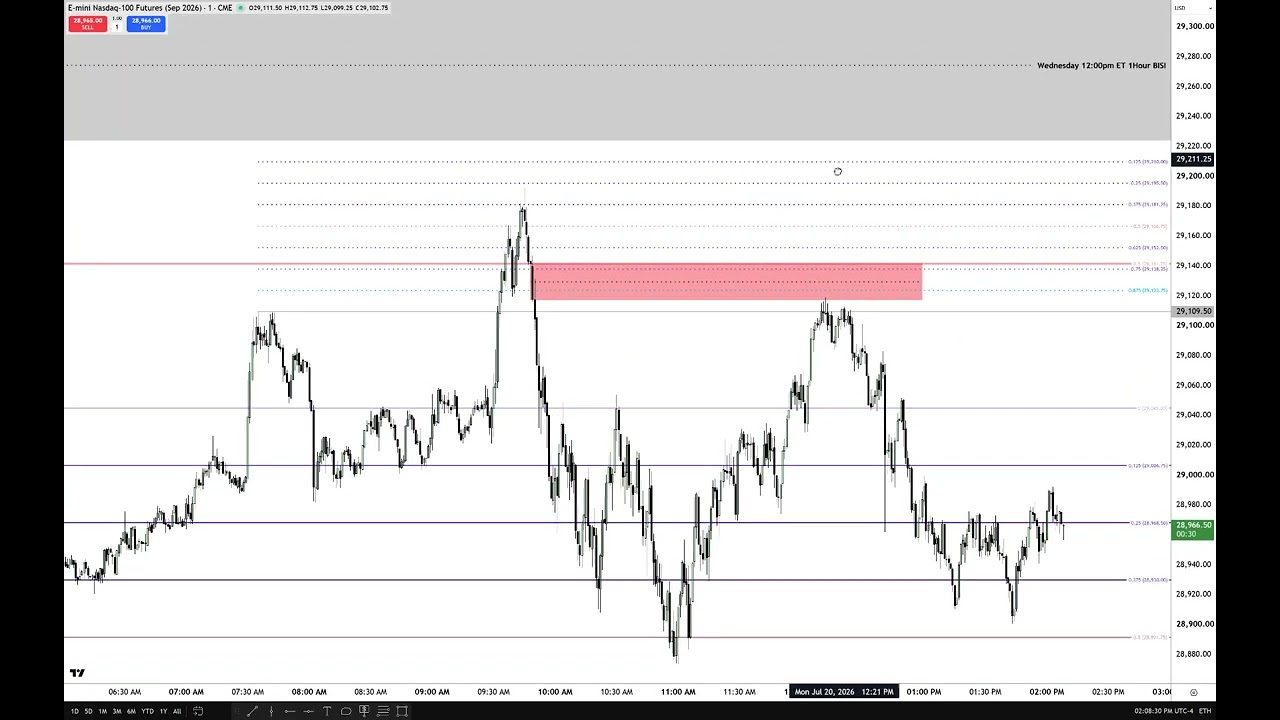
    – Equities (E-mini S&P / Micro NASDAQ): trading in an ugly range. Watch specific volume/imbalance levels—only bullish if price trades and reclaims inversion fair value gaps. A potential new Fed chair could be a catalyst for a pronounced rally, but that’s speculative.

    Tone and recap:
    – Markets are unpredictable right now—many political/geopolitical influences. The speaker emphasizes caution, risk management, and learning rather than forced trading. They’ll be back with live commentary after their break.

    Quiz

    1) According to ICT, what should traders do during Passion Week / the upcoming week he referenced?
    A. Increase trading frequency to capture volatility
    B. Avoid trading with real money and use practice/demo instead
    C. Aggressively trade commodities only
    D. Move all positions to long-term holds

    2) How does ICT describe the gold and silver markets in the transcript?
    A. Fair and easy to trade for beginners
    B. Highly manipulated and risky, often driven by big institutional interests
    C. Always bullish and safe to hold long-term
    D. Unaffected by event-driven forces

    3) What did ICT say would likely happen if the dollar index “loses this imbalance and go lower”?
    A. Dollar strengthens and Euro/pound fall
    B. Dollar weakens and Euro/pound rise
    C. No significant change across FX pairs
    D. Immediate global market crash

    4) Which condition would cause ICT to change his current bearish stance on Euro dollar to a bullish one?
    A. If Euro dollar trades above and reclaims the inversion fair value gap he identified
    B. If gold and silver both spike simultaneously
    C. If crude oil drops below $50 per barrel
    D. If unemployment numbers are revised downward

    5) What did ICT recommend regarding contract size / leverage for index trading this year?
    A. Use full leverage and standard E-mini contracts for maximum gains
    B. Focus on micro contracts (e.g., MNQ) to avoid overleveraging and encourage smaller risk
    C. Only trade options, never futures
    D. Avoid all index trading completely

    Answer Key
    1: B
    2: B
    3: B
    4: A
    5: B

    Evidence from the transcript (timestamps not available):

    Q1 Evidence (supports answer B):
    – “because of uh or observance next week of the resurrection of our Lord and Savior Jesus Christ… I’m not engaging price action. I’m not trading that. Usually not commenting at all.”
    – “don’t take any trades right now. Practice and demo. Just practice. Read price action…”

    Q2 Evidence (supports answer B):
    – “This market, just like gold, is extremely manipulated.”
    – “they suppress it. They’re paper markets… these markets will do it because it’s the good old boys behind it all.”

    Q3 Evidence (supports answer B):
    – “If we lose this imbalance and go lower, then we’re probably going to see some pressure on dollar index and the Euro dollar and pound dollar will be allowed to go higher.”

    Q4 Evidence (supports answer A):
    – “if it were to trade above that then I would expect this to become a reclaimed bullish fair value gap but right now the characteristic that it’s under … is that of inversion fair value gap”
    – “I’m looking for Euro dollar to give up the ghost and make a run below this low… But if this gets violated to the upside much like Euro dollar then I’m probably wrong.”

    Q5 Evidence (supports answer B):
    – “I told everybody I would be focusing on that market this year for the sake of encouraging you all not to be trying to overlever your accounts. So what do we have here? We have this wick… MNQ, this is the micro NASDAQ.”

  • ICT 2026 Market Commentary \ March 21, 2026

    ICT 2026 Market Commentary \ March 21, 2026

    https://youtu.be/YrBrgUON9fE

    Summary:

    – Opening: Live market commentary focusing on one teaching — “time distortion” — and chart-based analysis across the dollar index, FX (EUR/USD, GBP/USD), commodities (oil, gold, silver), Bitcoin, and US indices.

    – Time distortion (key lesson): When price sits in a prolonged range on a low timeframe, go to higher timeframes to see the true structure and the inefficiencies (fair-value gaps/volume imbalances) price is trying to resolve. Use the behavior of candlestick bodies relative to the midpoint of those inefficiencies to infer institutional order flow (bodies staying in the lower half = bearish; in the upper half = bullish).

    – Dollar index: Currently in large consolidation with structural shifts. ICT is biased to dollar staying firm or moving higher (flight-to-quality because of ongoing war), but names a clear “line in the sand” — loss of a specific suspension block/volume-bounce zone — that would flip the view bearish and favor higher EUR/GBP.

    – FX (EUR/USD, GBP/USD): Mixed/50–50 setups; direction depends on what the dollar does. Seasonal tendencies could push EUR/GBP higher later, but war and broader uncertainty are overriding factors.

    – Commodities & metals:
    – Crude/Brent: Expect significant upside (mentions targets into $150–$180+ for Brent).
    – Gold & silver: Recent sell-offs after failing key levels; watching for gaps/“consequent encroachment” and possible further downside. Silver is especially event-driven and volatile.

    – Bitcoin: In protracted consolidation with a bearish lean; has specific lower targets if it breaks key lows, though a break above recent highs would turn the bias bullish.

    – US indices: Bearish bias across Dow, S&P, NASDAQ supported by intermarket divergences (SMT) and distribution signals; specific downside targets given (e.g., NASDAQ ~22,779.75 continuous-contract target). Advises focusing on continuous contracts for structural analysis rather than individual delivery months.

    – Trading guidance / risk management:
    – In uncertain, event-driven markets (war, gaps), reduce trade frequency and leverage; be prepared to be wrong.
    – Use continuous futures contracts for top-down analysis.
    – Record timestamps of calls/levels for accountability.
    – If you can’t grasp these concepts within months, reassess your approach — the rules presented are simple and rule-based, not subjective.

    Overall: Market environment is conflicted and risky; use higher-timeframe context, fair-value gaps/volume imbalances, continuous-contract analysis, and conservative sizing to navigate time-distorted price action.

    Quiz – Recap and Test Your Memory

    1) According to ICT, what is the primary way to “fix” time distortion when price is stuck on a low timeframe?
    A. Lower your leverage and trade less frequently
    B. Go up to a higher timeframe to see the inefficiency it is trying to reach
    C. Use only one-minute charts and scalp more
    D. Switch to a different market entirely

    2) When doing top-down analysis of index futures, which contract type does ICT emphasize using for clearer, smoothed higher-timeframe information?
    A. Front-month delivery contract (e.g., June)
    B. Continuous contract (no month code)
    C. Spot cash index only
    D. Only monthly options expiries

    3) ICT identifies a specific “line in the sand” level for the dollar index. What defines that level?
    A. A simple round psychological price level
    B. A moving average crossover
    C. “This volume imbalance low, volume imbalance high” and a suspension block / inversion fair value gap
    D. Fibonacci retracement 61.8%

    4) What is ICT’s overall bias on the major equity indices as expressed in the livestream?
    A. Strongly bullish and expecting sustained new highs
    B. Neutral — no clear bias
    C. Bearish — expecting distribution and lower targets (e.g., Dow, ES, NQ draws)
    D. Only intraday scalping bias, no directional view

    5) What risk-management action does ICT recommend in the current uncertain (war-driven) market environment?
    A. Increase leverage to chase bigger moves
    B. Maintain usual trading frequency and risk
    C. Dial back trading frequency and lower leverage to smallest sizes
    D. Always hold positions overnight to capture weekend gaps

    Answer key:
    1: B
    Evidence: “What time distortion mean?… How do you fix it?… you go up to the higher time frames. … We’re in a one minute. We’re go up to a five minute. … Above 5 minute… 15-minute. It’s already jump off the chart at you.” (time-distortion section, near end)
    2: B
    Evidence: “When you’re looking at trading the indicy market, are you referring to the continuous contract at all?… you always see me go to the continuous contract. … If you look up here. If you see a month ever, that’s not continuous contract. … it’s continuous contract because there’s no month being mentioned here.” (continuous contract discussion)
    3: C
    Evidence: “you got this volume and bounce low, volume and bounce high. This is like the line in the sand for me. If we lose this, then I’m I’m not so optimistic for dollar.” (dollar index discussion)
    4: C
    Evidence: “I’ve been sticking to I’m bearish on all the indices, and I’m telling you where my targets are… We’re seeing heavy distribution here. … that’s why I’ve been sticking to I’m bearish.” (indices discussion)
    5: C
    Evidence: “Whenever I have been confronted with uncertainty, my experience has taught me to dial back frequency, dial back the desire to want to participate and then lower leverage. That means go down to the smallest leverage you can do.” (risk-management / war discussion)

  • ICT 2026 Market Commentary \ March 19, 2026

    ICT 2026 Market Commentary \ March 19, 2026

    https://youtu.be/w2zTfhjScDg

    Summary:

    Overview
    – Live market commentary and teaching on price action across multiple instruments; the speaker uses concepts like fair value gaps, consequent encroachment, volume imbalances, event-horizon midpoints, and buy/sell-side liquidity pools.
    – Repeated emphasis on risk management, selective trading, and that his commentary is not investment advice — do not trade solely on what he says.

    Market views (short form)
    – Micro E‑mini NASDAQ (NQ/MNQ): Watching for a drop to a specific sell‑side liquidity level (~24,485); if price closes below certain wicks/gaps, expect continued downside.
    – Dollar Index: Bias is firm-to-higher; sees prominent discount wick and volume/balance structure that supports further strength. If dollar is firm, expect EUR/GBP weakness.
    – EUR/USD: Bearish bias if bodies stay below a key wick/encroachment level; watching sell‑side liquidity pools and an unresolved fair gap.
    – GBP/USD (Cable): Expects a move lower toward a sell‑side liquidity pool if the pair confirms inversion/fair-value gap behavior; describes the market‑maker sell model and entry/validation rules.
    – Bitcoin/crypto: Speaker is skeptical and personally doesn’t trade crypto; expects lower prices long‑term, outlines how he would manage partial exits if short. Warns of mania and high risk.
    – Gold & Silver: Prefers caution—metals showing signs of a smart‑money exodus (especially silver, where he cites delivery shortages). Recommends taking profits rather than holding into potential deep retracements.
    – Crude Oil: High volatility and manipulation; he personally avoids trading it despite expecting higher prices longer term.
    – S&P (ES): Noted gaps, volume imbalances, and price actions that suggest potential continued downside; March 19, 2026 flagged as a defining day for direction.

    Trading methodology & rules highlighted
    – Primary tools: OHL(C) levels, fair value gaps, consequent encroachment (midpoints), volume imbalances, and liquidity pool mapping — rule‑based, visual order-flow reading rather than reliance on on‑tick internal footprint data.
    – Event horizon (midpoint between lows/highs) used as targeting/partial-exit technique.
    – Inversion fair‑value gap validation requires specific price behavior (closes, reclaims, midpoint tests) before treating zones as tradeable.
    – Position management: use partial exits at structurally meaningful midpoints; take profits and preserve capital; be selective — don’t overtrade.

    Warnings, commentary & community
    – Markets are unusually manipulated and volatile; avoid trading into major news (e.g., FOMC) and be wary of hype.
    – Strong criticism of paid gurus, rebranded/leaked mentorship content, and people who misinterpret his methods; he offers most teaching for free and stresses learning the rules before arguing.
    – Personal/philosophical remarks: he teaches to protect traders from self-inflicted losses, values humility and charity, and encourages using trading gains to bless others rather than chase status.

    Tone & intent
    – The presenter is candid, often colorful, and mixes technical teaching with personal anecdotes and strong opinions. Primary goals: educate on a rule‑based price‑action framework, prevent unnecessary losses, and build disciplined traders.

    Quiz – Recap

    1) According to ICT, what does he explicitly tell viewers regarding taking trades based on his live commentary?
    A. He encourages viewers to copy his trades exactly.
    B. He warns viewers not to take trades based solely on his commentary.
    C. He suggests viewers should always trade during his livestreams.
    D. He advises viewers to use maximum leverage when following his ideas.

    2) What is ICT’s short-to-intermediate bias for the U.S. Dollar Index (DXY) in this session?
    A. Bearish — he expects the Dollar Index to fall significantly.
    B. Neutral — he has no view on the Dollar Index.
    C. Bullish/Firm — he is not bearish and expects it to stay firm or go higher.
    D. He recommends closing all Dollar positions immediately.

    3) Which statement best reflects ICT’s relationship with Bitcoin/crypto
    A. He is long large positions in Bitcoin and recommends others buy.
    B. He actively day-trades crypto and teaches intraday crypto strategies.
    C. He has never traded Bitcoin/crypto and personally would not touch it.
    D. He runs a paid crypto mentorship and solicits students for crypto trades.

    4) What guidance did ICT give regarding gold and silver in the livestream?
    A. He urged viewers to aggressively buy and hold both metals for massive gains.
    B. He warned that metals could retrace, advised taking profits, and noted delivery/supply issues in silver.
    C. He recommended ignoring risk management for precious metals.
    D. He said silver has abundant physical supply and no delivery risk.

    5) What is ICT’s stance on trading crude oil during the market environment he described?
    A. He recommends active trading in crude oil because it’s stable and predictable.
    B. He advises treating crude like a “rattlesnake” and not trading it due to extreme volatility and geopolitical risk.
    C. He suggests using high leverage in crude to maximize gains.
    D. He states crude oil prices are irrelevant and offers no opinion.

    Answer key (with evidence from transcript and approximate location in the recording):

    1) Correct answer: B
    Evidence: “guys are taking trades based on what I’m saying and I asked you not to do that. I know do not do that stuff.” (Opening portion of the transcript / early in the livestream)

    2) Correct answer: C
    Evidence: “I’m not bearish on dollar index. So that means I’m expecting lower prices on euro, lower prices on pound dollar… I personally don’t think that we’re done with the dollar index going up higher.” (Dollar Index section / early–middle)

    3) Correct answer: C
    Evidence: “I have never traded Bitcoin. I’ve never traded crypto… I wouldn’t touch it. I wouldn’t trade it. And that’s just my opinion.” (Bitcoin section / middle of the transcript)

    4) Correct answer: B
    Evidence: “When we were trading here, I said it would be univilized for you not to be taking profit in silver and gold… There is no silver to take delivery of… So the people that were holding it to take delivery, what’s their incentive to hold the contract? None.” (Gold & Silver sections / middle of the transcript)

    5) Correct answer: B
    Evidence: “don’t trade it. … Crude oil doesn’t make sense. It doesn’t make sense. There’s so much volatility now… Treat it like a rattlesnake. … I’ll admire you from a distance, but I’m not trying to touch you because it’s going to bite you.” (Crude oil section / middle of the transcript)

  • ICT 2026 EOD Market Review \ March 13, 2026

    ICT 2026 EOD Market Review \ March 13, 2026

    https://youtu.be/l7hRTBvK7to

    Summary:

    – ICT reviews end-of-week price action and emphasizes a trading concept he calls “immediate rebalance” — a price delivery behavior (PD Array) he codified — which recently hit his target precisely on the dollar index and signaled directional moves.
    – Dollar strength (immediate rebalance) translated into clear selling opportunities in dollar-quoted FX pairs (EUR/USD, GBP/USD, AUD/USD, etc.); EUR/USD and GBP/USD behaved largely as he expected.
    – Technical themes he repeatedly uses: fair value gaps, consequent encroachment (50% midpoint of wicks), rejection blocks, discount/ premium wicks, order blocks, volume imbalances, and gradient levels (quadrants/octants). These guide entries, targets and invalidation.
    – Commodities: crude needs a close above the wick midpoint to confirm a run higher; gold remains range-bound with possible lower pullback; silver he expects could be manipulated lower (cites historical precedent) and may fall quickly if key levels break.
    – Equity futures (micro E-Mini S&P and micro Nasdaq): he anticipates a weak Sunday open (gap down) and continuation lower toward prior lows; recommends using micro contracts and paper/demo trading given current volatility.
    – Trade example: he discussed a micro trade where market structure, fair value gaps and discount wicks informed entry/stop management; TradingView paper-trading glitches limited his ability to modify stops.
    – Practical advice and risk notes: use demo/micro to practice, don’t rush to trade live, be cautious over the weekend due to geopolitical risk, and allow trades room to breathe in volatile markets.
    – Mentorship/philosophy: he positions himself as a price-action teacher who shares concepts freely, defends his methodology against critics, stresses discipline and study, and encourages community learning rather than drama.

  • Cooking breakfast and NQ…

    Cooking breakfast and NQ…

    Summary:

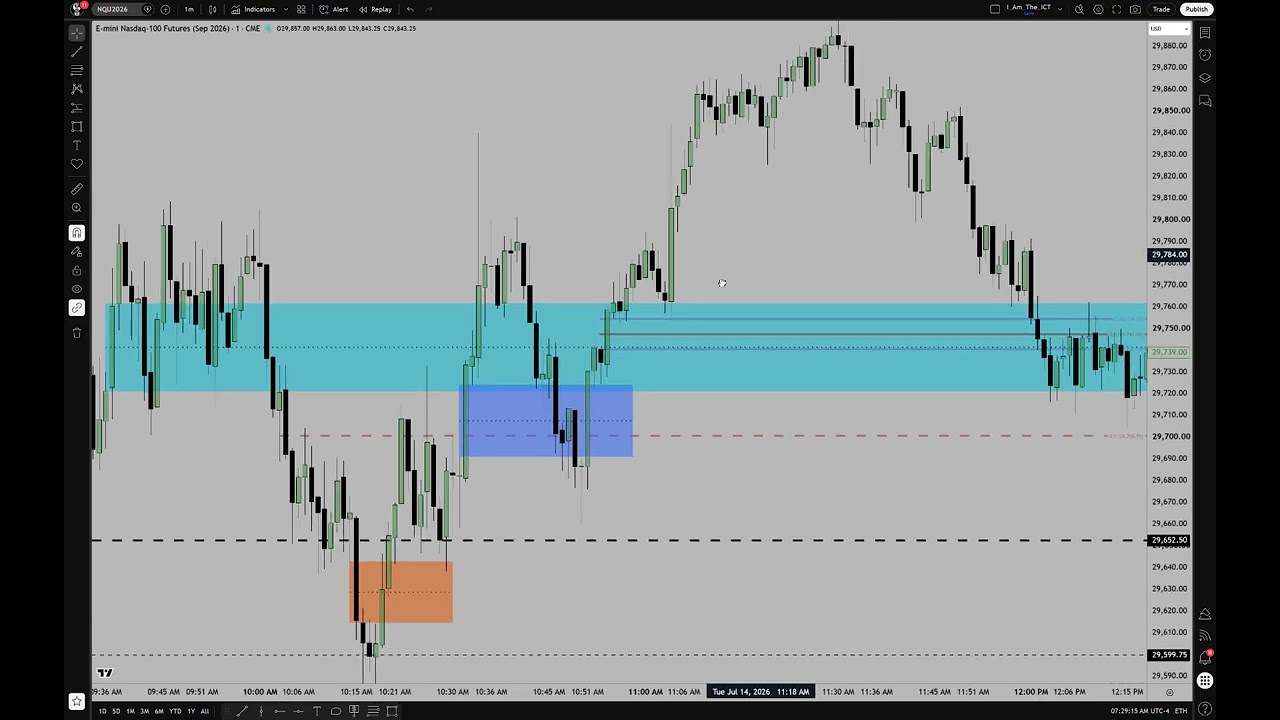
    ICT is describing a short “turtle soup” trade setup: entering short above a recent high with a stop just above the inversion/value gap (around 764.5) and targeting lower precession/liquidity pools near ~723 and the 700-area. The thesis: smart money is selling into retail breakouts, so price should stay in the lower half of the current range, form long black candles, and erode through the blue-box liquidity without accumulation — ideally breaking strongly below ~714. Risk management: trade small (one contract), trail stops above the inversion, accept possible stop-outs from spikes, and remove risk as price moves lower. He emphasizes identifying inline and pooled liquidity as the reason price will decline, warns retail longs will be trapped, and encourages practice to learn the method. The commentary mixes trading instruction with casual multitasking (cooking) and encouragement to follow his approach.

  • Trading FOMC Two Stage Delivery

    Trading FOMC Two Stage Delivery

    https://www.youtube.com/watch?v=7pW4-84U1RE

    Summary:

    Here’s a brief, clear summary of the lecture (Sept. 17, 2025) on trading FOMC two-stage delivery and the NASDAQ session:

    – Context: Rolled into the December NASDAQ futures contract; lecture uses both daily and 1-minute charts to connect higher- and lower-timeframe structure.
    – Core trading philosophy: Focus on specific price points (opens/closes), volume balance, fair value gaps (FVGs), liquidity pools, inefficiencies, and market structure — avoid “trying to pick the top.” Intraday shorts are acceptable, longer swings usually follow the trend.
    – Model 2022 (the speaker’s method): Run Fibonacci from relevant high to low, look for price to trade above 50% (premium), and use the classic 3/4 pullback “optimal trade entry” into FVG/inefficiencies for entries. (Instructor insists this is not “Goldbach” or “Enigma.”)
    – Key levels and tools: grade HTF inefficiencies and quadrants onto LTF charts (upper/lower quadrant, consequent encroachment, premium/discount wicks, volume imbalances) — these are more precise than simple S/R.
    – Definitions: premium wick = wick above a candle body; discount wick = wick below body. Distinguish FVGs from volume imbalances when annotating trades.
    – Day’s structure / trade examples (NASDAQ): morning run then bearish shift in structure; identification of buy- and sell-side liquidity pools and unfinished business; speaker shorted in the morning, re-entered around the FOMC using the Model 2022 rules, and described being stopped out on one attempt.
    – FOMC “two-stage delivery”: initial move at 2:00 (first stage), a pause/during the press conference, then a second distinct follow-through (second stage) — be surgical: get in/get out and avoid overtrading during consolidation.
    – Practical tips: always transpose higher-timeframe levels onto lower-timeframe charts, maintain a multi-timeframe journal, print/annotate notes, and review the session replay (clip posted on X).
    – Macro observations: Dollar index viewed as bearish until it forms constructive bullish arrays; Euro had a tight FOMC spike then rejection — FX was generally sloppy and less tradable intraday.

    Main takeaway: trade with precise, multi-timeframe level grading (volume/FVG/liquidity concepts) and use the Model 2022 entry rules, especially on FOMC days where moves commonly occur in two distinct stages. Good discipline, quick execution, and journaling are emphasized.

    Quiz

    1) How does ICT describe the “optimal trade entry” in his Model 2022?
    A. A 50% retracement on any swing
    B. A 3/4 pullback in an impulsive price leg into a small inefficiency/fair value gap
    C. Buying the daily low and holding for weeks
    D. A simple moving average crossover

    2) According to ICT, when does the “second stage” of FOMC delivery often begin intraday?
    A. 9:30 AM
    B. 2:00 PM
    C. 2:30 PM
    D. 4:00 PM

    Answer Key with evidence

    1) B — “the optimal trade entry, which is simply just a 3/4 pullback in a impulsive price leg like this, and then running up higher into this small little inefficiency right there.”

    2) C — “Usually there’s a another wave of price action that begins at 2:30 and whatever the high or the low is, usually it’ll run for it.”

  • Trading All Time Market Highs

    Trading All Time Market Highs

    https://www.youtube.com/watch?v=pn1OgwxlK4U

    Summary:

    – ICT emphasizes patience and warns against building premature expectations. He will share lecture notes via Telegram, YouTube, and his website; beware of impersonators and scams—he will never DM you.
    – Main topic: trading markets at or near all-time highs. Key principle: markets at highs are more likely to keep making higher highs, so avoid trying to predict the top.
    – Tactical guidance (daily-timeframe focus):
    – Treat down-close/up-close candles and their closing prices as rejection blocks and reference points.
    – Expect overshoots below the previous day’s close (bear traps) that lure shorts before strong rebalances higher.
    – Look for buy-side imbalances, fair-value/efficiency gaps, and “premium candle wicks” (and their midpoints/consequent encroachments) as areas of discount sensitivity where rallies often resume.
    – Immediate rebalances back to prior candle highs commonly produce strong bullish moves.
    – Risk management: don’t trade real money impulsively, avoid overleveraging, and accept occasional losses—manage trades so no single position can wipe you out.
    – Practical advice: study historical charts across markets (stocks, Forex, futures) to recognize these repeating price behaviors; stay bullish until price convincingly proves a breakdown.

    Quiz

    1) According to ICT, when a market is trading at all-time highs, it is:
    A. Very likely to immediately reverse and crash
    B. More likely to continue to post higher all-time highs
    C. Equally likely to go up or down with no bias
    D. Impossible to trade and should always be avoided

    2) Which price feature does ICT call a “rejection block” that tends to promote new runs higher in price?
    A. Price trading above up-close candle highs
    B. Price trading under down-close candles’ closing prices
    C. Long upper wicks only
    D. Opening gaps that never rebalance

    3) What behavior near all-time highs does ICT describe as a common “bear trap”?
    A. Market gaps higher and never looks back
    B. Market trades below the previous day’s close (overshoots) enticing traders to short, then reverses higher
    C. Market forms tight low-volatility ranges for weeks
    D. Market shows immediate, sustained reversal confirmed in one candle

    4) What is ICT’s recommendation about leverage and risk management?
    A. Use maximum leverage to chase gains at all-time highs
    B. Overleverage but use many positions to diversify
    C. Avoid overleveraging so a single trade can’t take you out of the game
    D. Never use stop losses under any circumstance

    Answer key with evidence

    1) B — More likely to continue to post higher all-time highs
    Evidence: “When a market is trading at all-time highs, it is more likely that it will continue to post higher all-time highs.”

    2) B — Price trading under down-close candles’ closing prices
    Evidence: “Look for price to trade under down close candles. closing prices. These are rejection blocks and they tend to promote new runs higher in price.”

    3) B — Market overshoots below the previous day’s close, enticing shorts, then reverses higher
    Evidence: “it tends to create these little bear traps where it doesn’t just simply go back to the previous day’s close, it goes beyond that and trades lower… They’re going to think the market’s going to keep going lower… and that’s what the market makers tend to do… these are just very generic principles…” and “When that happens, generally, you’re going to see a very, very strong reaction… the market’s going to immediately launch higher from there.”

    4) C — Avoid overleveraging so a single trade can’t take you out of the game
    Evidence: “If you’re fearful that it’s going to take you out of the game on any one particular trade… then you’re probably over overleveraging… No trader should ever have their leverage or gearing on their trades that high.”

  • 2025 Storytellers Series – Daily High To Low June 21, 2025

    2025 Storytellers Series – Daily High To Low June 21, 2025

    https://www.youtube.com/watch?v=ixKzHykP0CY

    Summary:

    – ICT reviews his analysis and live execution on the September NQ futures for trading Friday, June 20/21, 2025, and references a pre-market video he posted at 4:50 a.m. ET on X/Twitter that outlined his bias and expected price behavior.
    – He had a bearish bias: he didn’t expect new highs, predicted price would overlap a specific daily range (marked on charts), and warned of weekend gap risk driven by Middle East geopolitical developments (Iran/Israel and likely U.S. involvement).
    – His methodology centers on identifying repeated, high-probability levels using multi-timeframe concepts (long/intermediate/short swing highs), PD arrays, order-blocks, inefficiencies (“CIBI”/“BISI”), opening-range and fair-value-gap logic—levels he says repeat and produce reliable setups.
    – Using that framework he executed a market-maker sell model: shorted into the rally above Wednesday’s daily high, pyramided, and captured the subsequent drop and gap closure. The trade largely unfolded as he predicted; some wick action briefly pierced a level but bodies respected his structure.
    – He emphasizes that this skill is gained through long experience and disciplined backtesting and cannot be shortcut by courses, signal services, or copying; his teaching aims to make students self-sufficient rather than dependent.
    – He also mentions technical issues with his Camtasia recordings (static screenshots during live recording) and explains why he doesn’t trade fully live for large audiences (broadcasting entries would degrade execution).
    – Throughout he asserts the uniqueness and proprietary nature of his approach, challenges others to replicate it, and stands by the pre-market call he posted publicly.

    Quiz

    1) Which commonly taught concept did ICT say is “infancy” and not the framework he uses?
    A. Supply and demand
    B. Elliott Wave
    C. Market profile
    D. Fibonacci retracement

    2) Why did ICT say he avoids doing live executions for large audiences?
    A. He prefers private mentoring only
    B. Copying by many viewers would remove liquidity and throttle his specific fills
    C. Legal/regulatory reasons prevent live trading
    D. He doesn’t want to reveal his P&L

    Answer Key and Evidence

    Q1 Answer: A
    Evidence: “This is why I’m not supply and demand. Supply and demand is infancy. It’s it’s it’s lacking a lot.” (transcript)

    Q2 Answer: B
    Evidence: “What happens if just oh, I don’t know, 10% of them, five% of them all try to get the same fill I’m aiming for, I’m probably not going to get filled. … it’ll it’ll distort or throw off or thwart my edge, my my very specific element of entry.” (transcript)

  • 2025 Lecture Series – Keys To Success In Troubled Markets June 16, 2025

    2025 Lecture Series – Keys To Success In Troubled Markets June 16, 2025

    https://www.youtube.com/watch?v=L6DHi1iXRW0

    – He’s rolling out of the June NASDAQ (NQ) contract and will reference September 2025 contracts going forward (NQ, ES, DAX).
    – Market context: current environment is a “troubled market” — chaotic consolidation/time distortion driven by geopolitical risk — causing low willingness to trend and large gap risk.
    – Chart analysis (daily → 1-min/30-sec): key reference is the Feb. 24 daily level (consequent encroachment / “cibby”), several fair value gaps and liquidity pools, and a recent failure to reach a longer-term upside target. Price has been oscillating around quadrant levels (low, midpoint, upper quadrant, high) and leaving liquidity and volume-imbalance signatures.
    – Trading approach in this environment: be nimble, stop thinking only in classic support/resistance, use algorithmic/order-flow concepts (consequent encroachment, fair value gaps, premium/discount anchored to breaks of structure). Aim for setups that offer sufficient edge (he looks for ~15 handles net on NQ before entering shorts).
    – Risk & trade management: he uses very tight, precise stop placement (often 1–2 ticks above/below defined micro levels) and proprietary “PD arrays” that he will not teach or reveal. He stresses that he’s not giving trade advice and that risks are unusually large now.
    – Personal notes: brief anecdote about his family and puppy, reiterates he won’t disclose broker relationships or certain methods, and confirms future analysis will use the September contract.

  • 2025 Lecture Series – EurUsd & NQ Futures June 11, 2025

    2025 Lecture Series – EurUsd & NQ Futures June 11, 2025

    https://www.youtube.com/watch?v=CxT_b32UsB0

    Brief market update and context
    – Speaker has been tied up with a family matter; this is a short commentary on the NASDAQ, EUR and macro risks.
    – Main theme: expect higher prices for NASDAQ (continuing the prior bias), but be cautious because near-term volatility is likely.

    NASDAQ technical view
    – Daily: price has been repeatedly encroaching a prior wick/imbalance (daily CBI from Feb 24, 2025) and is tracking toward a cluster of fib/“consequent encroachment” levels and quadrant boundaries.
    – The speaker has no open position; would be comfortable stepping to the sidelines if price fills the fair-value gap. He stresses that in the current climate professionals avoid pressing edges.

    Macro calendar / risk advice
    – CPI today and PPI tomorrow create a high-volatility “Molotov cocktail.” Don’t trade aggressively; this is a poor environment for taking high risk or overtrading.
    – General market stance is risk-on (dollar weak, euro/gold/silver expected higher), but short-term moves from data releases are unpredictable.

    Commodities and fundamentals
    – He prefers commodities (gold/silver) over equities because of clear supply/demand drivers—believes metals have further upside, especially silver for industrial demand.

    EUR and trading process
    – Euro: previously signaled levels—if they break down, expect sideways consolidation; if they hold, higher prices remain likely.
    – Emphasis on journaling, experience, and having a tested model; novices should avoid gambling in messy market conditions.

    Personal / closing
    – Limited trading activity this week; small missed opportunities but content to sit out.
    – Thanks listeners for prayers; a reminder to be careful this weekend (U.S.) and to trade conservatively around data.