Year: 2026

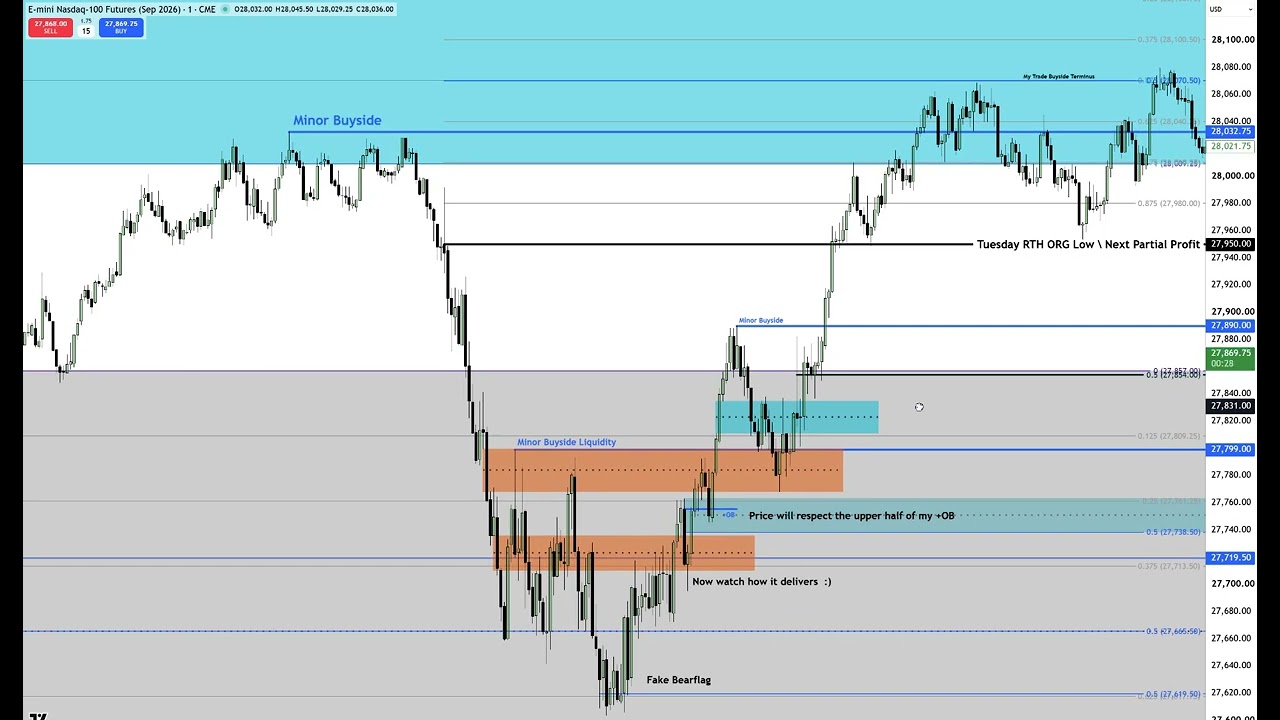
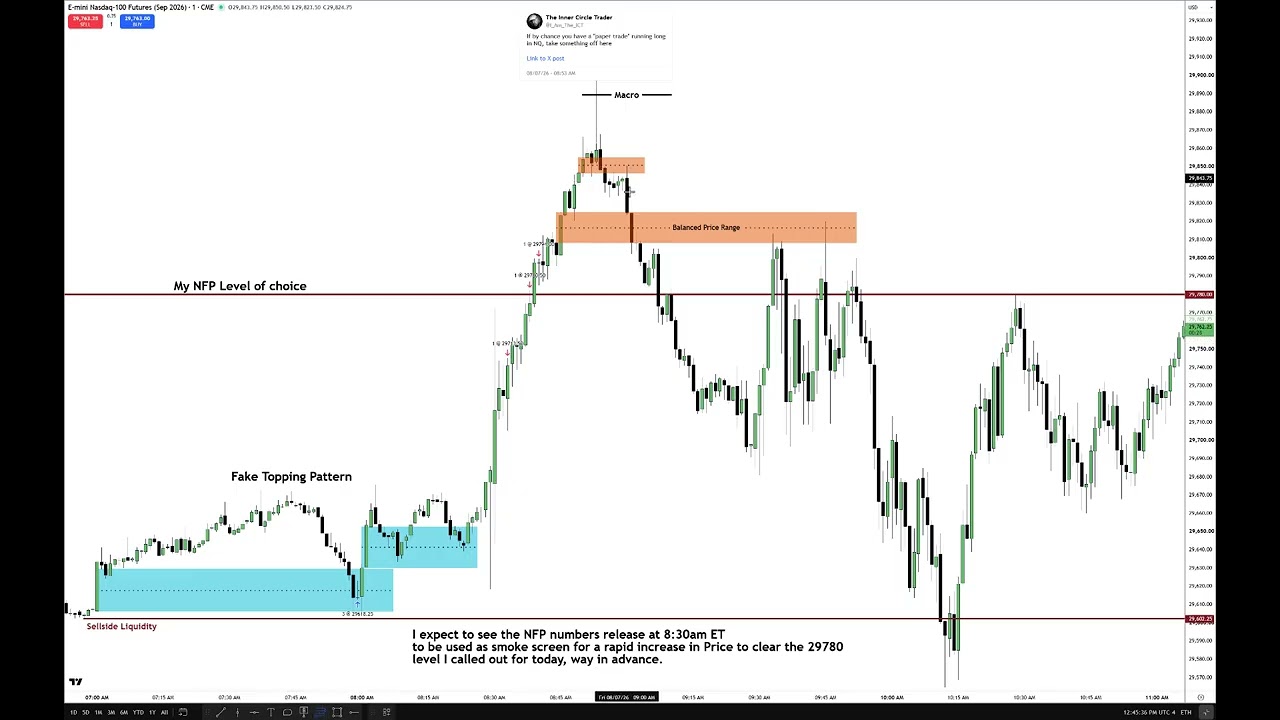
  • NQ Futures Review & Commentary \ June 02, 2026

    NQ Futures Review & Commentary \ June 02, 2026

    https://www.youtube.com/watch?v=bqmqylAuLcI

    Summary:

    Micheal reviews a morning NQ trade executed from a phone, explaining the technical framework that guided entries and exits.

    Key observations: relative equal highs formed during the London session and relative equal lows later; the trader prefers to start watching for higher-probability moves at 6:00 a.m. into the 7–9 a.m. pre-session. The trade used smart‑money concepts: buy- and sell-side liquidity, accumulation/distribution structure, breaker patterns, volume imbalances, and an inversion fair value gap (important: inversion gaps require a candlestick close to be validated, unlike order blocks).

    Execution: a small initial two-contract long was entered anticipating a re-test of the inversion FVG, added into a bounce/encroachment, then flipped/added and scaled out as price breached minor sell-side levels and cleared the relative equal lows. The plan targeted a terminus objective and captured a significant down leg; partial profits were taken along the way. Final notes: watch relative equal highs/lows as liquidity magnets, avoid picking tops, and be patient—the “early bird” window around 6 a.m. is often where reliable runs begin.

  • NQ Futures Review & Commentary \ May 28, 2026

    NQ Futures Review & Commentary \ May 28, 2026

    https://www.youtube.com/watch?v=NS5EcfChL3o

    Michael gives a pre-market review of the Nasdaq futures (NQ), recapping yesterday’s livestream and outlining a short bias based on liquidity structure and price/time alignment.

    Key points:

    – He graded two pools of liquidity anchored to specific lows and drew an equilibrium line; anything above that premium side was a candidate to short aiming to push below those lows.
    – Yesterday’s market showed a rapid “blowoff” drop, a deferred delivery back into the range, then a selloff that ultimately hit the targeted area (just below his graded level).
    – He emphasizes looking for algorithmic behavior tied to specific price/time windows (notably ~9:50–10:10), stop hunts, and precise price anchors rather than vague indicators.
    – A preferred setup was a candlestick overlapping a gradient level forming an inversion/fair-value-gap (an ICT-style validation) used to enter shorts; the execution produced the expected speed and distance.
    – Quick ES (S&P) note: price action there displayed clean imbalances and efficient runs—ideal low-resistance liquidity conditions—whereas congested, candle-stacking markets are less desirable.
    – Practical advice: establish a premise, grade ranges by time and price, watch for inefficiencies/imbalances, manage risk (take profits or reduce size if the market becomes choppy), and let price/time align before committing.

    He closes saying he’ll provide a forex/dollar update after the futures session.

  • NQ Futures Review & Commentary \ May 27, 2026

    NQ Futures Review & Commentary \ May 27, 2026

    https://www.youtube.com/watch?v=qf5qokimwO4

    Here’s a concise summary of the livestream:

    – Focus: Review of the NASDAQ/ES daily charts and a live intraday example showing how the speaker reads price action to identify short opportunities even inside a primary bull market.
    – Instruments & accounts: Recommends micro contracts for small or inexperienced accounts (and for prop-firm trading) to reduce risk and size.

    – Market context: Predicted a post‑May rally after taking out relative highs, then identified a specific daily volume‑imbalance area that would act as a magnet for price and a likely place for a short‑term reversal.

    – Key technical concepts taught: read the open/high/low/close, spot volume imbalances, fair‑value gaps (and inversion FVGs), “consequent encroachment” and inefficiencies after blowoff runs, and use measured moves/standard‑deviation projections to set targets.

    – Trade rules and mindset: prefer short setups that show quick, one‑direction fills of inefficiencies; use fulcrum/measure moves and -2 SD projections for precision; accept being stopped if overleveraged is avoided; novices (<~1–2 years) should favor longs in a bull market.

    – Execution example: identified an intraday fair‑value gap and volume imbalance, entered a short around the open with a built‑in buffer, saw a clean drop to the target but missed some of the larger move—used the experience as intel.

    – Warnings and advice: don’t rely on “gimmicks” or paid holy‑grail claims; develop price‑reading language/discipline; keep capital and living expenses in reserve (two years, ~$100k suggested) before trading full‑time.

    – Operational note: will reduce public real‑time detail in future live trading to avoid influencing other traders’ orders; continues to teach concepts and critique poor mentorships.

    Main takeaway: focus on clean price‑action reading (open/high/low/close, volume imbalances, fair‑value gaps), manage risk and position size, gain experience before aggressively shorting into a bull market, and use measured projections to plan entries and targets.

  • Oil Review & General Commentary

    Oil Review & General Commentary

    https://www.youtube.com/watch?v=dwMgP2zkH0w

    – Market backdrop: Prices are largely driven by geopolitical news (U.S./Israel/Iran) — stay cautious and avoid chasing volatile instruments.
    – Recent price action: After a gap down, the author expected further weakness and described a quick, profitable short based on 15‑minute and 1‑minute patterns (relative equal lows, an inversion/fill of a volume/price imbalance). Stop was placed above the swing high.
    – Dollar/FX: The dollar (DXY) is stuck in a range, so USD-based major forex pairs are quiet; non‑USD (exotic or cross) pairs show more movement.
    – Metals: Gold and silver have shown capitulation-like behavior after big rallies. ICT advised taking profits earlier and is currently sidelined on metals, not bullish on silver.
    – Crypto: Bitcoin failed to push past the 127k area, then sold off. Key supports to watch are the mid/high‑tens of thousands (noted ~49.7k) and then the ~24–26k area; downside risk remains.
    – Trading stance: The author is being cautious, practicing on demo for indices (ES/NQ) and not trading live due to fickle market conditions.
    – Takeaway: Be selective, follow price structure and risk management, and avoid markets the author has flagged to “leave alone.”

  • Return of Michael | May 27, 2026

    Summary — main points and takeaways

    – Personal update: Michael has been family-focused and relaxed; others shared family news (graduation) and appreciation for reconnecting.

    – Market conditions and trader sentiment: Price action has been difficult lately; many traders face drawdowns, shaken confidence, and frustration. Michael expects conditions may worsen and advises prudence.

    – Trade less, trade better: When markets are hard, be highly selective—reduce participation, focus on high-probability setups, and avoid revenge or overtrading driven by emotion.

    – Continuous study matters: Even profitable traders benefit from ongoing learning, backtesting, journaling, and revisiting core concepts. Adding new PD arrays/techniques slowly strengthens models and trade conviction.

    – On teaching and claims of mastery: Beware of shortcuts and people selling oversimplified systems. Mastery takes time and foundation; claiming full understanding after consuming limited material is misleading.

    – PD arrays, fair value gaps, imbalances and macros: Discussion of PD arrays (rebalance, redelivery, reclaimed), implied P.D Arrays (less visible/less rigid), nested inefficiencies, and how macros/time-of-day (e.g., 20-minute windows) can support or negate price moves. These tools provide anticipatory edge when combined with market structure and narrative.

    – Global applicability: Michael’s concepts translate across markets (reports of success in Indian Nifty, China, Japan, Africa), supporting the idea of common algorithmic behaviors across exchanges.

    – Practical trade management: To capture larger runs, scale up gradually—use partial exits, leave runners, desensitize yourself to unrealized gains through journaling and incremental exposure. Accept missed opportunities rather than forcing trades.

    – Automation and macro data bots: Building a macroeconomic-data-driven tool is feasible and marketable, but complex and likely a long-term project; large firms are actively interested in such capabilities.

    – Community and boundaries: The community is supportive; free content (YouTube) is extensive and valuable. Michael appreciates gratitude but prefers focused, question-driven sessions and warns against excessive praise in live contexts.

    – Final tone: Encouragement to study deeply, be patient, marry concepts with market structure and time, and maintain discipline—these produce durable edge even in hard markets.

  • Tapereading \ Practice Session Final Hour ES

    Tapereading \ Practice Session Final Hour ES

    https://www.youtube.com/watch?v=7zlblhLGraA

    Summary:

    Michael describes taking a long trade with a stop loss just below a recent low, targeting the last hour’s relative equal highs (around 3,400–3,450). They watch for accumulation, footholds, fair value gap inversions and order-blocks as entry/validation points, then raise stops to reduce risk as price confirms. The session is slow and “spotty” early, but a run of big green candles and algorithmic buying in the 3:15–3:45 macro window drives a clean rip higher. The trader criticizes sloppy use of “macro” by others, notes this was tradable though not ideal, and ultimately clears positions after the highs are taken out.

  • Market Alchemy – Trading ATH \ May 14, 2026

    Market Alchemy – Trading ATH \ May 14, 2026

    https://www.youtube.com/watch?v=wprXVW1pW9Y

    – Time comes before price. Anchor your charts to New York local time and use vertical time lines—time windows strongly govern predictable market behavior.
    – Key times to watch:
    – Market open / opening price at 9:30 ET (opening range gap).
    – New York “lunch macro” 11:30–13:30 ET (optimal setups usually form in the first hour, 11:30–12:30).
    – PM opening range around 13:30–14:00 ET (use this for the late session and evening sessions).
    – Opening range gap: the gap between the prior close and the opening price is a useful reference. It often fills, acts as discount/premium arrays, and can become a trampoline for continuation in the direction of the higher timeframe.
    – Combine time with price projections: measure the opening-range gap and use Fibonacci/standard-deviation multipliers (he refers to roughly 6.5–7.5 “SD” levels empirically) to project targets. Use these projections in the specific time windows (especially the lunch macro) for higher-probability signals.
    – Liquidity mechanics: expect stop-hunts and liquidity runs (micro spikes that are later “redelivered”). Markets often move to clean out liquidity (everyone’s stop losses) before reversing.
    – Trade selection & risk management:
    – Be highly selective shorting at all-time highs; inexperienced traders should avoid aggressive shorts against a strong higher-timeframe trend.
    – Use limit orders placed around known wicks/relative equal lows/highs for exits; take partial profits and be mindful of one-tick overruns.
    – If market is sloppy or choppy, don’t trade—wait for clearer setups (e.g., next morning pre-market).
    – Markets behave algorithmically and repeat patterns at specific times—studying the time+price relationships repeatedly builds the necessary edge.
    – Practical advice: practice, study the time-based methods, and be patient—experience is required to execute these techniques reliably.

    Bottom line: prioritize time structure (NY time windows), measure opening-range gap projections, expect liquidity grabs, manage risk carefully (especially when trading against the higher-timeframe trend), and practice consistently to internalize these repeatable patterns.

  • Turning Loss Into Gain – Market Alchemy

    Turning Loss Into Gain – Market Alchemy

    https://www.youtube.com/watch?v=d8du4fMvOQU

    – Context & setup: The speaker walks through a live trade using an inversion/fair-value-gap as a long entry, targeting the 8:30-news candlestick high. The plan is to buy in the lower half of the gap, wait for a candlestick close inside/above key levels, and push price toward the buy-side liquidity zones.

    – Technical rules emphasized: watch candlestick bodies (preferably staying in the upper half of the gap), respect wick/correction closes (a close above the corrective wick is confirmation), and prefer a fast, low‑candle-count rip (speaker wanted <7 candles to first partial).

    – Risk & position management: use stops below the relevant candlestick low, scale into/out of the position (take partials at meaningful highs), move stops to reduce risk, and keep a small residual position if necessary rather than over‑leveraging.

    – Market behavior: describes frequent stop-hunts, manual intervention/“manipulation,” and baiting of retail shorts. These conditions require more active management and patience compared with clean, low-resistance liquidity runs.

    – Psychology & process: accept losses as part of trading; don’t fear stops; avoid revenge trading or overtrading after a stop; follow rules and a consistent model. Experience desensitizes the trader to market “jump scares.”

    – Teaching philosophy: there are no shortcuts—learning comes from watching price and practicing. The speaker rejects flashy marketing and emphasizes practical experience, journaling, and developing one’s own approach rather than copying others.

    – Practical takeaway: trade the plan, manage risk proactively (partials and stop moves), monitor each new candlestick to see if it still supports the thesis, and prioritize consistent process and experience over chasing perfect trades.

  • When It Finally Clicks… | May 9, 2026

    ICT opens a live podcast to announce a major personal change: he is stepping away from his provocative trading persona (“ICT”) and much of his market-focused teaching to devote himself to his Christian faith, family, and sharing the Gospel.

    Key points:
    – His wife, sister, and brother-in-law recently received the Holy Spirit; this and other spiritual experiences (including a strong impression to “remove the profane”) triggered a deeper conversion and renewed spiritual calling.
    – He feels God has released him from using a profane, attention-grabbing persona to attract an audience; he no longer wants to rely on that style and intends to stop being primarily the ICT market teacher.
    – He will significantly reduce or stop live streams, paid mentorship, market calls, and daily trading content (he even says he will not trade again), though he doesn’t rule out occasional market commentary.
    – He plans to focus on Bible study and faith content; he will not monetize that channel for profit and promises any ad revenue will go to St. Jude (with audits).
    – He urges generosity, warns that money and trading won’t save people from coming hardships, and acknowledges some followers may leave but accepts that outcome.

    Overall: grateful and resolved, he’s closing the ICT chapter to prioritize faith, family, and a life that reflects his renewed spiritual convictions.

  • Post ICT Livestream | April 29, 2026

    Summary:

    – Participants praised Michael’s live masterclass for clearly demonstrating his price-action methodology (PD arrays, fair value gaps, gradients) in real time and showing how textbook concepts apply during live markets.
    – Core technical themes: use PD arrays/gradient levels, fair value gaps (FVGs), order blocks, suspension blocks, wicks/encroachment, and quadrant/array positioning to judge directional bias and trade decisions.
    – Macros/time: trade during defined macro “kill-zone” times (5010 macros) when possible — win rate and expectancy improve. Don’t trade ahead of macro events; use macro windows or enter shortly after if price supports the move.
    – Grid lines: horizontal lines = price levels; vertical lines = time. Michael declined to teach proprietary/time-secret techniques beyond basic session/kill-zone times.
    – Practical rules: prefer simplicity and consistent rules (if-then logic). Backtest, paper-trade in a lab, and prove concepts to yourself rather than chasing complexity or FOMO.
    – Trade management: look for signature behaviors (e.g., staying in upper/lower halves for bullish/bearish bias), use the largest/tallest relevant wick for anchoring, and avoid setups that spend too many candles inside a PD array (around five candles wears out the setup).
    – Timeframes: if small‑timeframe inefficiencies look fragmented, go up one timeframe to clean/merge them into a single actionable inefficiency. Use a 20-day lookback to collect salient PD arrays (shorter lookbacks can still work).
    – Gap-and-go logic: large opening-range/gap setups (gap-and-go) are high-probability triggers—e.g., gap into a 25% quadrant and fail to run higher → short in gap-down cases (and vice versa).
    – Behavioral advice: control emotions, avoid trading on FOMC/volatile multi-event days (or trade demo), prioritize discipline over overtrading, and practice patience.
    – Props vs personal accounts: consider allocating capital to a personal account rather than overrelying on prop firm accounts—trading your own capital is often easier and more practical long-term.
    – Next content: Michael plans additional lectures and PD-array releases later in the year (including more on the Reaper array, but some advanced time methods will remain undisclosed).

    Overall message: stick to simple, repeatable price-level rules, trade during macros, validate methods via backtesting/paper labs, manage emotion and risk, and focus on consistent execution rather than chasing secret techniques.

    Quiz

    1) According to ICT, what is his primary instruction regarding trading around macro times (e.g., 50/10 macros)?
    A. Always position yourself well before the macro begins to capture the full move.
    B. Avoid trading during macros; only trade long after they finish.
    C. Do not trade ahead of the macro; trade during the macro or just after it.
    D. Macros are irrelevant—only price matters, never consider macro times.

    2) Why does ICT refuse to fully teach certain time-based techniques to the community, as explained in the transcript?
    A. He thinks time-based techniques are worthless and don’t help trading.
    B. He considers some time knowledge proprietary/too advanced and believes many students would choke on that extra complexity.
    C. He forgot the details and never recorded them.
    D. He prefers students to invent their own time methods without guidance.

    3) When a trader sees many small imbalances or “broken pieces” on a 1-minute chart, what does ICT recommend doing to simplify and clean up inefficiencies?
    A. Keep using the 1-minute chart and manually pick the cleanest wick.
    B. Go up one time frame (e.g., to 2- or 3-minute) to merge and clean those pieces into one inefficiency.
    C. Ignore the imbalances and trade only larger timeframes such as daily.
    D. Delete prior session data to reduce clutter.

    4) When trading near all‑time highs with a large bullish opening gap, which price behavior did ICT say would make him more inclined to trust a continuation (“gap and go”)?
    A. Price immediately smashes through the upper quadrant level without hesitation.
    B. The upper quadrant is traded to, price flirts just below it and shows interest (doesn’t smash through), indicating continuation.
    C. Price trades only in the lower half and stays bearish.
    D. Multiple candles form inside the gap for a long time, indicating strong continuation.

    5) For building a matrix of salient PD arrays and relevant opening prices, what look-back period did ICT recommend as a good baseline?
    A. Last 5 days only
    B. Last 10 days only
    C. Last 20 days (with options to go 40 or 60)
    D. Last 365 days

    Answer Key with evidence

    1) Correct answer: C
    Evidence: “Don’t try to predict the move or be positioned ahead of the macro. … don’t try to trade ahead of the macro. Trade either during the macro time or just after it as long as you’re in close proximity to what starts that trade.” (Transcript, ICT response)

    2) Correct answer: B
    Evidence: “There are things in time that I was very honest and told you all as a community that I would not divulge… I’m not going to breach that line. I’m not going to change it. … And many of you think that if you had it, it would help you. You would go crazy with it because I was on the edge of that. So, just know that it’s not necessary.” (Transcript, ICT response)

    3) Correct answer: B
    Evidence: “What you can do is just go back — go up one time frame. … It can in a one minute perspective, it looks like it’s two broken. But if you do it as a two minute or a three minute, it may give you a better cleaner inefficiency to work with. So, it kind of like helps you consecutive where there’s volume imbalances.” (Transcript, ICT response)

    4) Correct answer: B
    Evidence: “If we have a gap higher … when the upper quadrant gets traded to and it flirts with it just below that, but then says I’m not going to go any lower, then I would be more inclined to trust that it’s going to be gap and go. If it’s really wanting to to go lower and be heavy, it’ll smash through that upper quadrant level and just cut right through it.” (Transcript, ICT response)

    (related time references in transcript concerning highs/gaps: ICT referenced the all-time highs context and gap behavior; also discussed specific intraday wick at “9:47 Eastern time” as a wick he highlighted during the live stream.)

    5) Correct answer: C
    Evidence: “So, yes, you going you’re going to go back 20 days and everything that you would utilize within your model … You’re going to go back 20 days, and everything that you would utilize within your model and what PD array that you like to use or implement, you’re going to look for all of them. … Yes, 20 days, 40 days, and 60 days look back. But you can’t you can’t do wrong if you’re going back the last five days.” (Transcript, ICT response)