
https://www.youtube.com/watch?v=DRTvbkKmuAw
– Opening remarks and brief apology for a distracted recording; personal anecdote about family and a live-stream discussion.
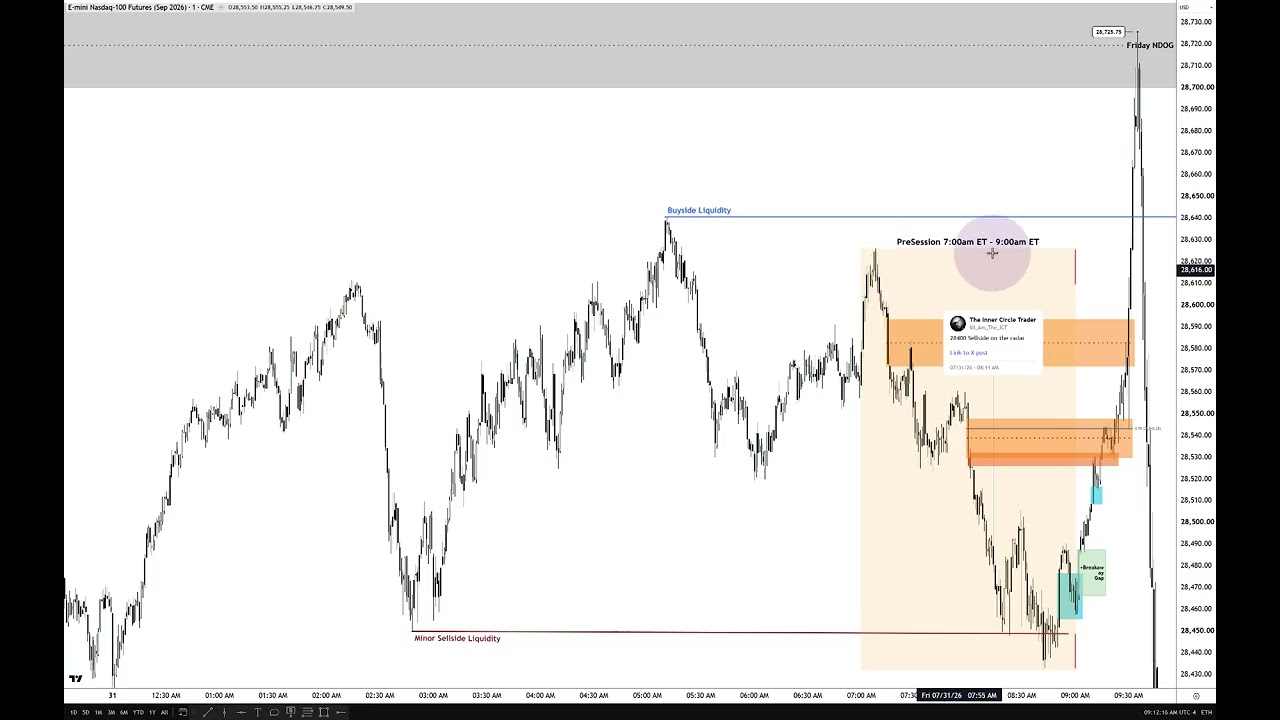
– Core trading idea: focus on a specific, finite pre-market time range (pre-session 7:00–9:00 a.m. ET). Treat that window as the primary data sample for the regular session.
– Methodology: anchor a Fibonacci to the highest high and lowest low inside the 7–9 a.m. range, then project precise horizontal price levels (quadrants/octants, midpoints) forward as key reference points.
– Key price-structure concepts used: buy-side imbalances / sell-side inefficiencies, inversion fair value gaps, breakaway gaps, consequent encroachment — all tethered to specific candles and the time-based range.
– Practical rule: levels must be precise and time-anchored (not vague “zones”); trades are anticipatory (based on those specific levels and the 9:01+ behavior), not reactive.
– Example: he publicly identified and shorted the daily high in a recent session, targeted ~28,400, and the market reached the projected area—used to demonstrate the method’s predictive value.
– Broader approach: use the last 3 days for intraday low/high projections; combine daily and intraday references (wicks, opening gaps) to refine targets.
– Teaching philosophy and criticism: urges students to study and verify (not blindly trust), defends against trolls/copycats, and stresses the mental effort and discipline required to master the method.
– Summary takeaway: a time-anchored, level-specific framework (pre-market 7–9 a.m. + precise technical constructs) yields high-probability, anticipatory trade setups when applied consistently.
Leave a Reply