
https://www.youtube.com/watch?v=NPU4gsM9jqA
Summary:
– The speaker defends long-form trading education over short-form clips, saying brief videos can’t teach the depth and context his lessons provide. He makes students “work for it” and posts free, detailed lectures across platforms (YouTube, X, ICT spaces).
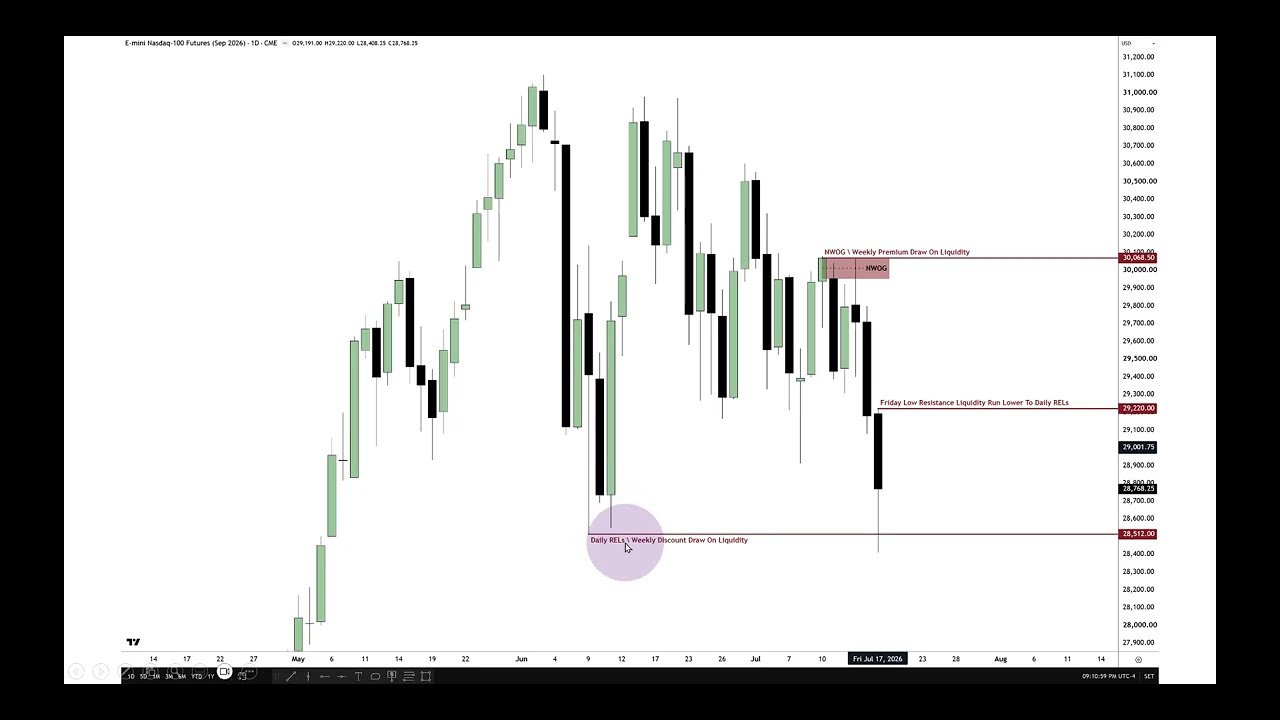
– Core teaching: use higher-timeframe structure (daily chart) to forecast the weekly range and key price targets before intraday action unfolds. He emphasizes suspension blocks, volume imbalances, fair value gaps/inefficiencies, and relative equal highs/lows as the primary draws for price.
– For the week in question he predicted in advance a “new week opening gap” in a premium area that would limit upside and act as the weekly draw to lower prices—specifically the daily relative equal low at ~28,512. He documented this view daily and used it to guide intraday reads.
– Market rhythm: Monday–Wednesday were harder (news like CPI/PPI), while after Wednesday PM the market became low‑resistance and produced easy directional runs (Thursday/Friday). Session opens (especially 7:00am pre‑market and 9:30am regular open) provide the volatility/“rocket fuel” that executes the weekly draws and liquidity hunts.
– Intraday mechanics shown: short-term buy/sell-side efficiencies, market-maker sell model, and liquidity pools. Electronic trading hours often fill gaps and give early clues before regular trading hours; studying how gaps and overnight prints behave is important.
– TGIF concept: after a weekly low and retrace, the close often retraces to ~20–30% of the weekly range. He used that to forecast the weekly close successfully.
– Main lessons for students: study full lectures, follow the multi-timeframe structure and price signatures, prioritize time and position of sessions, and focus on mapping the weekly targets rather than relying on short clips or simplistic support/resistance ideas.
– Final point: his method is about predicting and proving price behavior before it happens; students should put in the time to learn the process rather than dismiss it based on short excerpts.
Leave a Reply