
https://www.youtube.com/watch?v=4SJlJdIANCo
Summary:
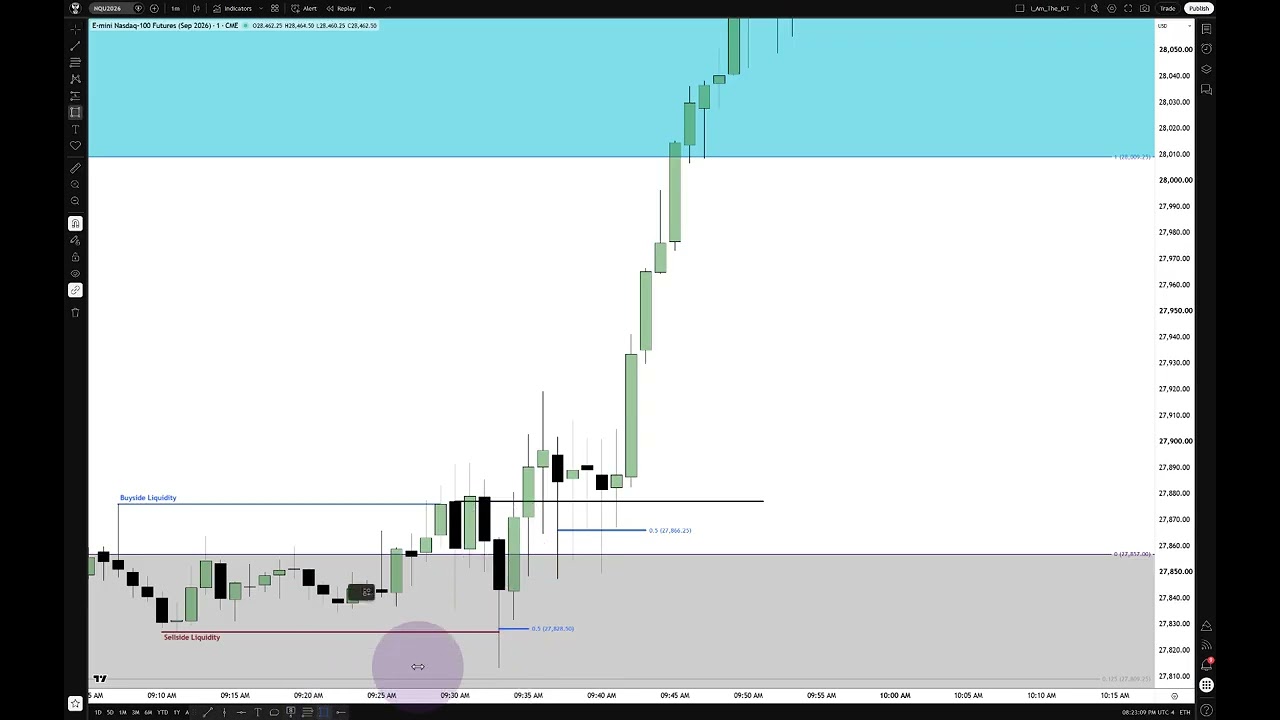
– He reviews the NASDAQ September futures move: an aggressive sell-off at open followed by a fast, efficient rally into a daily-level target, driven by intraday order flow and algorithmic programs.
– Key technical framework: daily “suspension blocks” (shaded blue/gray), octants/quadrants, PD arrays, order blocks, fair value gaps (FVGs) and “buy/sell efficiency” cells. These layered levels anchor where price will turn or continue.
– Important price-action rules he uses: bodies staying in the upper half of a candle = bullish; wicks probing but not closing below midpoints = accumulation; stop-hunts clear retail stops before directional moves; measuring wicks and candle midpoints predicts strength/ failure.
– Time structure matters: he applies a horizontal/vertical time-price grid (macro start times, top-of-hour/macro closes like 10:50 and 11:10) to anticipate where turns and PDAs will form.
– Examples from the session: opening above short-term highs, stop-hunt to take out stops, accumulation in an order block anchored to a daily octant, then a rapid buy program that produced big moves into the daily suspension-block high; later formation of inversion FVGs and retracements that validated his rules.
– Methodology emphasis: predict from repeating algorithmic signatures rather than react; learn the specific language/criteria he teaches, backtest, then tape-read live; one PDA at a time before mastering others.
– Critique of common alternatives: he rejects generic “supply/demand” or momentum-chasing approaches and market randomness claims, arguing markets are algorithmic and can be read with precise rules.
– Teaching philosophy: encourages discipline, independent thought, patient practice, and money management. The goal is to internalize his methods so students can trade independently.
Bottom line: he argues the day’s action confirmed his layered price/time framework and rules for reading order flow, and he stresses learning that language and discipline to predict rather than react.
Leave a Reply