
Summary:
– Opening: Live market commentary focusing on one teaching — “time distortion” — and chart-based analysis across the dollar index, FX (EUR/USD, GBP/USD), commodities (oil, gold, silver), Bitcoin, and US indices.
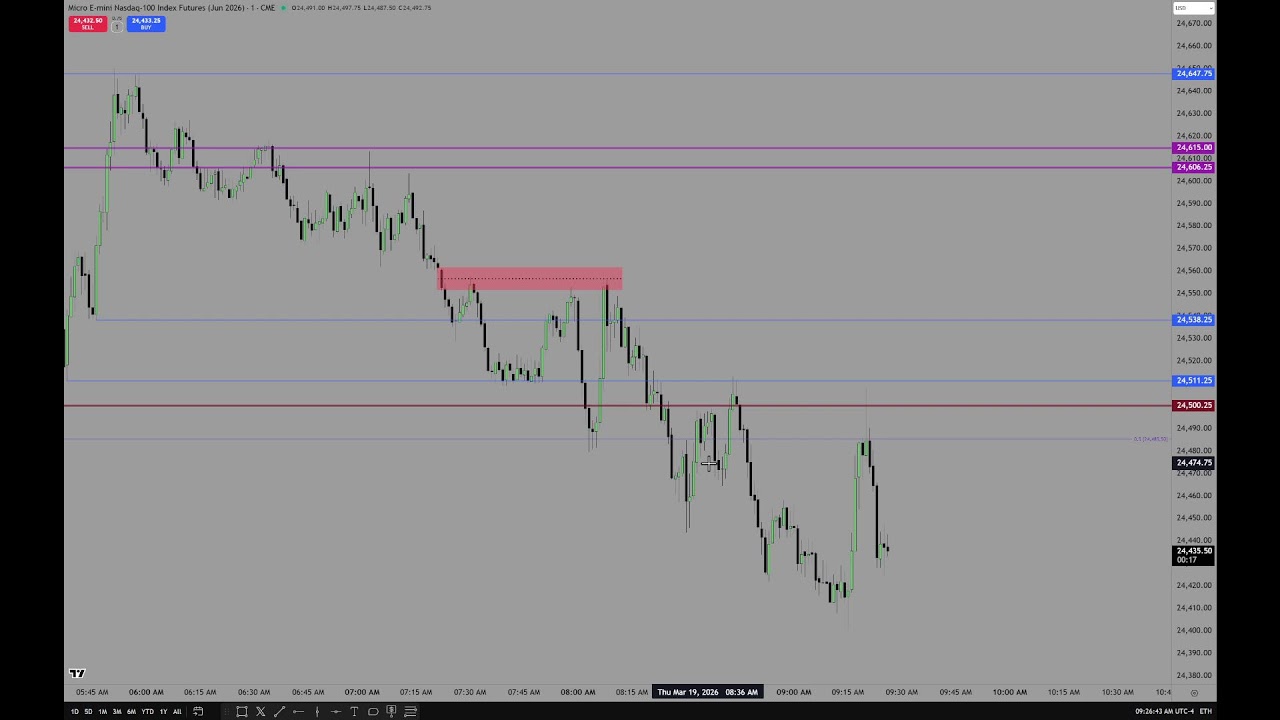
– Time distortion (key lesson): When price sits in a prolonged range on a low timeframe, go to higher timeframes to see the true structure and the inefficiencies (fair-value gaps/volume imbalances) price is trying to resolve. Use the behavior of candlestick bodies relative to the midpoint of those inefficiencies to infer institutional order flow (bodies staying in the lower half = bearish; in the upper half = bullish).
– Dollar index: Currently in large consolidation with structural shifts. ICT is biased to dollar staying firm or moving higher (flight-to-quality because of ongoing war), but names a clear “line in the sand” — loss of a specific suspension block/volume-bounce zone — that would flip the view bearish and favor higher EUR/GBP.
– FX (EUR/USD, GBP/USD): Mixed/50–50 setups; direction depends on what the dollar does. Seasonal tendencies could push EUR/GBP higher later, but war and broader uncertainty are overriding factors.
– Commodities & metals:
– Crude/Brent: Expect significant upside (mentions targets into $150–$180+ for Brent).
– Gold & silver: Recent sell-offs after failing key levels; watching for gaps/“consequent encroachment” and possible further downside. Silver is especially event-driven and volatile.
– Bitcoin: In protracted consolidation with a bearish lean; has specific lower targets if it breaks key lows, though a break above recent highs would turn the bias bullish.
– US indices: Bearish bias across Dow, S&P, NASDAQ supported by intermarket divergences (SMT) and distribution signals; specific downside targets given (e.g., NASDAQ ~22,779.75 continuous-contract target). Advises focusing on continuous contracts for structural analysis rather than individual delivery months.
– Trading guidance / risk management:
– In uncertain, event-driven markets (war, gaps), reduce trade frequency and leverage; be prepared to be wrong.
– Use continuous futures contracts for top-down analysis.
– Record timestamps of calls/levels for accountability.
– If you can’t grasp these concepts within months, reassess your approach — the rules presented are simple and rule-based, not subjective.
Overall: Market environment is conflicted and risky; use higher-timeframe context, fair-value gaps/volume imbalances, continuous-contract analysis, and conservative sizing to navigate time-distorted price action.
Quiz – Recap and Test Your Memory
1) According to ICT, what is the primary way to “fix” time distortion when price is stuck on a low timeframe?
A. Lower your leverage and trade less frequently
B. Go up to a higher timeframe to see the inefficiency it is trying to reach
C. Use only one-minute charts and scalp more
D. Switch to a different market entirely
2) When doing top-down analysis of index futures, which contract type does ICT emphasize using for clearer, smoothed higher-timeframe information?
A. Front-month delivery contract (e.g., June)
B. Continuous contract (no month code)
C. Spot cash index only
D. Only monthly options expiries
3) ICT identifies a specific “line in the sand” level for the dollar index. What defines that level?
A. A simple round psychological price level
B. A moving average crossover
C. “This volume imbalance low, volume imbalance high” and a suspension block / inversion fair value gap
D. Fibonacci retracement 61.8%
4) What is ICT’s overall bias on the major equity indices as expressed in the livestream?
A. Strongly bullish and expecting sustained new highs
B. Neutral — no clear bias
C. Bearish — expecting distribution and lower targets (e.g., Dow, ES, NQ draws)
D. Only intraday scalping bias, no directional view
5) What risk-management action does ICT recommend in the current uncertain (war-driven) market environment?
A. Increase leverage to chase bigger moves
B. Maintain usual trading frequency and risk
C. Dial back trading frequency and lower leverage to smallest sizes
D. Always hold positions overnight to capture weekend gaps
Answer key:
1: B
Evidence: “What time distortion mean?… How do you fix it?… you go up to the higher time frames. … We’re in a one minute. We’re go up to a five minute. … Above 5 minute… 15-minute. It’s already jump off the chart at you.” (time-distortion section, near end)
2: B
Evidence: “When you’re looking at trading the indicy market, are you referring to the continuous contract at all?… you always see me go to the continuous contract. … If you look up here. If you see a month ever, that’s not continuous contract. … it’s continuous contract because there’s no month being mentioned here.” (continuous contract discussion)
3: C
Evidence: “you got this volume and bounce low, volume and bounce high. This is like the line in the sand for me. If we lose this, then I’m I’m not so optimistic for dollar.” (dollar index discussion)
4: C
Evidence: “I’ve been sticking to I’m bearish on all the indices, and I’m telling you where my targets are… We’re seeing heavy distribution here. … that’s why I’ve been sticking to I’m bearish.” (indices discussion)
5: C
Evidence: “Whenever I have been confronted with uncertainty, my experience has taught me to dial back frequency, dial back the desire to want to participate and then lower leverage. That means go down to the smallest leverage you can do.” (risk-management / war discussion)
Leave a Reply