
Summary:
Market views and targets
– Dollar index: bullish; expects higher, with a minor buy-side run toward ~101.97 as an upside objective.
– EURUSD / GBPUSD: bearish bias; price structure and fair-value gaps point to continued downside.
– Crude oil: would be very bullish if Sunday/Monday gap opens above the 50% fib, leaves the gap, then rips higher — a scenario he’s watching, not recommending as a trade.
– Bitcoin: strongly bearish view (ICT’s opinion: long-term collapse to zero); near-term expects lower prices unless short-term highs are decisively reclaimed.
– Gold and silver: bearish near-term; volume imbalances and inversion fair-value gaps argue for a rapid selloff to stated targets (first-half-of-year objectives).
– Equities (Dow, S&P, NASDAQ/MNQ): bias lower with defined first-half (six-month) downside objectives; some intraday targets already met.
Core trading concepts taught
– Volume imbalances / inversion fair-value gaps: use gaps and imbalances as support/resistance; when treated as inverted they can accelerate moves.
– Consequent encroachment and wicks vs. bodies: bodies staying in the lower (or upper) half of a range indicate directional bias; wicks do “damage” (stop runs) while bodies show the narrative.
– Reclaimed (bearish/bullish) fair-value gap: once price closes through a fair-value gap, it can become reclaimed and used as bias confirmation.
– Buy/sell-side liquidity pools: identify where stops/liquidity is concentrated and watch for stop hunts.
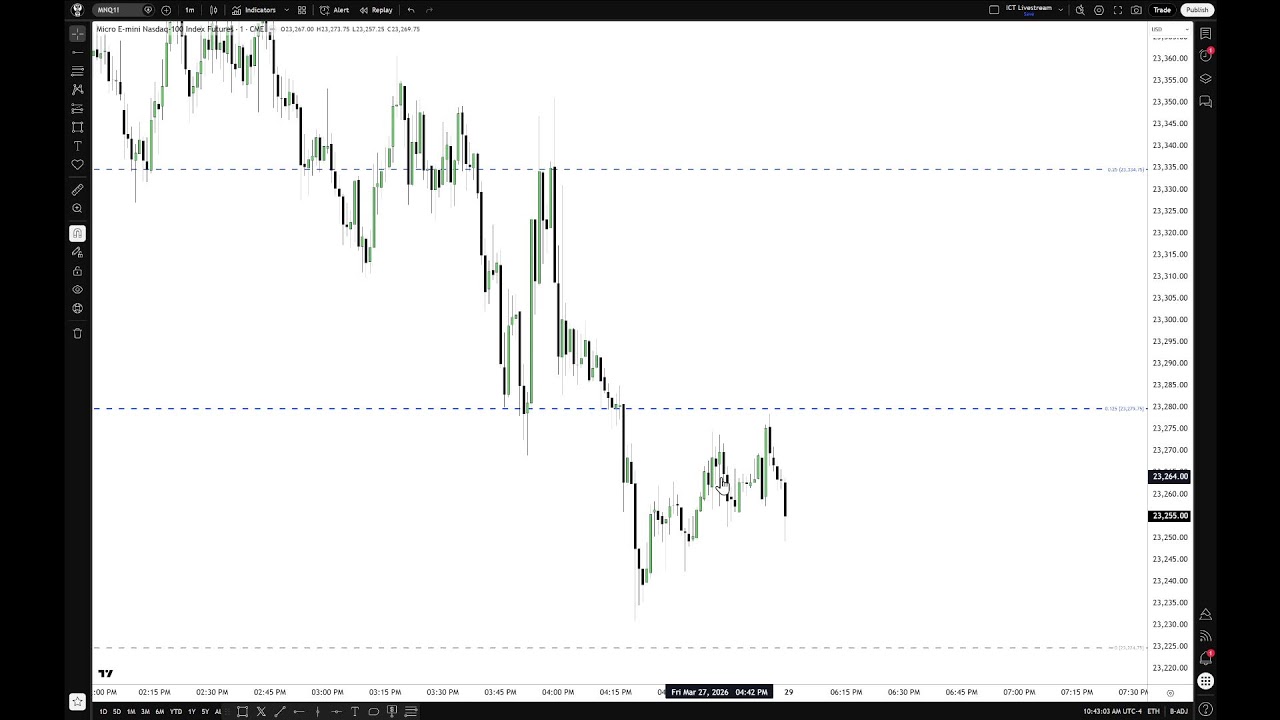
– First hour’s dealing range (key practical lesson): define the range from 9:30–10:30 ET — not the 30-minute “opening range”
– uses the first-hour range to forecast afternoon direction.
– Fibonacci octants/quadrants on first-hour range: project intra-day reaction levels; many moves respect those subdivisions.
– In a trending day, after we have broken 1st hours dealing range. Look for the 1st presented FVG after it is broken, thats the one you want to sell on
-Project the range 1 standard deviation lower and that is your target in a perfect world.
– Add octants to the projected range
– Trailing stops and risk management: trail stops above the high of the last three candles (or use 25%–75% fib slices of a projected range) to lock profits and limit drawdowns. Dont do this every trade
– Trading psychology & risk warnings: paper-trade these methods first; don’t overleverage, avoid treating commentary as hard trade advice, beware holiday/low participation volumes and manipulation.
Practical recommendations
– Re-watch the live-stream segments (first hour, Trader Roundup recordings) for the real-time teaching examples.
– Backtest and log observations; he offers to run a week-long backtest/how-to series if there’s interest.
– Paper trade new methods; be conservative with real money and avoid emotional overleverage.
Tone and context
– Strongly opinionated style with frequent warnings about market manipulation and trolling; live-stream had household noise in the background (noted repeatedly).
Quiz
1) According to ICT in the transcript, what was his directional bias for the dollar index versus Euro and Pound?
A. Bearish on dollar; bullish on Euro and Pound
B. Bullish on dollar; bearish on Euro and Pound
C. Neutral on dollar; bullish on Euro and Pound
D. Bullish on dollar; bullish on Euro and Pound
2) ICT describes a close below “consequent encroachment” on a Eurodollar candle as most indicative of what?
A. A higher probability of price continuing higher
B. A higher probability of price continuing lower
C. Market indecision and likely sideways action
D. Immediate reversal to previous high
3) What time window does ICT define as the “first hour’s dealing range” (Eastern Time)?
A. 9:00–10:00 ET
B. 9:30–10:30 ET
C. 10:00–11:00 ET
D. 11:30–12:30 ET
4) What probability did ICT give that price will attempt to reach the midpoint of the opening-range gap in the first 30 minutes?
A. 30% likelihood
B. 50% likelihood
C. 70% likelihood
D. 90% likelihood
5) What trading practice does ICT explicitly recommend listeners follow when using his commentary?
A. Trade with maximum leverage on live accounts
B. Only trade his signals with real money
C. Paper trade his ideas rather than risking real money
D. Use his commentary to ignore risk management
Answer Key:
1. B
Evidence: “I’m bullish on dollar and I’m bearish on Euro dollar and pound dollar.”
2. B
Evidence: “we close below consequent encroachment, which is indicative of a continuation. It just means it’s much more probability that it’s going to go in this direction lower.” (transcript)
3. B
Evidence: “So, we’re going to go back to 10:30, which is your first hours dealing range… all I’m doing is moving this around until I see 10:30 a.m. at the bottom of the chart… So, there’s your first hours range.” (transcript; references to 9:30 open and 10:30)
4. C
Evidence: “Always anticipate the likelihood because there’s a 70% likelihood that it’s going to try to get to the midpoint of that opening range gap.” (transcript; referencing 9:30–10:00 opening range)
5. C
Evidence: “Paper trading is what you should be doing. If you’re listening to me, just paper trade. If you do it with real money is extremely uncomfortable for me…” (transcript)
Leave a Reply