Summary — key points from the livestream
Market read (overall)
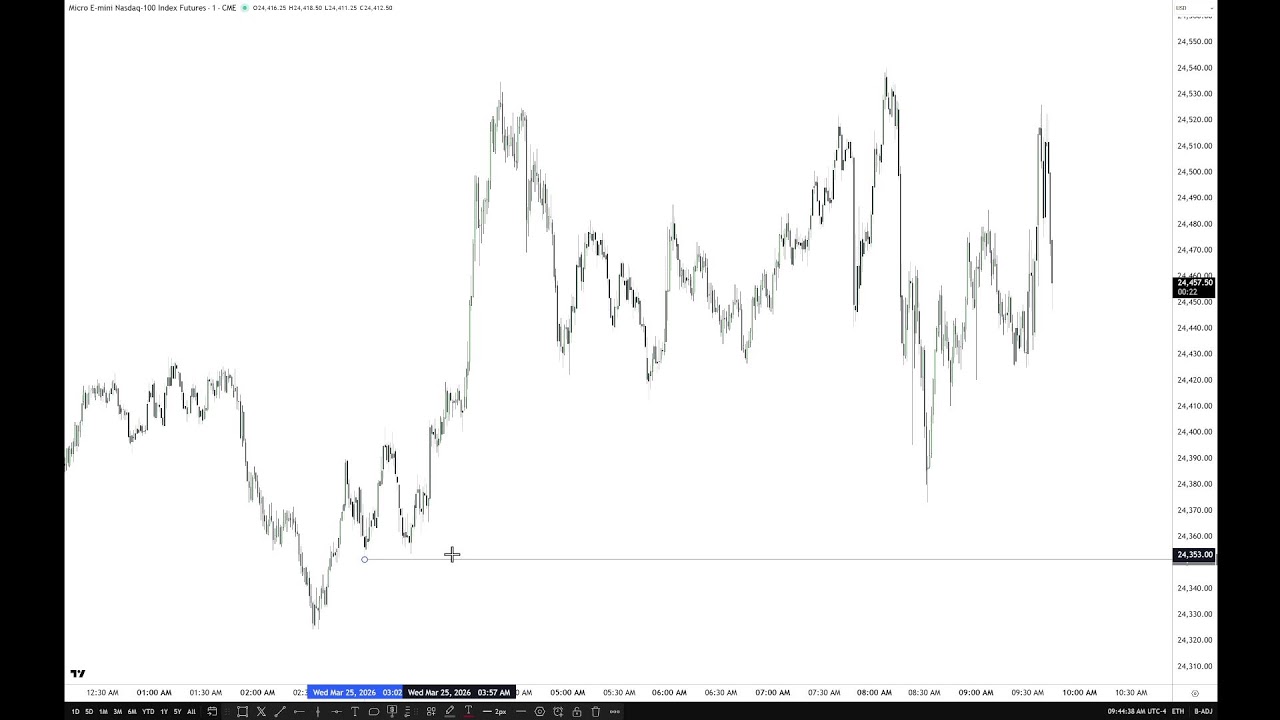
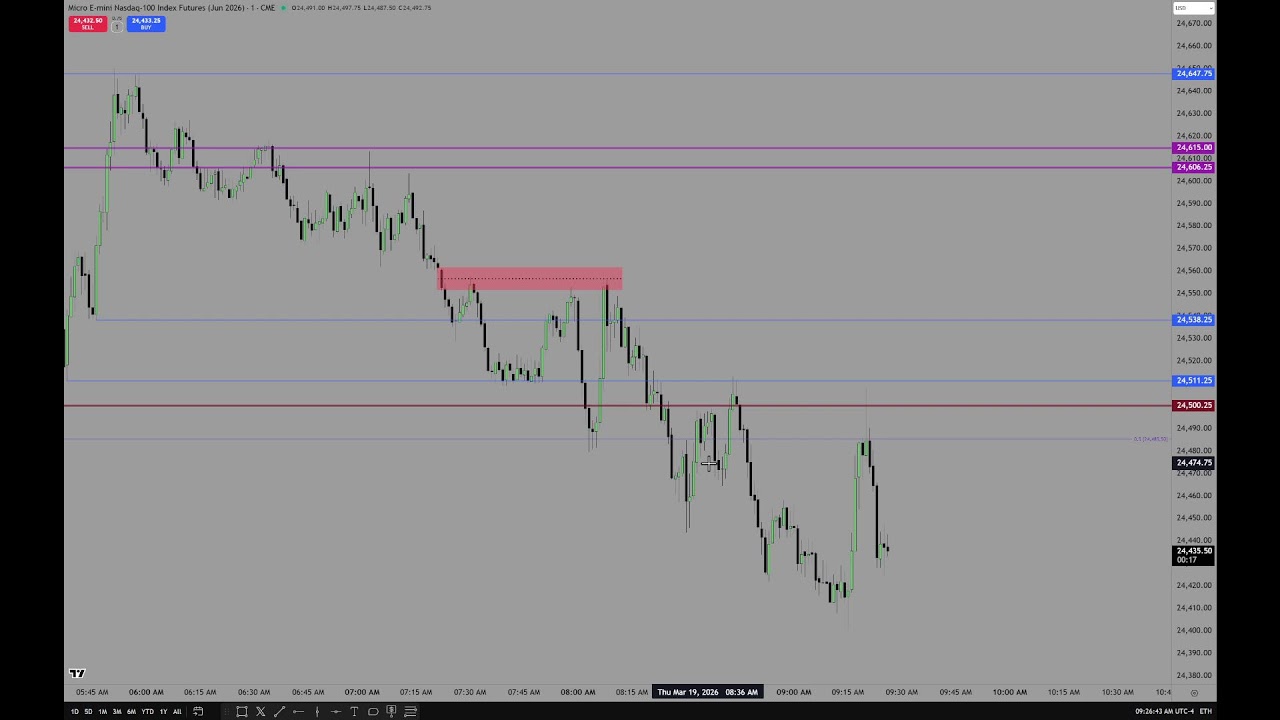
– The presenter is biased bearish on US indices (Nasdaq, S&P), but is cautious about taking new shorts on a Friday (TGIF effects, weekend/gap risk, possible manipulation). Price action is one‑sided since the open and has produced several valid sell-side signals, but follow‑through is uncertain.
– He repeatedly warns about market “shenanigans” / manipulation (pre‑market/electronic spikes, news-driven moves) and stresses gap risk on Sunday evening opens.
Technical framework (what ICT’s using)
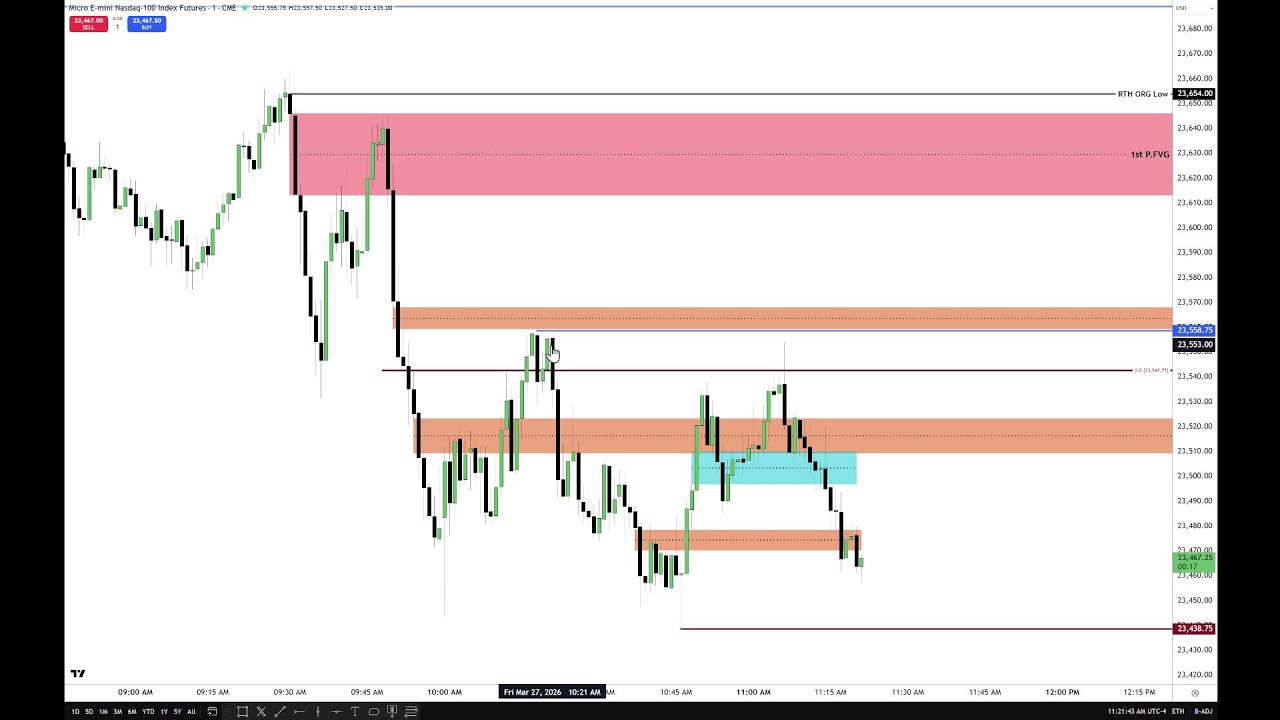
– Primary tools/concepts: fair value gaps (FVGs) / inefficiencies, volume imbalances, “consequent encroachment” (midpoint of a range), PD arrays / daily ranges, order blocks, and using higher‑timeframe levels to guide intraday tape reading.
– Important rules: treat certain FVGs as inversion areas (if price closes beyond them on a body basis they can act as directional pivots); watch whether price leaves or lays bodies in the upper/lower halves of key wicks/ranges; rapid leaves of inefficiencies = high conviction moves, lingering/time distortion inside gaps = weak or problematic setups.
– Use micro contracts and low leverage while learning; prefer observing price reactions to levels before trading.
Practical trading guidance / risk management
– Don’t chase or force trades because a setup “looks good”; watch time‑of‑day, day‑of‑week (Fridays), and whether price behavior matches the expected signatures before committing.
– Manage positions actively: take partial profits, trail stops, reduce size when price fails to act as anticipated; lower exit precision in chaotic markets to secure gains.
– If a FVG or PD array isn’t performing as expected, treat that as actionable intel (i.e., it weakens the trade case).
Instrument highlights (brief)
– Nasdaq / indices: bearish structure, multiple inefficiencies and sell‑side liquidity pools. He’s expecting lower prices over the coming weeks/months, but not necessarily intraday on Friday.
– S&P / MES: similar dynamics — needs decisive follow‑through below recent lows to confirm continuation.
– Dollar / EUR / GBP: dollar strength bias; euro and pound showing setups consistent with downside (watch bodies staying out of upper halves).
– Crude (Brent/WTI): expects higher prices (mentions ~$180–200+/bbl as an outlook) but is not participating; warns about news-driven volatility.
– Gold & silver: targets met; a Sunday open gap lower and heavy follow‑through would be very bearish.
– Bitcoin / crypto: he’s skeptical and expects lower (he doesn’t trade crypto; commentary is opinion).
Teaching emphasis
– Focus on learning tape reading and level behavior (observe, measure, test), not on instant live trading. Many failures stem from skipping practice/backtesting and overleveraging.
– ICT stresses patience: only trade environments where multiple signals (time of day, FVG behavior, volume imbalance, body closes) favor the thesis.
Tone / housekeeping
– He’s not issuing trade recommendations to follow; the livestream is instructional. He also shared anecdotes and frustrations (road rage, household interruptions) but the core is teaching level-based order‑flow interpretation and conservative risk management in a manipulative/high‑risk market environment.
1. According to ICT, what should bearish price action do after trading below a bearish suspension block?
A. Stay in the upper half and run higher
B. Stay out of the upper half and work toward lower prices
C. Fill the entire gap immediately
D. Reclaim the daily wick high
2. Why did ICT say he was reluctant to short aggressively on Friday?
A. Because the market had already opened above the weekly high
B. Because it was Friday and the market had already sold off well, making TGIF conditions less trustworthy
C. Because the dollar index was bullish
D. Because crude oil was failing to rally
3. What did ICT say about how inversion fair value gaps should behave in strong moves?
A. They should spend a lot of time getting filled
B. They should leave quickly, often in one or two candles
C. They should always reverse into bull flags
D. They should only work on daily charts
4. What was ICT’s view on Bitcoin in this transcript?
A. He was strongly bullish and expecting a breakout
B. He said it looked bad and he would not be comfortable being long
C. He said it was guaranteed to reach all-time highs
D. He said it was unrelated to fair value gaps
Answer Key:
1. B Evidence: “If it weren’t the if it wasn’t rather um Friday, say this was Thursday, I’d be all over this shorting it. But because it’s Friday, I’m a little reluctant to trust this going down.”
2. B Evidence: “If we’re bearish, if we’re going to continuously maintain bearishness, we want to see price once it trades below it here… we want to see that stay kind of like a no trespassing don’t don’t come up here anymore… and then we would see it uh you try to work towards lower prices.”
3. B Evidence: “if they’re valid, if they’re very much in the right side of the marketplace, they’re not going to waste your time. They’re going to try to run. They’re going to they’re going to use that moment and sharply leave it.”
4. B Evidence: “I wouldn’t be comfortable if I was long on Bitcoin. I’ll just say that… But this just looks it looks bad.”