
https://www.youtube.com/watch?v=Dj0663u7VRc
Summary:
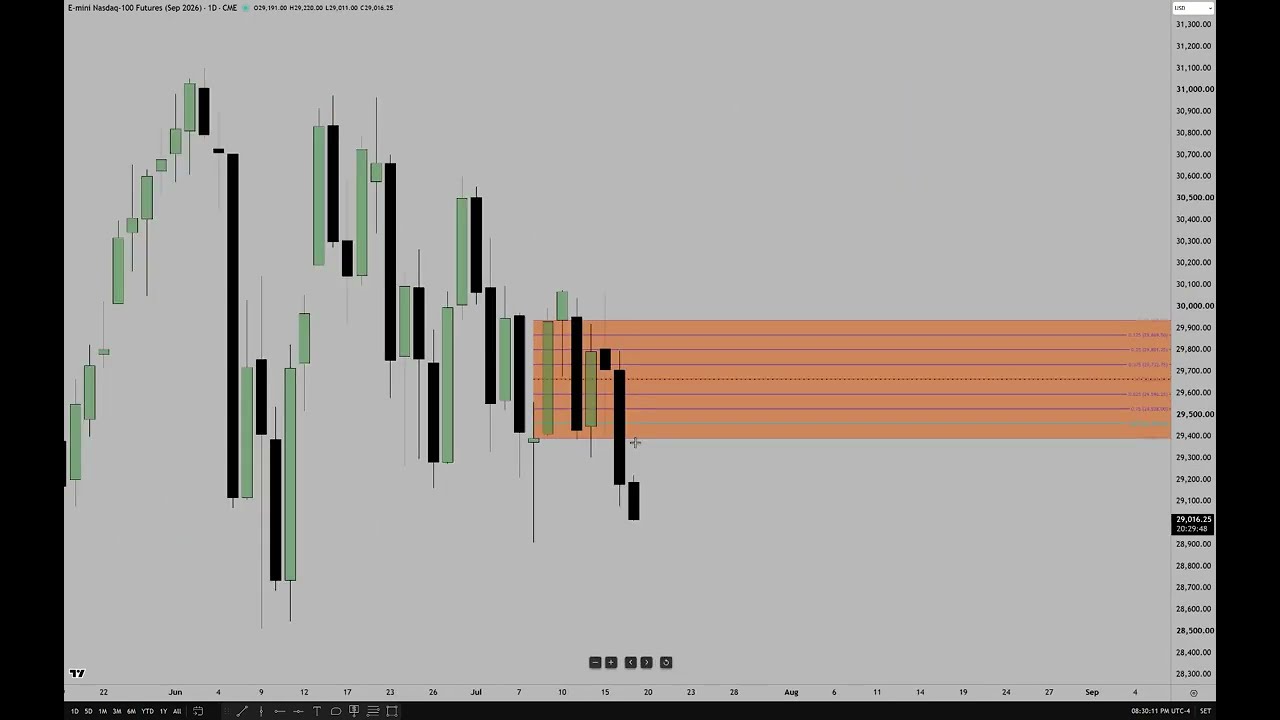
– Market view: The presenter expected and saw lower prices after a daily close below a key volume/inefficiency area (sell-side liquidity with relatively equal lows). That setup increased the probability of downside continuation and possible gap lower by Sunday if momentum picks up.
– Key technical concepts used: daily/weekly anchoring, suspension blocks, buy-side imbalances / sell-side inefficiencies (fair value gaps), quadrants/octants, “consequent encroachment” (midpoint) and “first utilization/first presented” — all used to judge whether a zone will act as premium (resistance) or inversion (support).
– Intraday action: On the hourly and 1-minute charts, price interacted with a daily suspension block and a 1-hour buy-side imbalance formed Wednesday. Price hit the lower quadrant of the daily inefficiency at the 9:30 open, then rejected and moved lower into the annotated fair-value gaps — validating the bearish thesis. Lunch macro (around 11:30 / 10:00 low) and subsequent price structure reinforced the down move.
– Trade execution notes: The speaker described missed ideal entries (wasn’t always in front of the chart), pyramiding short entries at inefficiencies, taking partial profits and being stopped out on remaining contracts. He emphasized bodies (open/close) over wicks for true order-flow information.
– Market psychology and live streams: Retail chat often cheerleads the wrong direction; the public is usually wrong (contra-indicator). Advice: live streamers should largely ignore chat; viewers should not follow chat-driven crowd trades.
– Teaching/philosophy: High-probability setups are those anchored to daily/weekly timeframes. The instructor keeps certain personal notes/private levels to avoid students overfitting to his precise entries — encourages students to develop their own models through study and repetition.
– Practical takeaways: Watch for closes below key levels to validate bearish first-utilization, prioritize anchored higher-timeframe levels, use inefficiencies and fair-value gaps to time entries, prefer bodies (open/close) as volume/algorithms’ signals, and cultivate independent trading judgment.
– Closing: The week’s technical calls mostly played out as taught; consistent study of the method and exposure to the live lessons will speed learning.
Leave a Reply