
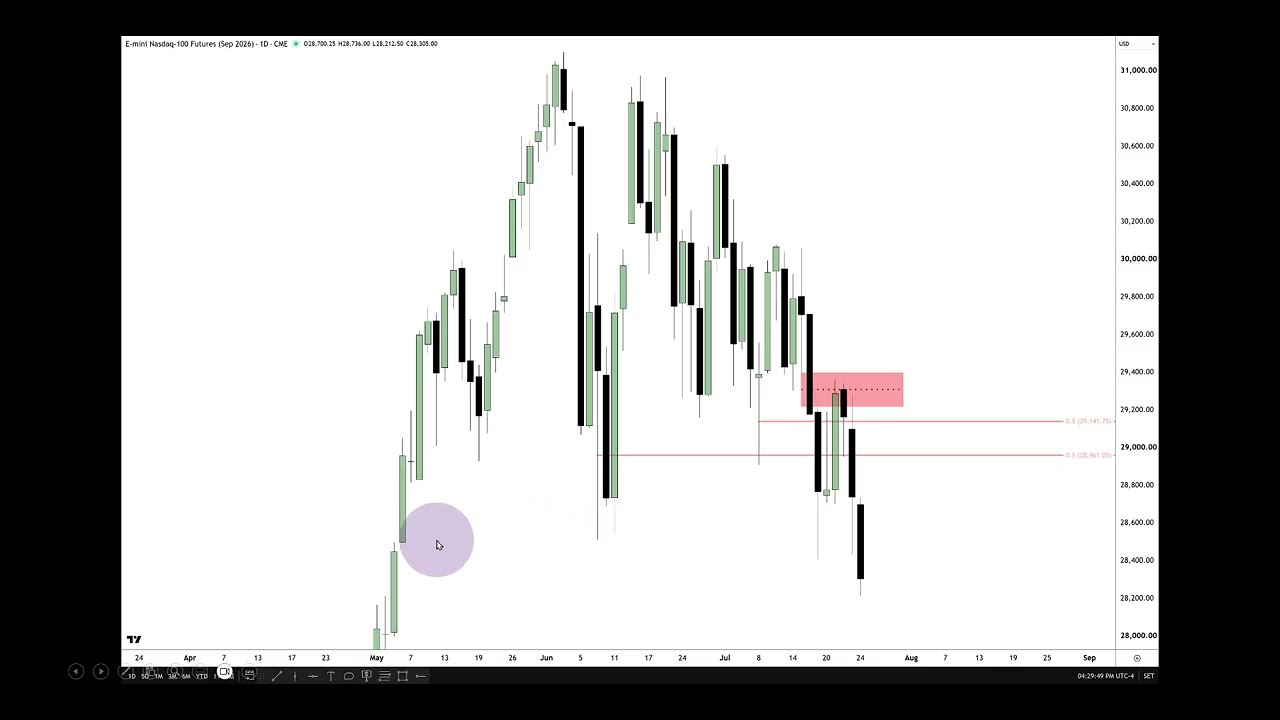
https://www.youtube.com/watch?v=dYQSUCSbYn8
– This lecture reviews the instructor’s price‑action method applied to the Nasdaq September 2026 mini contract, emphasizing clarity on why recent moves happened and how to anticipate them using his proprietary PD (price‑dissection) arrays.
– Core concepts: grade and track specific PD arrays (sell‑side imbalances / buy‑side inefficiencies a.k.a. SIBIs, fair value gaps, consequent encroachment / midpoints, volume imbalances, suspension blocks). These form a repeatable “chain of custody” that guides where price is likely to go.
– Practical rules stressed repeatedly: use candle bodies (not wicks) to define ranges; treat upper/lower halves of inefficiencies as premium/discount — bodies in the lower half indicate bearishness (and vice versa); midpoint (consequent encroachment) and half points are key targets and rejection zones.
– Multi‑timeframe workflow: collect and carry daily PD levels down into lower timeframes (down to 1‑minute) and use opening‑range gaps, extended fair value gaps, and octant/ quadrant grading to locate high‑probability entries, stops, and targets.
– Week’s example: he annotated how clustered PD arrays and a daily purple volume imbalance acted as liquidity draws; price respected midpoints, formed measuring/inversion fair value gaps at expected places, and delivered the bearish range he anticipated. He showed a live trade, partial miss and later recovery, to illustrate execution and management.
– Teaching points: this is advanced material that requires backtesting, note‑taking and repetition. Beginners will find it hard initially but will benefit from learning in volatile conditions. He warns against sloppy anchoring to arbitrary highs/lows or trendlines.
– Differentiator: he claims his rules are unique, teachable, and reproducible if students use his exact PD arrays and grading process rather than generic support/resistance methods.
– Next steps: he’ll stop giving advance levels next week to force students to practice grading PD arrays themselves; he will provide daily hindsight reviews so students can learn to recognize the patterns and build skill through repetition and backtesting.
Leave a Reply