
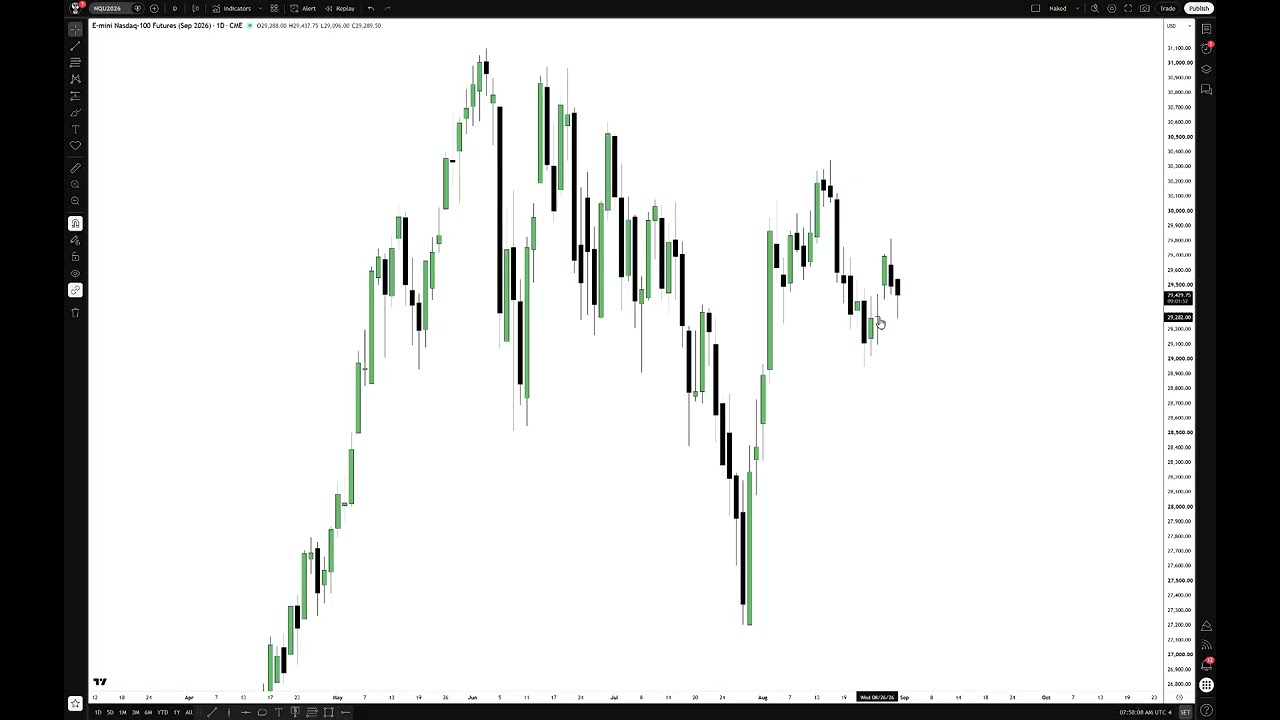
https://www.youtube.com/watch?v=BWEPtHZ1Y2Y
Summary:
– Market context: Entering September brings stronger, cleaner price delivery due to seasonal/holiday-driven flows. Check the economic calendar (Forex Factory) and focus on US-dollar/high-impact events — especially ISM, JOLTS, and Non-Farm Payroll (NFP) week.
– NFP-week guidance: NFP Friday causes big volatility. Treat the week specially: Mondays of NFP-week often present reliable setups; avoid trading on Thursday and Friday (and until 11:00am on Wednesday) if you are a new trader. Learn patience and discipline.
– Key time windows: The “macro” window is the last 10 minutes of the hour + first 10 minutes of the new hour — high-probability times for directional runs. For RTH (regular trading hours) gaps, half-gap fills happen often (quoted ~70% into 10:00am).
– Chart preparation and workflow: Do a weekly/monthly prep (best done on weekend). Annotate monthly/weekly highs/lows and make those levels visible across all timeframes. Create and save separate workspaces/layouts (e.g., naked price, opening-range gaps, fair-value gaps) to avoid clutter and speed navigation.
– Structural levels and annotations: Mark buy-side and sell-side liquidity pools, suspension blocks (buy/sell balance/efficiency areas), fair value gaps (including inversion gaps), wicks as mile-markers, midpoints/octants, and RTH opening-range gap high/low/settlement. Keep labels right-justified for consistency across timeframes.
– Reading price action: Use higher-timeframe anchors (daily/weekly/monthly) to define probable targets and areas where stops/liquidity sit. Watch how price behaves around these levels (bodies vs. wicks, closes above/below midpoints) to infer continuation or reversal.
– Execution & risk management: Use partial profit-taking (e.g., take some off at an “event horizon” / midpoint) and trail stops down to protect gains. Don’t be emotionally married to being “right” — follow a repeatable model and accept transactional errors.
– Practice regimen: Demo/tape-read before trading real money. Record one-minute charts (or your session) and review, screenshot key inflection moments, annotate them, and journal observations. Consistent practice and journaling build the skill to recognize setups.
– Teaching philosophy: Start simple, build habits, and avoid chasing high-risk funded challenges early. The goal is consistent process and understanding, not heroic single-trade wins.
Leave a Reply