Tag: innercircletrader

  • How New Students Should Start Part 1

    How New Students Should Start Part 1

    https://www.youtube.com/watch?v=BWEPtHZ1Y2Y

    Summary:

    – Market context: Entering September brings stronger, cleaner price delivery due to seasonal/holiday-driven flows. Check the economic calendar (Forex Factory) and focus on US-dollar/high-impact events — especially ISM, JOLTS, and Non-Farm Payroll (NFP) week.

    – NFP-week guidance: NFP Friday causes big volatility. Treat the week specially: Mondays of NFP-week often present reliable setups; avoid trading on Thursday and Friday (and until 11:00am on Wednesday) if you are a new trader. Learn patience and discipline.

    – Key time windows: The “macro” window is the last 10 minutes of the hour + first 10 minutes of the new hour — high-probability times for directional runs. For RTH (regular trading hours) gaps, half-gap fills happen often (quoted ~70% into 10:00am).

    – Chart preparation and workflow: Do a weekly/monthly prep (best done on weekend). Annotate monthly/weekly highs/lows and make those levels visible across all timeframes. Create and save separate workspaces/layouts (e.g., naked price, opening-range gaps, fair-value gaps) to avoid clutter and speed navigation.

    – Structural levels and annotations: Mark buy-side and sell-side liquidity pools, suspension blocks (buy/sell balance/efficiency areas), fair value gaps (including inversion gaps), wicks as mile-markers, midpoints/octants, and RTH opening-range gap high/low/settlement. Keep labels right-justified for consistency across timeframes.

    – Reading price action: Use higher-timeframe anchors (daily/weekly/monthly) to define probable targets and areas where stops/liquidity sit. Watch how price behaves around these levels (bodies vs. wicks, closes above/below midpoints) to infer continuation or reversal.

    – Execution & risk management: Use partial profit-taking (e.g., take some off at an “event horizon” / midpoint) and trail stops down to protect gains. Don’t be emotionally married to being “right” — follow a repeatable model and accept transactional errors.

    – Practice regimen: Demo/tape-read before trading real money. Record one-minute charts (or your session) and review, screenshot key inflection moments, annotate them, and journal observations. Consistent practice and journaling build the skill to recognize setups.

    – Teaching philosophy: Start simple, build habits, and avoid chasing high-risk funded challenges early. The goal is consistent process and understanding, not heroic single-trade wins.
  • NQ Trade Review Jackson Hole Symposium Day #2

    NQ Trade Review Jackson Hole Symposium Day #2

    https://www.youtube.com/watch?v=iSWZOe3aUFE

    Summary:

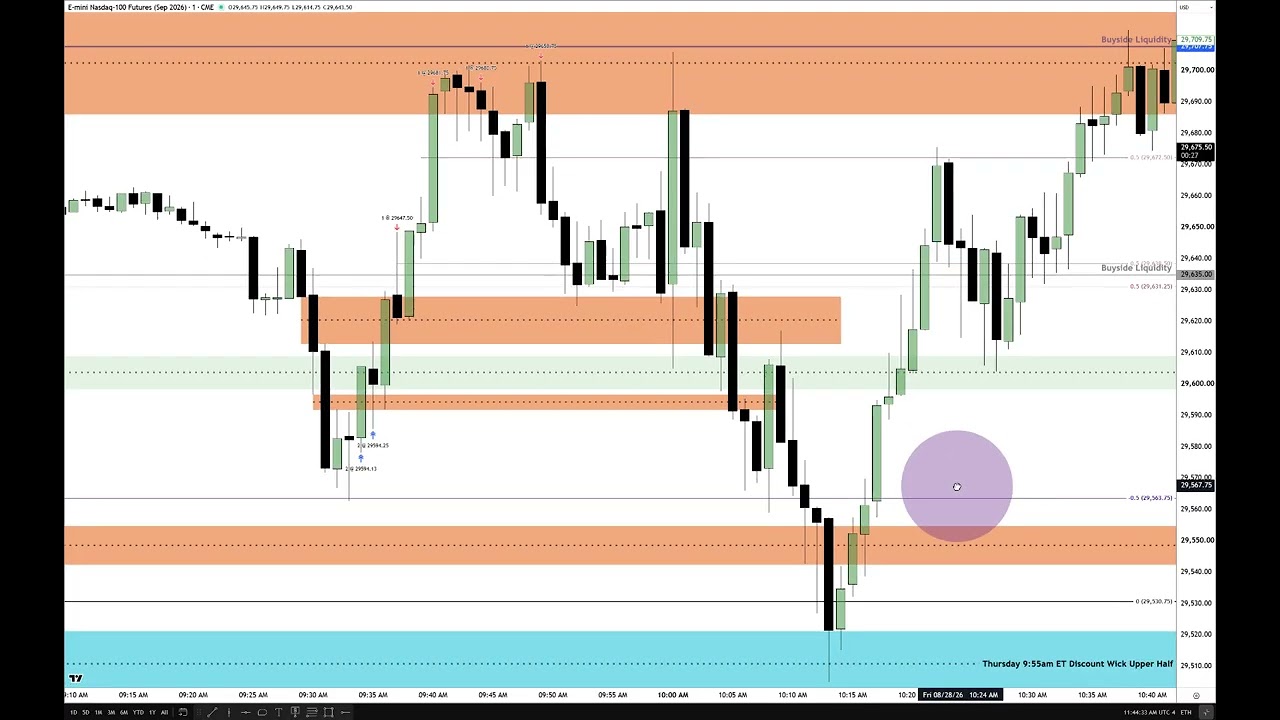
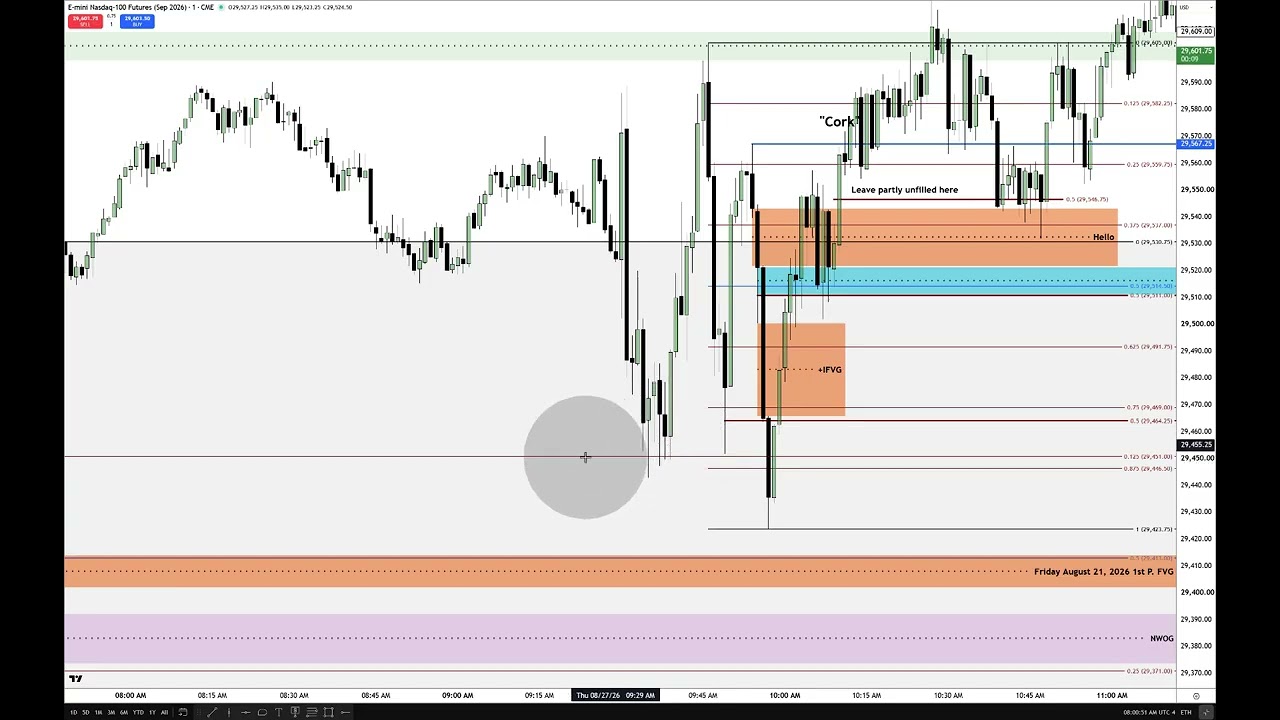
    – The speaker reviews NASDAQ price action during day two of the Jackson Hole Symposium, describing significant volatility, “seek-and-destroy” moves (second runs that take out highs/lows), and how they traded using tools like Fibonacci anchors, inversion fair value gaps, inefficiencies, order blocks and discount wicks.
    – They explain trade decisions and executions, note technical issues (market-replay executions hidden while rendering video in Camtasia), and admit imperfect execution and missed exits during the session.
    – Key market takeaway: Jackson Hole week produces large, often manipulated moves—expect volatility and frequent retraces; respect these events and prepare your plan accordingly.
    – Trading advice: novices should avoid trading real money during such weeks (or at all until sufficiently experienced); watch live price action and tape-reading instead of impulsive demo trading; log and annotate price behavior, backtest your observations, then demo-trade for a minimum of 2–3 months before risking live funds.
    – Behavioral guidance: don’t trade to please an audience; avoid overleveraging or chasing gains (especially on Fridays); cultivate discipline and patience by focusing on process and repeating observed patterns rather than money.
    – Next week the speaker will post daily lectures on what to observe in price action to build a repeatable model and prepare students for demo then live trading. They reiterate this is market commentary, not investment advice.

  • NQ Trade Review & Deep Dive Into Price Delivery

    NQ Trade Review & Deep Dive Into Price Delivery

    https://www.youtube.com/watch?v=MD1Ts09dkYs

    Summary:

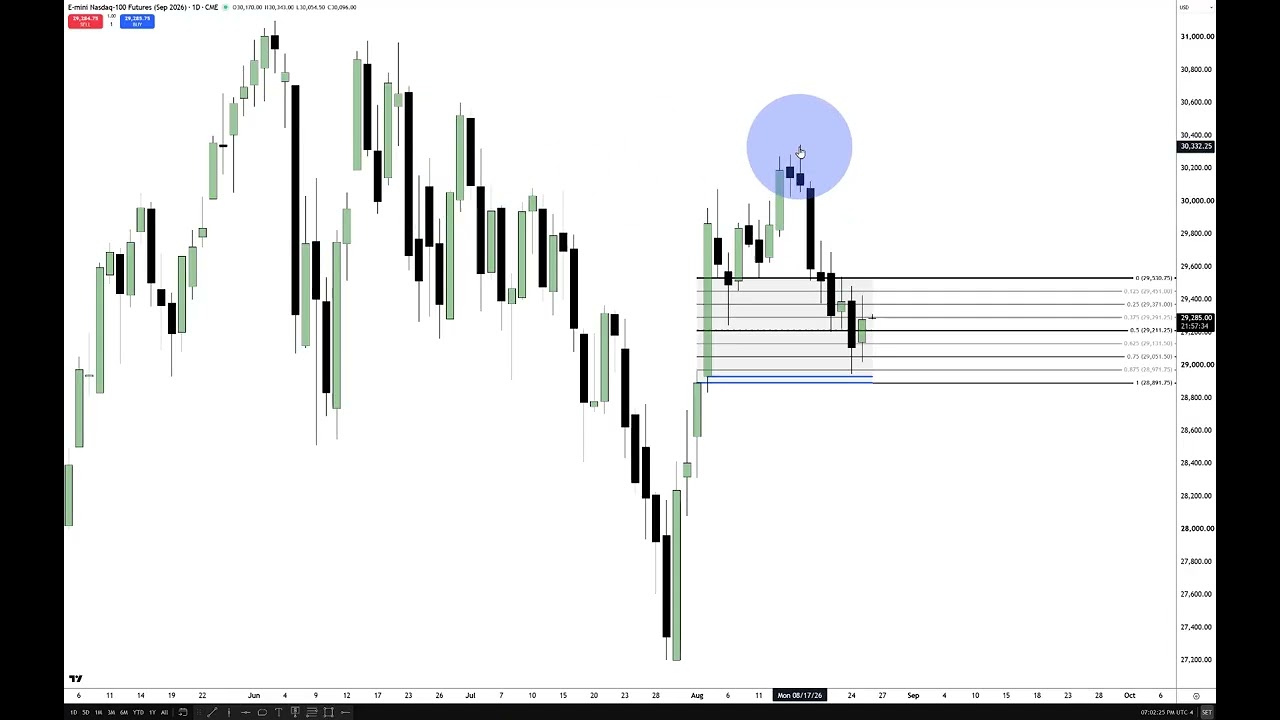
    – Context: Live trading review from Aug 28, 2026 covering trades taken on day one of the Jackson Hole Symposium and the technical reasoning behind them. Emphasis on using the daily chart to set the framework and drilling into a 1‑minute view for execution.

    – Framework and concepts used: daily PDA (price‑delivery arrays) levels, buy‑side/balance‑sell‑side efficiency (gray shaded area), suspension blocks (cibby), volume‑of‑bounce, fair value gaps (FVG) and inversion FVGs, consequent encroachment (mid‑wick behavior), liquidity pools, order blocks, and the idea of “seek-and-destroy” stop sweeps. He repeatedly stresses reading open/high/low/close (price action) and anchoring levels to leftmost pivots.

    – Trade narrative and execution: he saw a false break below key lows, entered long anticipating a stop‑sweep and reversal into daily buy‑side efficiency, pyramided the position (add at/below equilibrium), took partial profits at pre‑planned targets, and nearly got stopped out by one tick. If stopped, he would have immediately re-entered. He adjusted stops and exits dynamically based on wick behavior, equilibrium, and inefficiencies.

    – Rules and risk management highlighted:
    – Pyramid additions at or below equilibrium (don’t add beyond equilibrium).
    – Add on consequent encroachment/equilibrium; use partials and runners.
    – Place stops with market mechanics in mind (futures have identical prices; forex can have widened spreads).
    – Anticipate price behavior rather than react to it.

    – Teaching points: learn his trading “language” (how he describes wicks, midpoints, gaps), annotate charts, backtest, and slow down when learning. He argues his methods come from decades of experience and are deterministic in reading market structure.

    – Market view & advice: Jackson Hole days are volatile—day one especially prone to engineered liquidity/seek‑and‑destroy—so expect the unexpected. Short‑term bias was bullish into daily buy‑side efficiency with nearer targets noted around the 29,757–29,830 area, but remain cautious and adaptive.

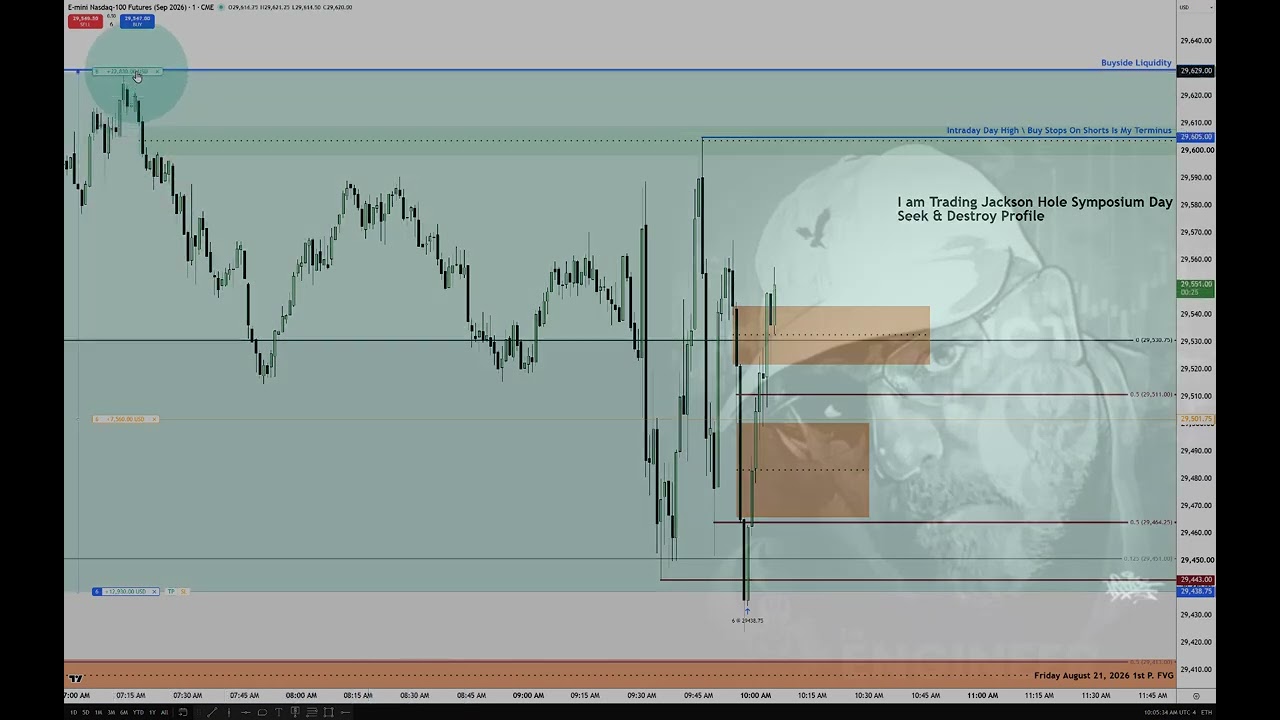
  • NQ Trading Seek & Destroy Profile Jackson Hole Symposium Day 1

    NQ Trading Seek & Destroy Profile Jackson Hole Symposium Day 1

    https://www.youtube.com/watch?v=SUcRywSry5U

    – The speaker is trading NQ during day one of the Jackson Hole Symposium using a “seek and destroy” intraday model that targets the session high.
    – The plan relies on structure like inversion fair value gaps, buy-side imbalances, wicks, order blocks and “PD arrays” to identify entry, stop placement (under the wick), and pyramid opportunities.
    – He waits for price to behave around prior representative fair value gaps and upper-half wick closes, enters longs, moves stops to breakeven/positive when conditions are met, and places limit orders at defined intraday highs.
    – The trade is patience-intensive: price consolidates (“corks”) and slowly probes stops, leaving imbalances partially unfilled — a bullish sign he wants to see before adding size.
    – He narrates emotional management, trade adjustments, and skepticism of other indicator methods, emphasizing experience and discipline.
    – Result: price eventually breaks upward, he takes partial profits at his target, raises stops, documents the trade, and posts proof.

  • NQ High Of Day Short Review

    NQ High Of Day Short Review

    https://www.youtube.com/watch?v=P8Pn8DHFSW8

    Summary:

    – This is a market/trading lesson and weekly wrap-up from a futures trader (NQ Nasdaq), noting limited availability for the rest of the week and warning that Jackson Hole will likely create highly manipulated, erratic price action.

    – Core methodology: trade using precise price‑action and order‑flow signals on a 1‑minute chart rather than generic indicators. Key concepts include:
    – First‑presented fair value gaps (FPFGs), especially those from the prior Friday and Monday, are high‑value reference levels.
    – Wicks can be treated as imbalances/gaps and graded with a fib from body high to wick high; the consequent encroachment (midpoint) is a critical decision line.
    – Opening‑range gap (difference between prior regular close and next open) octants/midpoint are reliable intraday targets (70% rule toward midgap by 10:00 ET).
    – Relative equal highs mark buy‑side liquidity; behavior of candle bodies vs. wicks (upper/lower half) signals bullish vs. bearish order flow.
    – Use minimal, well‑chosen PDAs (fair value gaps, order blocks) on a chart or workspace (keep last weeks’ new‑week opening gaps) rather than cluttering the chart.

    – Execution philosophy and behavior:
    – The instructor emphasizes prediction and prepared levels over reactive trading, precise entry/stop sizing, and adding to positions when warranted.
    – He refuses to run public copy/signal services (liquidity issues, front‑running, and student risk), doesn’t post broker statements, and won’t spoon‑feed trades.
    – Accepts he isn’t perfect (showed a stop on a single contract) and models live trade management and journaling.

    – Teaching approach and advice:
    – Study the repeated patterns and narrative logic in his lectures; practice quietly and verify concepts yourself.
    – Beginners should start simple (use mid‑gap and first partial targets) before pursuing very high‑precision tactics.
    – Keep disciplined risk, avoid shortcuts, and cultivate skill over time.

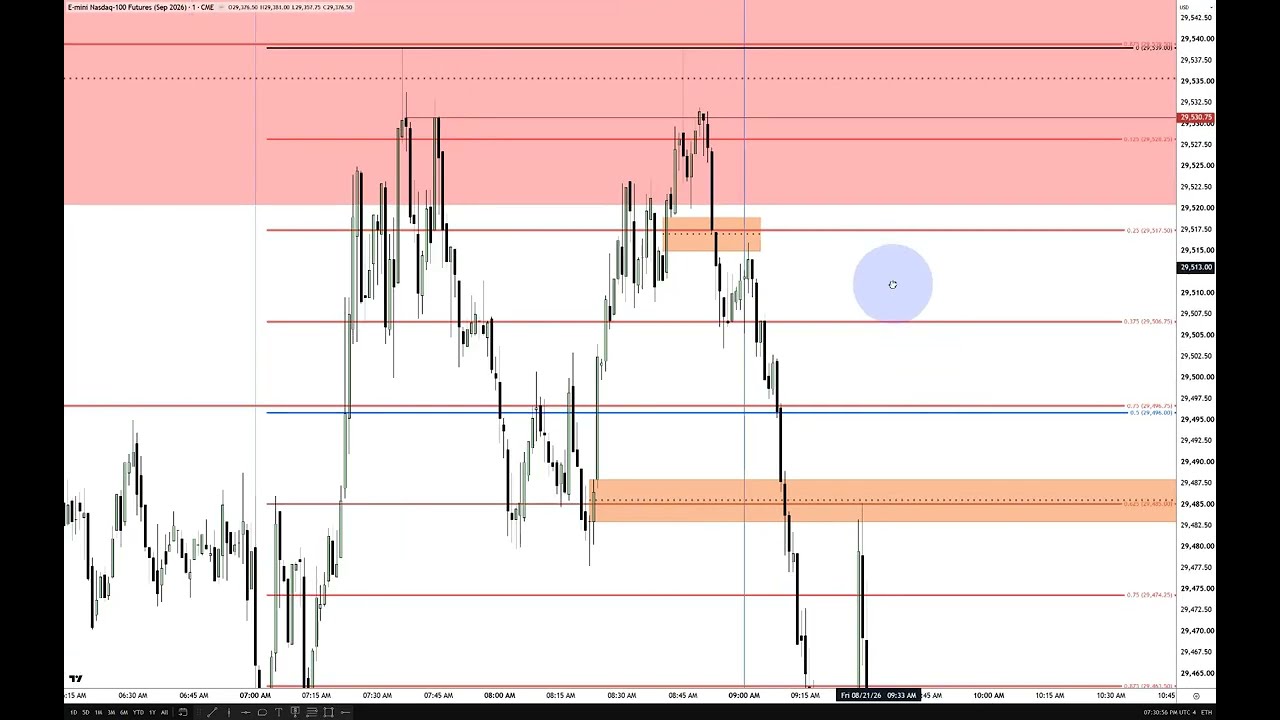
    – Practical recap of session: he expected a rejection near Friday’s FPFG, executed a short at the predicted high using the described rules, took partials, was stopped on one contract during a full‑gap closure attempt, and ultimately cautions limited confidence in forecasts during Jackson Hole.

  • PreMarketSession NQ Consolidation August 25, 2026

    PreMarketSession NQ Consolidation August 25, 2026

    https://www.youtube.com/watch?v=ieJSy4YsVgk

    Summary:

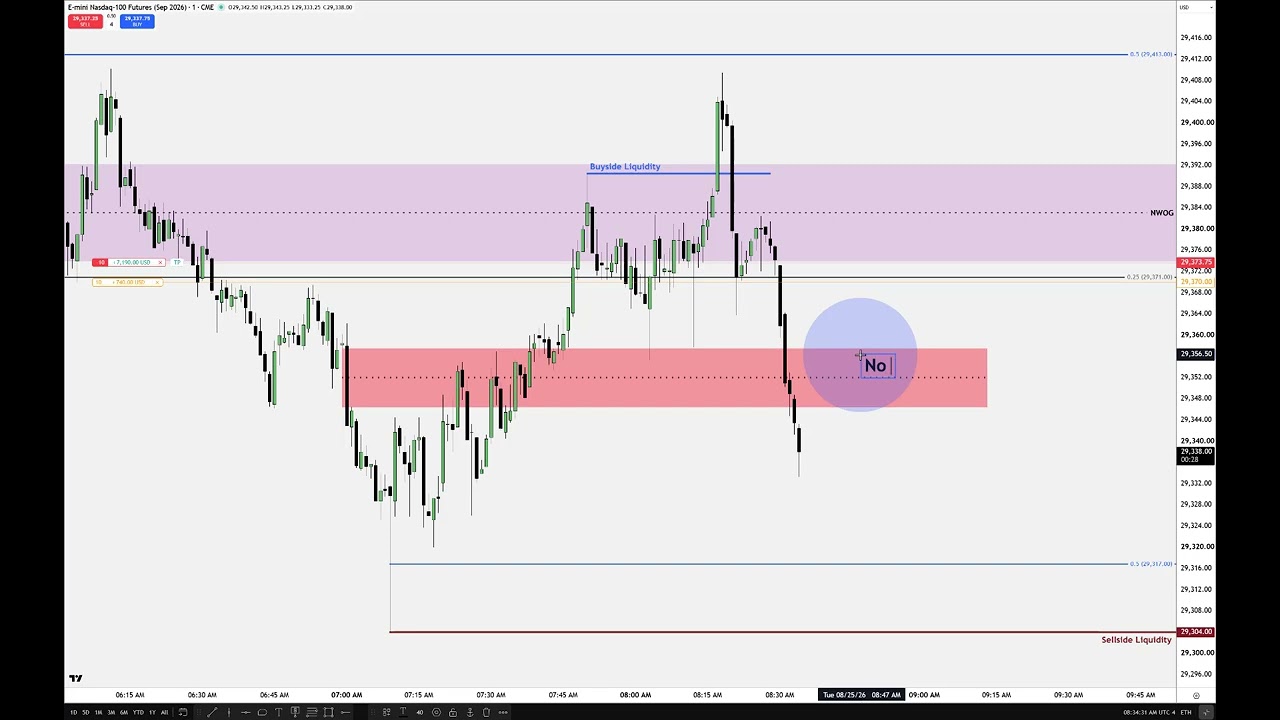
    The speaker is trading a short after a failed new-week opening gap. Key ideas and actions:

    – Trade setup: sell short into the failed new-week opening gap with a stop just above the volume-balance/high; looking for a run down to the gap low and below as confirmation.
    – Fair Value Gap (FVG) logic: a down-close candle creates a bearish FVG; if price closes above it the gap becomes an inversion (bullish use). It reverts to bearish only if price later closes back below the gap.
    – Confirmation criteria: strongest bearish signal is price not returning to the upper half of the gap (or not touching it at all). Secondary: it returns to the gap low and then drops. Weak: it puts body in the gap but doesn’t close above. The trader wants a close below the gap/obsidian low to confirm momentum.
    – Position management: take partials in a range environment, move stops to lock profits, reduce size if conditions change. The speaker reduced contracts and locked in profit (noting ~$5,640) and adjusted limit/stop orders to manage risk.
    – Session context: London session had been trending; the 7–9am period was boxy/consolidating, so trades must be nimble and sized for range behavior until the 9:30 open when directional moves often resume.
    – Trading philosophy/teaching: prioritize candlestick-based order-flow reading over complex indicators (volume profile, footprints); journal the rules and scenarios; be ready to take partials and adapt to session structure.

    Overall: short idea after a failed gap, wait for a decisive close below the FVG/obsidian low for confirmation, manage risk with partials and tightened stops, and trade with session-context awareness.

  • Monday Review On NQ & PreMarket Session Rules Revisited

    Monday Review On NQ & PreMarket Session Rules Revisited

    https://www.youtube.com/watch?v=grcLMbjs-zs

    Summary:

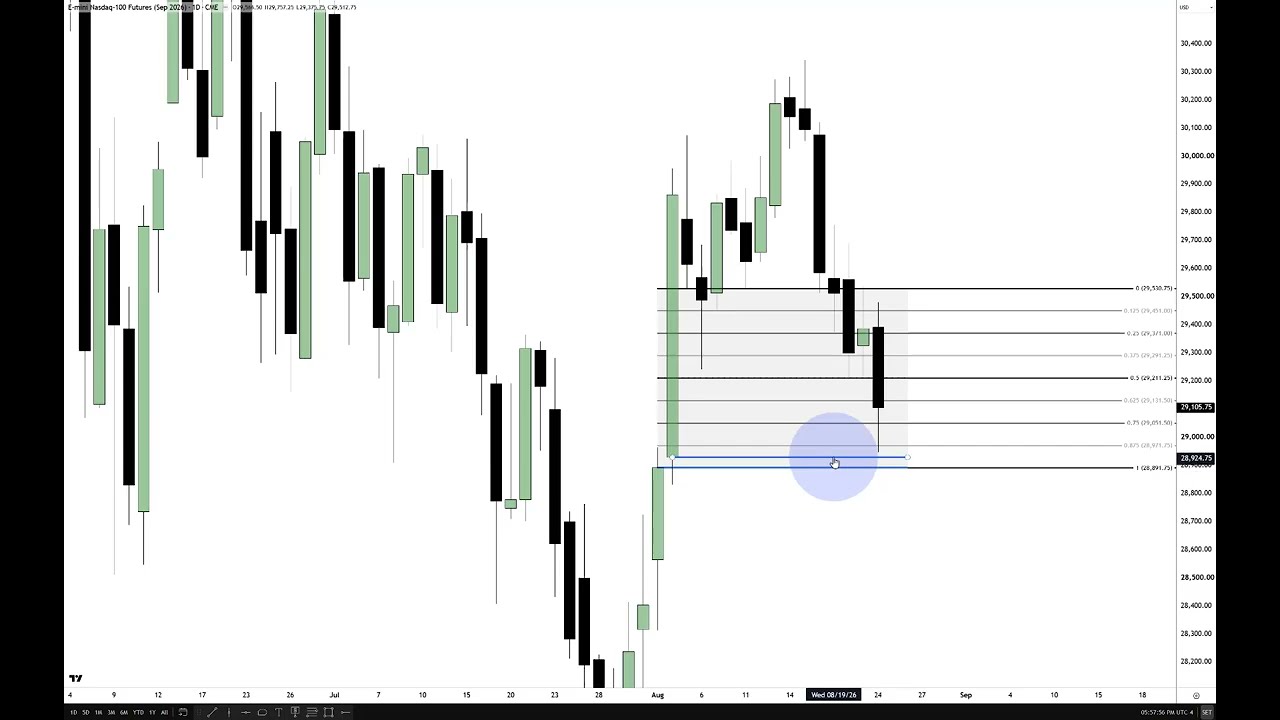
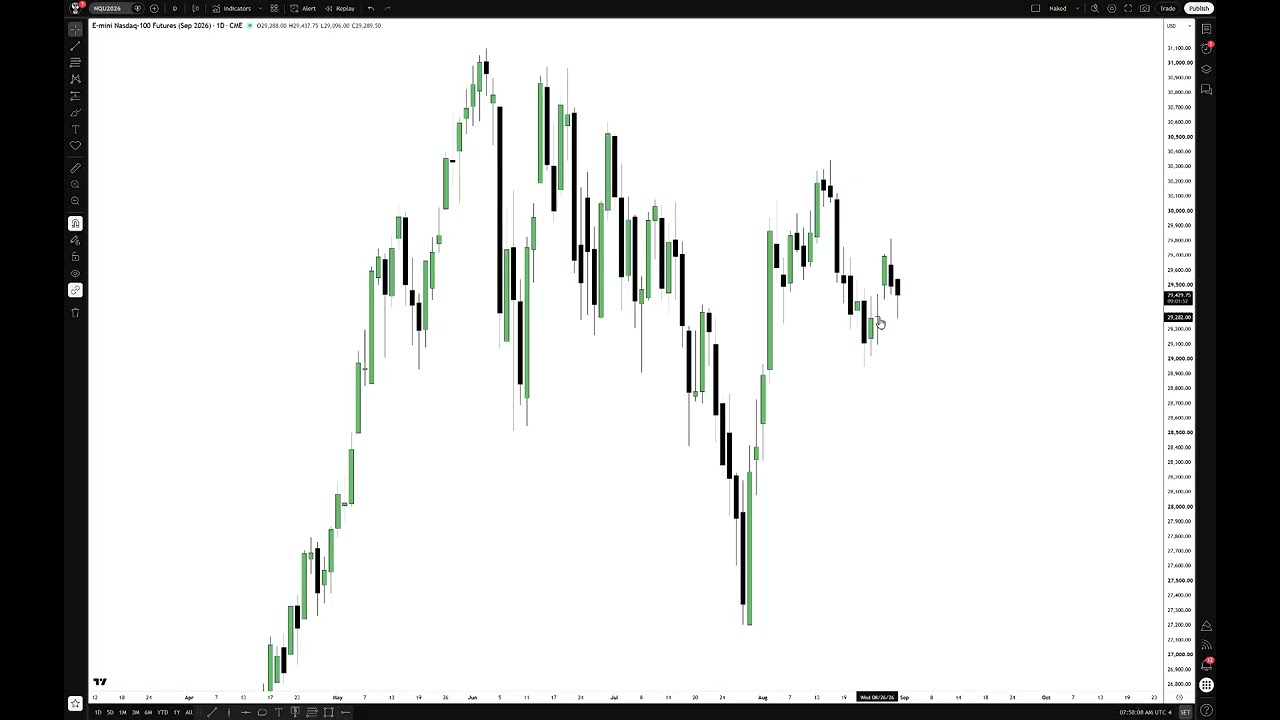
    – The speaker reviews the NASDAQ (NQ) daily chart and says they expected a pull down into a daily “buy-side balance / sell-side efficiency” area (a volume imbalance). A close below the midpoint of a key wick confirmed a likely move down.
    – Emphasis on grading imbalances by candlestick bodies (not wicks) and watching volume imbalances, order blocks, fair value gaps (CBIs), and quadrant/octant levels as key reference points.
    – Market action described: a weak opening, a rally into the graded buy/sell efficiency that failed, then a sharp, fast drop out of the open that moved too quickly to short. Price consolidated between ~7–9am (rules: consolidation vs trend), then produced a strong directional move at 9:30.
    – Tactical levels: watch the low of the daily volume imbalance (target for further downside), a bullish inversion fair value gap used as a rally target, and a bearish order block that validated resistance. The speaker planned to hunt a “silver bullet” level around 10:00–10:30.
    – Practical notes and warnings: Jackson Hole could cause erratic market behavior — don’t overleverage. The speaker missed the ideal short entry and encourages viewers to learn the rules and grade their own charts rather than blindly copying levels.
    – Logistics: the speaker will be lower output this week (fewer posts/videos) and encourages reviewing recent materials for important lessons.

  • Friday Review On NQ & PreMarket Session Rules Revisited

    Friday Review On NQ & PreMarket Session Rules Revisited

    https://www.youtube.com/watch?v=4KW2acdPi-M

    Summary:

    – The speaker teaches a specific intraday method focused on the premarket 7:00–9:00 a.m. ET dealing range (or 7:00–8:30 when an 8:30 report is due). The high, low and midpoint of that window act as key levels: above the midpoint = premium, below = discount.
    – Whether price is trending or consolidating in that 7:00–9:00 window helps predict the next session’s behavior (consolidation tends to be followed by trending sessions and vice versa). Previous-session levels remain relevant and should be extended to the right — they don’t “expire.”
    – He uses order-flow concepts (imbalances, fair-value gaps, inversion FVGs, PD arrays) anchored to those key levels to identify entries, stops and targets. Examples from a Thursday→Friday sequence are used to show these principles in action.
    – He emphasizes that the market is algorithmic and time (session structure) is often more important than price alone when reading order flow.
    – He defends the authenticity of his live trade recordings against accusations of using TradingView market-replay, pointing out visual/control differences between live feed and replay and describing his process of posting trade screenshots in real time; he even issues a monetary challenge to anyone who can replicate his live-results fraudulently.
    – He also notes his public persona (Inner Circle Trader) is partly theatrical, used to draw attention, and acknowledges critics while insisting his methods consistently work.

  • NQ Consolidation Day Algorithmic Rules In Action

    NQ Consolidation Day Algorithmic Rules In Action

    https://www.youtube.com/watch?v=0olLwAiLa3o

    Summary:

    – Speaker opens briefly, then shifts to a fast technical review followed by real-time trade execution footage to study tape reading and order flow.
    – Emphasizes taking notes and using a notepad; his methods rely on detailed rules and nuances taught over time.
    – Key timeframe: pre-market 7:00–9:00 AM ET. Measure the highest high and lowest low between those lines to define the dealing range; that range sets equilibrium, octants and premium/discount context for the regular session.
    – Example level used throughout: the August 6, 2026 daily low at 29,241.25 — treated as an “event horizon”/target for unfinished business and potential washout.
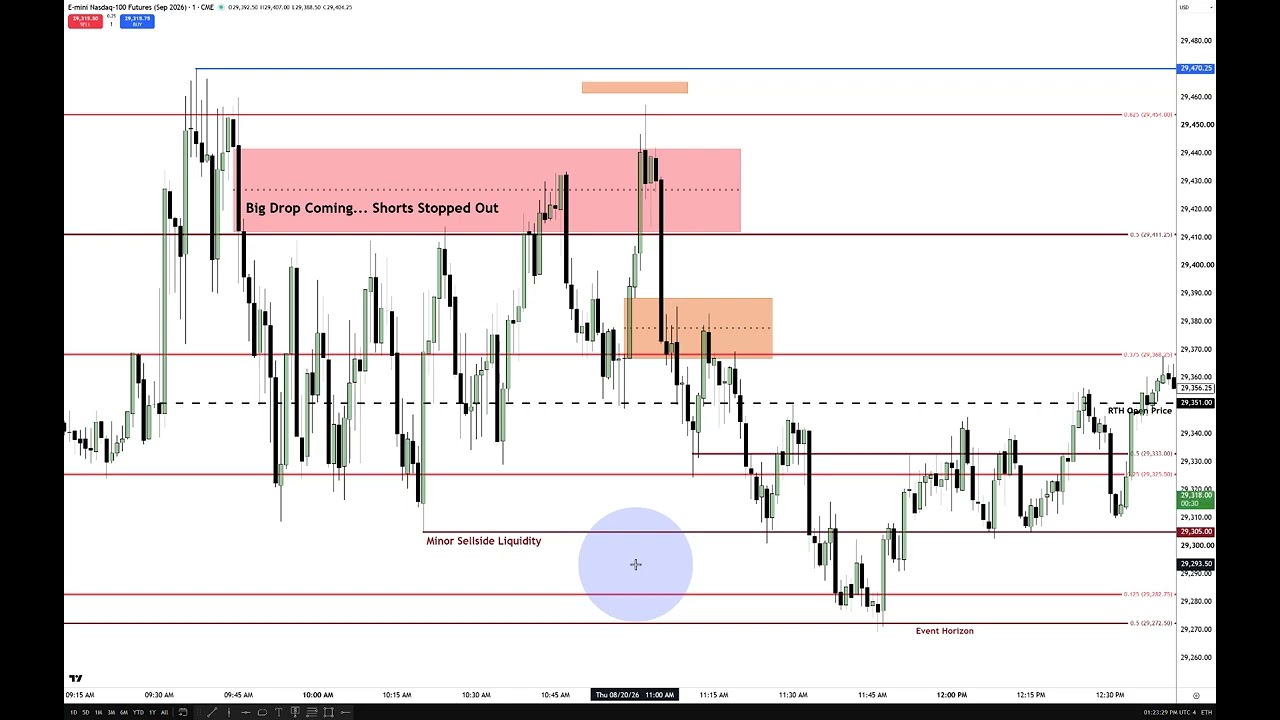
    – Market behavior explained: if 7–9 is trending, the 9:30–11:30 AM session often consolidates and chops; rallies into premium near measured octants can fail (bodies vs wicks indicate algorithmic intent), producing traps and inefficiencies.
    – Intraday structure: watch for sell-side/buy-side efficiencies, inversion fair value gaps, wicks and consequent encroachment as benchmarks of strength/weakness and trade triggers.
    – Trade execution: entries were taken at consequent encroachment and the upper octant of an inefficiency, with added position on a re-test; the method is precise, rule-based, and consistent rather than discretionary zone-chasing.
    – Overall message: the market shows systematic, algorithmic behavior visible in candlesticks; using these specific time/price frameworks and smart-money concepts gives a repeatable edge.

  • ICT Obsidian Teaching

    ICT Obsidian Teaching

    https://www.youtube.com/watch?v=EC0UuarROyo

    Summary:

    – Core idea: Trade one premium PD array (PDA) at a time and use a clear visual candlestick language to read institutional order flow. Bodies in the lower half of a PDA indicate bearish order flow; bodies in the upper half indicate bullishness. This simplifies decision-making and forces you to follow the market rather than wishful thinking.

    – Daily-first hierarchy: Start with the daily chart (identify PDAs, wicks, inefficiencies, gaps and new-week opening gap) and only then move into intraday timeframes. Valid intraday trades must be supported by the higher-timeframe structure.

    – Obsidian model: Defined as two opposing wicks (the second wick higher than the first). Split each wick in half and use the midpoint/consequent-encroachment levels to grade price action and find trade entries, liquidity pools, and failures. Obsidian helped signal bearish failure in the recent session.

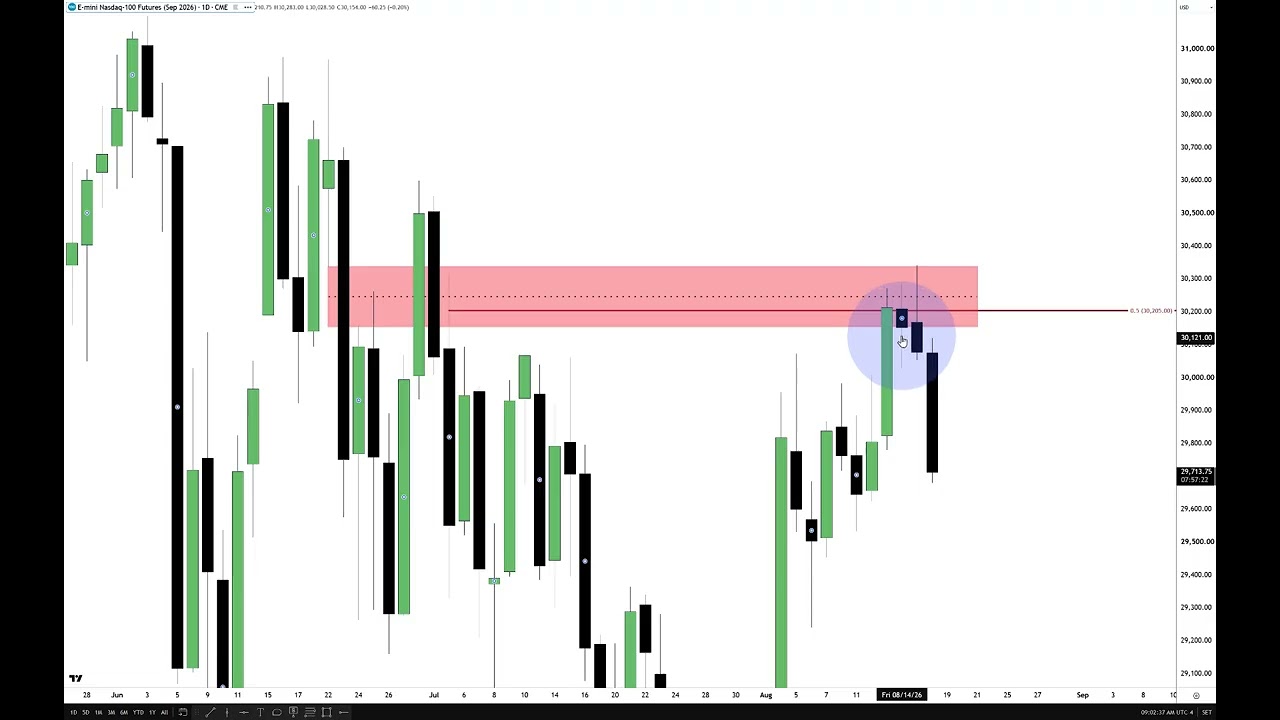
    – Practical application: He used the 7:00–9:00am pre-market dealing range, the 9:30 open structure (including a Judas swing), daily wicks/inefficiencies, and specific levels (example target ~30,137.5) to justify shorting into an upper liquidity pool, building position, and scaling out as price hit partial targets. Closing below key PDA levels was an early bearish sign.

    – Takeaways: Use consistent rules, carry higher-timeframe levels forward, grade ranges and wicks visually, and avoid relying solely on short timeframes or generic supply-and-demand rules. The method is proprietary to his teaching and informed by his personal process.