
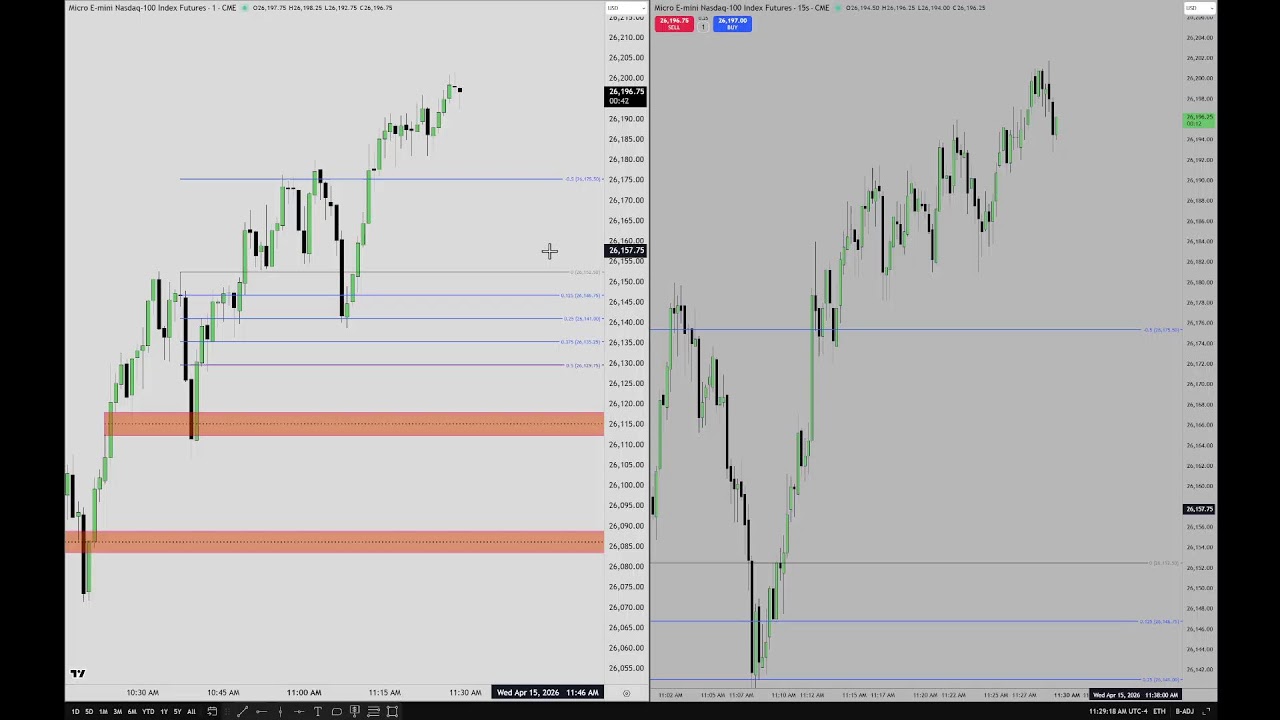
Here’s a concise summary of the livestream content and main takeaways:
– Purpose: The session is a practice/drill demonstration—not trade advice. The instructor emphasizes using drills to build experience, desensitize to fear, and learn entry mechanics (like leg day in training).
– Timeframes & tools: Focus on the 1-minute chart with sub‑minute execution (15‑second) to practice entries, fair value gaps (today’s topic), and order blocks (scheduled for tomorrow).
– Approach to trades: Use paper/demo accounts only—do not copy live. Target small, repeatable objectives (roughly 10–15 handles) and use a simple 1:1 risk/reward stop model for drills.
– What to practice: Enter small, well-defined liquidity pools (gaps, imbalances, relative equal highs/lows, consequent encroachment/inversion fair value gaps), place stops, record outcome and emotions, then repeat.
– Mindset & risk management: Train indifference to outcomes—focus on repetition, not being right or making money. Journaling and recording trade narration help expose emotional issues and accelerate learning.
– Market commentary: Today’s market was messy—high resistance, choppy, decoupled between indices (MNQ vs. ES). Such conditions are hard but valuable for practice because they reveal problematic price signatures.
– Meta-advice: Real skill requires hands-on repetition; there are no shortcuts or paid fixes that reliably replace deliberate practice. Even profitable traders continue to practice off-account to retain edge.
– Logistics: Disclaimer—this is educational; trading with real money is separate. The instructor plans more drill sessions and a review later.
Bottom line: Use controlled, repeatable demo drills on short timeframes to build real-world experience, manage emotions, and develop pattern recognition before risking live capital.
Quiz
1. What was ICT’s main purpose for the session?
A. To provide live trade signals for funded accounts
B. To demonstrate drill practice in difficult market conditions
C. To predict the exact daily high and low
D. To teach only order blocks
2. What did ICT say you should do if there is nothing in the chart to work with?
A. Enter anyway to stay active
B. Wait for the market to move first
C. Sit still and do not force a trade
D. Switch to a higher time frame and trade immediately
3. What was ICT’s suggested target range for these drill trades?
A. 1 to 3 handles
B. 5 to 7 handles
C. 10 to 15 handles
D. 25 to 30 handles
4. What did ICT say about the mindset needed during these drill sessions?
A. Focus on being right and making money
B. Avoid all losses by only trading perfect setups
C. Be indifferent to the outcome and use the session for experience
D. Trade only when social media can verify the setup
Answer Key with Evidence:
1. B
Evidence: “I want you to think about how say for instance 10 to 15 handles… that’s a really good small lowhanging fruit objective… today we’re going to work with fair value gaps… please don’t take these as trade entries for you to put on your funded accounts… we’re going to look at how you can go in on a day-by-day basis… these types of little drills, little exercises”
No timestamp available.
2. C
Evidence: “So far, no gaps to work with. So, if you have nothing to work on, you sit still. This is all part of it, knowing what you’re looking for. If there’s nothing in the chart, don’t force it.”
No timestamp available.
3. C
Evidence: “I want you to think about how say for instance 10 to 15 handles. Okay? So that’s a really good small lowhanging fruit objective to look for…”
No timestamp available.
4. C
Evidence: “It’s not about being right or wrong… You don’t care about being right… the outcome is not imperative. It’s not important. You don’t need it to be right. You don’t care.”
No timestamp available.
Leave a Reply