
https://www.youtube.com/watch?v=dmHSwlmS9iY
Summary:
– Purpose and approach: The speaker outlines a weekly market-workshop method (given on a Saturday) focused on mapping likely price action before the market opens. He emphasizes disciplined study of his core lessons rather than casual Q&A.
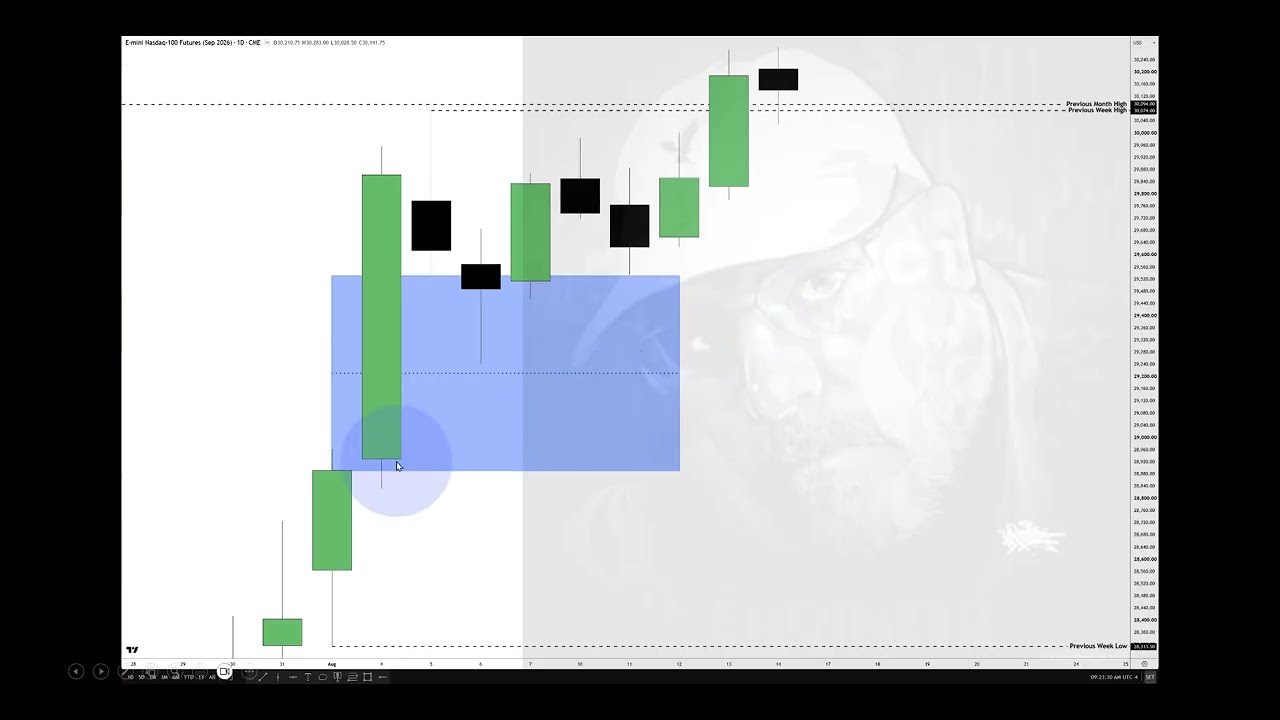
– Charting framework: Analysis always begins with a continuous contract (gives consistent historical highs/lows/inefficiencies). He layers monthly, weekly, daily, 15-minute and 1-minute timeframes to build a roadmap.
– Key reference levels: Primary anchors are previous month/week highs and lows, session highs/lows (Asian, London, NY, AM, lunch), and midpoints. These static and session-based levels identify liquidity pools and likely “draws” for price.
– Order-flow concepts used: PD arrays, buy/sell-side balance efficiencies, inefficiencies (gaps), fair-value gaps, rejection blocks, inversion order blocks, and his “silver bullet” setups. He reads price structure and wick/body behavior to infer bullish vs bearish order flow.
– Weekly profile + economic calendar: He maps a likely weekly profile in advance and aligns it with scheduled high-impact news (CPI, PPI). That combination helps anticipate when and where liquidity will be hunted and how midweek volatility will unfold.
– TGIF concept and targets: For bullish weeks he expects a pullback into the weekly range (typical retrace ~20–30% of weekly range, with 25% a common target). He uses this to set extraction points and partial-profit targets.
– Execution & risk management: Example trade—posted target level (29,984), entered two contracts against defined stops around consequent encroachment/ order block structure, aimed for 20–30% weekly-range profit zones. He stresses matching models to market conditions and sizing relative to stop distance.
– Teaching philosophy: He gives much content free, insists students do the work (study prior mentorship material), and argues his methods are repeatable across markets (futures, CFDs, forex, gold, etc.). He defends public level-calls and live trade evidence as proof of concept.
– Practical takeaway: Use continuous-contract reference levels, session and weekly profiles, and order-flow price-structure clues (inefficiencies, wicks/bodies, rejection blocks) combined with the economic calendar to form a pre-market bias and tradable targets; study the core material repeatedly to internalize the models.
Leave a Reply