
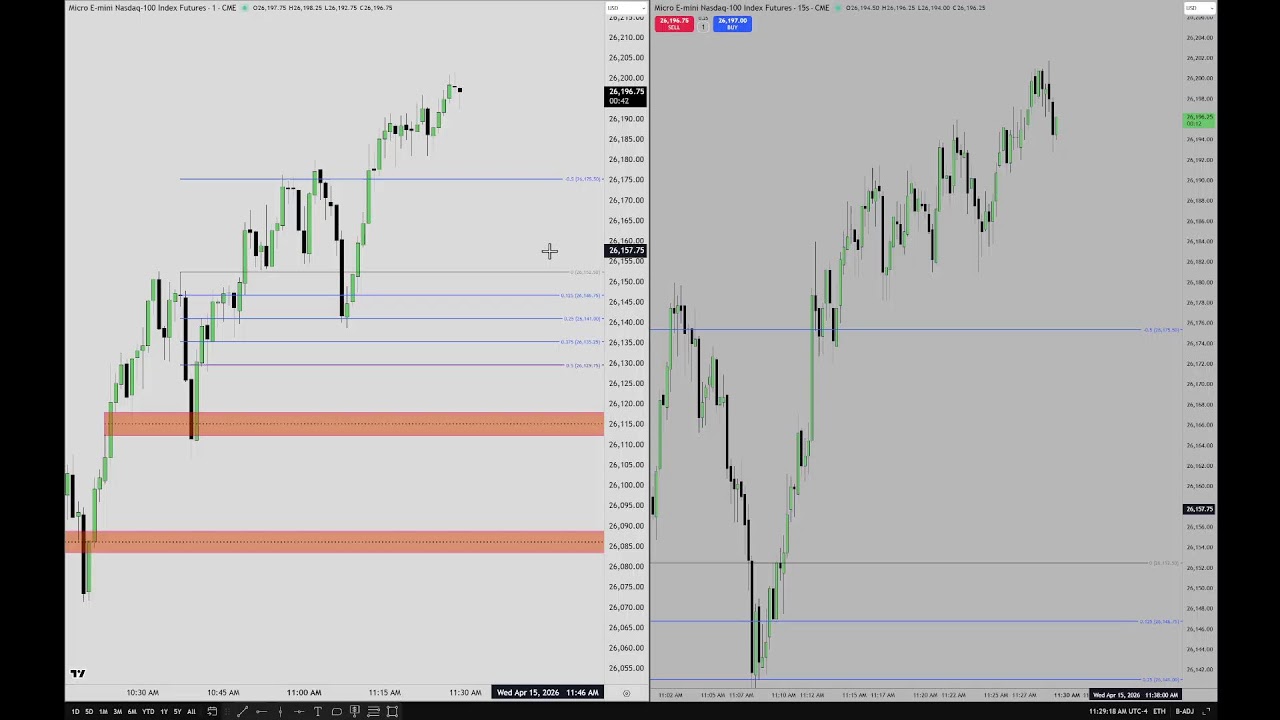
Summary:
– This was a live trading “drill” session meant as practice, not trade advice. The instructor repeatedly warns viewers not to copy these live examples with real money and to use demo/paper accounts for drills.
– Focus and method: working mainly on 1-minute charts with a sub‑1‑minute executable frame (15‑second) to practice entries into fair value gaps (today) and order blocks (upcoming). The aim is to learn how to spot small inefficiencies, liquidity pools, relative equal highs/lows, and consequent encroachment.
– Objective and trade sizing: treat drills like “leg day” — uncomfortable but necessary. Target small, low‑risk moves (roughly 10–15 handles), use a one‑for‑one model, place stops, and accept that outcomes don’t matter for the exercise.
– Mindset and psychology: primary goal is to desensitize to fear/need-to-be-right. Record emotional reactions, keep a journal, narrate and review your screens, and build repetition/experience rather than seeking instant profits or highlight trades.
– Market commentary: the session’s market was “sloppy,” choppy and fast, with decoupling between indices and occasional order-fill glitches on TradingView. Such hard conditions are exactly where practicing is most useful.
– Practical tips: do drills for short periods (15 minutes/day minimum), screenshot glitches/fills, record yourself narrating price action, focus on process not outcomes, and keep edge sharp by ongoing practice even after profitability.
– Final point: there are no shortcuts — consistent practice, honest journaling, and accepting short‑term failure are required to develop reliable trading skills.
Quiz
1. According to ICT, what should traders do when there is nothing on the chart to work with?
A. Enter anyway to stay active
B. Wait and do nothing
C. Increase position size
D. Trade the opening bell only
2. What did ICT say is the purpose of these drills?
A. To make money quickly
B. To build a highlight reel for social media
C. To practice participation in price action without fear or money pressure
D. To predict every market move correctly
3. What target range did ICT repeatedly say he was looking for in these drills?
A. 1 to 3 handles
B. 5 to 8 handles
C. 10 to 15 handles
D. 25 to 30 handles
4. What did ICT say about using live trading accounts for these drill examples?
A. They are meant to be copied directly into funded accounts
B. They should only be used on futures contracts
C. They are not trade entries to copy into live or funded accounts
D. They only work during the London session
5. What market condition did ICT say would make him reluctant to participate?
A. Clean price action with open traffic
B. Fast, loose, low resistance liquidity run conditions
C. Messy, choppy, range-bound price action with shared candle ranges
D. A market with large clean imbalances and expansion
Answer Key with Evidence
1. B. Wait and do nothing
Evidence: “So if you have nothing to work on, you sit still.” He also said, “If there’s nothing in the chart, don’t force it.”
2. C. To practice participation in price action without fear or money pressure
Evidence: “You’re just simply looking for something to engage with to get accustomed to the watching price action… You got to get that baseline foundation of experience. And don’t be afraid.” Also: “Drills are simply looking for small little participations in price action with no monetary hope of making money and no fear of losing.”
3. C. 10 to 15 handles
Evidence: “think about how, say for instance, 10 to 15 handles. Okay? So, that’s a really good small low-hanging fruit objective to look for”
4. C. They are not trade entries to copy into live or funded accounts
Evidence: “please don’t take these as trade entries for you to put on your funded accounts. Do not try to copy them for your live account trading. If you’re here to do that, I promise you I’m going to hurt you.”
5. C. Messy, choppy, range-bound price action with shared candle ranges
Evidence: “when the candlesticks are all parked next to each other it’s like you trying to go northbound or southbound on interstates. And it’s frustrating.” Also: “When it’s like that… you’re more prone to see a lot of continued consolidations.” He described it as “high resistance liquidity run conditions” and “very messy.”
Leave a Reply