
Summary:
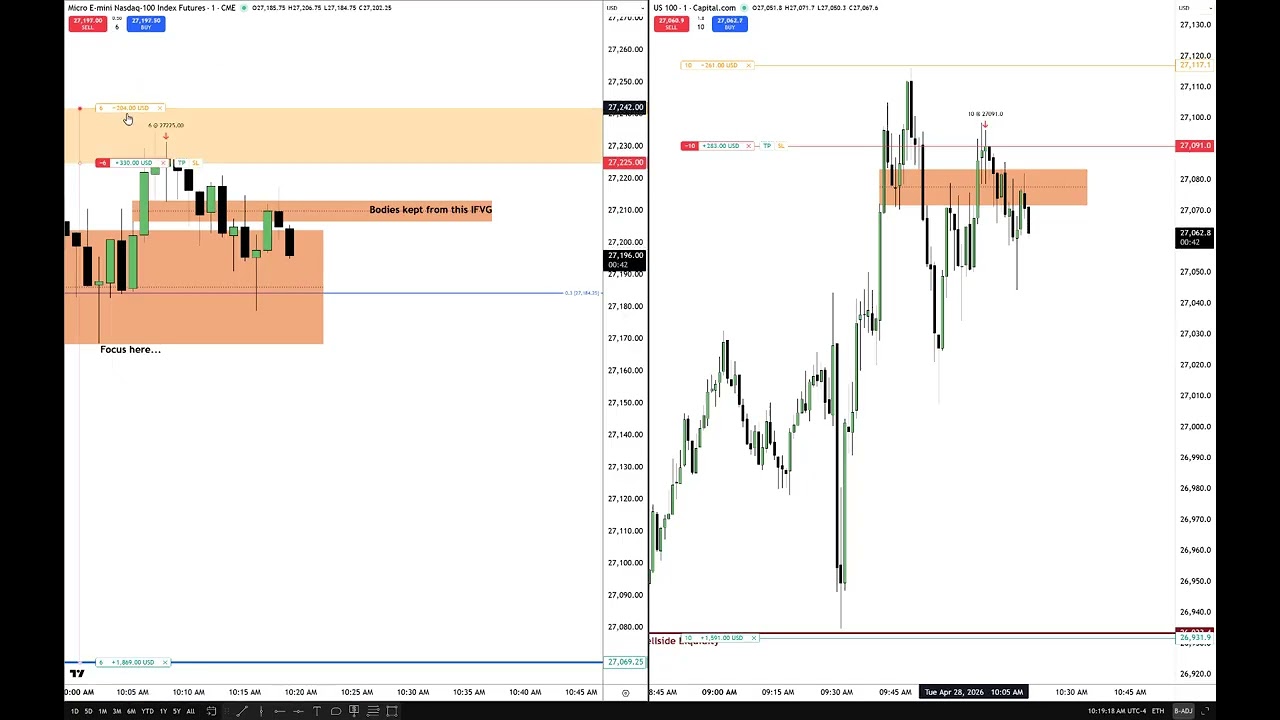
– ICT is executing a short trade in the micro NASDAQ (MNQ) and mirroring it on a US 100 CFD, adjusting stops and targets to the relative equal lows from that morning.
– He highlights price discrepancies between real-time MNQ futures and the CFD feed but emphasizes that the same liquidity-based entry logic (lower quadrant 75, opening-range/gap levels, order blocks) can be transposed between futures and CFDs.
– Key technical concepts used: opening-range gap, inversion/fair-value gaps, bullish/bearish order blocks, “gray pool” (sell-side liquidity pool between two wicks), event horizon (midpoint between lows), and body/wick placement as confirmation.
– Trade management: stop placed above recent highs, partial profit-taking planned at an “event horizon” level, and a time stop rule if price fails to show directional conviction within a few candles.
– He annotates the CFD chart heavily for students who can’t access futures markets, demonstrating that CFD price action can validly reflect the same order-flow signals (while noting legal/regional restrictions on CFD trading).
– Emphasizes not endorsing any broker shown (Capital.com appears on his chart but he has no affiliate relationship).
– The trade is executed and managed live (demo for CFDs due to US legal limits), partials are taken, and execution confirmations appear in the corner—used to teach that the method works across instruments when managed properly.
– Overall point: the order-flow/liquidity approach and execution rules used for MNQ futures can be applied to CFDs; careful stop management, candle-body rules, and liquidity targets drive entries, confirmations, and exits.
Quiz
1) What instrument did ICT say he was shorting at the start of the session?
A. S&P 500 futures
B. Micro NASDAQ (MNQ)
C. US 100 CFD only
D. EUR/USD
2) Why did ICT compare MNQ futures price versus the CFD price?
A. To promote Capital.com as a broker
B. To show CFDs are illegal everywhere
C. To compare and contrast real-time price action and show they may differ but map similarly
D. To prove market replay is necessary
3) Which specific entry mechanism level did ICT mention using?
A. Upper quadrant 50 level
B. Lower quadrant 75 level
C. VWAP pivot level
D. Opening range high
4) What name did ICT give to the two-wick liquidity area he annotated?
A. Event horizon
B. Minor sellside pool
C. ICT gray pool
D. Inversion fair value gap
5) What trade management action did ICT describe after the move progressed?
A. Closed the entire position immediately
B. Doubled the position size
C. Took partial profits (e.g., “take three off”, “take two off”)
D. Moved stop to break-even and added a new leg
Answer key with evidence (no timestamps available):
1) B. Micro NASDAQ (MNQ)
Evidence: “All right. So, we’re going to be doing some work here in the CFD. So, I’m going short here in the micro NASDAQ.” and later references to “MNQ” throughout.
2) C. To compare and contrast real-time price action and show they may differ but map similarly
Evidence: “Notice that the prices do not agree, but we’re comparing and contrasting real-time price action with MNQ futures price versus the CFD um price…” and “I’m comparing and contrasting what I would do if I was doing the futures contract only versus what I see in the CFD market.”
3) B. Lower quadrant 75 level
Evidence: “the entry mechanism which is the lower quadrant 75 level”
4) C. ICT gray pool
Evidence: “There’s a gray pool forming. … Now, in between those two consequent encroachments, that is the ICT gray pool.”
5) C. Took partial profits (e.g., “take three off”, “take two off”)
Evidence: “Take three off. That’s good. … And we’ll take two off here in the MNQ and we’ll market that.” and “I’m probably going to take something off.”
Leave a Reply