Author: Summarizer

  • Case Study With NonFarm Payroll & NQ Futures \ August 07, 2026

    Case Study With NonFarm Payroll & NQ Futures \ August 07, 2026

    Summary:

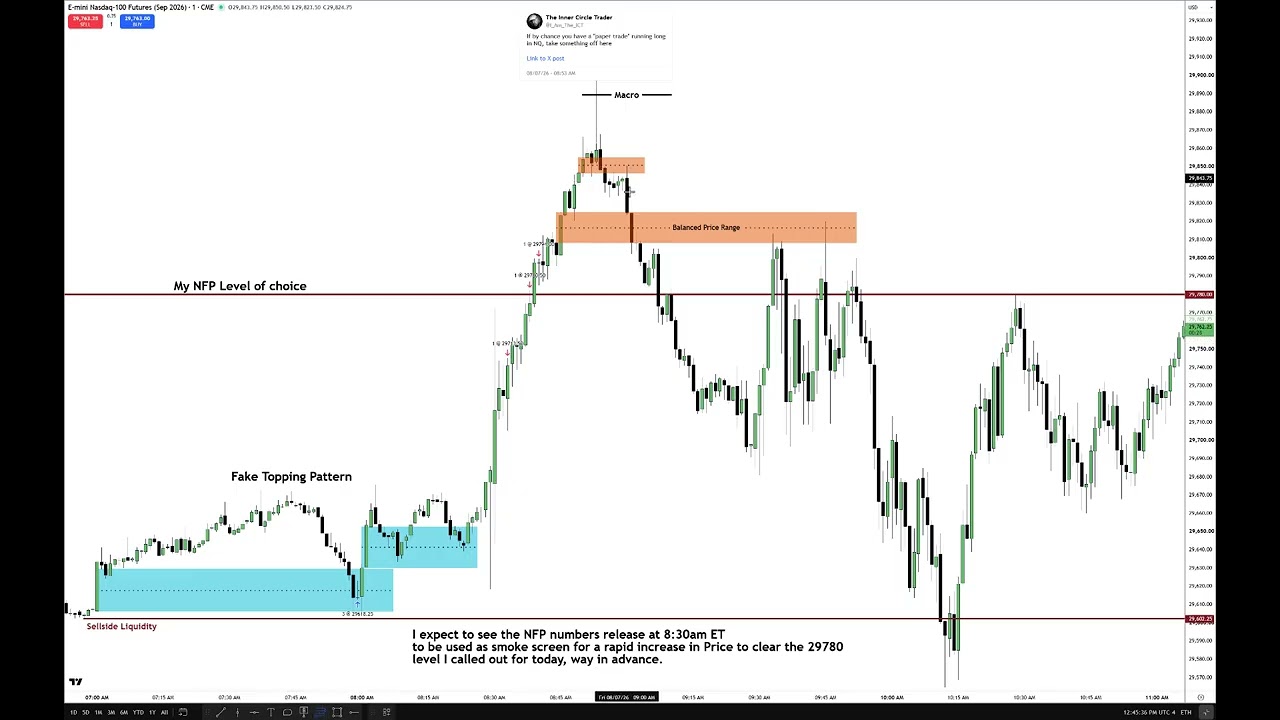
    – The speaker reviews NASDAQ price action on non-farm payroll (NFP) Friday and strongly warns inexperienced traders not to trade on Thursday/Friday of the first week of the month because NFP creates extreme volatility.
    – He uses a pre-market range from 7:00–8:30 a.m. ET (highest high and lowest low) to define the “dealing range” and guide trade expectations ahead of the 8:30 NFP release.
    – He had posted a target level of 29,780 and explains how price interacted with that level during the morning: initial consolidation, a rally into the target, then a macro-time (8:50–9:10) reversal—consistent with NFP’s typical two-stage move (initial spike then retracement).
    – He describes his trade mechanics and tools: algorithmic projections, standard-deviation targets, Fibonacci anchoring, concepts like buy/sell-side balance, fair-value gaps, encroachment/octants, and liquidity runs. He entered a demo (paper) long on three contracts, took a partial profit around the halfway point, and emphasized conservative sizing and risk management.
    – He recorded and will annotate the session for further teaching, and closes with personal notes (birthday tomorrow) and well wishes.

  • ICT Price Action Chronicles – The Science Of Anticipation In Price Action

    ICT Price Action Chronicles – The Science Of Anticipation In Price Action

    https://www.youtube.com/watch?v=tByaPnk3fc4

    Summary:

    The speaker reviews a strong post-FOMC rally and explains the technical reasons they entered a long trade, focusing on daily “inversion fair value gap” levels, volume imbalances, and a premarket suspension block on a one-minute chart. They describe the live entry at the midpoint of a gap, how they managed the trade (partial profit-taking and moving the stop to lock in gains), and the importance of watching whether price defends the upper half of the gap and closes above key wicks and prior highs. Practical trading advice includes using Monday–Wednesday mornings during non‑farm‑payroll (NFP) weeks for cleaner price action, preferring technical price‑action/supply‑demand analysis over fundamentals (which they view as unreliable for indices), and focusing on anticipation, pattern recognition, and disciplined risk management. They emphasize: set and keep measured stops, take partial profits to manage emotions, trade with probability by using daily key levels (PD arrays, gaps, volume imbalances), and build experience through consistent observation of price behavior.

  • ICT Price Action Chronicles – MOC Crushing The Buying & Selling Pressure Myth

    ICT Price Action Chronicles – MOC Crushing The Buying & Selling Pressure Myth

    https://www.youtube.com/watch?v=HFWqQelvrJw

    Summary:

    The speaker reviews an E-mini S&P Market‑on‑Close trade (Aug 4, 2026), using the prior day’s lecture as context and focusing on precise, repeatable price‑action methods rather than broad indicators. Key ideas:

    – Focus window: measure the full daily range (intraday high to low) and concentrate on the final hour (3:00–4:00 PM ET) and PM‑session structure (pre‑market 1:30–2:00 PM, then 3:50–4:00 PM) to find high‑probability, short-duration setups.
    – Tools and signals: use simple price‑action tools — measured range, anchored fibs (including negative .5), octant/16th splits, candlestick structure, fair value gaps, and volume imbalances — to calculate exact price levels and bias.
    – Trade logic: wait for price to rally into defined highs (liquidity pools/inefficiencies), then look for failure (rejection, fair‑value gap inversion, close below key levels) to enter a short; use partials and tight stops. Candlestick behavior and order‑flow rules validate direction.
    – Execution nuance: setups are surgical and time‑sensitive; small imperfections and manual intervention can occur. The instructor shows live execution but warns that publicizing exact stops/targets attracts other traders’ orders, which can undermine an edge.
    – Teaching stance and risk: the presenter will not provide live trade calls or one‑on‑one mentorship and stresses operator responsibility — students must practice, learn the process, and accept personal risk. The methods are presented as systematic, mathematical, and repeatable but require experience to use reliably.

  • ICT Price Action Chronicles – Market On Close Macro

    ICT Price Action Chronicles – Market On Close Macro

    https://www.youtube.com/watch?v=PP1-i0ti_tQ

    This is a trading lesson using the August 3, 2026 New York PM session to teach a short, repeatable intraday “market-on-close” (aka “murder on close”) scalping macro that often produces clean, predictable price runs in the last hour of regular trading. Key timing rules: set your clock to New York local time; the NY PM pre-session begins at 1:30 PM ET, 3:00 PM often produces a defining premium wick (PDA) and 3:50–4:00 PM is the critical 10-minute market-on-close window to watch. Method highlights: identify the last-hour high/low range, grade any wicks (wicks take precedence over adjacent fair-value gaps), spot relative equal highs/lows and minor sell-side/buy-side liquidity pools, then project the first-octant/0.5 fib level as a high-probability target (example target shown ~28,870.75). Risk and execution: anchor stop-losses near the 3:00 premium-wick high (upper-half context), allow measured drawdown into the wick, add to positions on expected tests, and use partials rather than obsessing over perfect exits. Trade psychology and process: expect losses and missed trades, backtest the rules, practice disciplined entries/management, and refine execution over time rather than chasing perfection.

  • Part 2 High Precision Secrets To Intraday Price Action

    Part 2 High Precision Secrets To Intraday Price Action

    https://www.youtube.com/watch?v=BD7kqmgdBU8

    Summary:

    – The speaker (34 years trading) emphasizes studying how markets form highs/lows and session structure by logging, backtesting and learning the underlying mechanics rather than relying on pundits or simplified “systems.”
    – Primary framework: use the daily chart as the source for high/low/range information, then grade that range by time (opening range, first hour, PD arrays, octants/quadrants) and price (fair value gaps, order blocks, volume imbalances).
    – Practical setup explained in detail: measure the opening range gap (e.g., 9:30 open vs prior settlement at 4:14), identify consequent encroachment (half-gap), fair value/inversion gaps, and PD arrays to predict likely reactions and targets.
    – Trade rules and money management: prefer low-hanging objectives first (half-gap), take partials (e.g., partial at half-gap, bulk at full gap closure), leave a runner, pyramid into drawdown if able, place stops above consequential levels, and use micro contracts if volatility makes larger stops impractical.
    – Targets and extensions: plan exits at half-gap, full gap, negative0.2, negative0.5, and 1.0 standard deviation levels; roll stops up as trades progress to protect profits.
    – Philosophy: this is a technical, time-and-price science — not pattern superstition. It requires disciplined study and cannot be meaningfully shortcuted; laziness produces weak, short-lived results.
    – Personal notes: he’s confident in his method, will be reducing his teaching pace over the next two years, supports a charity via partner prop firms, and encourages serious students to study deeply to gain precision and confidence.

    Takeaway: Learn to measure and grade daily ranges, identify key price/time levels (opening range, fair value gaps, PD arrays), trade conservatively with staged profit-taking and stop management, and commit to disciplined journaling and backtesting rather than quick shortcut systems.

  • Part 1 \ High Precision Secrets To Intraday Price Action

    Part 1 \ High Precision Secrets To Intraday Price Action

    https://www.youtube.com/watch?v=DRTvbkKmuAw

    – Opening remarks and brief apology for a distracted recording; personal anecdote about family and a live-stream discussion.
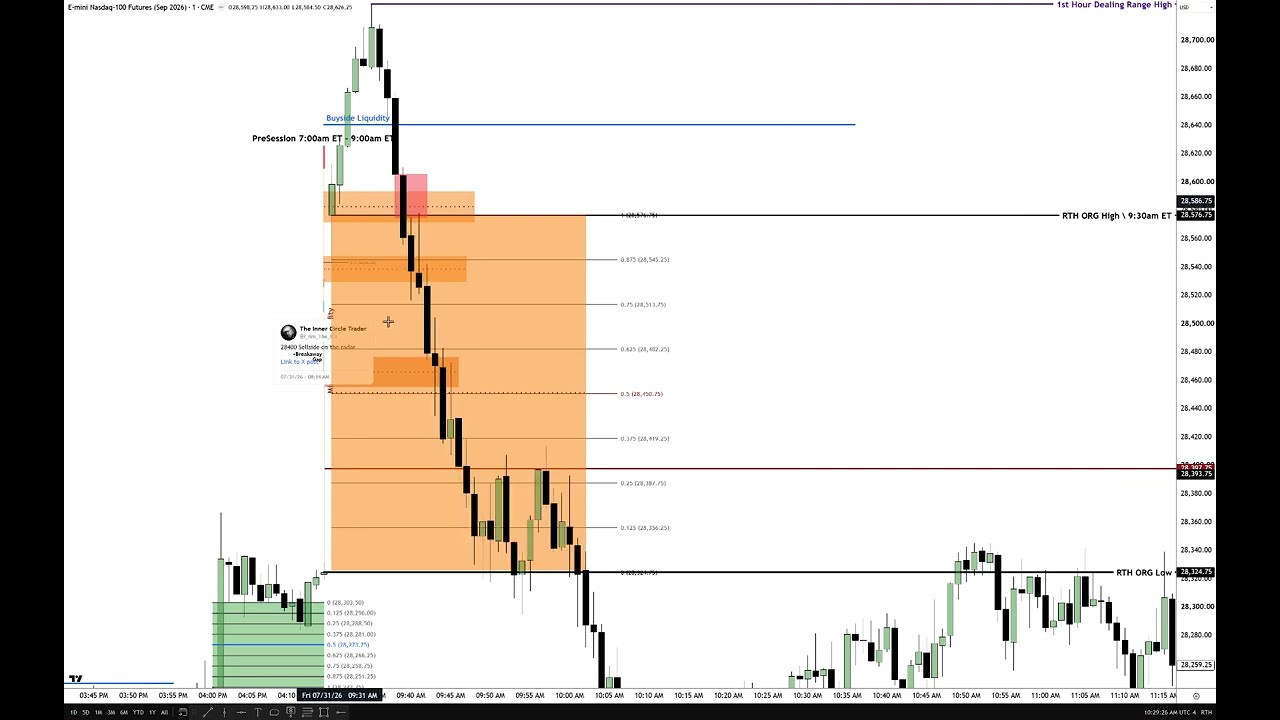
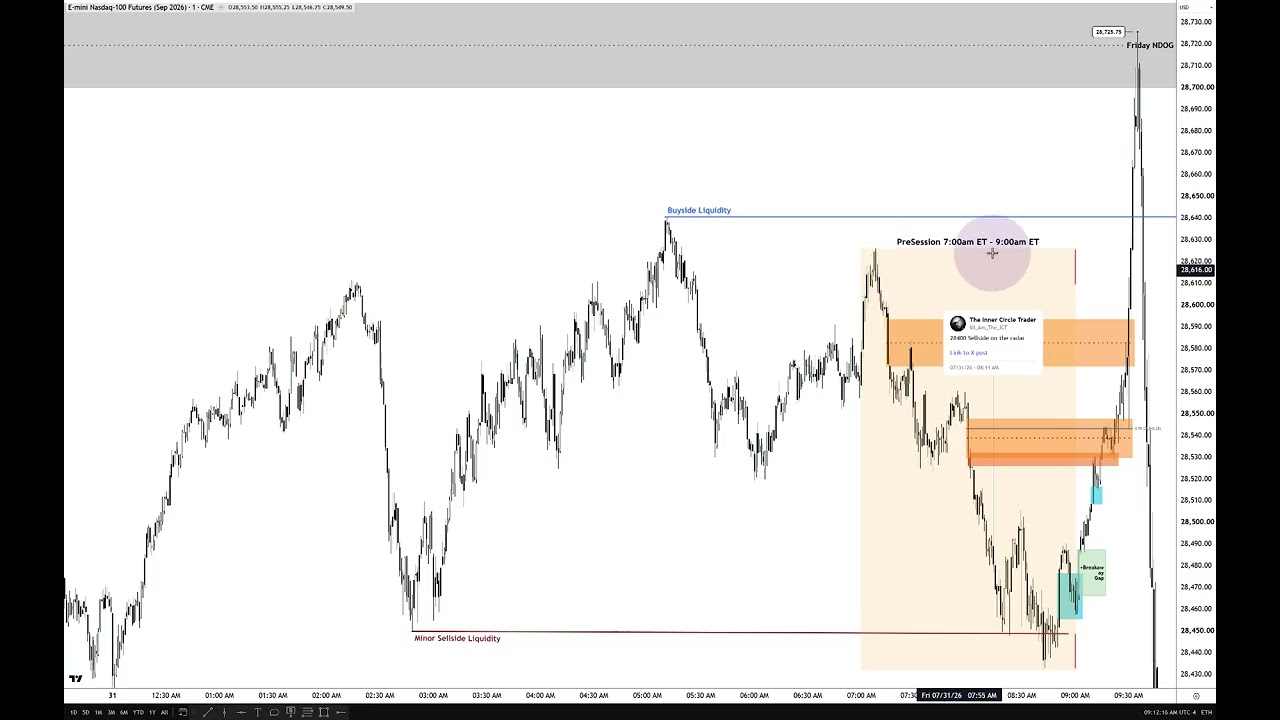
    – Core trading idea: focus on a specific, finite pre-market time range (pre-session 7:00–9:00 a.m. ET). Treat that window as the primary data sample for the regular session.
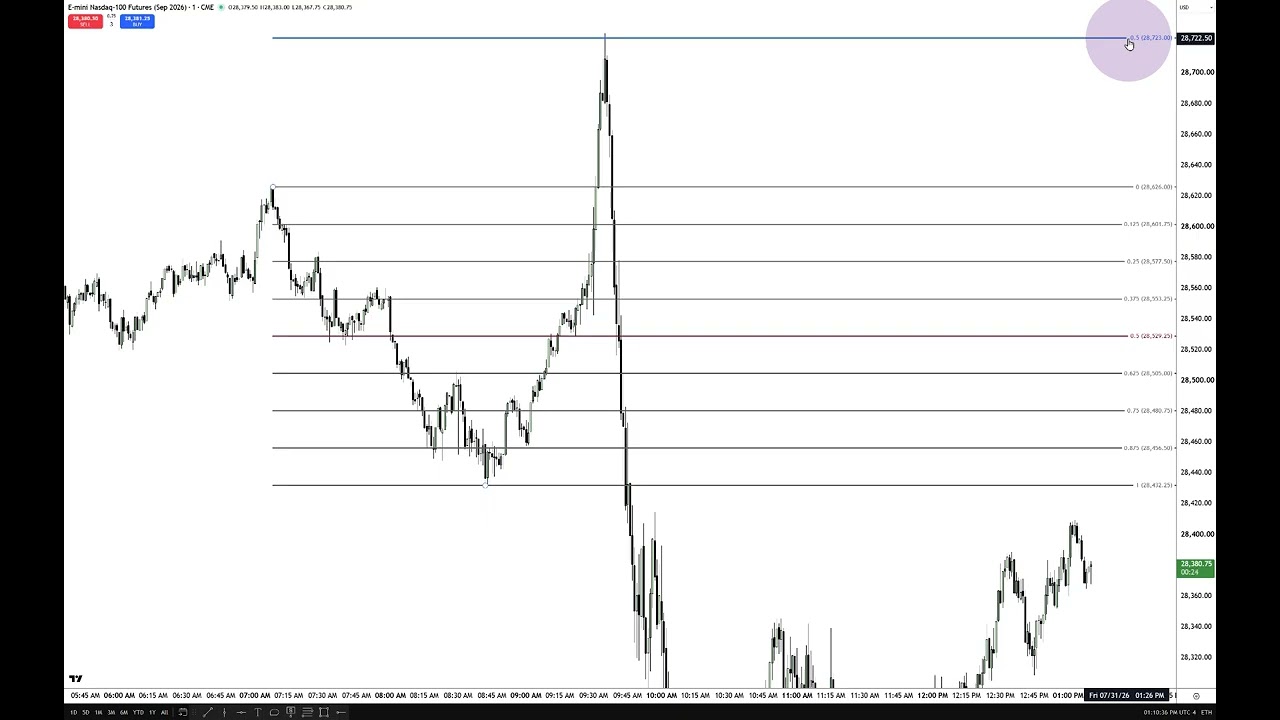
    – Methodology: anchor a Fibonacci to the highest high and lowest low inside the 7–9 a.m. range, then project precise horizontal price levels (quadrants/octants, midpoints) forward as key reference points.
    – Key price-structure concepts used: buy-side imbalances / sell-side inefficiencies, inversion fair value gaps, breakaway gaps, consequent encroachment — all tethered to specific candles and the time-based range.
    – Practical rule: levels must be precise and time-anchored (not vague “zones”); trades are anticipatory (based on those specific levels and the 9:01+ behavior), not reactive.
    – Example: he publicly identified and shorted the daily high in a recent session, targeted ~28,400, and the market reached the projected area—used to demonstrate the method’s predictive value.
    – Broader approach: use the last 3 days for intraday low/high projections; combine daily and intraday references (wicks, opening gaps) to refine targets.
    – Teaching philosophy and criticism: urges students to study and verify (not blindly trust), defends against trolls/copycats, and stresses the mental effort and discipline required to master the method.
    – Summary takeaway: a time-anchored, level-specific framework (pre-market 7–9 a.m. + precise technical constructs) yields high-probability, anticipatory trade setups when applied consistently.

  • Market Review NQ July 31, 2026

    Market Review NQ July 31, 2026

    https://www.youtube.com/watch?v=uws9egBxPLI

    – Instructor opened with a short review and logistics (may post more content on YouTube; translations can be limited if videos exceed an hour).
    – Market recap: price rallied into last week’s Friday volume imbalance, then after FOMC retraced into the same imbalance; weekly low held and price followed through to near the week’s start.
    – Teaching focus: a methodology combining market structure, time-and-price grids (PD arrays, octants/quadrants), and strict criteria for using fair value gaps/inefficiencies and volume imbalances — not just visual guesses.
    – Key tactical framework: use the pre-market “dealing range” (7:00–9:00 ET) and the opening range (9:30–10:30 ET) to build time-based horizontal levels; project range extensions (notably the 0.5 fib) to forecast likely session highs/lows.
    – Examples given: specific levels (e.g., 28,400) and how buy-side imbalances / sell-side inefficiencies aligned with octants and algorithmic times (8:30, 8:50–9:10) to produce predictable reactions.
    – Execution tips: enter small “information” contracts to read order flow (even 1-second candles), use demos or micros to test, and scale into trades when price confirms.
    – Emphasis on experience: the system requires practice; the teacher criticizes shortcuts, rebranding by others, and says experience cannot be simply transferred.
    – Personal anecdote: he traded the setup (shorted near the projected high, hit target around 28,400), describing trade management lessons and minor execution errors.

  • ICT Algorithmic Time & Price Grids

    ICT Algorithmic Time & Price Grids

    https://www.youtube.com/watch?v=4SJlJdIANCo

    Summary:

    – He reviews the NASDAQ September futures move: an aggressive sell-off at open followed by a fast, efficient rally into a daily-level target, driven by intraday order flow and algorithmic programs.
    – Key technical framework: daily “suspension blocks” (shaded blue/gray), octants/quadrants, PD arrays, order blocks, fair value gaps (FVGs) and “buy/sell efficiency” cells. These layered levels anchor where price will turn or continue.
    – Important price-action rules he uses: bodies staying in the upper half of a candle = bullish; wicks probing but not closing below midpoints = accumulation; stop-hunts clear retail stops before directional moves; measuring wicks and candle midpoints predicts strength/ failure.
    – Time structure matters: he applies a horizontal/vertical time-price grid (macro start times, top-of-hour/macro closes like 10:50 and 11:10) to anticipate where turns and PDAs will form.
    – Examples from the session: opening above short-term highs, stop-hunt to take out stops, accumulation in an order block anchored to a daily octant, then a rapid buy program that produced big moves into the daily suspension-block high; later formation of inversion FVGs and retracements that validated his rules.
    – Methodology emphasis: predict from repeating algorithmic signatures rather than react; learn the specific language/criteria he teaches, backtest, then tape-read live; one PDA at a time before mastering others.
    – Critique of common alternatives: he rejects generic “supply/demand” or momentum-chasing approaches and market randomness claims, arguing markets are algorithmic and can be read with precise rules.
    – Teaching philosophy: encourages discipline, independent thought, patient practice, and money management. The goal is to internalize his methods so students can trade independently.

    Bottom line: he argues the day’s action confirmed his layered price/time framework and rules for reading order flow, and he stresses learning that language and discipline to predict rather than react.

  • Trader Round Up – Weapons of War | July 31, 2026

    Summary — Trader Roundup conversation (key points)

    • Opening anecdote: Kitt describes taking an early loss and trading out of drawdown intraday by patiently re-entering his model; conversation centers on loss mitigation and trade management.
    • Core trading lessons (Michael/ICT):
      • Losses are inevitable; quicker acceptance and measured responses (partial exits, reduced size) preserve capital and mindset.
      • Know your model, read price action (PD arrays, order blocks, fair value gaps, breadth of candles) and use those structures to validate projections.
      • Use pre-market / early-morning windows (roughly 7–9 AM ET) to set anchors and high-probability levels for the session.
      • Manage risk impeccably but be willing to add size correctly to capture large, repeated moves (manage profit as well as manage risk).
      • Talk to yourself aloud about what each candlestick is telling you to stay focused and avoid reactionary decisions.
    • Practical technique notes from participants:
      • Use standard-deviation / protraction measurements and PDRA anchoring for targets and stops; be careful with settlement vs. RTH prints.
      • Many traders find mobile execution (phones/iPads) intuitive for short-timeframe reads.
      • Floor vs. screen trading: floor gave human-volume cues and direct knowledge of positioning; screens and algos changed the game (less market-making opportunity, more market-taking).
    • Psychology, habits and preparation:
      • Build routines (sleep, exercise, prayer/meditation, schedule) to reduce anxiety and improve execution; gratitude and faith were emphasized as stabilizing forces.
      • Consistency comes from practice: small daily steps, logging, and disciplined adherence to process.
    • Community, mentorship and frustration:
      • Michael has invested years teaching advanced methods; he shared detailed, high‑precision lectures (including a recent one) and expressed frustration that some students/trolls dismiss or fail to appreciate the material.
      • He worries about the emotional burden of mentoring, the misuse of teachings, and the toll of criticism; nonetheless he’s committed to helping those who seriously apply the work.
      • Community support and peer accountability (Trader Roundup, archives, forums) are presented as valuable for development.
    • Wider initiatives and personal notes:
      • Michael mentioned a charity initiative (St. Jude) with prop firms; clarified he won’t profit from it.
      • Personal reflections on age, family, health, legacy and plans to scale back intensity while continuing to support students.

    Takeaway: trading success requires a reliable process (price-structure reading, risk control, and profit management), psychological preparation and steady practice; mentorship and a constructive community help, but results only follow committed, disciplined work.

  • Predicting Session Low & High With Executions

    Predicting Session Low & High With Executions

    https://www.youtube.com/watch?v=J9G1j3-e1GU

    Summary — key points

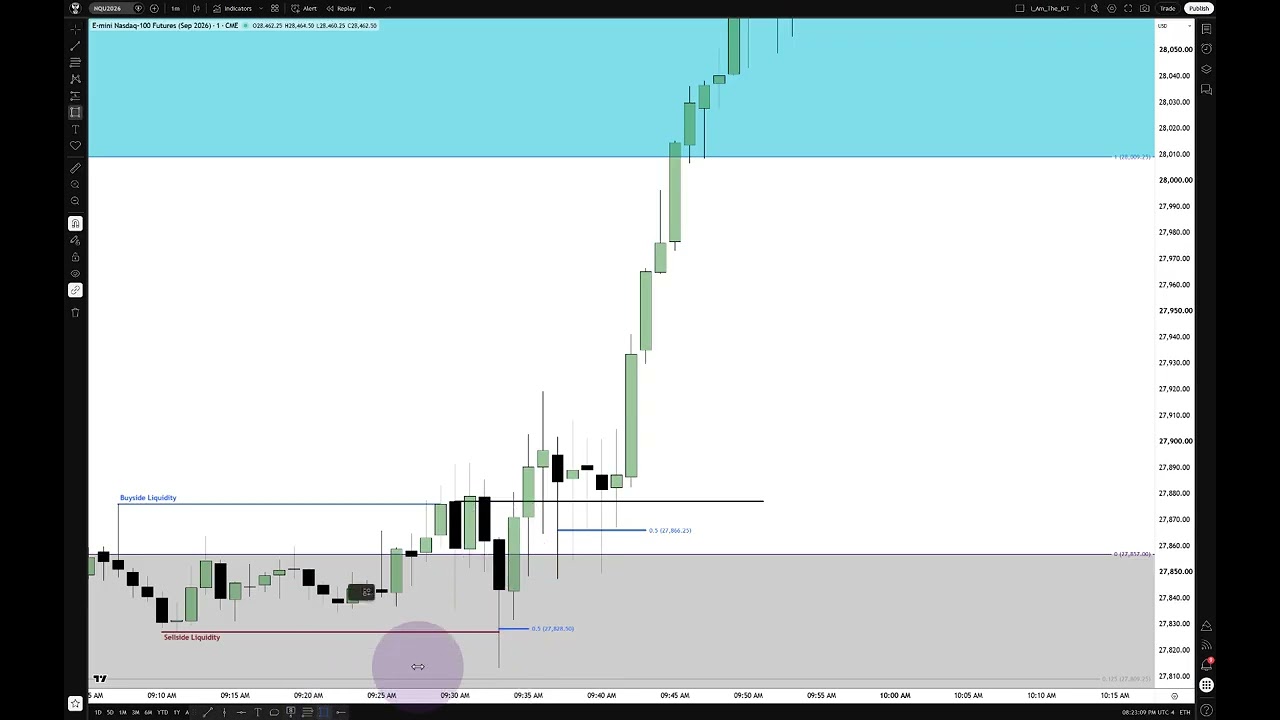
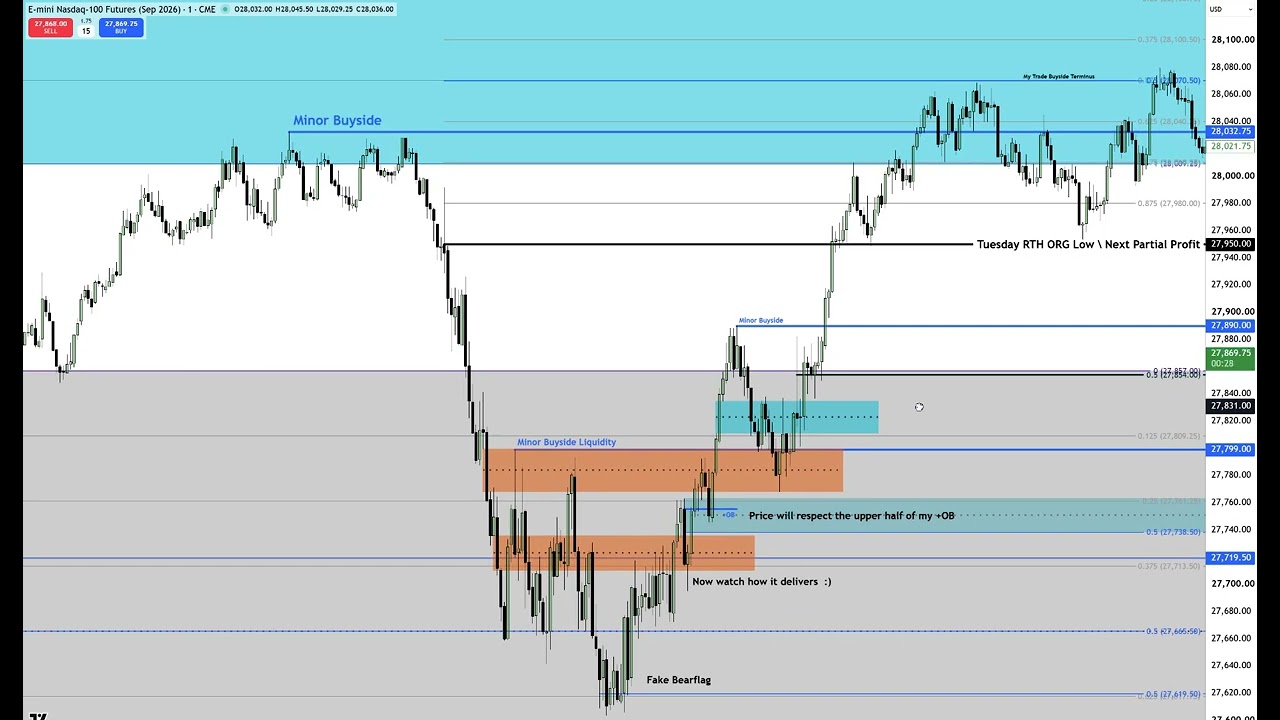
    – Daily chart: price reached the author’s downside objective and created a bullish order block / deep-discount suspension block with an inefficiency. That zone (around 27,665.5) is a likely bounce area; even if price keeps falling, it’s a good hunt for a low-risk buy.
    – Intraday (1‑minute): the move formed a market‑maker buy model — probes lower to collect sell‑side liquidity, prints a wick/reversal and then reaccumulates, which led to a rally toward the planned target.
    – Trade execution: the author entered aggressively below the wick midpoint with 3 contracts, planned to scale into partials (including around the 9:30 RTH open), and saw the price reach the intended levels but could not fully manage the position.
    – Personal interruption: he had to leave due to a family medical emergency (sister‑in‑law with pregnancy complications), so he recorded the whole session and later uploaded an unedited, real‑time video.
    – Teaching points and follow up: emphasizes studying full real‑time footage (not just sped‑up clips) to learn market‑maker buy/sell models, fair‑value gaps, reaccumulation, etc. Promises further demonstration later in the day.