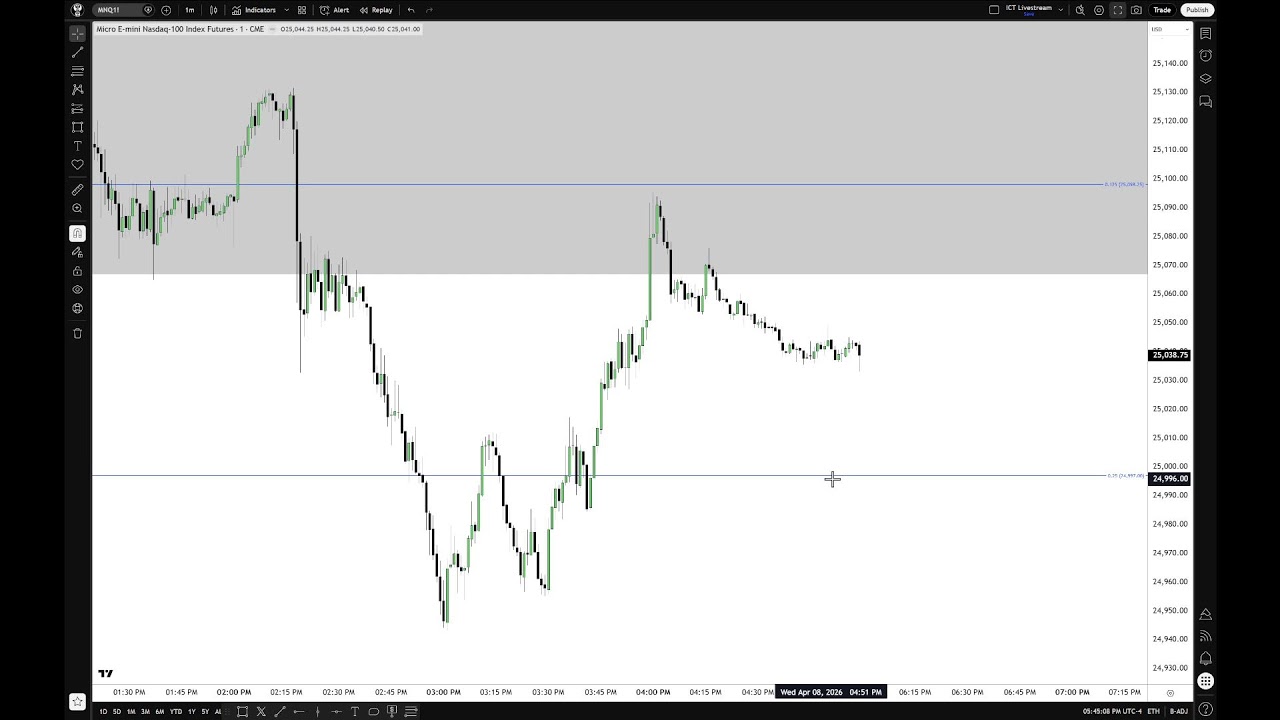
Tag: innercircletrader

  • Trader Round Up – ICT Post livestream | April 15, 2026

    Summary — Trader Roundup live stream (participants: Kitt, ICT/Michael, students)

    – Purpose/context: Community recap of Michael’s live-stream tape‑reading drills and Q&A. Hosts emphasized the “lab/college” mindset — short, repeated practice to build real experience and desensitize emotion.

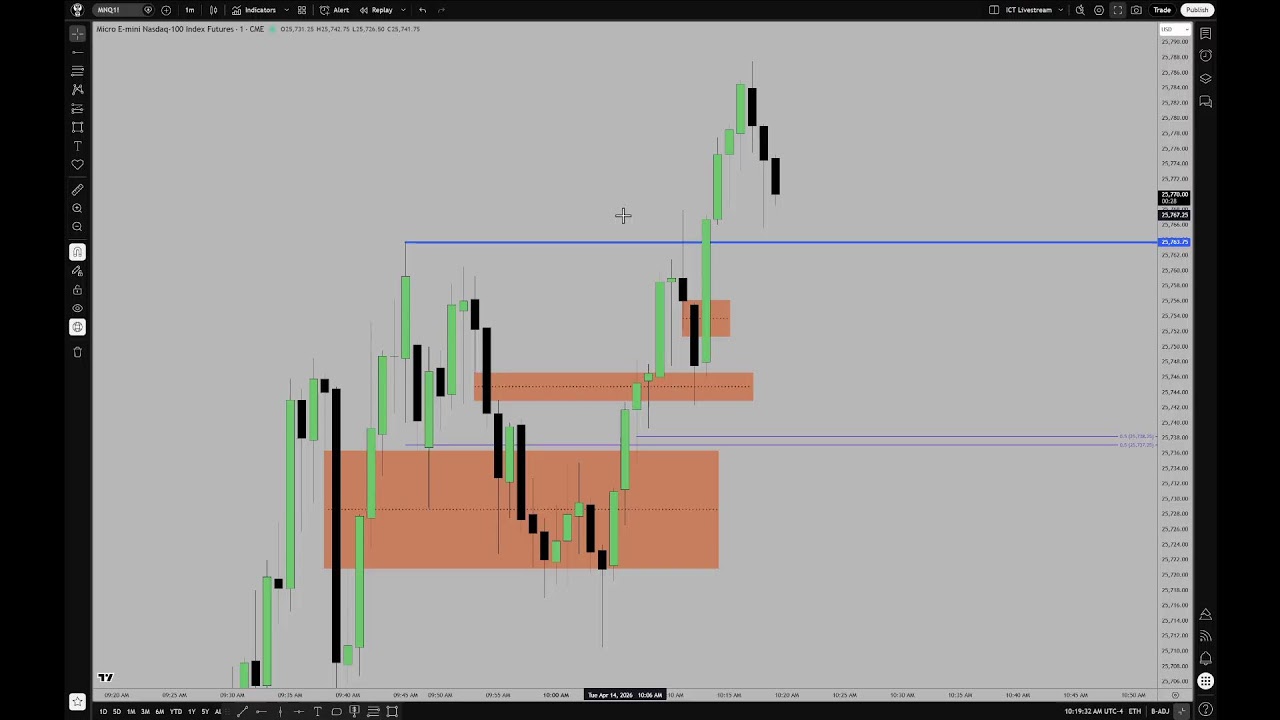
    – Daily drill recommendation: Use the 1‑minute timeframe for short drills (15 minutes/day), aim for small moves (10–15 handles) to learn price signatures without large P&L consequences. Record charts/audio, log time in trade, drawdown, emotions, and lessons.

    – Core trading foundations: Focus on the four elements of a trade setup (money management, entry trigger, draw/target, and context). Month 1–2 core content is essential; month 4/5+ adds advanced precision but isn’t strictly required to be profitable.

    – Timeframes and distortion: If 1‑minute looks “fuzzy,” back out to higher timeframes (5/10/15 min or 15‑sec when needed) to remove time distortion and clarify bias. Stack timeframes fractally.

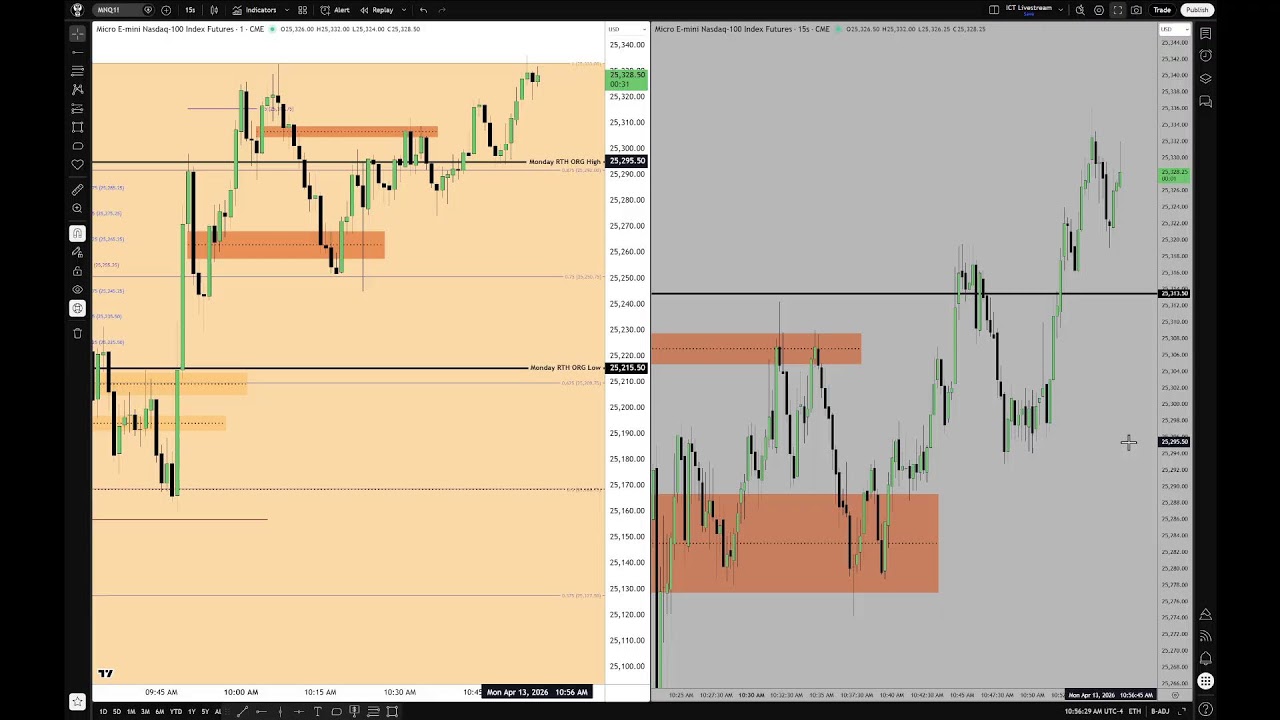
    – Market‑maker models / orderflow: Demonstrated market‑maker buy/sell models across 15‑minute intervals (including 15‑second reads). Key concepts: liquidity runs, inefficiencies, fair value gaps, order blocks, volume imbalances, relative equal highs/lows, WIC/WIX signatures, range projections and “six sister” market correlations (MES, MNQ, NQ).

    – Specific tactics taught: look for rangers/liquidity inefficiencies on micro timeframes; use inversion/reclaim, opening range gap and midpoint logic, quadrant/sixteenth grading of ranges, and recognize turtle‑soup false‑breakout setups. Grade ranges/gaps — importance if anchored to gradient levels.

    – Session/time‑based ranges: Always use the first 30 minutes (opening) as baseline; the first‑hour dealing range is useful while price remains near it and for intraday projections (including Asian, lunch, PM windows). Lunch/macro times often feature time distortion and retracements that can set up continuation or reversal.

    – Instruments: Use whichever contract (mini/micro/futures) shows the actionable signature; CFDs can mirror futures’ candles but may differ in price — translate logic by candlestick structure.

    – Journaling & pattern recognition: Take screenshots and notes; repeated review reveals time‑scheduled spooling (e.g., macro times like 9:50–10:10, lunchtime, PM session). Experience and disciplined recordkeeping are central to developing a reliable model.

    – Macro perspective: Michael and community discussed liquidity/QE and money printing driving asset inflation; warnings about broader economic risk (inflation, supply issues) and implications for markets.

    – Community & next steps: Mentorship content being refined; participants encouraged to revisit core content, practice daily in the “lab,” and build models incrementally.

    Quiz

    1. What did ICT say should be the focus when looking at the market on a very short timeframe during drills?
    A. Predicting earnings reports
    B. Looking for sub-one-minute low-hanging fruit like 10 to 15 handles, ranges, liquidity, and inefficiencies
    C. Trading only the daily chart
    D. Avoiding all chart analysis until the close

    2. What did ICT say about the first 30 minutes of the trading day?
    A. It should never be used for analysis
    B. It is always a given and should always be used
    C. It is only useful after noon
    D. It matters only on consolidation days

    3. When describing time distortion, what did ICT recommend doing if a lower timeframe chart looks fuzzy or unclear?
    A. Trade more aggressively
    B. Delete the chart and start over
    C. Go up in timeframes to remove the distortion and bring price back into focus
    D. Ignore price action and wait for the weekly close

    Answer Key with Evidence:

    1. B — Evidence: ICT said they were “just looking for inefficiencies to act on liquidity” and earlier the discussion highlighted “10 to 15 handles” and “sub one minute low hanging fruit.” [00:22:07-00:22:10], [00:02:30-00:03:00]

    2. B — Evidence: “Well, every day you use the first 30 minutes. That’s always, always a given. That’s gonna happen all the time.” [00:39:14-00:39:30]

    3. C — Evidence: “If you go up to a 10 minute… you’ll see that it’s absolutely 100% crystal clear… you wanna back it out.” Also: “go up in timeframes and it’ll remove it.” [00:26:26-00:26:30], [00:28:00-00:28:28]
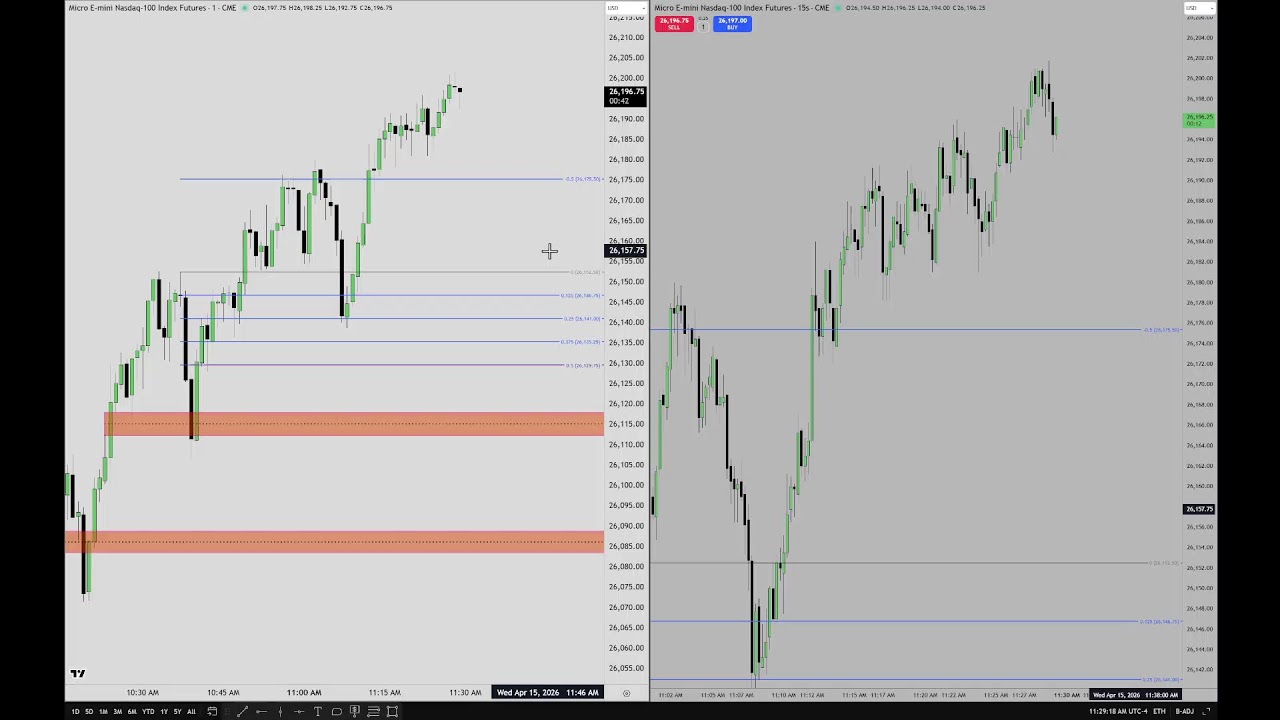
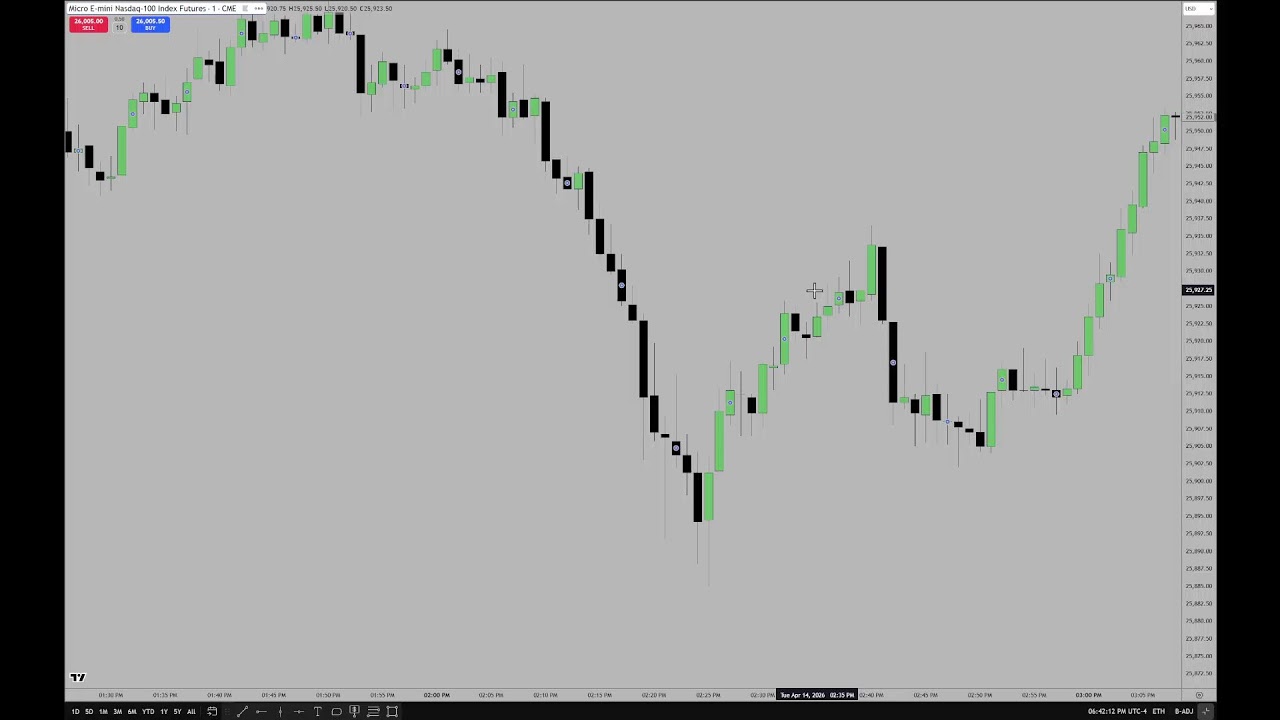
  • ICT 2026 Entries & Drills \ April 15, 2026

    ICT 2026 Entries & Drills \ April 15, 2026

    https://youtu.be/KASpfAd1MnI

    Here’s a concise summary of the livestream content and main takeaways:

    – Purpose: The session is a practice/drill demonstration—not trade advice. The instructor emphasizes using drills to build experience, desensitize to fear, and learn entry mechanics (like leg day in training).
    – Timeframes & tools: Focus on the 1-minute chart with sub‑minute execution (15‑second) to practice entries, fair value gaps (today’s topic), and order blocks (scheduled for tomorrow).
    – Approach to trades: Use paper/demo accounts only—do not copy live. Target small, repeatable objectives (roughly 10–15 handles) and use a simple 1:1 risk/reward stop model for drills.
    – What to practice: Enter small, well-defined liquidity pools (gaps, imbalances, relative equal highs/lows, consequent encroachment/inversion fair value gaps), place stops, record outcome and emotions, then repeat.
    – Mindset & risk management: Train indifference to outcomes—focus on repetition, not being right or making money. Journaling and recording trade narration help expose emotional issues and accelerate learning.
    – Market commentary: Today’s market was messy—high resistance, choppy, decoupled between indices (MNQ vs. ES). Such conditions are hard but valuable for practice because they reveal problematic price signatures.
    – Meta-advice: Real skill requires hands-on repetition; there are no shortcuts or paid fixes that reliably replace deliberate practice. Even profitable traders continue to practice off-account to retain edge.
    – Logistics: Disclaimer—this is educational; trading with real money is separate. The instructor plans more drill sessions and a review later.

    Bottom line: Use controlled, repeatable demo drills on short timeframes to build real-world experience, manage emotions, and develop pattern recognition before risking live capital.

    Quiz

    1. What was ICT’s main purpose for the session?
    A. To provide live trade signals for funded accounts
    B. To demonstrate drill practice in difficult market conditions
    C. To predict the exact daily high and low
    D. To teach only order blocks

    2. What did ICT say you should do if there is nothing in the chart to work with?
    A. Enter anyway to stay active
    B. Wait for the market to move first
    C. Sit still and do not force a trade
    D. Switch to a higher time frame and trade immediately

    3. What was ICT’s suggested target range for these drill trades?
    A. 1 to 3 handles
    B. 5 to 7 handles
    C. 10 to 15 handles
    D. 25 to 30 handles

    4. What did ICT say about the mindset needed during these drill sessions?
    A. Focus on being right and making money
    B. Avoid all losses by only trading perfect setups
    C. Be indifferent to the outcome and use the session for experience
    D. Trade only when social media can verify the setup

    Answer Key with Evidence:

    1. B
    Evidence: “I want you to think about how say for instance 10 to 15 handles… that’s a really good small lowhanging fruit objective… today we’re going to work with fair value gaps… please don’t take these as trade entries for you to put on your funded accounts… we’re going to look at how you can go in on a day-by-day basis… these types of little drills, little exercises”
    No timestamp available.

    2. C
    Evidence: “So far, no gaps to work with. So, if you have nothing to work on, you sit still. This is all part of it, knowing what you’re looking for. If there’s nothing in the chart, don’t force it.”
    No timestamp available.

    3. C
    Evidence: “I want you to think about how say for instance 10 to 15 handles. Okay? So that’s a really good small lowhanging fruit objective to look for…”
    No timestamp available.

    4. C
    Evidence: “It’s not about being right or wrong… You don’t care about being right… the outcome is not imperative. It’s not important. You don’t need it to be right. You don’t care.”
    No timestamp available.

  • ICT 2026 Futures Review \ April 14, 2026

    ICT 2026 Futures Review \ April 14, 2026

    https://youtu.be/DJ67ft6XENo

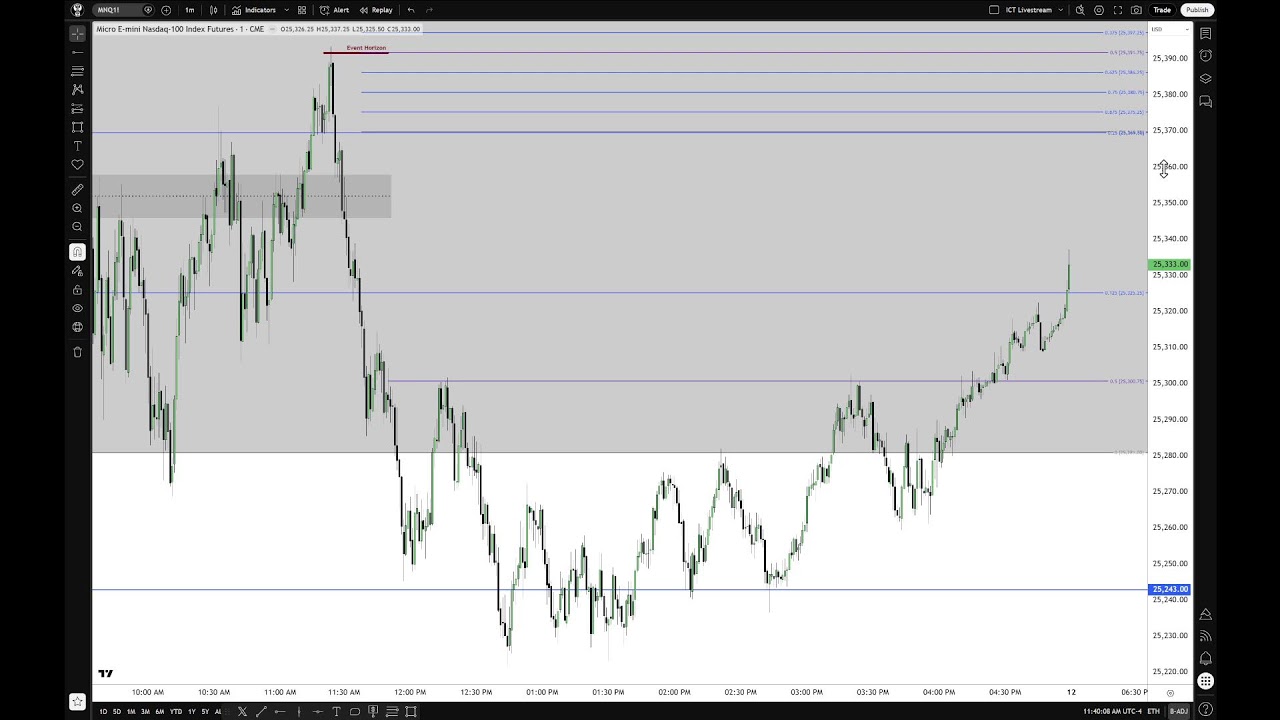
    – Market context: the market found support after dipping into the lower 30% of last week’s range and rallied strongly. The broader bias remains bullish with upside targets on the continuous contract near ~26,399.5, 26,562.75 and the all‑time adjusted high ~26,859.

    – Key intraday concept: the “lunch macro” is a common intraday retracement that can begin as early as 10:30 (effectively the first-hour/first dealing‑range completion after the 9:30 open) and often pulls price back into the range established since the open.

    – Trade framework: watch for higher highs into the macro window, then look to sell into buy‑side imbalances/sell‑side inefficiencies, inversion fair value gaps and bearish order blocks formed just before those highs. Target external range liquidity and wick midpoints as exits.

    – Execution notes: prefer obvious, visually clear fair value gaps/imbalances (don’t force ambiguous setups). Use market orders for entry, pyramid into positions, and exit at defined liquidity points; the author shared a live short that hit targets and exemplified these rules.

    – Teaching points: this is a repeatable, rule‑based approach (not the Turtle Soup method despite historical references). The author apologizes for a missed recording, praises student application, and will provide further live analysis tomorrow morning.

    Quiz

    1. What time window does ICT say the lunch macro can begin as early as?
    A. 9:30 Eastern
    B. 10:30 Eastern
    C. 11:30 Eastern
    D. 1:30 Eastern

    2. According to ICT, what is the default direction of the lunch macro in a bullish market?
    A. It runs to the upside
    B. It stays flat until closing
    C. It runs to sellside / lower prices
    D. It reverses only after 1:30

    —

    Answer Key with Evidence

    1.B. 10:30 Eastern
    Evidence: “the lunch macro can occur slightly earlier… it can begin around the 10:30 hour.”

    2. C. It runs to sellside / lower prices
    Evidence: “So, that’s the target. So, that’s the that was my maximum objective for the macro… I was looking to go short there.” Also: “What’s the macro? The lunch macro. It’s a retracement inside of the range from 9:30… It can aim for this low.”

  • ICT 2026 Futures Opening Range Tape-Reading \ April 14, 2026

    ICT 2026 Futures Opening Range Tape-Reading \ April 14, 2026

    https://www.youtube.com/watch?v=G9mVorSyvR0

    Summary:

    – This was a follow-up market review after Saturday’s live stream: the June contract target (~25,715) was reached using the morning PPI print, validating the prior analysis.
    – Main teaching: don’t rush back into trades once your targets are hit — be content with “enough” and watch price for further confirmation instead of chasing short-term excitement.
    – Key technical concepts explained and reinforced:
    – Suspension block and breaker: use these daily-chart reference points to anchor where liquidity and objectives are likely to sit.
    – Continuous vs. delivery-month contracts can show different nearby objectives; prefer the target closest to market price.
    – TGIF framework: weekly range behavior often retraces ~20–30% into Thursday afternoon/Friday close; failure to do so has predictable follow-up behavior the next week.
    – Fair value gaps, wick midpoints and body placement (bodies staying above the midpoint of a gap) are practical signs of institutional order flow and bullish continuation.
    – Multi-timeframe work: move from daily/weekly context down to 1-minute, 30s and 15s charts to capture entry/price-action clues; screenshot and journal setups for study.
    – Market structure and inter-market context: annotate liquidity pools across correlated indices (NQ, ES, Dow) and favor trading the weakest/strongest index as appropriate; focus on one market to build skill.
    – Practical stance: rely on price/time structure and simple candlestick evidence rather than paid indicators or gimmicks; study repeatedly and test the methods on demo before trading live.
    – Overall market read: strong bullish behavior validated targets, but reasonable intraday/near-term retracements are healthy; watch the highlighted liquidity and consequent encroachment levels for next directional clues.

  • TRU ICT – Post YouTube Livestream | April 13, 2026


    Summary — Trader Roundup with Michael (ICT)

    – Main focus: tape reading and simple, repeatable price-action models. Michael emphasized stripping analysis down to essentials (especially two primary gaps: the new-week open gap and the RTH opening-range gap) so traders can read candlesticks and market signatures in real time without overloading their setup.

    – Practical guidance: don’t abandon a working model. Learn additional concepts as side projects, but avoid continually tinkering with a model that is already profitable.

    – Key signatures and tactics discussed:
    – Anticipatory tape-reading cues (Canary-in-the-coal-mine analogy).
    – Inversion entries, fair-value gaps (FVGs), order blocks and “turtle soup” setups.
    – The importance of bodies vs. wicks (e.g., a lower body close can define a lower low even if a wick is lower).
    – Aggressive break of a nearby low often signals a hunt for opposing liquidity (stop-hunt behavior).

    – Market structure and participants: Michael clarified “retail” versus “smart money” — most participants (including big funds using retail logic) are not smart money. Algorithms and coordinated liquidity runs (stop hunts, engineered gaps) are real and must be read, not debated.

    – Multi-timeframe and PD array use:
    – Multi-timeframe confluence is useful but not inherently more “magical”; use PD arrays and key levels as actionable reference points.
    – Look for multiple PD arrays/defensive layers (three levels of defense is a useful rule of thumb).
    – Midpoints between PDAs often act as responsive areas; cascading/connecting PDAs as ranges evolve is valid.

    – Learning strategy: use lower timeframes (sub‑1-minute) for practice and pattern repetition to build confidence. Focus equally on learning what setups fail (to avoid them) as on what works.

    – Psychology & narrative: frame a market narrative in advance, watch how price action changes it, and be prepared to adapt. Example pre-market takeaway: large gap risk can spook bulls and inspire bears; manipulated moves can be used to seize liquidity before a directional run.

    – Final takeaway: read price first, apply a small set of reliable tools, practice tape reading to build confidence, and use disciplined entry/stop structure rather than chasing many disparate signals.

    Quiz

    1. According to ICT, what is the best way to use a model when it is already working for you?
    A. Add more indicators until it becomes more complex
    B. Change it every time a new concept is taught
    C. Stay with it and do not tinker with it
    D. Replace it with a completely different model

    2. What did ICT say about “retail” and “smart money”?
    A. Retail traders are the only liquidity that matters
    B. Institutional trading is retail, and smart money targets bigger liquidity than retail
    C. Smart money and retail are the same thing
    D. Only bank traders can be considered smart money

    3. What did ICT say about a fair value gap when price uses the wick but does not violate the body?
    A. It should always be ignored
    B. The fair value gap remains valid if the body is not violated
    C. It automatically becomes invalid
    D. It must always be reversed immediately

    4. In response to the question about multiple timeframes showing the same wick, what did ICT say about its importance?
    A. It is always a stronger signal and higher probability
    B. It only matters on hourly charts
    C. It does not bring greater importance by itself; it is a natural order of timeframes
    D. It is only useful if the wick appears on three or more timeframes

    5. What did ICT say about using multiple P.D. arrays behind a trade?
    A. You should always use only one P.D. array
    B. You should use prior P.D. arrays as a “three levels of defense” behind the trade
    C. P.D. arrays should never be used for trade protection
    D. Only the most recent candle matters, not prior structure

    Answer Key with Evidence:

    1. C — “If you have a model that’s working for you, try to not to tinker with it… don’t tinker with your model. Just keep it the way it is.” [00:15:00–00:16:00]

    2. B — “They’re looking for the opportunity to cannibalize the fucking whales, the biggest portion of liquidity… If you’re not them, you’re […] retail.” [00:40:30–00:43:00]

    3. B — “The wick is allowed to do that… That fair value gap did not get violated.” [00:19:00–00:20:00]

    4. C — “I personally don’t ascribe a lot more credence to it because it’s on multiple timeframes, because what you’re describing is a natural order of things with timeframes.” [00:35:08–00:35:35]

    5. B — “The key level has to be associated with these gradient walls… you have to have three P.D. arrays from where price is right now… you have to have three levels of your defense.” [00:56:26–00:57:00]

  • ICT 2026 Futures Opening Range Tape-Reading \ April 13, 2026

    ICT 2026 Futures Opening Range Tape-Reading \ April 13, 2026

    https://youtu.be/Il_DM4T7nzg

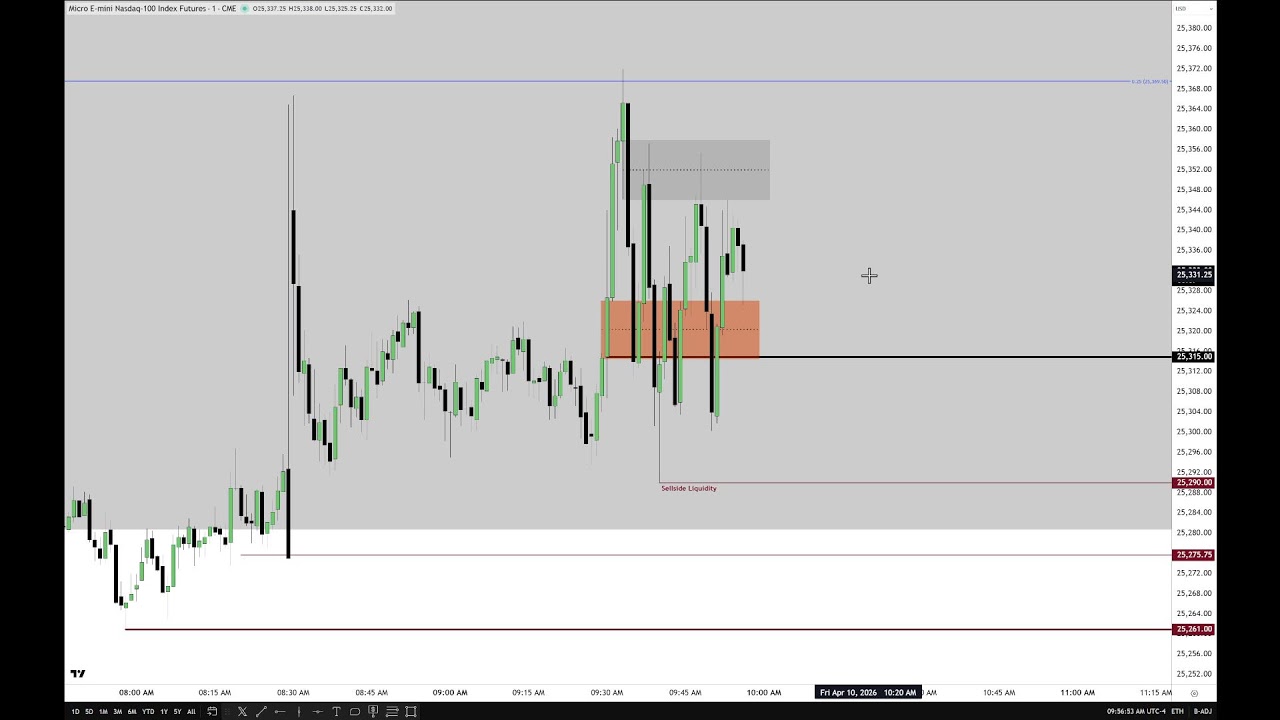
    – Hosting a live tape-reading session focused on price action around the regular trading-hours opening range and the opening gap. The main technical hooks: opening range gap, consequent encroachment, fair value gaps (FVGs), inefficiencies, and buy/sell liquidity pools.
    – Market context: peace negotiations failed over the weekend (geopolitical risk), which created a big gap lower at the open. ICT remained neutral and observational—no trade taken—because price action was ambiguous and low probability.
    – Key technical thesis: watch whether price reclaims the consequent encroachment and closes the full gap. If it closes and accelerates higher, the speaker expects continuation up; if bodies close into the upper half of inefficiencies or fail to reject key levels, that supports a bearish retracement.
    – Practical entry criteria: prefer one‑sided, high-probability setups (clear imbalances, reclaim/inversion FVGs, confirmed lower‑timeframe FVGs). Don’t trade “tries” or guess—wait for confirmation on the body close, not just wicks.
    – On stop hunts and liquidity: algorithms hunt stops and engineered liquidity; recognize stop hunts and then look for opposing liquidity as the next target instead of panicking.
    – Teaching focus: live demonstration of tape reading in difficult/mixed conditions to build anticipatory skills rather than reactive guessing. Emphasis on learning to identify warning signs (“canary” analogy) when price is reluctant to behave as expected.
    – Process advice: take shorthand notes while watching, later annotate charts and keep a study/journal of observations, emotions and outcomes. This builds experience and improves anticipation.
    – Psychological guidance: accept uncertainty; don’t force trades for ego or social media clout. Avoid copying signals or chasing influencers who “try” trades without conviction.
    – Performance goal: aim for repeatable, high-probability setups (targeting ~70%+ edge), not constant activity. Expect to sit out many sessions until criteria align.
    – Macro view: speaker expects cleaner, more one-sided markets when a new Fed chair is installed, which could draw sidelined money back in; but current event-driven volatility requires extra caution.

    Overall: read price action patiently, rely on clearly defined FVG/imbalance criteria and lower‑timeframe confirmation, journal everything, and only trade when the market shows one‑sided, high‑probability behavior.

    Quiz

    1. According to ICT, what is a warning sign that a trade setup may have lower probability?
    A. Price immediately respects the PD array and runs in the expected direction
    B. Price hesitates, wicks around, and does not show one-sidedness
    C. Price moves cleanly with strong follow-through
    D. Price closes beyond the expected target

    Answer Key with Evidence:

    1. B — “If you can see the PD arrays in price action and they’re not really adhering to the logic… that’s usually indicative of a lower degree of probability in your favor.”
    Evidence: “If you can see the PD arrays in price action and they’re not really adhering to the logic that would be implemented with them as I teach it, that’s usually indicative of a lower degree of probability in your favor.”

  • ICT 2026 Futures Weekend Review \ April 11, 2026

    ICT 2026 Futures Weekend Review \ April 11, 2026

    https://youtu.be/RY67bW2UhxY

    Summary:

    – Topic: using the continuous contract (vs front-month/delivery contracts) when analyzing micro E-mini NASDAQ futures (MNQ). The speaker demonstrates why he toggles the continuous contract on/off: not to find fair value gaps, but to reveal volume imbalances (suspension blocks) and historical price structure that the front-month data can miss when contracts roll.

    – Practical reason: the continuous contract smooths historical gaps and can show different important levels (breakers, volume imbalance highs/lows, consequent encroachment, half-gap). He compares the two views and uses whichever set of levels price respects for intraday decisions.

    – Key technical points: read candlestick bodies and wicks as order-flow footprints (wicks often indicate the first-presented fair-value gap; bodies indicate heaviness/strength). Use PD arrays, suspension blocks, octants/quadrants, and “event horizon” midzones to measure targets and sensitivity.

    – Trading approach: focus on index futures and the first hour of regular trading (9:30–10:30). The opening-range half-gap/consequent encroachment is a high-probability intraday objective (he cites ~70%); prioritize low-hanging fruit (smaller, higher-probability targets) rather than chasing large moves. Use lower timeframes to practice entries, place proper stops, and build a repeatable model.

    – Pedagogy and warnings: don’t over-rely on fundamentals, indicators, heatmaps, or paid gimmicks; learn to read price/time and develop your own model through journaling and disciplined practice. Expect the market to be noisier and manipulated at times; risk-manage and avoid overleveraging.

    – Logistics/upcoming: he recorded this live, will post further material (a lecture on journaling and sessions on practicing entries, order blocks and fair-value-gap strategies), and asks students to refer others to this video when asked about the continuous-contract function.

    Quiz

    1. What does ICT say he primarily uses the continuous contract for?
    A. To find fair value gaps only
    B. To look for volume imbalances and compare key levels
    C. To analyze forex pairs
    D. To identify earnings reports

    2. Why does ICT say he toggles the continuous contract setting on and off?
    A. To change the chart color scheme
    B. To compare different contracts and locate volume imbalances
    C. To remove all historical data
    D. To draw trendlines more easily

    3. According to ICT, what is the first draw or initial bias for the session when price opens above the consequent encroachment level?
    A. Look for sell-side liquidity
    B. Look for buy-side liquidity
    C. Ignore the opening range
    D. Trade only gold

    4. What does ICT say a wick can indicate when price cannot leave bodies above a key PD array in bullish conditions?
    A. Bullish continuation
    B. Premium sensitivity
    C. Bearish heaviness
    D. No useful information

    5. What does ICT recommend new students focus on first when developing a model?
    A. The first 60 minutes of trading, especially the first 30 minutes
    B. Yearly charts only
    C. Earnings season
    D. News headlines

    Answer Key:

    1. B
    Evidence: “I predominantly start my analysis on the continuous contract… I’m only toggling on the continuous contract. I’m only using this function here to see where those volume imbalances are.”
    2. B
    Evidence: “The only time I’ve ever utilized this function here is when I’m looking for volume imbalances… I’m looking for where volume imbalances exist.”
    3. B
    Evidence: “If we have a market that has a discount opening range gap… my initial bias for session… I’m going to be looking for price to go up to the half gap. So I’m going to be looking for what? Buy side liquidity.”
    4. C
    Evidence: “When it does that, that’s proving heaviness. Heaviness is bearishness. It’s not showing strength to continue higher.”
    5. A
    Evidence: “What is a good way of starting… to help you understand at least the first hour trading?… Between 9:30 and 10:30, that first hour’s dealing range…”

  • Trader Round Up – Post ICT Livestream | April 10, 2023

    Summary — Trader Roundup (post-ICT livestream)

    – Market context: ICT described the session as “decoupled” and congested — messy price action with low-probability setups, driven by news/CPI and pre-news positioning. Clean, high-probability runs were rare; targets could still be hit but holding trades was harder.
    – Primary trading guidance: avoid trading when the market is decoupled. Favor restraint, smaller size, clearer confluences, and defined risk rather than chasing or forcing trades.
    – Timing and news: expect increased pre-news animation/positioning; sometimes the real move happens before official releases. Adapt by lowering leverage, front-running cautiously with tighter rules, or waiting until the environment becomes clearer.
    – Tools and concepts referenced: RTH opening-range gap, CPI lows, fair value gaps, opening range, “midnight,” Octa/event-horizon and subdividing (e.g., 16ths), average ranges — use multiple confluences before engaging.
    – Psychology and risk management: frustration and “missing moves” are common — they create tilt and revenge trading. ICT emphasized journaling, positive self-talk, protocols, and treating mistakes as data/trial-and-error rather than failure.
    – Community takeaways: several traders shared similar frustrations; many are adapting their models, backtesting in current conditions, and exploring refinements (event horizon + Octa, 16ths, tape reading).
    – Broader advice: there are no shortcuts — build experience slowly, accept variability between market regimes, and prioritize sustainable money management over social-media clout or trying to impress others.
    – Logistics: technical issues cut the session short; group planned a follow-up trade roundup later in the day.

    Key takeaway: recognize when markets are unfavorable, protect capital with disciplined risk rules and journaling, and adapt models thoughtfully rather than forcing trades.

    Quiz

    1) What did ICT say is the best response to a difficult, decoupled market day?
    A. Trade more aggressively to force a win
    B. Avoid it and wait for cleaner conditions
    C. Increase leverage to catch the move
    D. Only trade after every news release

    2) According to ICT, what is one of the biggest dangers for new traders on days like this?
    A. Making too many journal entries
    B. Feeling frustrated and entering tilt
    C. Using too many indicators
    D. Trading only during the open

    3) What did ICT say about trading before major news events in the current environment?
    A. Never trade before news under any circumstance
    B. Only trade after the news settles for an hour
    C. Sometimes price runs before the news because positioning happens ahead of it
    D. News has no effect on price

    4) What did ICT recommend traders do if market conditions make their usual setup less reliable?
    A. Abandon all models permanently
    B. Trade less leverage and adapt
    C. Double position size to compensate
    D. Ignore risk and chase the move

    5) What did ICT say about journaling?
    A. It is optional once you become profitable
    B. It is only useful for beginners
    C. It is the central point of navigation
    D. It should only record winning trades

    Answer key

    1. B Evidence: [00:04:00]-[00:04:30] “I’m not touching it. I don’t want anything to do with it… this is the market that’s saying, nah, not today.”
    2. B Evidence: [00:13:00]-[00:14:00] “that’s what causes tilt… you get so caught up in the emotion… and you go back and forth… all of a sudden you, your, your account’s blown.”
    3. C Evidence: [00:30:30]-[00:32:00] “you’ll also see less follow through after the news comes in because they’re positioning before the news.”
    4. C Evidence: [00:32:00]-[00:33:30] “you’re gonna have to adapt. That means trade less leverage.”
    5. C Evidence: [00:36:57]-[00:39:30] “the journaling is, that’s the, that’s the whole central tenet to doing it because that’s navigation… your journal is the central point of navigation.”
  • ICT 2026 Tape-Reading Opening Range \ April 10, 2026

    ICT 2026 Tape-Reading Opening Range \ April 10, 2026

    https://youtu.be/Hiq47zliJ_Y

    Summary:

    – Market recap: The CPI print was weak and price failed to reach a key daily suspension/block level. The speaker is watching several technical levels — opening-range gap, fair value gaps (FVGs), liquidity sweeps, and rejection/inversion zones — with a bias toward lower prices if certain lows (including the CPI low and midpoint of the opening-range gap) are taken out.

    – Technical observations: There’s SMT divergence between the three major averages (ES, NQ, Dow), making price action messy and lowering conviction. ICT refuses to chase longs into a decoupled rally and would prefer to see clean accelerations into sell-side liquidity to confirm downside moves.

    – Trade note: He accumulated size into an inversion/fair-value gap, added on retracements, and suffered slippage on an exit near 325. He would lose interest in morning trading if key rejection blocks hold; might look for a lunch or PM session move instead.

    – Teaching point: For newer traders, decoupling across indexes complicates market structure and requires caution; high-probability setups rely on agreement among averages and clear one-sidedness.

    – Personal incident: While dropping his son off, an aggressive driver confronted him, pulled a gun, then lowered it and called someone. He drove away for safety and may file a report if dashcam evidence exists. Lesson: avoid confrontation and stay safe.

    – Wrap-up: He’s ending the live session due to lack of meaningful price action, will post a review later, and plans a Twitter space on Saturday. Wishes viewers a safe, relaxing weekend.

    Quiz

    1) What was ICT’s main concern about the market direction after the CPI reading?
    – A. He was looking to chase the market higher
    – B. He expected a guaranteed rally into the close
    – C. He was watching for possible downside liquidity to be taken
    – D. He believed the market had become completely untradeable

    2) How did ICT describe the condition of the three major averages during the session?
    – A. They were all perfectly aligned
    – B. They were decoupled and not in agreement
    – C. They were all making new highs together
    – D. They were all closed for the session

    Answer Key with Evidence

    1) C. He was watching for possible downside liquidity to be taken.
    Evidence: “I’m just saying that it could go down here and take that liquidity. This morning, I’ll be watching for that.”

    2) B. They were decoupled and not in agreement.
    Evidence: “So, already we can see some decoupling. Okay, decoupling is when the averages do not agree.”
    Evidence: “You can see clearly this is what decoupling looks like, okay?”

  • ICT 2026 Market Review \ April 08, 2026

    ICT 2026 Market Review \ April 08, 2026

    https://www.youtube.com/watch?v=3Uu2IB6kI28

    Summary:

    – Quick 15-minute review of Micro Nasdaq (MNQ); refer to this morning’s full live stream for background. Host may be off tomorrow depending on personal plans.

    – Market opened with a large regular-trading-hours opening-range gap (RTHORG) driven by headlines. Price ran up into the daily suspension block area, then rolled over and hit the speaker’s target: the low of the daily suspension block.

    – Key technical read: a 9:30–9:31 fair-value gap formed. The presenter emphasizes the rule that candlestick bodies failing to trade into key levels (wicks may touch but bodies do not) is a bearish signature used to anticipate further decline. Price retraced into the lower part of the daily suspension block but failed to reach the upper half/octant—another bearish sign—so the bias remains down toward consequent encroachment unless price behavior changes.

    – Caveat: geopolitical developments (missiles/ceasefire reports) can produce volatile overnight/Asian-session moves; the 6:00 (Asia open) price will determine the next actionable bias.

    – Trading advice: use less leverage, avoid overtrading, seek confluence, be nimble and accept partial moves.

    – Logistics: may post an update around 7:30 on X; otherwise family plans come first.