
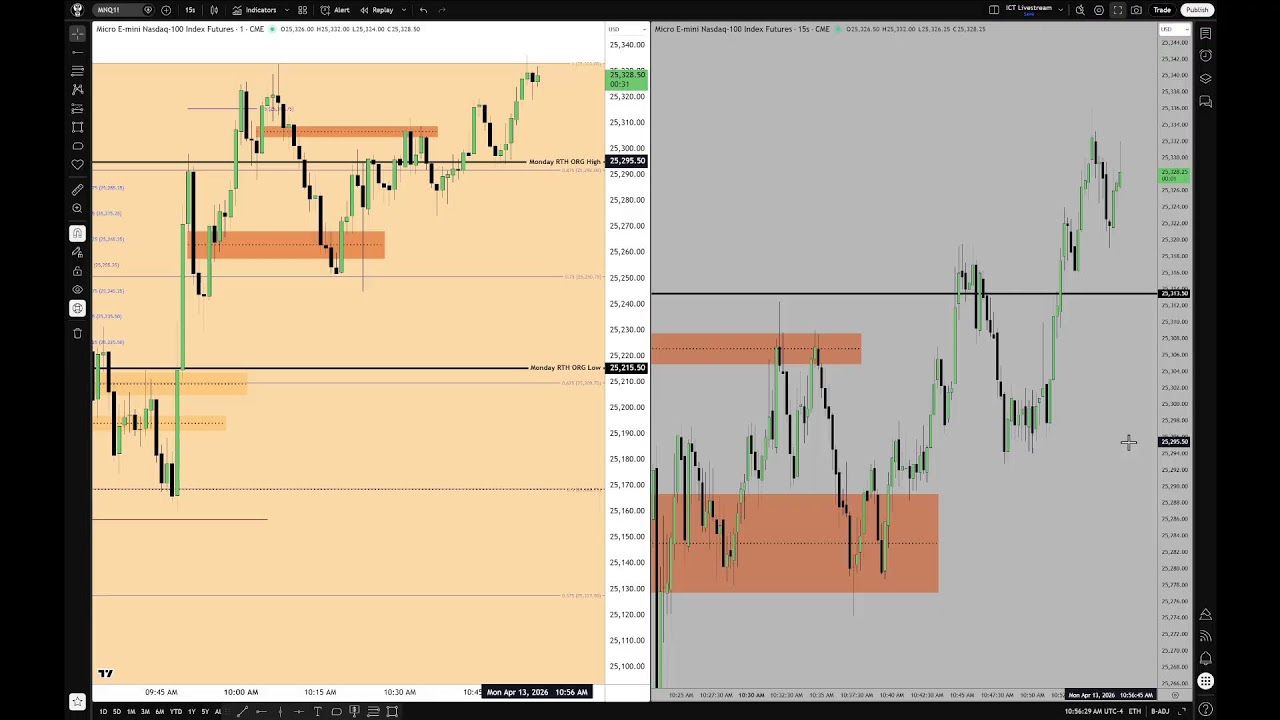
– Hosting a live tape-reading session focused on price action around the regular trading-hours opening range and the opening gap. The main technical hooks: opening range gap, consequent encroachment, fair value gaps (FVGs), inefficiencies, and buy/sell liquidity pools.
– Market context: peace negotiations failed over the weekend (geopolitical risk), which created a big gap lower at the open. ICT remained neutral and observational—no trade taken—because price action was ambiguous and low probability.
– Key technical thesis: watch whether price reclaims the consequent encroachment and closes the full gap. If it closes and accelerates higher, the speaker expects continuation up; if bodies close into the upper half of inefficiencies or fail to reject key levels, that supports a bearish retracement.
– Practical entry criteria: prefer one‑sided, high-probability setups (clear imbalances, reclaim/inversion FVGs, confirmed lower‑timeframe FVGs). Don’t trade “tries” or guess—wait for confirmation on the body close, not just wicks.
– On stop hunts and liquidity: algorithms hunt stops and engineered liquidity; recognize stop hunts and then look for opposing liquidity as the next target instead of panicking.
– Teaching focus: live demonstration of tape reading in difficult/mixed conditions to build anticipatory skills rather than reactive guessing. Emphasis on learning to identify warning signs (“canary” analogy) when price is reluctant to behave as expected.
– Process advice: take shorthand notes while watching, later annotate charts and keep a study/journal of observations, emotions and outcomes. This builds experience and improves anticipation.
– Psychological guidance: accept uncertainty; don’t force trades for ego or social media clout. Avoid copying signals or chasing influencers who “try” trades without conviction.
– Performance goal: aim for repeatable, high-probability setups (targeting ~70%+ edge), not constant activity. Expect to sit out many sessions until criteria align.
– Macro view: speaker expects cleaner, more one-sided markets when a new Fed chair is installed, which could draw sidelined money back in; but current event-driven volatility requires extra caution.
Overall: read price action patiently, rely on clearly defined FVG/imbalance criteria and lower‑timeframe confirmation, journal everything, and only trade when the market shows one‑sided, high‑probability behavior.
Quiz
1. According to ICT, what is a warning sign that a trade setup may have lower probability?
A. Price immediately respects the PD array and runs in the expected direction
B. Price hesitates, wicks around, and does not show one-sidedness
C. Price moves cleanly with strong follow-through
D. Price closes beyond the expected target
Answer Key with Evidence:
1. B — “If you can see the PD arrays in price action and they’re not really adhering to the logic… that’s usually indicative of a lower degree of probability in your favor.”
Evidence: “If you can see the PD arrays in price action and they’re not really adhering to the logic that would be implemented with them as I teach it, that’s usually indicative of a lower degree of probability in your favor.”
Leave a Reply