
Summary:
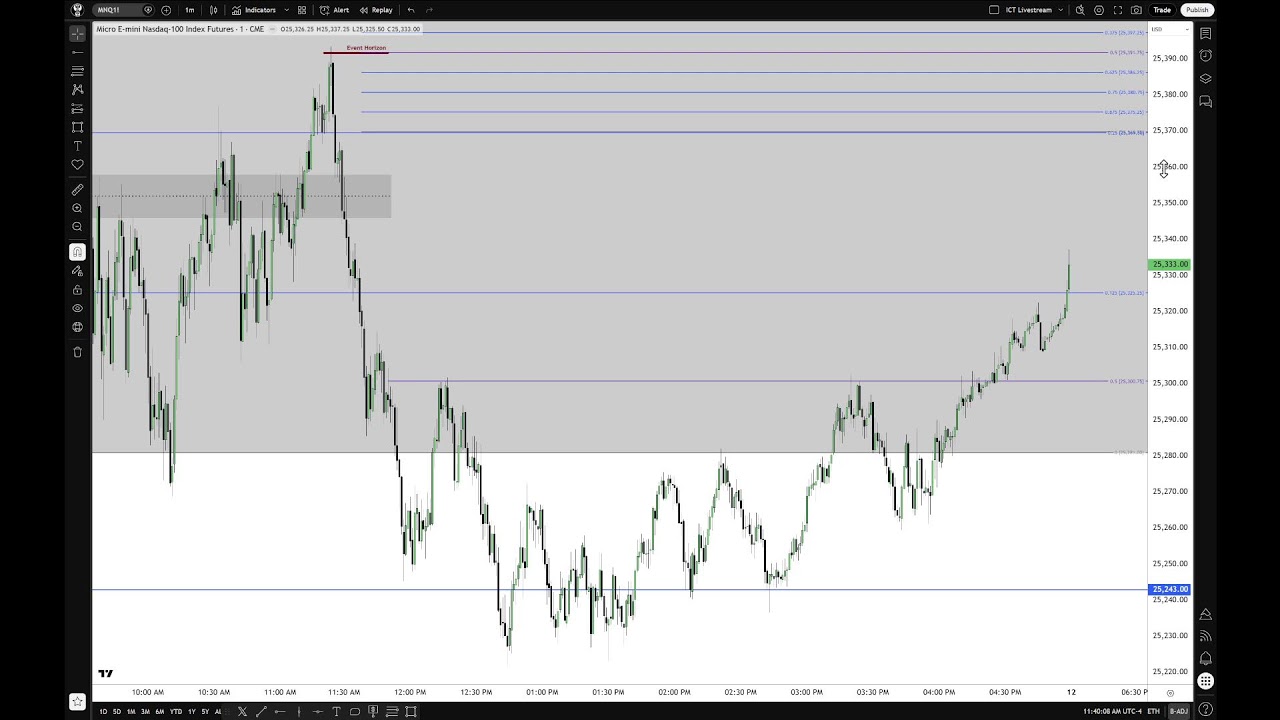
– Topic: using the continuous contract (vs front-month/delivery contracts) when analyzing micro E-mini NASDAQ futures (MNQ). The speaker demonstrates why he toggles the continuous contract on/off: not to find fair value gaps, but to reveal volume imbalances (suspension blocks) and historical price structure that the front-month data can miss when contracts roll.
– Practical reason: the continuous contract smooths historical gaps and can show different important levels (breakers, volume imbalance highs/lows, consequent encroachment, half-gap). He compares the two views and uses whichever set of levels price respects for intraday decisions.
– Key technical points: read candlestick bodies and wicks as order-flow footprints (wicks often indicate the first-presented fair-value gap; bodies indicate heaviness/strength). Use PD arrays, suspension blocks, octants/quadrants, and “event horizon” midzones to measure targets and sensitivity.
– Trading approach: focus on index futures and the first hour of regular trading (9:30–10:30). The opening-range half-gap/consequent encroachment is a high-probability intraday objective (he cites ~70%); prioritize low-hanging fruit (smaller, higher-probability targets) rather than chasing large moves. Use lower timeframes to practice entries, place proper stops, and build a repeatable model.
– Pedagogy and warnings: don’t over-rely on fundamentals, indicators, heatmaps, or paid gimmicks; learn to read price/time and develop your own model through journaling and disciplined practice. Expect the market to be noisier and manipulated at times; risk-manage and avoid overleveraging.
– Logistics/upcoming: he recorded this live, will post further material (a lecture on journaling and sessions on practicing entries, order blocks and fair-value-gap strategies), and asks students to refer others to this video when asked about the continuous-contract function.
Quiz
1. What does ICT say he primarily uses the continuous contract for?
A. To find fair value gaps only
B. To look for volume imbalances and compare key levels
C. To analyze forex pairs
D. To identify earnings reports
2. Why does ICT say he toggles the continuous contract setting on and off?
A. To change the chart color scheme
B. To compare different contracts and locate volume imbalances
C. To remove all historical data
D. To draw trendlines more easily
3. According to ICT, what is the first draw or initial bias for the session when price opens above the consequent encroachment level?
A. Look for sell-side liquidity
B. Look for buy-side liquidity
C. Ignore the opening range
D. Trade only gold
4. What does ICT say a wick can indicate when price cannot leave bodies above a key PD array in bullish conditions?
A. Bullish continuation
B. Premium sensitivity
C. Bearish heaviness
D. No useful information
5. What does ICT recommend new students focus on first when developing a model?
A. The first 60 minutes of trading, especially the first 30 minutes
B. Yearly charts only
C. Earnings season
D. News headlines
Answer Key:
1. B
Evidence: “I predominantly start my analysis on the continuous contract… I’m only toggling on the continuous contract. I’m only using this function here to see where those volume imbalances are.”
2. B
Evidence: “The only time I’ve ever utilized this function here is when I’m looking for volume imbalances… I’m looking for where volume imbalances exist.”
3. B
Evidence: “If we have a market that has a discount opening range gap… my initial bias for session… I’m going to be looking for price to go up to the half gap. So I’m going to be looking for what? Buy side liquidity.”
4. C
Evidence: “When it does that, that’s proving heaviness. Heaviness is bearishness. It’s not showing strength to continue higher.”
5. A
Evidence: “What is a good way of starting… to help you understand at least the first hour trading?… Between 9:30 and 10:30, that first hour’s dealing range…”
Leave a Reply