
Summary:
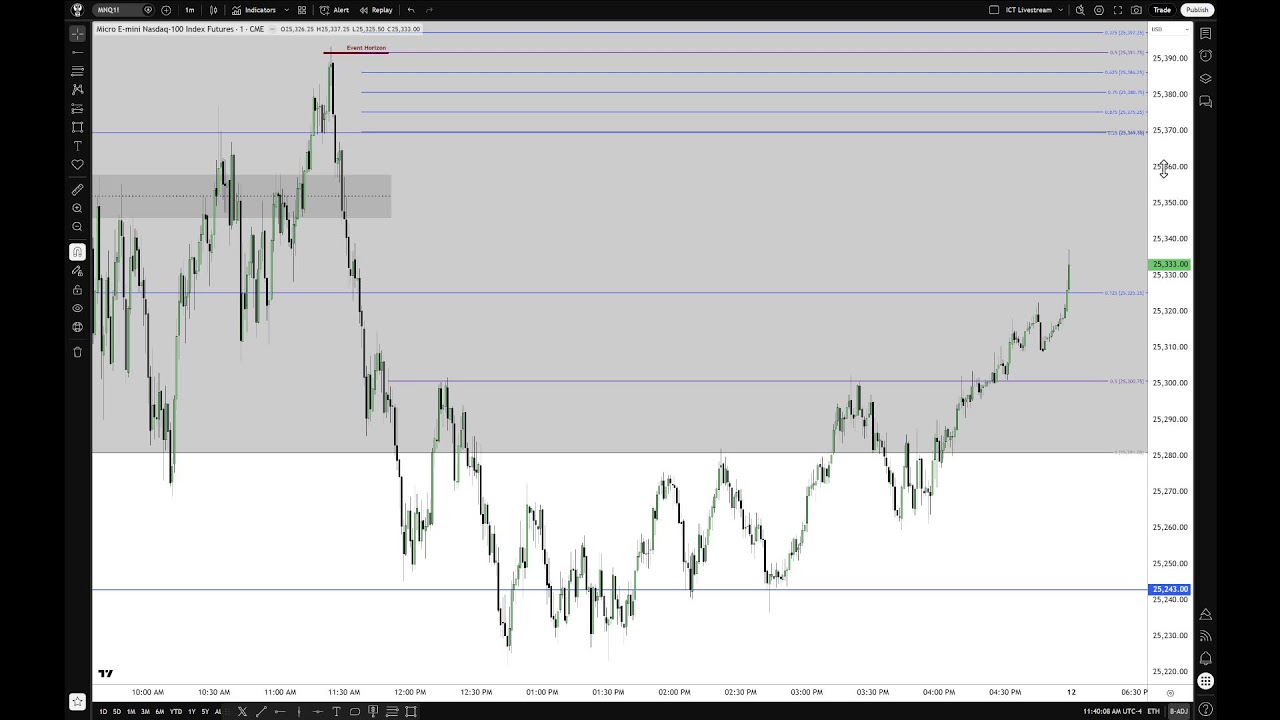
– Topic and purpose: ICT explains when and why they toggle the continuous contract setting (vs. the front-month/delivery contract) when analyzing micro E-mini Nasdaq (MNQ) futures, and demonstrates how they use it to find useful price structure.
– Continuous vs front-month: Continuous contracts smooth historical data across rollovers and reveal different price levels. The front-month can be spotty farther back; continuous lets you compare historical imbalances and measure market strength by seeing which levels price actually respects.
– What they look for: The speaker uses the continuous-contract toggle specifically to reveal volume imbalances / “suspension blocks” (not merely to find fair value gaps). Comparing the imbalances on both views helps pick the most relevant PD arrays, breakers, half-gaps (consequent encroachment), octants/quadrants and targets.
– Practical trading rules emphasized:
– Prioritize low-hanging fruit objectives (smaller, more probable targets) over chasing large moves.
– Use the first hour of regular trading (9:30–10:30) and opening-range gaps (half-gap/consequent encroachment) as a primary bias tool—these give strong statistical edges.
– Monitor bodies vs. wicks: bodies respecting/avoiding levels indicate strength/weakness; wicks often represent the “first presented fair value gap.”
– Compare continuous and front-month levels to assess how much effort/energy a run will require.
– Market context and mindset: The speaker is skeptical of fundamental narratives and stresses focusing on price and time (algorithmic behavior). Markets are complex and sometimes manipulated; traders should conserve risk, use stops, and lower expectations in difficult regimes.
– Teaching & practice plans: The speaker will continue live-streaming, teach journaling and concrete order-entry practice (limit and stop placements) to desensitize traders and help build repeatable models. Students should practice the first-hour framework, collect data, and commit to learning rather than chasing quick wins.
– Tone and stance: The speaker is direct and insistent—urging discipline, focused practice, and to adopt the described price-reading methods rather than indicators or gimmicks.
Leave a Reply