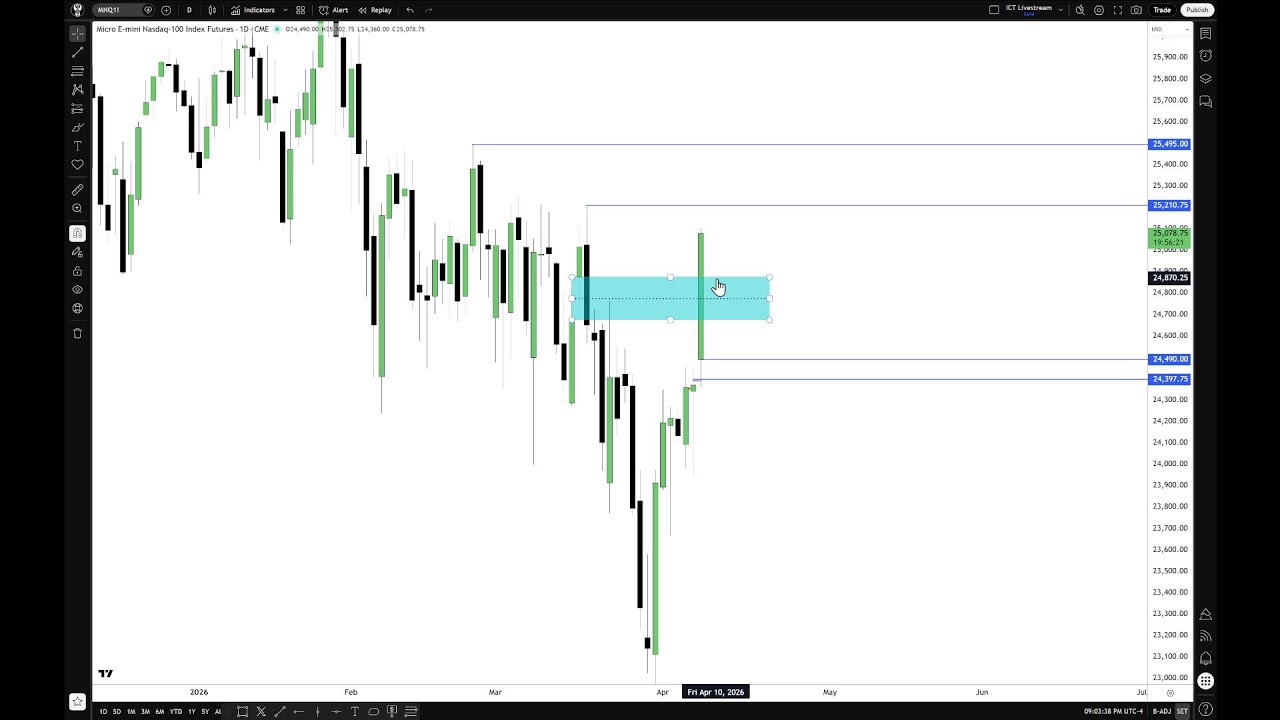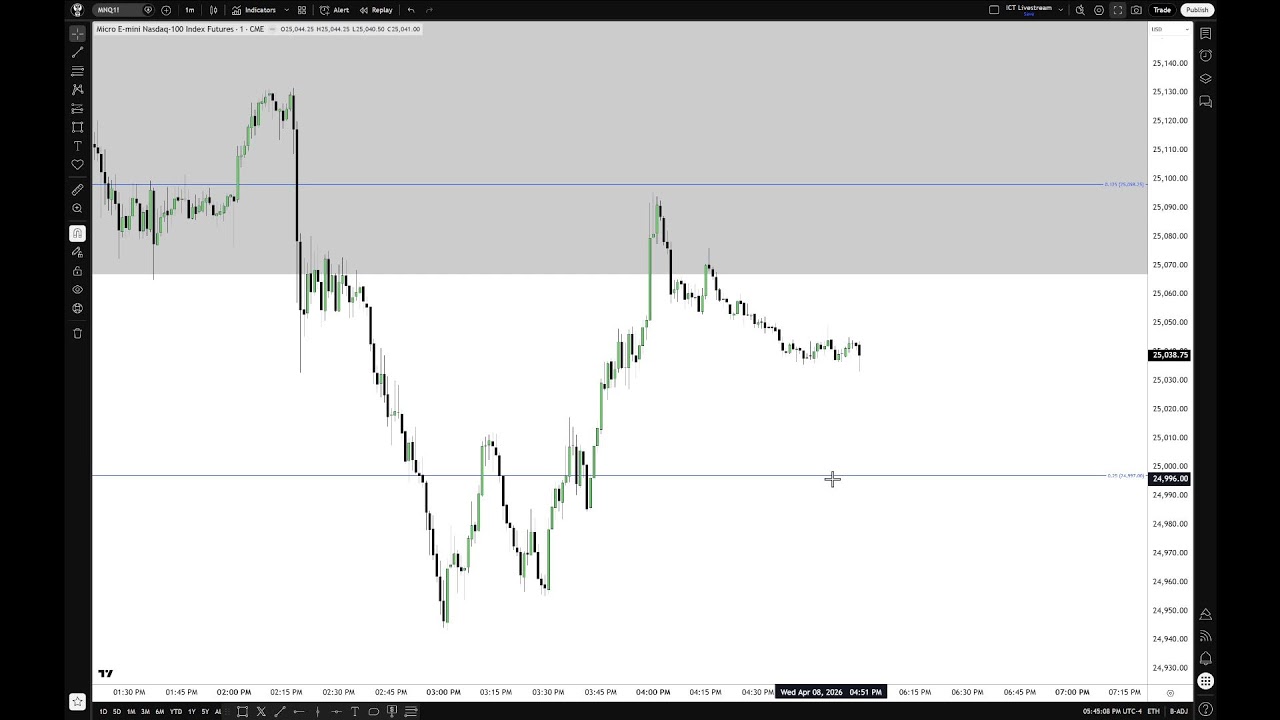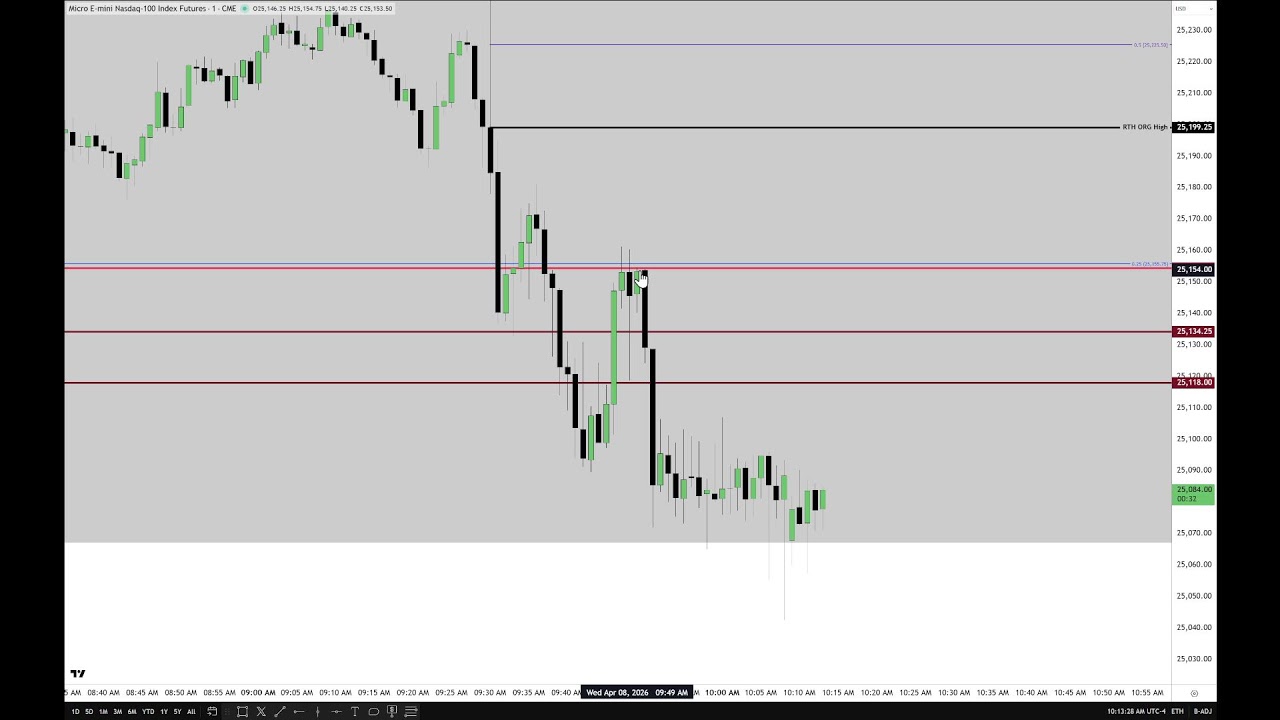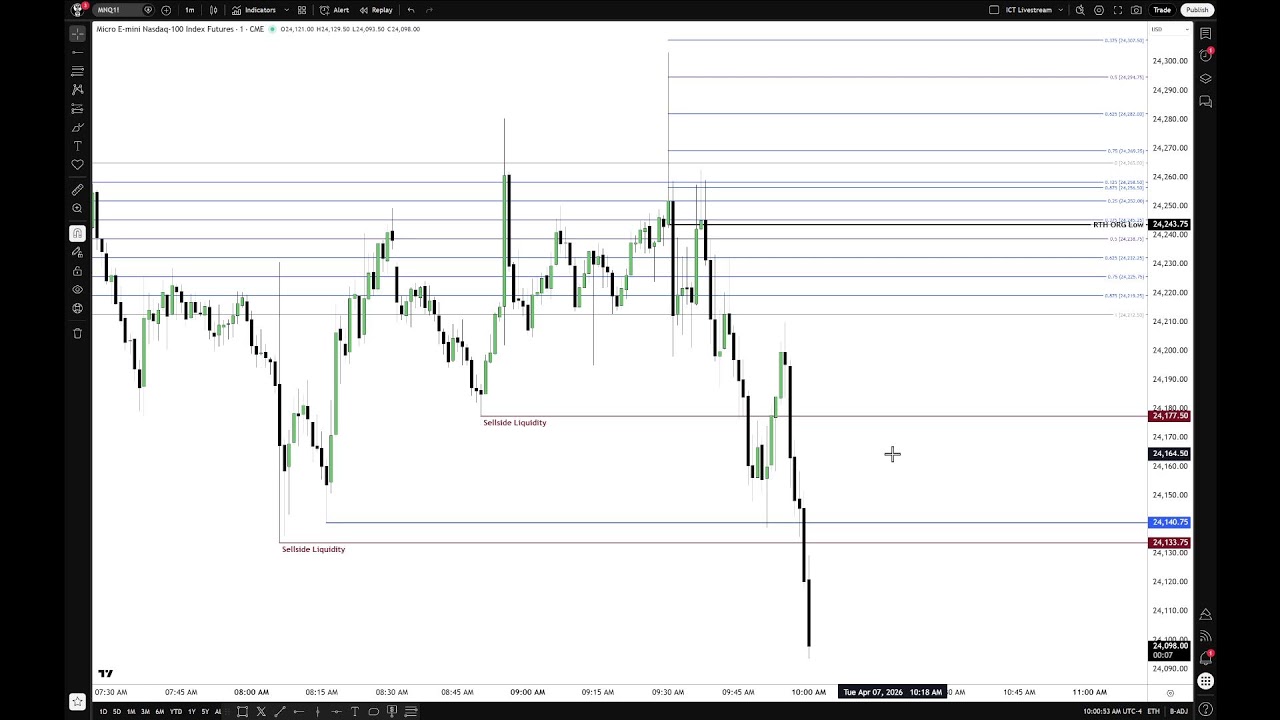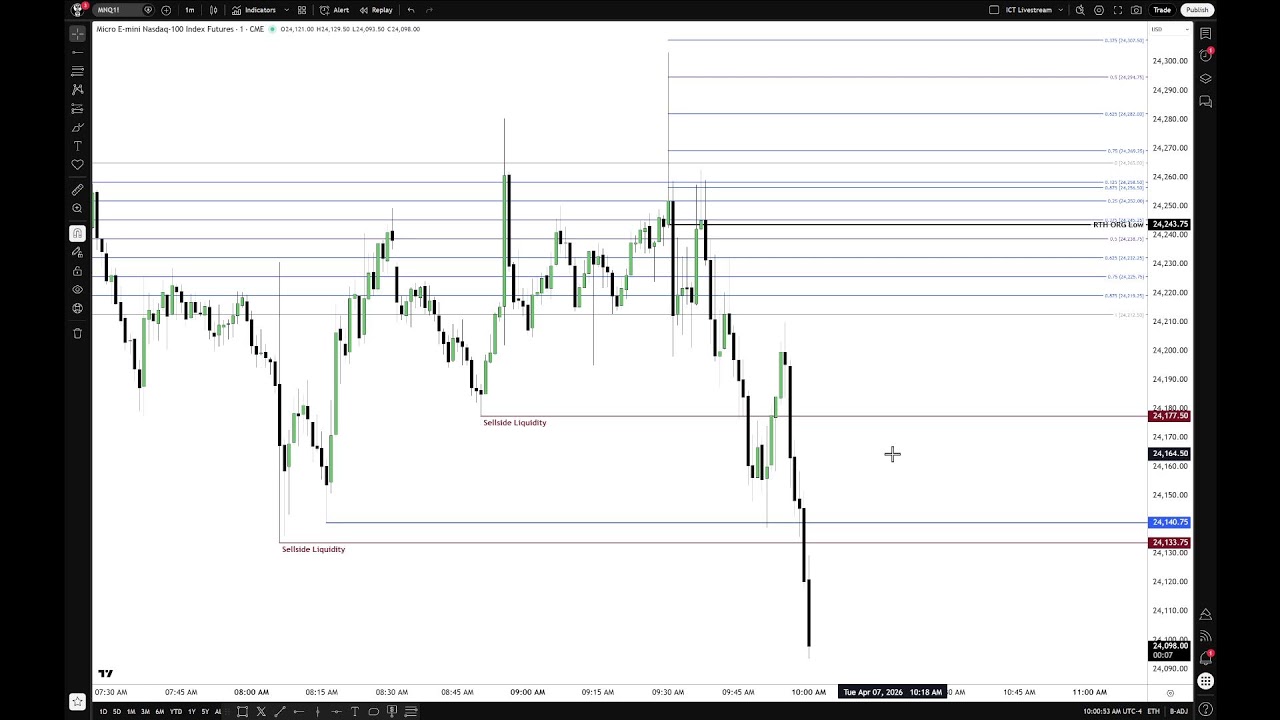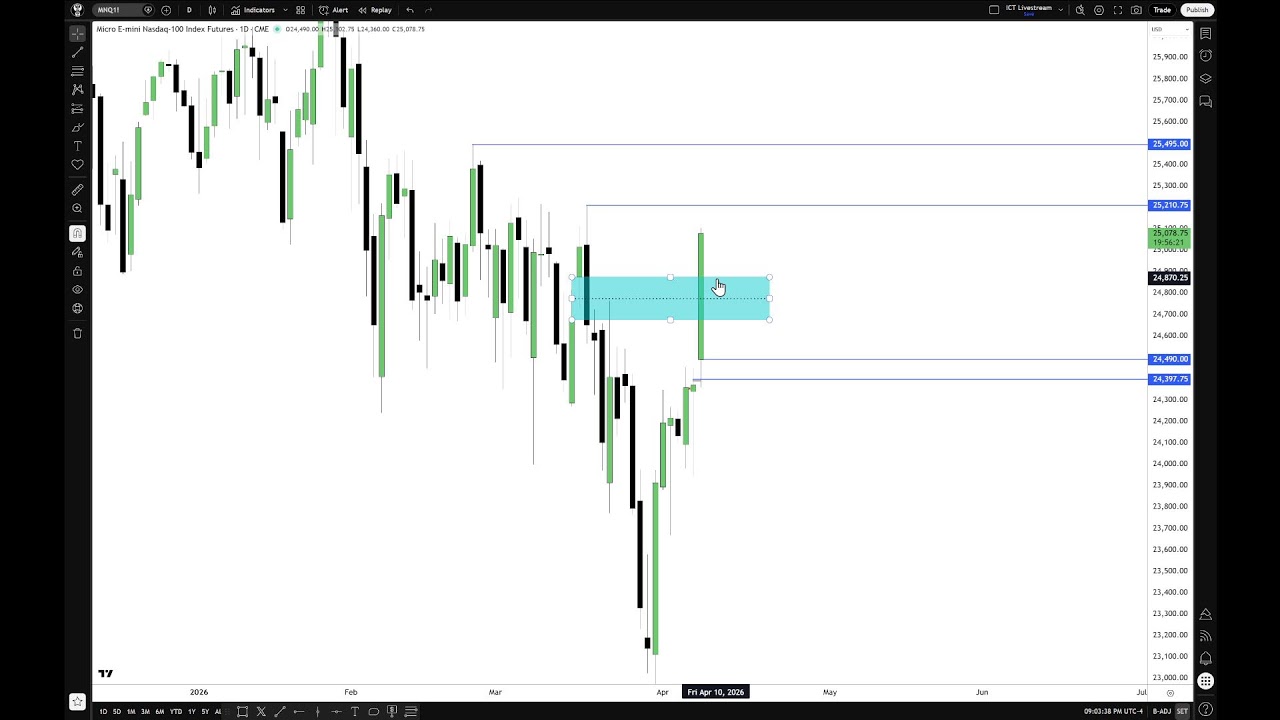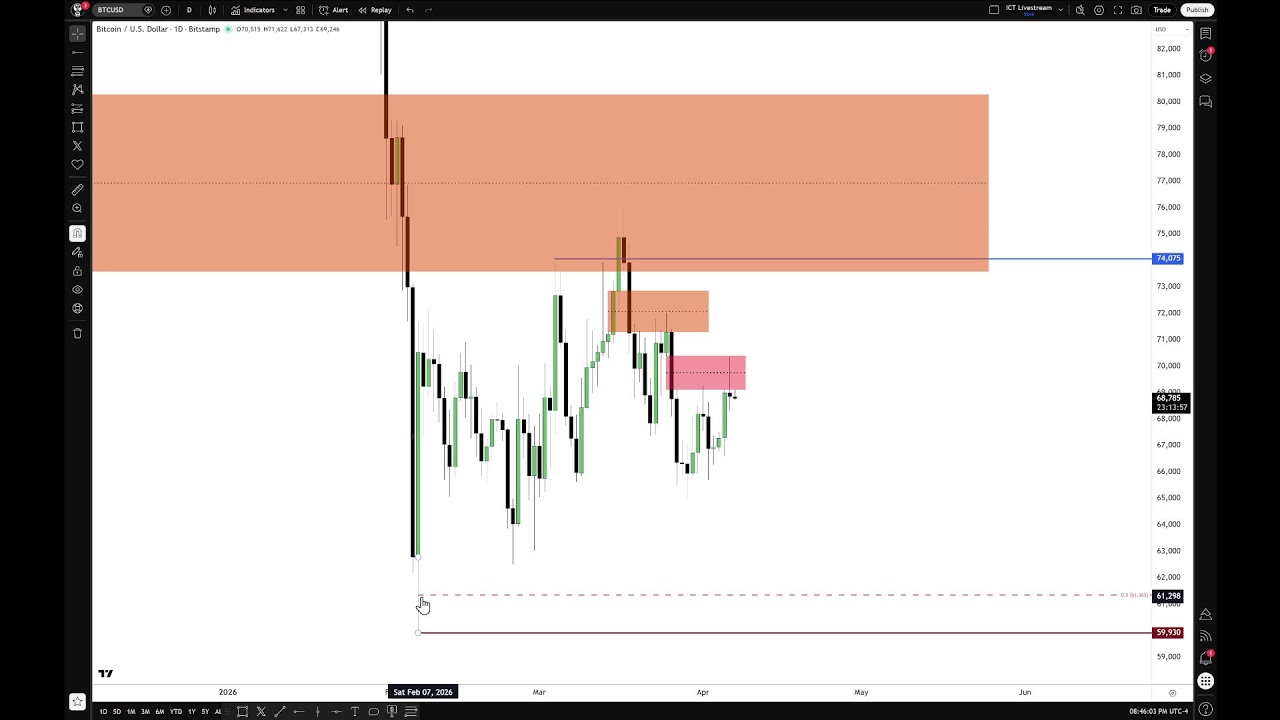
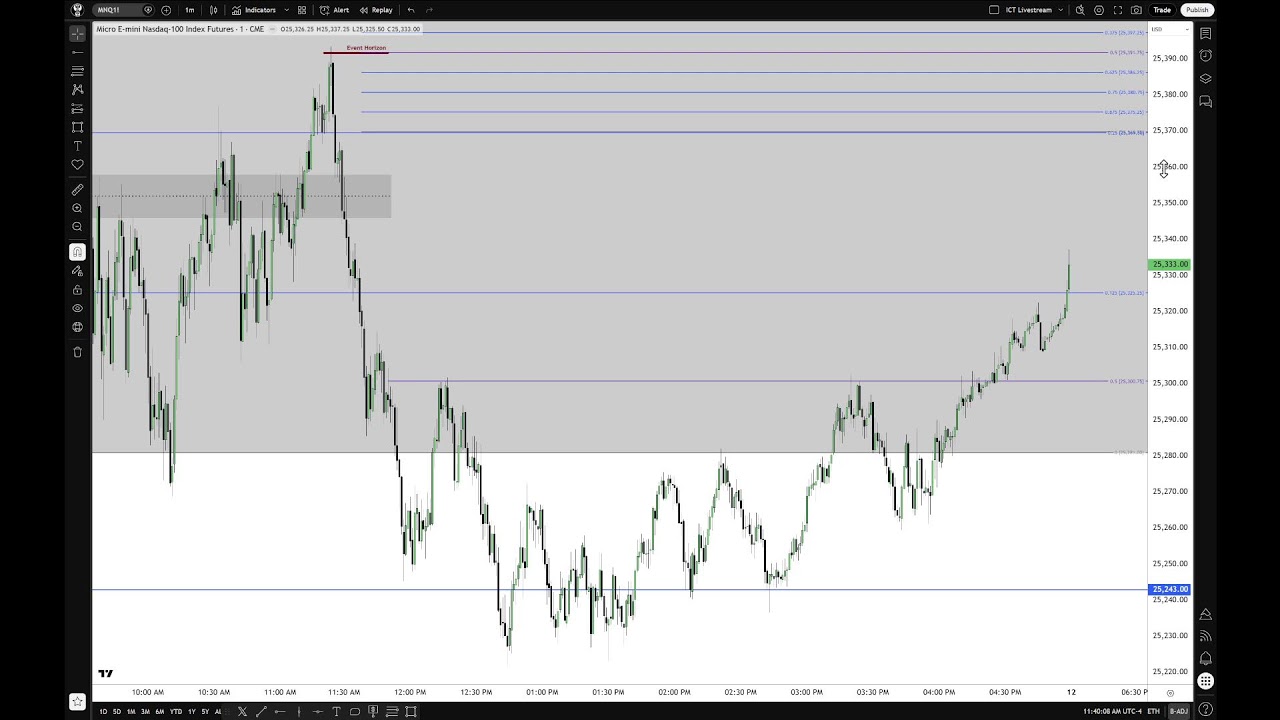
– Market opened down after peace talks collapsed, creating a gap. ICT is watching regular trading hours opening ranges and anchoring fibs to assess whether the gap will be closed and where price may go next.
– Primary focus is price action and structure (opening-range gap, consequent encroachment, inversion/reclaimed fair value gaps, rejection blocks), not predicting or forcing trades.
– Clear trade criteria: require closing-basis confirmation (bodies, not just wicks), bodies to stay above/below midpoints of inefficiencies, and reclaimed/inversion FVGs before committing. Full gap closure + follow-through would signal continuation and potential higher targets.
– If price action is ambiguous or 50/50, the proper response is to sit out and wait for clearer, one‑sided structure rather than “trying” longs/shorts. High-probability setups give immediate feedback; anything else is lower probability.
– Stop hunts and engineered liquidity (not just stop orders but algorithmic behavior) create pools of opposing liquidity. Recognize these to avoid getting stopped out or to anticipate where price may reverse.
– Use multiple timeframes (e.g., 15s, 1min) to identify fair value gaps and orderflow confirmation; the next fair value gap on a lower timeframe often provides the entry signal once the higher-timeframe context aligns.
– Practical workflow: keep a simple notepad of levels/times, watch price live, annotate after a run, and journal both technical outcomes and emotional state to accelerate learning.
– Emphasizes anticipation over reaction (like a marksman), building pattern recognition through repeated exposure rather than chasing every move or copying other streamers.
– Critique of hype/gambling mentality on social media: warns against emotional crowd bias and influencers who “try” trades without conviction.
– Macro view: geopolitical events and algorithmic activity matter; speaker expects markets to become cleaner and more one‑sided after a new Fed chair is in place, which could bring sidelined money back and clearer trends.
– Teaching goal: train traders to read tape in difficult conditions, develop patience and discipline, and focus on repeatable, high-probability setups that compound over time.
Tag: ictlive
-

ICT 2026 Futures Opening Range Tape-Reading \ April 13, 2026
-

ICT 2026 Futures Opening Range Tape-Reading \ April 13, 2026
– Hosting a live tape-reading session focused on price action around the regular trading-hours opening range and the opening gap. The main technical hooks: opening range gap, consequent encroachment, fair value gaps (FVGs), inefficiencies, and buy/sell liquidity pools.
– Market context: peace negotiations failed over the weekend (geopolitical risk), which created a big gap lower at the open. ICT remained neutral and observational—no trade taken—because price action was ambiguous and low probability.
– Key technical thesis: watch whether price reclaims the consequent encroachment and closes the full gap. If it closes and accelerates higher, the speaker expects continuation up; if bodies close into the upper half of inefficiencies or fail to reject key levels, that supports a bearish retracement.
– Practical entry criteria: prefer one‑sided, high-probability setups (clear imbalances, reclaim/inversion FVGs, confirmed lower‑timeframe FVGs). Don’t trade “tries” or guess—wait for confirmation on the body close, not just wicks.
– On stop hunts and liquidity: algorithms hunt stops and engineered liquidity; recognize stop hunts and then look for opposing liquidity as the next target instead of panicking.
– Teaching focus: live demonstration of tape reading in difficult/mixed conditions to build anticipatory skills rather than reactive guessing. Emphasis on learning to identify warning signs (“canary” analogy) when price is reluctant to behave as expected.
– Process advice: take shorthand notes while watching, later annotate charts and keep a study/journal of observations, emotions and outcomes. This builds experience and improves anticipation.
– Psychological guidance: accept uncertainty; don’t force trades for ego or social media clout. Avoid copying signals or chasing influencers who “try” trades without conviction.
– Performance goal: aim for repeatable, high-probability setups (targeting ~70%+ edge), not constant activity. Expect to sit out many sessions until criteria align.
– Macro view: speaker expects cleaner, more one-sided markets when a new Fed chair is installed, which could draw sidelined money back in; but current event-driven volatility requires extra caution.Overall: read price action patiently, rely on clearly defined FVG/imbalance criteria and lower‑timeframe confirmation, journal everything, and only trade when the market shows one‑sided, high‑probability behavior.
Quiz
1. According to ICT, what is a warning sign that a trade setup may have lower probability?
A. Price immediately respects the PD array and runs in the expected direction
B. Price hesitates, wicks around, and does not show one-sidedness
C. Price moves cleanly with strong follow-through
D. Price closes beyond the expected targetAnswer Key with Evidence:
1. B — “If you can see the PD arrays in price action and they’re not really adhering to the logic… that’s usually indicative of a lower degree of probability in your favor.”
Evidence: “If you can see the PD arrays in price action and they’re not really adhering to the logic that would be implemented with them as I teach it, that’s usually indicative of a lower degree of probability in your favor.” -

ICT 2026 Futures Weekend Review \ April 11, 2026
Summary:
– The speaker explains why and how he uses the continuous contract (vs the front‑month delivery contract) for analysis: continuous contracts smooth historical data, reveal volume imbalances/suspension blocks that the front‑month can hide, and let you compare how price behaves across contracts to judge market strength.
– The continuous‑contract toggle (and the settlement‑price toggle) on charting platforms changes whether certain volume imbalances and suspension blocks are visible; he uses these toggles only to find volume imbalances, not to “hunt” fair value gaps.
– Key technical concepts emphasized: breakers, suspension blocks (volume imbalances), consequent encroachment (half‑gap), wicks vs bodies (wicks show first‑presented FVG/inefficiency; bodies show order‑flow conviction), inversion, PD arrays, octants/quadrants for measuring ranges.
– Practical trading rules: focus on low‑hanging fruit objectives and intraday targets rather than chasing large, improbable moves; use the opening range and the first hour (9:30–10:30) as the primary bias engine (half‑gap/consequent encroachment is a common first target with strong statistical edge).
– He stresses price‑action/time‑based analysis over indicators or fundamental narratives (fundamentals are noisy/manipulated), and warns about increased manual intervention and algorithmic behavior in current markets—use stops and moderate leverage.
– Teaching goals and next steps: he will post lectures on journaling and live sessions teaching entries and practical drills (order‑block and FVG-based entries) so students can build and test a repeatable model by practicing on lower timeframes.
– Final message: commit to disciplined practice and journaling, focus on the first hour and simple, repeatable methods, and avoid chasing gimmicks or shortcuts.Quiz
1. According to ICT, what is his primary use of the continuous contract toggle on and off for?
A. To identify fair value gaps only
B. To compare volume imbalances and suspension blocks across contract rollovers
C. To calculate forex session opens
D. To hide key price levels from retail traders2. When the market opens above the consequent encroachment of the opening range gap, what is ICT’s stated initial session bias?
A. Look for buy side liquidity
B. Look for sell side liquidity
C. Avoid trading until the next day
D. Fade the opening range gap immediately3. In ICT’s explanation, what is the “first presented fair value gap” on the chart?
A. The wick
B. The candle body midpoint
C. The settlement price line
D. The prior day’s high only4. What does ICT say about a bullish PD array in relation to the candle body?
A. The body should close through the array
B. The body should be above or touching it aggressively
C. The body should not touch it; only the wick may touch or fail to touch
D. The body should always close below it5. What did ICT say he was going to teach later in the week to help students build a baseline?
A. Cryptocurrency arbitrage and news trading
B. Order block strategy and fair value gap strategy
C. Forex hedging and options gamma scalping
D. Elliott Wave counting and harmonic patternsAnswer Key
1. B
Evidence: “the only time I’ve ever utilized this function here is when I’m looking for volume imbalances” and “I’m only toggling on the continuous contract, I’m only using this function here to see where those volume imbalances are.”
2. A
Evidence: “my initial bias for session, okay? For session bias… I’m going to be looking for price to go up to the half gap. So, I’m going to be looking for what? Buy side liquidity.”
3. A
Evidence: “when we have a PD array or a range that we’re looking at… price goes up and can’t even accomplish getting to the high of it… you see that? When it does that, that’s proving heaviness.” and “the gap… what you see as the gap. That is not it. This is the wick.”
4. C
Evidence: “If you’re bullish, it should not touch it with the body or lay a body on it. The wick can touch it or fail to touch it. That’s bullish.”
5. B
Evidence: “I’ll do it with an order block strategy and I’ll do it with a fair value gap strategy. So that way it’ll help you build a baseline on what you’re looking for in price action.” -

ICT 2026 Futures Weekend Review \ April 11, 2026
Summary:
– Topic: using the continuous contract (vs front-month/delivery contracts) when analyzing micro E-mini NASDAQ futures (MNQ). The speaker demonstrates why he toggles the continuous contract on/off: not to find fair value gaps, but to reveal volume imbalances (suspension blocks) and historical price structure that the front-month data can miss when contracts roll.
– Practical reason: the continuous contract smooths historical gaps and can show different important levels (breakers, volume imbalance highs/lows, consequent encroachment, half-gap). He compares the two views and uses whichever set of levels price respects for intraday decisions.
– Key technical points: read candlestick bodies and wicks as order-flow footprints (wicks often indicate the first-presented fair-value gap; bodies indicate heaviness/strength). Use PD arrays, suspension blocks, octants/quadrants, and “event horizon” midzones to measure targets and sensitivity.
– Trading approach: focus on index futures and the first hour of regular trading (9:30–10:30). The opening-range half-gap/consequent encroachment is a high-probability intraday objective (he cites ~70%); prioritize low-hanging fruit (smaller, higher-probability targets) rather than chasing large moves. Use lower timeframes to practice entries, place proper stops, and build a repeatable model.
– Pedagogy and warnings: don’t over-rely on fundamentals, indicators, heatmaps, or paid gimmicks; learn to read price/time and develop your own model through journaling and disciplined practice. Expect the market to be noisier and manipulated at times; risk-manage and avoid overleveraging.
– Logistics/upcoming: he recorded this live, will post further material (a lecture on journaling and sessions on practicing entries, order blocks and fair-value-gap strategies), and asks students to refer others to this video when asked about the continuous-contract function.
Quiz
1. What does ICT say he primarily uses the continuous contract for?
A. To find fair value gaps only
B. To look for volume imbalances and compare key levels
C. To analyze forex pairs
D. To identify earnings reports2. Why does ICT say he toggles the continuous contract setting on and off?
A. To change the chart color scheme
B. To compare different contracts and locate volume imbalances
C. To remove all historical data
D. To draw trendlines more easily3. According to ICT, what is the first draw or initial bias for the session when price opens above the consequent encroachment level?
A. Look for sell-side liquidity
B. Look for buy-side liquidity
C. Ignore the opening range
D. Trade only gold4. What does ICT say a wick can indicate when price cannot leave bodies above a key PD array in bullish conditions?
A. Bullish continuation
B. Premium sensitivity
C. Bearish heaviness
D. No useful information5. What does ICT recommend new students focus on first when developing a model?
A. The first 60 minutes of trading, especially the first 30 minutes
B. Yearly charts only
C. Earnings season
D. News headlinesAnswer Key:
1. B
Evidence: “I predominantly start my analysis on the continuous contract… I’m only toggling on the continuous contract. I’m only using this function here to see where those volume imbalances are.”
2. B
Evidence: “The only time I’ve ever utilized this function here is when I’m looking for volume imbalances… I’m looking for where volume imbalances exist.”
3. B
Evidence: “If we have a market that has a discount opening range gap… my initial bias for session… I’m going to be looking for price to go up to the half gap. So I’m going to be looking for what? Buy side liquidity.”
4. C
Evidence: “When it does that, that’s proving heaviness. Heaviness is bearishness. It’s not showing strength to continue higher.”
5. A
Evidence: “What is a good way of starting… to help you understand at least the first hour trading?… Between 9:30 and 10:30, that first hour’s dealing range…” -
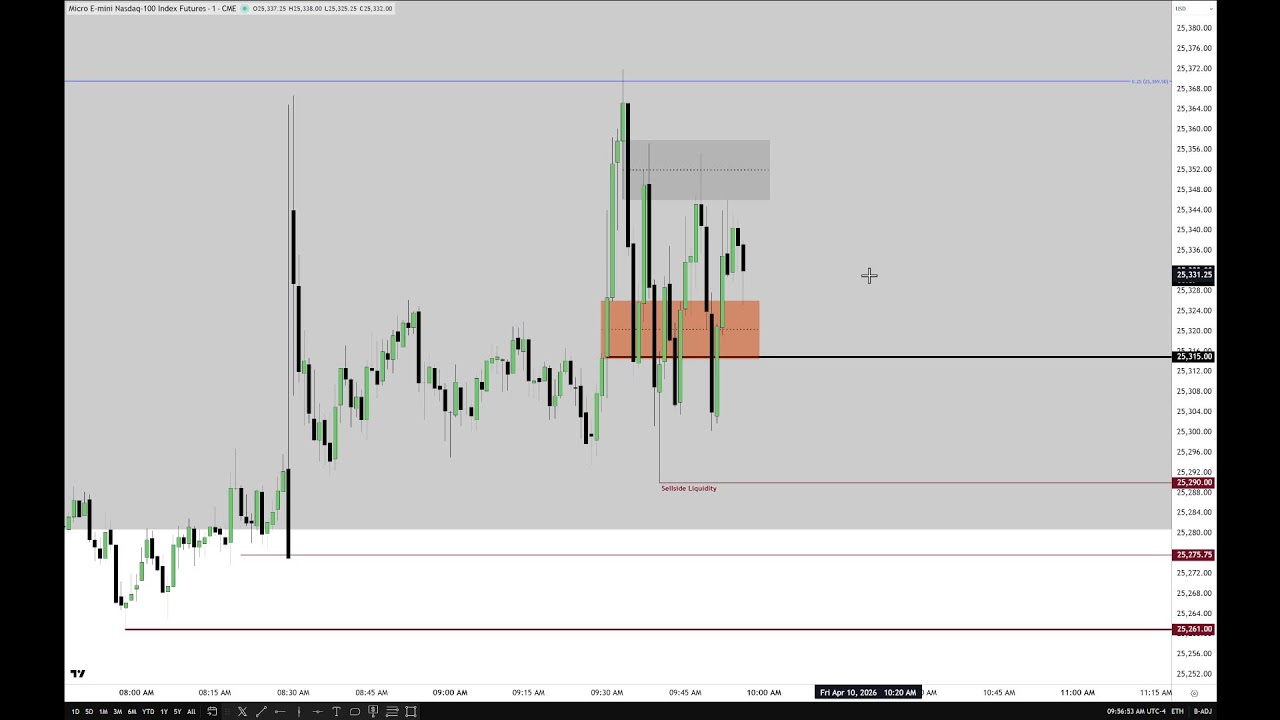
ICT 2026 Tape-Reading Opening Range \ April 10, 2026
Summary:
– Market read: After the CPI print, price stalled short of a key opening-range/gap level. The speaker sees bearish bias — CPI low intact, multiple sell-side liquidity pools, fair-value-gap/inefficiency setups, and SMT divergence (indices not in agreement). Because the averages are decoupled (NQ strength, Dow weakness), probability and clarity are reduced, so he is unwilling to chase longs; he’s watching for accelerations lower to take out CPI lows and other liquidity below.
– Trading notes: He described accumulation, slippage on an exit, and specific levels to watch (opening-range gap midpoints, rejection/inversion blocks, and daily suspension block). Liquidity sweeps and fair-value-gap behavior are key signals; if price trades cleanly through the upside rejection block, he’ll stand down and re-evaluate later (possibly at lunchtime or PM session).
– Personal incident: While dropping his son off he was nearly sideswiped by a driver who then drew a gun on him. He drove away safely, may check dashcam footage and file a brandishing report. Lesson learned: be cautious and prepared.
– Conclusion: Market action was messy and not worth trading for him on that Friday; he’ll end the session, post a review later, host a weekend Twitter Space, and wishes viewers a safe weekend.
-

ICT 2026 Tape-Reading Opening Range \ April 10, 2026
Summary:
– Market recap: The CPI print was weak and price failed to reach a key daily suspension/block level. The speaker is watching several technical levels — opening-range gap, fair value gaps (FVGs), liquidity sweeps, and rejection/inversion zones — with a bias toward lower prices if certain lows (including the CPI low and midpoint of the opening-range gap) are taken out.
– Technical observations: There’s SMT divergence between the three major averages (ES, NQ, Dow), making price action messy and lowering conviction. ICT refuses to chase longs into a decoupled rally and would prefer to see clean accelerations into sell-side liquidity to confirm downside moves.
– Trade note: He accumulated size into an inversion/fair-value gap, added on retracements, and suffered slippage on an exit near 325. He would lose interest in morning trading if key rejection blocks hold; might look for a lunch or PM session move instead.
– Teaching point: For newer traders, decoupling across indexes complicates market structure and requires caution; high-probability setups rely on agreement among averages and clear one-sidedness.
– Personal incident: While dropping his son off, an aggressive driver confronted him, pulled a gun, then lowered it and called someone. He drove away for safety and may file a report if dashcam evidence exists. Lesson: avoid confrontation and stay safe.
– Wrap-up: He’s ending the live session due to lack of meaningful price action, will post a review later, and plans a Twitter space on Saturday. Wishes viewers a safe, relaxing weekend.
Quiz
1) What was ICT’s main concern about the market direction after the CPI reading?
– A. He was looking to chase the market higher
– B. He expected a guaranteed rally into the close
– C. He was watching for possible downside liquidity to be taken
– D. He believed the market had become completely untradeable2) How did ICT describe the condition of the three major averages during the session?
– A. They were all perfectly aligned
– B. They were decoupled and not in agreement
– C. They were all making new highs together
– D. They were all closed for the sessionAnswer Key with Evidence
1) C. He was watching for possible downside liquidity to be taken.
Evidence: “I’m just saying that it could go down here and take that liquidity. This morning, I’ll be watching for that.”2) B. They were decoupled and not in agreement.
Evidence: “So, already we can see some decoupling. Okay, decoupling is when the averages do not agree.”
Evidence: “You can see clearly this is what decoupling looks like, okay?” -

ICT 2026 Market Review \ April 08, 2026
Summary:
– Quick 15-minute review of Micro Nasdaq (MNQ); refer to this morning’s full live stream for background. Host may be off tomorrow depending on personal plans.
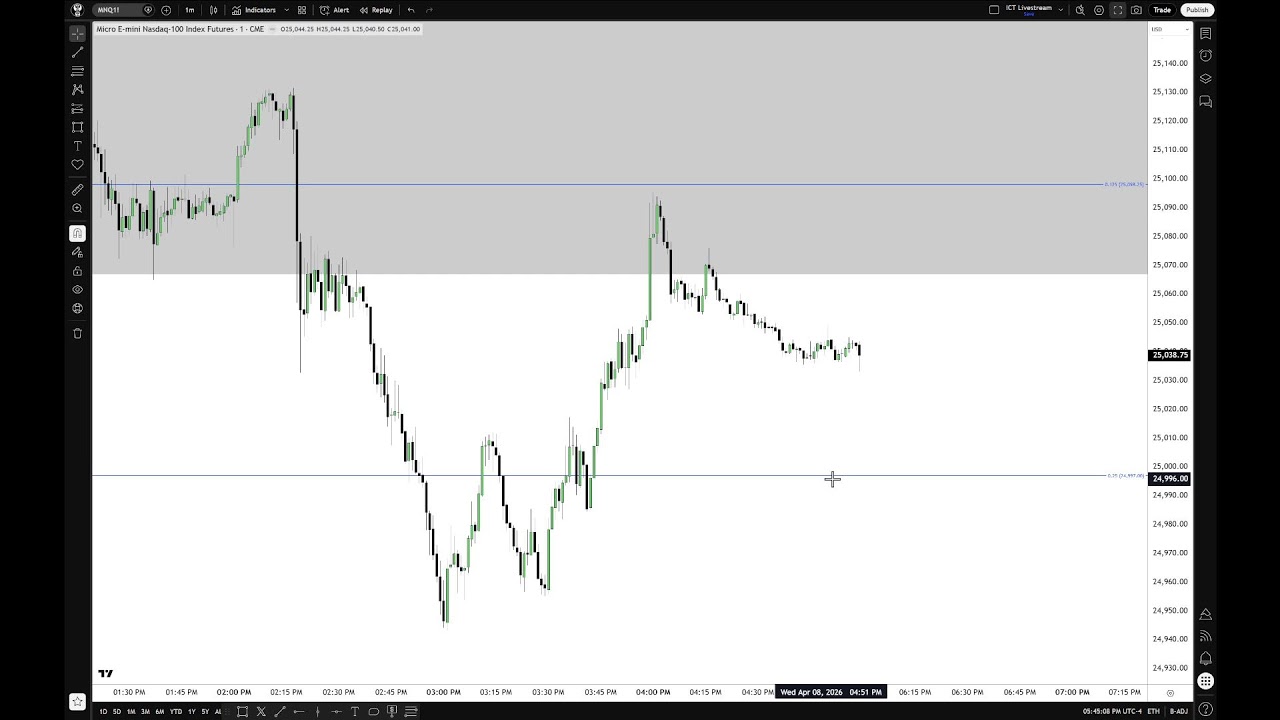
– Market opened with a large regular-trading-hours opening-range gap (RTHORG) driven by headlines. Price ran up into the daily suspension block area, then rolled over and hit the speaker’s target: the low of the daily suspension block.
– Key technical read: a 9:30–9:31 fair-value gap formed. The presenter emphasizes the rule that candlestick bodies failing to trade into key levels (wicks may touch but bodies do not) is a bearish signature used to anticipate further decline. Price retraced into the lower part of the daily suspension block but failed to reach the upper half/octant—another bearish sign—so the bias remains down toward consequent encroachment unless price behavior changes.
– Caveat: geopolitical developments (missiles/ceasefire reports) can produce volatile overnight/Asian-session moves; the 6:00 (Asia open) price will determine the next actionable bias.
– Trading advice: use less leverage, avoid overtrading, seek confluence, be nimble and accept partial moves.
– Logistics: may post an update around 7:30 on X; otherwise family plans come first. -

ICT 2026 OR Tape-reading \ April 08, 2026
Summary:
– Market setup: ICT is watching the micro Nasdaq this morning after a large premium opening-range gap. The primary technical focus is a daily “suspension block” (shaded box) and its lower quadrant — the low of that box is the main target. There is notable sell-side liquidity below current price and minor buy-side above; a break below the block should show range expansion and commitment to the downside.
– Trade plan & risk management: No trade advice is being given, but the presenter would run a very small position (e.g., one contract), take partial profits at predefined targets, protect the stop (move to sidelines if stops are threatened), and avoid letting stops be challenged. Expect retracements to remain within the lower quadrant if the drop is genuine.
– Tape-reading & technique: Emphasizes simple tape-reading — watching 1-minute candles (open/high/low/close and bodies) and liquidity — rather than complicated tools (footprint, volume profile, Elliott, etc.). Record your screen/price action, study live candles, and annotate levels.
– Practice & mindset: Recommend at least 6–8 weeks of disciplined practice/paper trading, journaling emotional triggers and KPIs, and focusing on a minimal set of reliable rules. Guard capital, avoid overtrading or social-media noise, and cultivate emotional balance (stay humble, avoid arrogance). Slow, repeatable practice beats shortcuts.
– Final point: Keep setups simple, know where price is likely to draw to, protect capital, and commit to consistent, patient skill development.
Quiz
1. What did ICT say was the most important thing for a developing student to learn first?
A. Using footprint charts and order flow tools
B. Finding the likely directional draw
C. Trading every candlestick reversal
D. Predicting FOMC reaction with news2. What did ICT recommend doing before attempting live trading?
A. Paper trade for a minimum of 6 to 8 weeks after consistent study
B. Trade live immediately to build confidence
C. Use market replay only and skip screen recording
D. Focus on social media performance reportsAnswer Key:
1. B
Evidence: “the primary function for you as a developing student is simply getting accustomed to determining the draw. That’s the first rule of engagement” and “know where it’s likely to go to.” No timestamp available.2. A
Evidence: “when that happens, and you have a a 2-month… 6 to 8 weeks… then… you can start paper trading. And spend a minimum 6 to 8 weeks doing that.” No timestamp available. -

ICT 2026 Market Review \ April 07, 2026
Summary:
– The speaker links recent extreme market moves to geopolitical developments (Trump’s threats to Iran, Pakistan reportedly advising a different course, Iran’s defiance and public positioning around targets). He suggests a possible tactical delay (a two‑week window contingent on reopening the Strait of Hormuz) may have been used to disperse civilians, buying time for a later strike — but he stresses this is his speculation.
– Crude oil was highly volatile (big gap and a sharp drop from ~$109+ toward the low $90s), but he remains fundamentally bullish on oil — the recent decline may have washed out longs, not ended the uptrend. Oil remains event-driven and can spike quickly if attacks occur.
– Markets are being driven and amplified by headlines and off‑hours moves (stock index futures jumped, crude plunged). Single‑minute candlesticks have moved by hundreds of handles, demonstrating extreme intraday volatility.
– Trading advice and risk warning: stay out of these markets if inexperienced or thinly funded; use stop losses; treat this year as an education year rather than taking big risks. Manipulation/insider positioning can create quick, damaging moves.
– Technical/read‑on‑the‑tape notes: dollar index slipped, euro/pound are mixed (pound showing relative strength), stock futures (MES/MNQ) show bullish structure if they hold above recent upper halves of ranges and inefficiencies; gold/silver also touched inefficiencies but are risky to trade now.
– Because of the volatile, event‑driven environment and his responsibility as an educator, he will scale back live trading/tape‑reading streams and focus on educational content for a while to avoid influencing followers into risky trades.
– He emphasizes the human cost of the conflict, the emotional difficulty of trading such markets, and urges prudence and humility given the high uncertainty.
Quiz
1. According to ICT, what was one reason he believed the announced attack on Iran may not happen immediately?
A. The markets had already closed for the week
B. Pakistan advised a different avenue and people were standing around the targets
C. Crude oil had already reached its final target
D. The Strait of Hormuz had already been opened2. What did ICT say the market reaction after hours suggested about crude oil and stock index futures?
A. Crude oil rose sharply while stock indices collapsed
B. Both markets stayed unchanged
C. Crude oil dropped hard while stock index futures rallied sharply
D. Gold and silver were the only markets affected3. What did ICT repeatedly advise inexperienced traders to do in this environment?
A. Trade only with higher leverage
B. Ignore stop losses and hold through volatility
C. Stay away from the market and use the time to study
D. Focus only on shorting crude oil4. What did ICT say he expected would happen if crude oil moved higher again after the drop?
A. Crude oil would probably stay flat for months
B. Oil prices could rise parabolically if attacks resumed
C. The dollar would instantly collapse to zero
D. Gold would become the only tradable market5. What was ICT’s view on the possibility of a ceasefire?
A. He believed a ceasefire was fully confirmed and permanent
B. He thought the ceasefire would definitely open the Strait of Hormuz immediately
C. He viewed it as temporary theater and doubted it would last
D. He said the ceasefire would eliminate all market volatilityAnswer Key:
1. B
Evidence: “a course of action has been suggested to the Trump administration by Pakistan and a uh They counseled him to consider a different avenue” and “they gave an a reason to to let the people go home and get away from those targets.”2. C
Evidence: “we’re up 600 plus handles on stock index futures, and crude oil’s down you know, tens of thousands of dollars per contract” and “crude oil opened up on that news. Sold off.”3. C
Evidence: “If you’re not experienced… this is not your year. I promise you you’re you’re you’re going to regret probably doing anything with it” and “Take this year as an education year. Spend it studying. Learn some concepts. Study. And remove yourself from the risk.”4. B
Evidence: “if they come back later on and do all the attacks they said and Iran said they were going to respond by hitting everything in the area oil-related and other… that’s going to obviously cause, you know, parabolic rise in oil prices.”5. C
Evidence: “I don’t foresee the Strait of Hormuz becoming open immediately” and “I just I can’t see 2 weeks… This might be just a temporary little speed bump in what may continue going on” and “It’s all theater. It’s all It’s nonsense. There’s no easy answer to this. It’s a mess.” -

ICT 2026 Market Review \ April 08, 2026
ICT gives a ~15-minute live review of the Micro Nasdaq (MNQ) price action, noting they may not stream tomorrow. He says viewers should also watch his earlier live stream because it explained the moves in real time.
Key technical points: a large regular-trading-hours opening-range gap formed after geopolitical headlines, price rallied into the midpoint of a daily “suspension block,” then fell to the block’s low (his target) and spent time trading in the lower half of that block.
He highlights a “fair value gap” (a buy-side inefficiency) and a recurring signature he uses: whether candlestick bodies — not just wicks — can touch key levels. Because the bodies failed to trade into the upper half of the suspension block (and could not touch certain levels), he interprets the structure as bearish and expects further downside unless price clears those levels at the next open.
He warns that off-hours geopolitical developments could change the picture at the 6:00 open, so be prepared. Practical advice: use less leverage, avoid overtrading, require stronger confluence before committing, be nimble and satisfied with partial runs. He closes noting family commitments and that he’ll post if he streams later.
Quiz
1. According to ICT, what is the key sign of bearishness when price retraces into a premium level?
A. The wicks must touch the level
B. The bodies cannot touch the level
C. Price must close above the level
D. Volume must increase2. What did ICT say happens after price fails to get back up into the upper part of the daily suspension block?
A. It becomes bullish
B. It usually trades to consequent encroachment
C. It immediately reverses to all-time highs
D. It stops trading for the dayAnswer Key:
1. B Evidence:“…if the bodies of the candlesticks can’t touch them… if the bodies can’t touch this key level while potentially being bearish… that’s bearish.”
2. B Evidence: “When it fails to get there, is that bullish or bearish? It’s bearish… I would look for that to eventually still try to work its way down to consequent encroachment right here