
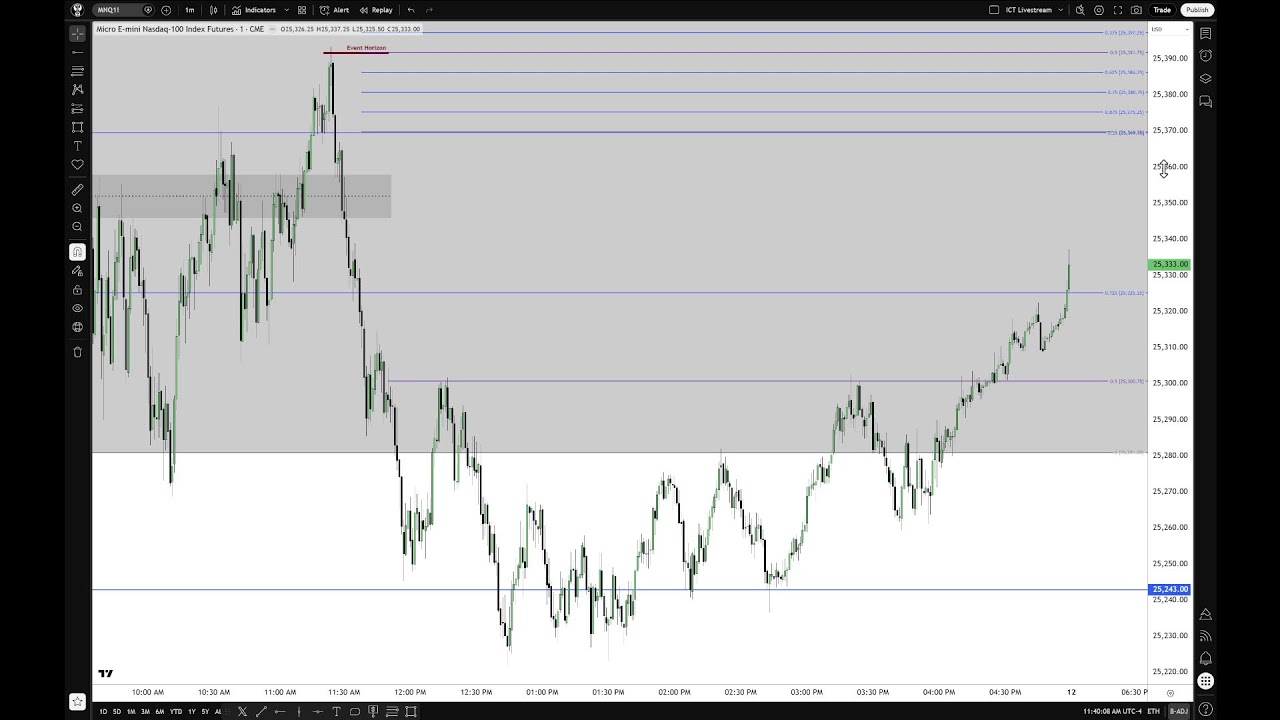
Summary:
– The speaker explains why and how he uses the continuous contract (vs the front‑month delivery contract) for analysis: continuous contracts smooth historical data, reveal volume imbalances/suspension blocks that the front‑month can hide, and let you compare how price behaves across contracts to judge market strength.
– The continuous‑contract toggle (and the settlement‑price toggle) on charting platforms changes whether certain volume imbalances and suspension blocks are visible; he uses these toggles only to find volume imbalances, not to “hunt” fair value gaps.
– Key technical concepts emphasized: breakers, suspension blocks (volume imbalances), consequent encroachment (half‑gap), wicks vs bodies (wicks show first‑presented FVG/inefficiency; bodies show order‑flow conviction), inversion, PD arrays, octants/quadrants for measuring ranges.
– Practical trading rules: focus on low‑hanging fruit objectives and intraday targets rather than chasing large, improbable moves; use the opening range and the first hour (9:30–10:30) as the primary bias engine (half‑gap/consequent encroachment is a common first target with strong statistical edge).
– He stresses price‑action/time‑based analysis over indicators or fundamental narratives (fundamentals are noisy/manipulated), and warns about increased manual intervention and algorithmic behavior in current markets—use stops and moderate leverage.
– Teaching goals and next steps: he will post lectures on journaling and live sessions teaching entries and practical drills (order‑block and FVG-based entries) so students can build and test a repeatable model by practicing on lower timeframes.
– Final message: commit to disciplined practice and journaling, focus on the first hour and simple, repeatable methods, and avoid chasing gimmicks or shortcuts.
Quiz
1. According to ICT, what is his primary use of the continuous contract toggle on and off for?
A. To identify fair value gaps only
B. To compare volume imbalances and suspension blocks across contract rollovers
C. To calculate forex session opens
D. To hide key price levels from retail traders
2. When the market opens above the consequent encroachment of the opening range gap, what is ICT’s stated initial session bias?
A. Look for buy side liquidity
B. Look for sell side liquidity
C. Avoid trading until the next day
D. Fade the opening range gap immediately
3. In ICT’s explanation, what is the “first presented fair value gap” on the chart?
A. The wick
B. The candle body midpoint
C. The settlement price line
D. The prior day’s high only
4. What does ICT say about a bullish PD array in relation to the candle body?
A. The body should close through the array
B. The body should be above or touching it aggressively
C. The body should not touch it; only the wick may touch or fail to touch
D. The body should always close below it
5. What did ICT say he was going to teach later in the week to help students build a baseline?
A. Cryptocurrency arbitrage and news trading
B. Order block strategy and fair value gap strategy
C. Forex hedging and options gamma scalping
D. Elliott Wave counting and harmonic patterns
Answer Key
1. B
Evidence: “the only time I’ve ever utilized this function here is when I’m looking for volume imbalances” and “I’m only toggling on the continuous contract, I’m only using this function here to see where those volume imbalances are.”
2. A
Evidence: “my initial bias for session, okay? For session bias… I’m going to be looking for price to go up to the half gap. So, I’m going to be looking for what? Buy side liquidity.”
3. A
Evidence: “when we have a PD array or a range that we’re looking at… price goes up and can’t even accomplish getting to the high of it… you see that? When it does that, that’s proving heaviness.” and “the gap… what you see as the gap. That is not it. This is the wick.”
4. C
Evidence: “If you’re bullish, it should not touch it with the body or lay a body on it. The wick can touch it or fail to touch it. That’s bullish.”
5. B
Evidence: “I’ll do it with an order block strategy and I’ll do it with a fair value gap strategy. So that way it’ll help you build a baseline on what you’re looking for in price action.”
Leave a Reply